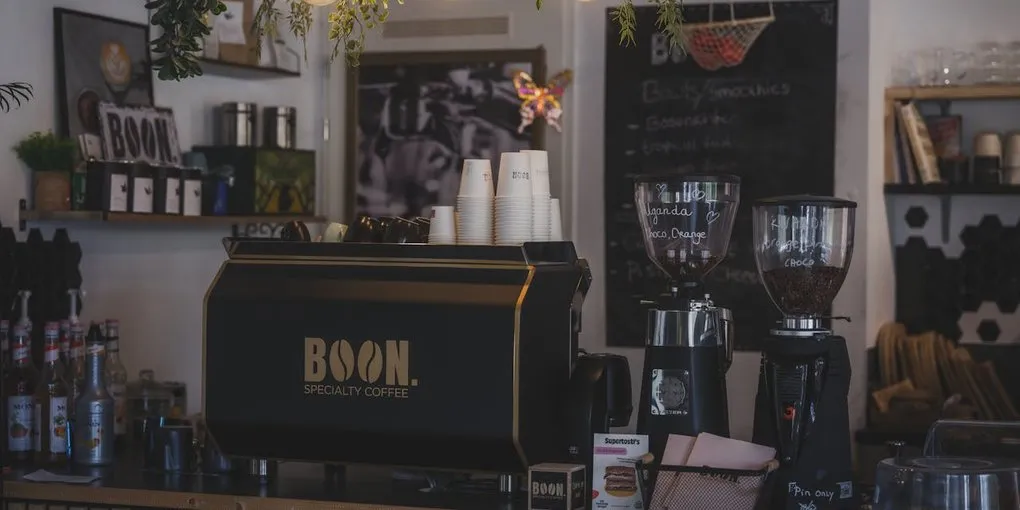
Third wave coffee is the cultural and commercial movement, beginning around 2002, that treats coffee the way serious wine is treated — as an agricultural product whose flavor is shaped by farm, variety, altitude, processing, roast, and brew method, and whose story belongs on the label. It is the reason your neighborhood cafe lists Ethiopia Yirgacheffe Kochere instead of “house dark roast,” why baristas weigh beans on 0.1 g scales, and why a washed Gesha from a specific hillside in Panama has sold for over $30,000 a kilogram.
It is also a shorthand for a specific generation of roasters, cafes, writers, and producers who reshaped American coffee between roughly 1999 and 2015. The term itself — “third wave” — is less than 25 years old, and the person who coined it did so in a coffee industry newsletter, not a national magazine. This is the story of where the label came from, what it actually describes, and how coffee became a drink people argue about with the intensity normally reserved for music or sports.
This piece is about the cultural movement, the named eras, and the people. For the technical SCA cupping framework and grading standards that emerged alongside it, see our piece on how the coffee scoring system actually works. For the economics of why specialty coffee costs what it does, see the coffee crisis explained.
The First Wave Was About Getting Coffee Into Every American Kitchen
The first wave was the commodity-coffee era — the period from roughly the late 19th century through the mid-1960s when American coffee meant Folgers, Maxwell House, Hills Bros., and Chase & Sanborn. Coffee was a household staple, marketed on convenience and consistency, sold pre-ground in vacuum cans, and brewed on the stove or in a percolator.
The goals of the first wave were scale, shelf stability, and price. Beans were blended from whatever was available on the commodity market, roasted dark and even to mask origin variation, and shipped in bulk. The per-capita consumption of coffee in the United States peaked in 1946 at around 46 gallons per person per year — a number the specialty era has never matched. For most Americans in 1955, “good coffee” meant coffee that was hot, brown, and reliable. Origin was irrelevant. Roaster was irrelevant. Variety was a word used about cherries and potatoes, not beans.
The first wave built a national habit. It did not build a culture of taste.
The Second Wave Built Cafe Culture Around Espresso
The second wave began in Berkeley in 1966, when a Dutch-born coffee importer named Alfred Peet opened Peet’s Coffee & Tea on the corner of Vine and Walnut. Peet imported high-quality arabica beans, roasted them dark but aggressively, and sold them fresh by the pound. His store immediately became a destination for Bay Area coffee lovers who had traveled in Europe and come home wanting something better than Folgers. Peet essentially reintroduced Americans to coffee as a craft product.
In 1971, three Peet’s customers — Jerry Baldwin, Gordon Bowker, and Zev Siegl — opened a store in Seattle’s Pike Place Market to sell high-quality beans using the same model. They called it Starbucks. For the first decade, Starbucks sold whole beans only; the founders apprenticed with Peet himself and bought his roasted coffee wholesale before starting to roast their own.
Starbucks became the engine of the second wave after Howard Schultz joined in 1982 and pushed the company toward Italian-style espresso drinks. Schultz had visited Milan and become convinced that Americans would fall in love with cappuccinos and lattes if someone built the cafe infrastructure to serve them. He was right. By the late 1990s, Starbucks had thousands of stores, and Americans had absorbed a new vocabulary: latte, cappuccino, macchiato, mocha, grande, venti.
Second wave coffee was about the experience as much as the beverage. Coffee became a lifestyle product — a third place between home and work, a daily ritual, an identity signal. Roasts were darker than anything in the third wave would eventually endorse, origins were obscured behind blend names, and the beverage itself was frequently a delivery vehicle for milk, sugar, and flavor syrups. But the second wave did something the first wave never did: it made quality beans and quality equipment profitable at national scale, and it built the barista as a recognizable professional role.
The Term “Specialty Coffee” Was Coined by a Green Bean Trader in 1978
In 1978, at a French coffee conference, a green coffee broker named Erna Knutsen used the phrase “specialty coffee” to describe the small lots of exceptional beans she traded to small roasters on the West Coast of the United States. Knutsen worked for B.C. Ireland, a San Francisco importer, and her job was unglamorous by commodity-trading standards: she sourced and graded outstanding individual lots of green beans that commodity buyers ignored because the volumes were too small.
Knutsen’s insight was that origin, elevation, and processing mattered enormously to flavor, and that a subset of roasters — Peet’s, Starbucks in its whole-bean era, and a handful of smaller operations — were willing to pay a premium for lots that could be traced to their source and cupped for distinctive character. The term she coined to describe these beans became the foundation for everything that followed. When the Specialty Coffee Association of America (SCAA) was founded in 1982, it adopted her language.
Knutsen is arguably the most important person in the early history of specialty coffee, and she is also the least famous. She died in 2018. The phrase she coined at a conference in 1978 now describes a roughly $100 billion global market.
Trish Rothgeb Coined “Third Wave” in 2002 in a Trade Newsletter
The term “third wave coffee” was coined by Trish Rothgeb (then publishing as Trish Skeie) in a 2002 article in The Flamekeeper, the newsletter of the Roasters Guild (a trade group within the SCAA). Rothgeb was a Bay Area roaster who would later go on to found Wrecking Ball Coffee Roasters in San Francisco. Her article argued that a distinct new generation of coffee professionals had emerged — one that rejected the second wave’s blend-and-roast-dark model and instead treated coffee the way wine producers treated grapes.
The third wave, as Rothgeb defined it, cared about single origin over blends, lighter roasts that revealed rather than hid origin character, direct relationships between roasters and producers, transparent pricing that credited farmers for specific lots, and brew methods that showcased clarity and acidity. The article was internal industry writing — published in a newsletter, not a magazine — but it named something that the trade had been feeling for several years without a label.
The term spread because it described a real shift. By 2002, a small cluster of roasters had already been operating on third wave principles for years without calling themselves that. Rothgeb’s article gave them a shared identity.
The Third Wave Had Four Anchor Roasters and One Auction
Four American roasters are usually named as the anchor operations of the third wave: Stumptown Coffee Roasters (founded 1999 in Portland, Oregon, by Duane Sorenson), Intelligentsia Coffee (founded 1995 in Chicago by Doug Zell and Emily Mange), Counter Culture Coffee (founded 1995 in Durham, North Carolina, and restarted in 2000 under Peter Giuliano’s leadership), and Blue Bottle Coffee (founded 2002 in Oakland by James Freeman). These four roasters shared a set of commitments: light-to-medium roasts, single-origin sourcing, direct trade relationships with farms, in-house quality control programs, and retail cafes designed to showcase pour-over and espresso as equally serious brewing methods.
The watershed moment for the movement was the 2004 Best of Panama auction, when a little-known Ethiopian variety called Geisha — grown by the Peterson family at Hacienda La Esmeralda in the Boquete region — scored higher at the cupping table than anything auction panelists had tasted in years. The lot sold for $21 per pound of green coffee, roughly five times the previous auction record. The flavor profile was unlike anything the commodity market had ever priced: jasmine, bergamot, white peach, and a floral character closer to fine tea than to traditional coffee. For a deeper dive into why this variety still dominates the top of the market, see our Gesha coffee guide.
The 2004 Esmeralda auction proved that single-origin coffee could command wine-like prices at wine-like quality tiers. Every subsequent record auction — and every serious third wave program — can be traced back to that moment. Gesha has dominated top-tier competitions ever since. By 2025, 40 of 50 lots in the Best of Panama auction were Gesha varieties, and the single highest-priced washed Gesha sold for $30,204 per kilogram.
What Third Wave Principles Actually Are
Stripped of ideology, the third wave’s operational commitments are concrete. A third wave cafe or roaster typically does most or all of the following: sources coffee by specific lot (farm, variety, processing method, crop year) and names each element on the bag; roasts lighter than second wave norms to let origin character show; brews filter coffee by weight and time on a scale, usually with a pour-over protocol and a gooseneck kettle; publishes green coffee sourcing information including price paid to farmers; rejects commodity blending in favor of single origins or transparent seasonal blends; and treats the barista as a skilled tasting professional rather than a beverage assembler.
The third wave also rewrote espresso. Second wave espresso was dark, evenly roasted, and designed to cut through milk in large-volume espresso drinks. Third wave espresso is lighter, more acidic, frequently single-origin, and designed to be tasted as a short drink — either neat or in a small milk format like a cortado or macchiato where the coffee is still the dominant flavor.
These commitments cluster together because they reinforce each other. Once you care about origin, you want the roast to reveal it. Once you roast light, you need brewing techniques that avoid under-extraction. Once you brew carefully, you can taste differences between farms. Once you can taste differences between farms, you want to pay farmers differently for better lots. The whole third wave package is the result of taking origin seriously and following the consequences.
The Third Wave Is Not Above Criticism
The third wave has also been criticized — sometimes by the people building it. Three critiques are worth naming honestly.
The first is a colonial critique. Third wave specialty coffee is a system in which predominantly white, Western roasters and buyers extract value from producers in formerly colonized regions of Latin America, East Africa, and Southeast Asia. Direct trade sounds egalitarian and often is, but the roaster sets the terms, controls the cupping score, and takes the retail margin. Critics inside the industry — Peter Giuliano of Counter Culture among them — have argued for years that “specialty” premiums at the cafe do not always translate into meaningful income changes at the farm level. For a deeper look at what certifications and trade labels actually guarantee, see our guide to coffee certifications.
The second is a gatekeeping critique. Third wave cafes can be intimidating. The vocabulary is opaque, the menu is short, and the barista’s job sometimes includes correcting customers who ask for the wrong drink. This is a cultural problem the movement has mostly acknowledged. James Hoffmann, the 2007 World Barista Champion and one of the most visible third wave voices, has repeatedly criticized specialty coffee’s tendency toward condescension, pretension, and affectation.
The third is a sameness critique. Ironically, a movement that began as a rebellion against commodity uniformity has in some markets produced a new kind of uniformity — the Scandinavian-minimal cafe, the Kalita Wave on the counter, the washed Ethiopian on the menu, the cortado in the cup. The forms are different from Starbucks, but the global sameness is starting to rhyme.
These critiques do not invalidate the movement. They sharpen what the best version of it could look like.
Where We Are Now: The Fourth Wave Conversation
Since roughly 2015, trade writers have been using the term “fourth wave” to describe a post-third-wave phase that combines specialty quality with broader accessibility. The fourth wave, as it’s typically described, includes direct-to-consumer coffee subscriptions, specialty chains that scale the third wave’s quality commitments without the gatekeeping attitude, roasters who emphasize origin science and fermentation research, and cafes that serve high-quality batch brew alongside pour-over to shorten lines and democratize access.
The label is contested. Some writers argue that “fourth wave” is just third wave maturation — the same commitments, minus the pretension, plus better tools and a broader audience. Others argue it is genuinely new, characterized by extreme processing innovation (anaerobic, thermal shock, inoculated fermentations) and by coffee’s integration with wine-style auction economics. What is clearly true is that the 2016-2025 era has included competition-winning coffees processed in ways no third wave purist would have allowed in 2005, and that the line between “innovation” and “flavor manipulation” is now the defining debate inside top-tier specialty.
If the first wave was about getting coffee to every kitchen and the second wave was about building a cafe culture around it, the third wave was about caring — about origin, about farmers, about roast, about method, about taste. Whatever comes next will be judged by whether it keeps that caring and drops the pretension.
For deeper dives into specific threads of the third wave story, see is Gesha coffee worth the price, coffee certifications decoded, and why coffee costs so much now.
Frequently Asked Questions
- Who coined the term 'third wave coffee'?
- Trish Rothgeb (then publishing as Trish Skeie) coined the term in a 2002 article for The Flamekeeper, the internal newsletter of the Specialty Coffee Association of America's Roasters Guild. The article wasn't a national-magazine piece — it was trade writing aimed at other roasters — but it named a shift the industry had been feeling for several years without a label, and the term spread quickly.
- Is there really a 'fourth wave' of coffee?
- The term is contested inside the industry. Some writers use 'fourth wave' to describe the post-2015 era of direct-to-consumer subscriptions, scaled specialty chains, and experimental processing like anaerobic fermentation and thermal shock. Others argue it's just the third wave growing up — the same commitments minus the gatekeeping, plus better science. What's clearly different since around 2020 is that competition-winning coffees now routinely use processing methods that didn't exist in the third wave's founding years.
- Was Peet's Coffee before Starbucks?
- Yes, by five years. Alfred Peet opened Peet's Coffee & Tea in Berkeley, California in 1966. In 1971, three of his customers — Jerry Baldwin, Gordon Bowker, and Zev Siegl — opened Starbucks in Seattle using essentially the same business model. The Starbucks founders apprenticed with Peet and bought roasted beans from him wholesale before they started roasting their own.
- What made the 2004 Panama auction so important for specialty coffee?
- The 2004 Best of Panama auction was the first time a coffee lot sold for a wine-like premium based on verified quality. A Geisha variety grown by the Peterson family at Hacienda La Esmeralda scored dramatically higher than anything auction panelists had previously encountered and sold at $21 per pound of green coffee — roughly five times the previous record. It proved that single-origin coffee had a genuine high-end market. By 2025, the Best of Panama auction included a Gesha lot that sold for over $30,000 per kilogram.
- How is 'third wave' different from 'specialty coffee'?
- They overlap but aren't identical. 'Specialty coffee' is a technical and commercial term coined by green coffee broker Erna Knutsen in 1978 and formalized by the SCAA in 1982 — it refers to coffee that meets specific grading and cupping standards. 'Third wave' is a cultural movement, starting around 2002, that adopted specialty coffee as its raw material and built a taste culture, a retail aesthetic, and a sourcing ethic around it. You can sell specialty-grade beans in a second wave cafe. You cannot run a third wave cafe without specialty-grade beans.