Single origin coffee has become one of the most common terms on specialty cafe menus and bag labels. But what does it actually mean, why should you care, and how do you actually use the information on a coffee bag to buy better coffee?
This guide breaks down single origin coffee — what the term means, the hierarchy of traceability behind it, and how geography, variety, and processing each shape what ends up in your cup.
What “Single Origin” Actually Means (And What It Doesn’t)
Single origin means coffee from one identifiable geographic source. But here’s the thing most people don’t realize: that term covers a huge range of specificity. A bag labeled “single origin” could mean anything from “all of these beans came from the same country” to “these beans came from one specific lot on one specific farm, harvested in one specific week.”
The industry actually has a hierarchy of traceability, and understanding it changes how you shop:
- Single origin — from one country or region. The broadest label. A “Colombian” coffee could contain beans from dozens of farms across multiple departments.
- Single region — from a named growing area within a country (e.g., Yirgacheffe, Tarazu, Nyeri). More specific, and these regional names usually correlate to real flavor differences shaped by local altitude, soil, and climate.
- Single estate / single farm — from one farm or cooperative. Now you’re getting into genuine traceability — you can often learn the farmer’s name, elevation, variety, and processing method.
- Micro-lot — a small, hand-selected portion of a single farm’s harvest, often from specific plots or picked during peak ripeness. This is the most specific label, and where you find the highest-scoring, most expensive specialty coffees.
The rising demand for single origin coffee has fundamentally changed the supply chain. Roasters now routinely visit producers and sample hundreds of coffees in a single day. Farmers experiment with different varieties, processing methods, and harvest timing because there’s a market that rewards that effort. It’s created more transparency than most consumer goods can claim.
Single Origin vs. Blends: Different Goals
It’s worth understanding this distinction because it shapes how you should approach each style.
Blends are engineered for consistency. A roaster combines beans from multiple origins so your morning cup tastes the same in January as it does in July. One coffee might contribute body, another brings acidity, a third adds fruity top notes. The roaster is a composer, and the blend is a finished composition designed to be reliably good.
Single origins are about celebrating variation. The flavor profile shifts seasonally based on harvest timing, weather, and processing decisions. You’re tasting one story instead of a committee-designed compromise — more distinct flavors, more to discover with each sip, but also more variability bag to bag.
Neither approach is inherently better. Blends are great for espresso and daily drivers where consistency matters. Single origins are great for manual brewing methods where you want to explore what a specific place and process can produce.
The Three Things That Shape Single Origin Flavor
When you taste a single origin coffee, you’re tasting the interaction of three major variables: where it grew, what variety it is, and how it was processed. Understanding each one makes you a dramatically better coffee buyer.
1. Terroir — Where It Grew
Terroir is borrowed from wine, and it’s just as important for coffee. It’s the combination of altitude, soil, rainfall, temperature, and microclimate that shapes a coffee’s character.
Altitude is the single most reliable predictor of quality and complexity. Higher elevations mean cooler temperatures, which slow cherry ripening. Slower ripening lets the plant develop more complex sugars and acids. Research shows that about 25% of the variation in how much flavor a coffee yields during extraction can be explained by elevation alone — higher-altitude coffees from Kenya, Ethiopia, and Burundi consistently extract more flavor than lower-altitude Central American coffees.
This is why you see altitude on specialty bags. It’s not marketing — it’s a genuine quality signal. Industry grading systems reflect this: “Strictly Hard Bean” (SHB) in Central America means grown above about 1,200m, and those beans are literally denser because the slower growth packs in more cellular material.
Soil composition matters too. Volcanic soils (common in Central America, Kenya, and parts of Indonesia) tend to produce coffees with bright, clean flavors and complex mineral notes. Different soil types deliver different nutrients to the plant, which is why regional flavor generalizations aren’t marketing fiction — they’re rooted in geology.
Two coffee farmers on opposite sides of the same mountain can produce remarkably different coffees. One side catches more afternoon sun. The other gets more rainfall. One sits at 1,500m, the other at 2,000m. These differences accumulate.
2. Variety — What Was Planted
Most specialty coffee is Arabica, but Arabica contains dozens of distinct varieties, each with different flavor tendencies. This is one of the most underappreciated factors in coffee quality.
Here’s what’s fascinating: almost all cultivated Arabica worldwide descends from a vanishingly small number of plants taken from Ethiopia and Yemen centuries ago. In Brazil — the world’s largest producer — 97.55% of all cultivated coffee traces back to just two varieties: Typica and Bourbon. That’s a staggering genetic bottleneck.
The major varieties you’ll encounter:
- Typica — the original cultivar. Clean, sweet, apple-like acidity. Low yield, which is why it’s being replaced.
- Bourbon — mutated from Typica on Reunion Island. Sweet, complex, delicate. 20-30% higher yield than Typica.
- Caturra — a Bourbon mutation. Bright citric acidity, compact plant. Dominates Central America.
- Catuai — Mundo Novo crossed with Caturra. Very high yield, good quality. Workhorse of Brazilian and Costa Rican production.
- SL-28 and SL-34 — developed at Scott Laboratories in Kenya. SL-28 is rated “exceptional” quality by the World Coffee Research catalog. That intense blackcurrant-and-citrus Kenyan character? That’s largely SL-28.
- Geisha/Gesha — an Ethiopian landrace variety that was ignored for decades until Hacienda La Esmeralda in Panama entered it in a competition in 2004. Jasmine, bergamot, tropical fruit, tea-like body. Commands the highest auction prices in the world — up to $30,204/kg in 2025.
Wait, really? Ethiopia has more coffee genetic diversity than everywhere else combined. The forests of southwestern Ethiopia contain thousands of uncatalogued wild Arabica varieties. When a bag says “heirloom varieties,” it usually means “we genuinely don’t know which specific varieties are in here” — there are just too many. This is why Ethiopian coffee can taste so wildly different from lot to lot, and why Ethiopia matters so much for coffee’s genetic future.
3. Processing — What Happened After Picking
Processing is how the coffee cherry is separated from the seed (the bean), and it dramatically changes the flavor. The same variety from the same farm can taste completely different depending on how it’s processed.
Washed (wet process): Cherry skin removed, beans fermented in water tanks for 12-72 hours, then washed and dried. Produces clean, bright, high-acidity coffees where terroir and varietal characteristics shine through. Dominant in East Africa and Central/South America.
Natural (dry process): Whole cherries dried intact on patios or raised beds for weeks. The fruit ferments around the seed, imparting fruity, full-bodied, sometimes wild or funky flavors. More body, less perceived acidity. Common in Ethiopia, Brazil, and Yemen. When you taste “blueberry bomb” in an Ethiopian natural, that intense fruit character comes from this extended cherry contact.
Honey process: A Costa Rican innovation. Skin removed but some or all of the sticky mucilage left on during drying. Graded by how much mucilage remains — white honey (least, closest to washed) through yellow and red to black honey (most, closest to natural). Creates a spectrum from clean-and-bright to sweet-and-syrupy.
Pulped natural: Brazil’s version of honey processing. Skin removed, mucilage left on. More body than washed, cleaner than natural.
The modern specialty world has gone much further with processing experimentation. Anaerobic fermentation (sealed oxygen-free tanks), carbonic maceration (borrowed from winemaking), and even thermal shock processing are producing wild, intensely fruity coffees. Every World Barista Championship winner since 2023 has used some form of experimental processing. It’s the defining trend in specialty coffee right now.
How to Read a Coffee Bag Label
Armed with the above, here’s what to look for when buying single origin coffee:
Country and region. “Ethiopia” is fine. “Ethiopia, Yirgacheffe, Gedeo Zone” is much better. The more specific the location, the more intentional the sourcing.
Altitude/elevation. Higher is generally better for complexity and acidity. Above 1,500m is excellent. Above 1,800m is exceptional.
Variety. If the bag names the variety (Bourbon, SL-28, Geisha, Caturra), the roaster is paying attention to sourcing details. “Heirloom” on Ethiopian coffee is standard and fine — it reflects genuine variety complexity, not laziness.
Processing method. Washed, natural, honey, anaerobic — this tells you a lot about what the coffee will taste like before you even open the bag. If you like bright and clean, lean toward washed. If you like fruity and full-bodied, try naturals.
Roast date. Buy within 2 weeks of roasting, use within a month. If there’s no roast date on the bag, the roaster doesn’t want you to know how old it is.
Harvest year/crop year. Specialty-grade bags often include this. Current-crop coffee is always preferable.
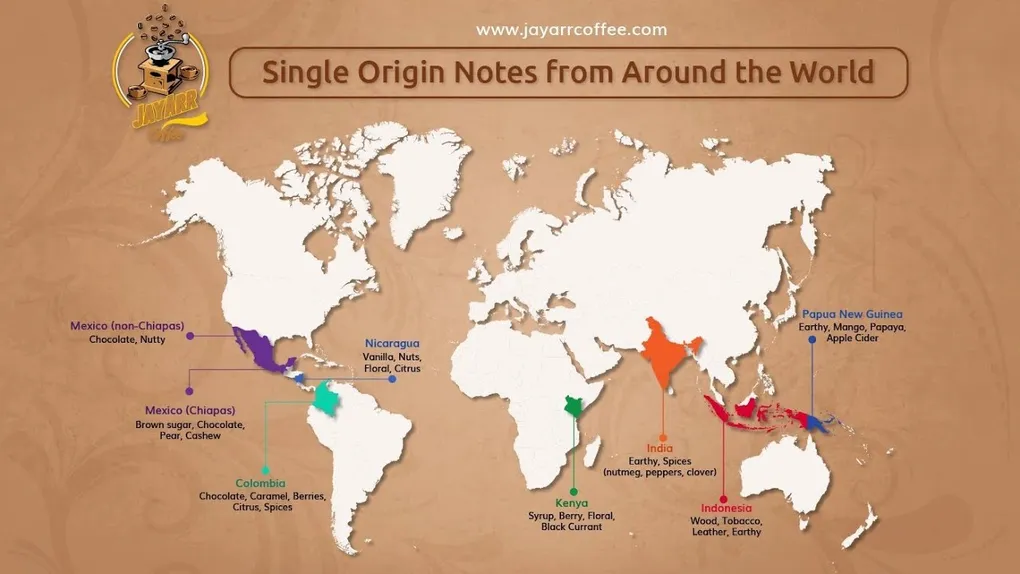
A Quick Regional Flavor Map
To get you started, here are the broad strokes of what major origins tend to taste like. These are generalizations — variety and processing shift things considerably — but they’re reliable starting points.
Africa:
- Ethiopia — floral, citrus, bergamot, candied fruit (washed = elegant and tea-like; natural = wildly fruity)
- Kenya — intense acidity, blackcurrant, berry, wine-like, full body
- Rwanda — red apple, grape, berry, floral
Central America:
- Costa Rica — bright, clean, sweet. Honey-processed lots add stone fruit and natural sweetness
- Guatemala — chocolate, nuts, bright acidity. Antigua region is especially renowned
- El Salvador — sweet, balanced, chocolatey. Pacamara variety is their signature
South America:
- Colombia — balanced, nutty, caramel, pleasant acidity. Enormous microclimate diversity across three Andes cordilleras
- Brazil — nutty, chocolatey, low acidity, heavy body. The world’s largest producer by far
Asia/Pacific:
- Indonesia — earthy, woody, herbal, heavy body, low acidity (from the unique wet-hulling process)
- India — pronounced body, mild acidity, spice notes. Monsooned Malabar is its signature: heavy, creamy, zero acidity
Start Exploring
The fastest way to develop your palate is comparative tasting. Buy two single origins from different regions — say, an Ethiopian and a Colombian — and brew them side by side with the same method, same ratio, same water temperature. The differences will be obvious, even to a beginner.
Once you can tell Africa from Central America in a blind test, try comparing within a region: two different Ethiopian lots, or a washed Costa Rican versus a honey-processed one. You’ll start recognizing patterns, and those patterns will guide every coffee purchase you make from here on.
Affiliate Disclaimer: Some of the links in this post are affiliate links. This means we may earn a small commission if you make a purchase through these links, at no additional cost to you. We only recommend products and services we genuinely believe in. Your support helps us continue creating coffee content.
Frequently Asked Questions
- Is single origin coffee better than blends?
- Neither is inherently better — they serve different goals. Single origins celebrate variation and let you taste what a specific place and process can produce. Blends are engineered for consistency and balance, combining beans from multiple origins so your cup tastes the same year-round. Single origins are great for manual brewing and exploration. Blends are great for espresso and everyday reliability. Many coffee professionals drink both.
- Why is single origin coffee more expensive?
- Traceability costs money. Someone had to visit the farm, cup hundreds of samples, negotiate directly, and maintain quality standards throughout the supply chain. The more specific the sourcing (single estate, micro-lot), the smaller the production volume and the higher the per-pound cost. You're also paying for freshness — specialty roasters roast in smaller batches with roast dates printed on the bag, which is more expensive than bulk commodity roasting.
- What should I look for on a single origin coffee bag?
- In order of importance: roast date (buy within 2 weeks of roasting), country and region (the more specific, the better), altitude (higher = more complex), variety (tells you the genetic starting point for flavor), and processing method (washed = bright/clean, natural = fruity/full, honey = in between). If a bag has all five, the roaster is paying serious attention to sourcing.
- What's the difference between single origin and micro-lot coffee?
- Single origin means from one country or region — potentially a mix of farms. Micro-lot is the most specific designation: a small, hand-selected portion of a single farm's harvest, often from specific plots picked during peak ripeness. Micro-lots are where you find the highest-scoring, most expensive specialty coffees. Think of it as a specificity hierarchy: country, region, farm, then micro-lot.