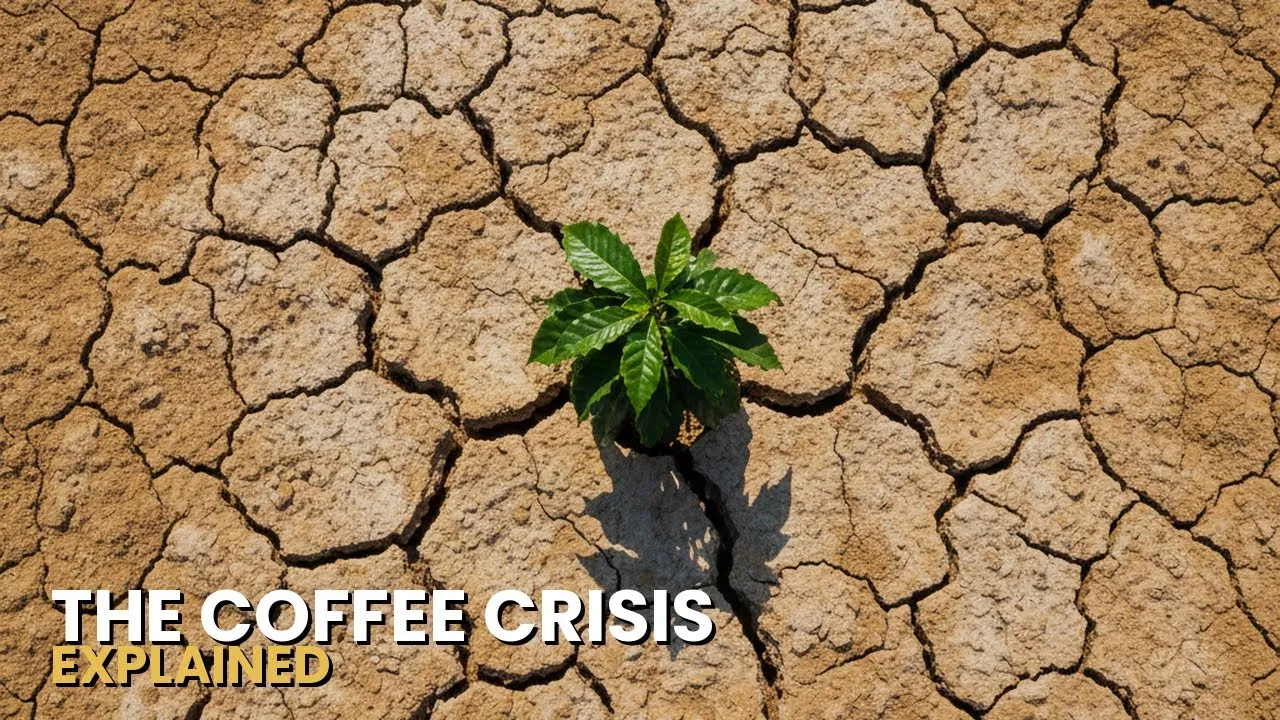
If your coffee costs more, it’s not your imagination. A 38-ounce container of Maxwell House went from about $13 to over $21 in under a year. Folgers raised prices four times since mid-2024. U.S. ground coffee hit $9.14 per pound in September 2025 — 41% higher than the year before.
In February 2025, Arabica futures reached $4.41 per pound — the highest price in recorded history, smashing a record from 1977.
Here’s what happened.
The Supply Shock: Two Countries, 56% of the World’s Coffee
Brazil and Vietnam produce 56% of the world’s coffee. In 2024, both got hit simultaneously.
Brazil experienced its worst drought in 70 years. Minas Gerais — where most of Brazil’s Arabica grows — was devastated. Crop estimates were slashed by 11 million bags. The drought didn’t just reduce quantity — it produced lighter, less dense beans. Less coffee, and worse coffee.
Vietnam endured a prolonged El Niño drought followed by severe flooding in its central highlands. Two consecutive years of damage. Exports dropped over 11%.
Here’s the critical detail most people don’t realize: a new coffee plant takes 3-4 years to start producing fruit. You can’t just replant and have beans next season. When trees die or crops fail, the supply gap lasts years.
The Tariff Problem
In 2025, the U.S. imposed tariffs on major coffee-producing countries: 50% on Brazil, 20% on Vietnam, 10% on Colombia. The United States produces essentially zero coffee commercially. We import every bean. When you put a 50% tariff on the country supplying a third of your coffee, there is no domestic alternative. You just pay more.
Brazil’s coffee exports to the U.S. dropped over 80%. Then something telling happened: Brazilian exports to Colombia surged 578% in a single month — cheaper Brazilian beans being mixed with Colombian coffee to dodge the higher tariff. By November 2025, the tariffs were largely rolled back, but months of price spikes had already worked through the supply chain onto store shelves.
The Hidden Logistics Crisis
Shipping containers became a bottleneck as severe as the droughts. A global shortage of 20-foot dry containers forced exporters to use more expensive 40-foot containers. Shipping prices from Shanghai to New York hit nearly $10,000 per container — double the cost from months earlier. Port strikes, labor shortages, and rerouting around the Red Sea extended transit times from weeks to months.
When coffee that once took three weeks to reach a roastery now takes three months, warehouses empty and prices spike before beans even arrive.
Demand Is Booming — and It’s Permanent
While supply got crushed, demand surged. China added 20,000 coffee shops in a single year — roughly 55 new shops opening daily. Chinese coffee consumption grew 150% in the last decade. India’s market is projected to double by 2030. Asia-Pacific demand is up over 14% since 2018.
This is the part that matters for the long term. A drought ends. Tariffs get rolled back. But 20,000 new coffee shops in China don’t close. A generation of young Indian professionals who discovered specialty coffee don’t stop drinking it.
The supply shocks are temporary. The demand growth is structural.
The Genetic Vulnerability Nobody Talks About
There’s a deeper problem underneath the weather. Coffee leaf rust — a devastating fungal disease — is spreading as temperatures rise. Most rust-resistant varieties share a common parent (the Timor Hybrid), and researchers at the World Coffee Research organization believe most of these varieties will lose their resistance in the near-to-medium term. Meanwhile, 97.55% of Brazil’s cultivars are Typica/Bourbon derived — an extreme genetic bottleneck. When the world’s largest producer plants almost exclusively from two closely related plant families, one well-adapted pathogen could be catastrophic.
F1 hybrid varieties show promise (higher yields, better disease resistance, excellent cup quality), but they can’t be grown from seed — they require expensive clonal propagation that’s out of reach for most smallholder farmers. The best long-term solution is also the hardest to implement at scale.
This Has Happened Before
In 1975, a “black frost” in southern Brazil destroyed an estimated 1.5 billion coffee trees overnight. Prices surged from about 50 cents to over $3 per pound — equivalent to about $19/lb in today’s money. Recovery took years because of that 3-4 year tree maturation cycle. That’s exactly where Brazil is now — except this time there’s no country with spare capacity waiting to fill the gap.
Shrinkflation and Shelf Tricks
Brands are shrinking packages instead of raising sticker prices. Nestlé shrank Nescafé jars from 200g to 190g — six fewer cups per jar, same price. Coffee packages across multiple brands quietly dropped from 12 oz to 10.5 oz. Median coffee prices rose in 41 states.
The Counterintuitive Opportunity
Here’s a twist: specialty coffee prices barely moved. While commodity coffee jumped over 14% in early 2025, specialty rose about half a percent. The gap between a bag of Folgers and a bag of single-origin beans has never been smaller.
This is actually a good time to upgrade. When commodity coffee costs nearly as much as specialty, the price difference for dramatically better flavor is minimal. If you want to explore what quality sourcing looks like, Ethiopian coffees are a great starting point — often among the most interesting cups in the specialty world.
What About the Farmers?
In Brazil and Vietnam, some farmers are genuinely benefiting — they receive 90-95% of the export price. But in less developed origins across Africa and Central America, middlemen capture 40% or more. Higher price per bag times fewer bags (because of the same droughts driving prices up) often equals about the same income, or less, once rising fertilizer and labor costs are factored in.
The Outlook
Brazil’s 2026-2027 crop is projected to be a record harvest — potentially 66-71 million bags, a 17% increase. The World Bank expects Arabica prices to drop 13% this year and another 5% next year.
But prices are not going back to 2020-2023 levels. That era of cheap coffee was the anomaly. Climate change makes supply shocks more frequent. Asian demand growth is permanent. New regulations add cost. And whenever more than half the world’s supply comes from just two countries, you’re always one bad weather season away from another spike.
What You Can Actually Do
Try specialty while the gap is small. Commodity prices have risen so much that Folgers approaches what specialty used to cost. If there was ever a time to upgrade, this is it. Check out what makes single-origin coffee different to understand what you’re getting.
Buy whole beans. Pre-ground loses flavor fast. Whole beans ground fresh extract more flavor from the same amount of coffee — more value per dollar. Pair this with a proper grind size guide to get the most from every bag.
Weigh your coffee. Most people use more than they need. A kitchen scale will probably reduce your daily dose and improve your cup at the same time. Start at 15g per cup and adjust from there.
Consider a subscription. Some roasters lock in prices for subscribers, which protects against the next spike.
None of this will fix the global supply chain, but it’ll help you get the most out of every bean while the market sorts itself out.
Some links above are affiliate links. If you purchase through them, we earn a small commission at no extra cost to you.
Frequently Asked Questions
- When will coffee prices go back down?
- Partially — but not to pre-2024 levels. Brazil's 2026-2027 harvest is projected at a record 66-71 million bags, and the World Bank expects Arabica prices to drop 13% this year. But the cheap coffee era of 2020-2023 was the anomaly, not the norm. Permanent demand growth from Asia, more frequent climate disruptions, and the 3-4 year lag before replanted trees produce fruit all keep a floor under prices. Expect some relief, not a return to $6 Folgers.
- Is it worth stockpiling coffee beans during price spikes?
- Only if you store them properly. Whole beans in airtight, opaque containers stay fresh about 4-6 weeks after roasting. For longer storage, freeze beans in vacuum-sealed portions — oxidation drops roughly fifteen-fold when properly frozen. Pre-ground coffee goes stale within days of opening regardless of price. Buying 2-3 bags ahead during a sale is reasonable; hoarding months of supply usually means drinking stale coffee by the end.
- Why is specialty coffee barely more expensive than Folgers now?
- Commodity and specialty coffee are priced by different mechanisms. Commodity prices track futures markets, which spiked 41% in 2025 due to supply shocks. Specialty prices are set by direct trade relationships and quality premiums that were already higher and more stable. When commodity surges close the gap, you're essentially getting dramatically better coffee for a similar price — making this an unusually good time to try specialty beans.
- Are coffee shops going to raise prices too?
- Most already have. But café pricing absorbs raw bean costs differently than grocery retail — beans are only 15-25% of a coffee shop's cost per cup (rent, labor, and milk are larger factors). A 40% increase in bean price might translate to a $0.25-0.50 increase per drink rather than a proportional jump. Independent shops with thinner margins are hit harder than large chains with locked-in contracts.