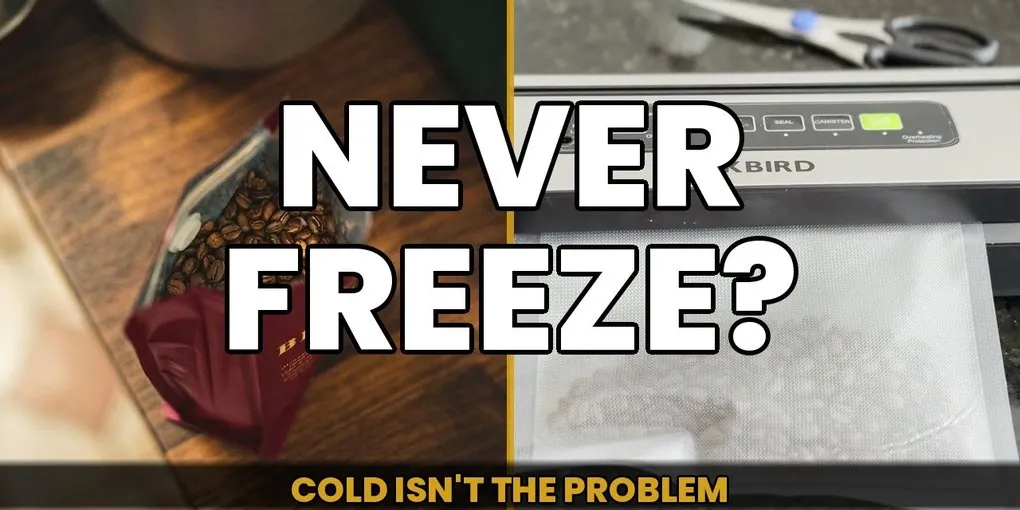
You spent twenty-five dollars on that bag of coffee. Maybe more. On your counter, it peaks somewhere in the first two weeks post-roast. After that, the flavor flattens fast. In your freezer — vacuum-sealed and portioned — that peak holds for months. The internet tells you never to freeze coffee. The internet is wrong. James Hoffmann freezes his. Jonathan Gagné — the physicist who wrote The Physics of Filter Coffee — freezes his too. The reason almost everyone gets this wrong has nothing to do with cold.
The classic “never freeze coffee” advice was written for a real problem. Just not the problem you have. It was written for ground coffee, in containers that did not seal, opened and closed every morning, thawed and refrozen. The damage was real. The diagnosis was wrong. The problem was never cold. The problem was condensation. Change the scenario — whole bean, vacuum-sealed, single-dose, thawed sealed or ground from frozen — and the answer changes. The video below walks through the visual proof; the text below adds the studies, the temperatures, and the full protocol both physicists actually use.
The Five Enemies of Coffee: Oxygen, Moisture, Heat, Light, Time
Coffee has five enemies, and four of them are accelerants of the fifth. Time is the obvious one — every roast has a window, and every day it closes slightly further. The other four set the rate at which time matters.
Oxygen oxidizes lipids and volatile aromatics — the same chemistry that browns a cut apple on the counter. Within days of opening a bag, citrus notes, chocolate notes, and the most delicate high-threshold volatiles are the first to go. Moisture on the bean surface accelerates staling chemistry and dissolves the CO2 that otherwise displaces oxygen inside the bag. Heat multiplies everything else. Light, specifically UV, breaks down proteins and oxidizes oils — direct sunlight is the worst.
The staling chemistry follows Arrhenius kinetics, and the rule of thumb across food science is that reaction rates roughly double for every 10 °C (Q10 ≈ 2) of warming. A 40 °C drop from room temperature (~22 °C) to a home freezer (−18 °C) drops the staling rate by approximately 15×. It is not zero. Nothing is zero. But it is slow enough that vacuum-sealed beans last a year or more at near-peak quality. Q10 kinetics are directionally correct across the organic chemistry of coffee (see Gantner 2024, Foods 13:3995, and the broader food-science literature); coffee-specific Arrhenius measurements are sparser but converge on the same order of magnitude.
Look at your coffee bag. That little nipple in the corner is a one-way degassing valve — it lets CO2 your beans are still producing escape without letting outside air in. The packaging itself is fighting four of the five enemies on your behalf. The valve bag is the model: vacuum-sealing at home is the same logic applied more aggressively.
The Condensation Turn: Why “Don’t Freeze” Was Wrong
Picture the scenario the old advice was written for. You pull a cold bag from the freezer. Open it on the counter. Warm humid air rushes in. The beans are at −18 °C. The air is at 22 °C and 40% relative humidity. Water vapor in the warm air condenses on the cold bean surface — same physics as a soda glass on a summer porch.
That surface moisture accelerates every chemical reaction that destroys aroma. You scoop your coffee, close the bag, put it back. The next morning, the cycle repeats. Each open-while-cold introduces another round of humid air, another round of condensation, another round of damage. The beans get progressively worse. The advice “don’t freeze coffee” was written by people who watched exactly this happen.
The damage was real. The diagnosis was wrong. The problem was never cold. The problem was condensation. Change the scenario — whole bean, vacuum-sealed, single-dose portions — and the damage cycle never happens. You take one pouch out at a time. You thaw it sealed, so the bean surface warms to room temperature before any air reaches it. Or you grind directly from frozen — in which case the bean surface goes from cold to brewing water without ever encountering warm humid air.
You get all the cold-temperature preservation. None of the moisture problem.
Uman 2016: Colder Beans Grind More Uniformly
In 2016, a team led by chemist Christopher Hendon at the University of Bath published the definitive freezing-and-grinding study in Scientific Reports (Uman et al., “The effect of bean origin and temperature on grinding roasted coffee,” 6:24483). They ground the same coffee at four temperatures — 20 °C (room), −19 °C (home freezer), −79 °C (dry ice), and −196 °C (liquid nitrogen) — and measured the resulting particle size distribution.
The colder the bean, the more uniform the grind. The most dramatic effect arrives at extreme cryogenic temperatures — Gagné flags the true “distinct shattering mechanism” for coffee as kicking in below roughly −80 °C (−112 °F), where a different fines distribution emerges that doesn’t depend on burr gap. At home-freezer temperatures (−18 to −19 °C), you’re not yet at that cryogenic regime, but you’re already on the brittle side of the ductility curve: the beans grind more uniformly than at room temperature. You do not need liquid nitrogen. Minus eighteen already helps.
Why does this matter? Uniform particle size means more even extraction — more flavor coming out of the same beans. This is the same argument our grinder science post makes about PSD, applied to bean temperature as an upstream variable. Cold beans shatter more uniformly because the cellular matrix is brittle at low temperatures and more elastic at room temperature; brittle materials fracture at defined planes while elastic materials deform before they fracture. This is why Gagné specifically recommends grinding from frozen when you can — every degree colder pushes the bean a little further toward the clean-fracture side of the curve.
Both Physicists Freeze — Here Are Their Protocols
James Hoffmann’s protocol (from his March 2020 YouTube video, “Should You Freeze Coffee Beans?”). Portion the beans into one-to-two-week quantities. Seal them airtight. Freeze them. When you want to brew, pull a pouch the night before. Thaw it sealed on the counter overnight, so condensation forms on the outside of the bag rather than on the beans themselves. Next morning, open and grind normally. Hoffmann says vacuum-sealing is “probably the best possible way” to do this but considers it optional — arguably extreme — for ordinary coffee.
Jonathan Gagné’s protocol (from The Physics of Filter Coffee, Chapter 8: Storage, and The Physics of Espresso, Chapter 5). Vacuum-seal in single doses. Freeze. Grind directly from frozen if you can — this takes advantage of Uman’s finding that colder beans produce a more uniform grind. If you must thaw, keep the pouch sealed until it reaches room temperature to prevent surface condensation. Gagné ranks freezing as the most powerful preservation method available to home coffee drinkers.
Both protocols work. The difference is nuance. Hoffmann’s is more forgiving for people using hopper-fed grinders or manual grinders that prefer room-temperature beans. Gagné’s captures the PSD improvement from cold grinding. Grinding from frozen is the optimal version; thawing sealed overnight is the robust everyday version.
Scott Rao converges on the same position in Everything but Espresso and his 2023 “Resting Roasts” blog post. Rao’s verified language: “At one extreme, freezing vacuum-sealed beans slows the aging process so much that it would probably take months or years to reach the same condition as coffee rested for a week or two at room temperature.” He calls the freezer a “terrific long-term storage strategy” with the same constraint — single portions, vacuum-sealed, no thaw-and-refreeze cycles.
The three most cited authorities in coffee — a working barista-researcher, a senior practitioner, and a physicist — converge on the same protocol. The internet mostly still says “don’t freeze.”
Fresh Is Not the Goal. Stable Is the Goal.
This is the unlock for most home coffee drinkers. You do not want the freshest beans you can find. You want the best version of the bean held at peak.
Our fresh bean trap post covers the companion point for espresso: beans that are too fresh underextract because CO2 back pressure inside the puck forces the barista to grind coarser. For filter coffee the window is gentler but still real — brightness and aromatic clarity peak somewhere in the first one-to-two weeks post-roast, then decline. The chase for “fresh” is really a chase for peak. Peak is a window, not a point.
When you freeze a vacuum-sealed bag at the right moment — somewhere in that one-to-three-week window post-roast — you are not preserving the freshest possible coffee. You are preserving the best version of that coffee. The version where the gas has settled, the flavor compounds have organized themselves, and the bean is at the moment it should be drunk.
Freezing does not make coffee better. It freezes coffee at the moment it was best. That changes how you shop. That changes how you store. That changes how you think about a Kenyan Peaberry you find at a local roaster in March when it is too good to risk losing in twelve days on the counter.
The Tools: What You Actually Need
A vacuum sealer. This is the one non-negotiable piece of gear for the protocol. I use an Inkbird automatic vacuum sealer — approximately $80 on Amazon. FoodSaver, Nesco, and Anova all make comparable units at similar prices. What matters is the physics, not the brand. The machine needs to pull the air out, visibly collapse the plastic against the beans, and weld the bag shut in one cycle.
The vacuum cycle is the entire argument made physical. The pump pulls the air out. The plastic visibly collapses against the beans. The seal strip welds the bag shut. No air means no oxygen to react with the lipids. No headspace means no humid air to condense when the bag goes cold. No reopening means the damage cycle never starts. Every enemy of freshness, locked out of one pouch.
Inkbird automatic vacuum sealer on Amazon →Bag material. Most vacuum sealers ship with a roll of textured vacuum-bag material. Cut pouches roughly 4x5 inches for an 18 g espresso dose, larger for filter doses. Trim to a size that minimizes waste plastic but leaves room for the heat seal. The bags are consumable — factor a few dollars a month of bag material into the protocol.
A dedicated freezer shelf or drawer. Not strictly necessary, but flat-stacking single-dose pouches benefits from a stable, uncluttered space. Coffee smells are strong and porous food does absorb flavor over time — keep the coffee drawer away from onions and fish.
The Non-Freezer Alternatives (For the Bag Already Open)
If you have an open bag on the counter that you are not ready to commit to freezing, vacuum canisters are a strong second-best option. The Fellow Atmos Electric at approximately $80 vacuums automatically when you press the lid — every time you close the canister, the air comes out. The Airscape at approximately $30 uses a manual plunger to push air out via a one-way valve.
Fellow Atmos Electric on Amazon → · Airscape on Amazon →
Both are legitimate tools for the bag-on-the-counter use case. Both are a step down from the freezer protocol. Neither solves long-term storage — they slow staling at room temperature, they do not near-arrest it. If you drink through bags within two weeks, canisters are sufficient. If you buy ahead, or want to catch roasters on special drops, the freezer protocol is a different tier.
Related Reading
- The Fresh Bean Trap: why “too fresh” ruins espresso — the V11 prequel: why resting matters and how to know when a bag is at peak
- Single-dose coffee freezing guide — deeper practical guide for single-dose freezing workflow
- How to store coffee beans — canister choices, daily storage, and the oxidation curve
- Coffee freshness from roast to stale — the full aging timeline of roasted coffee
- Why your grinder matters more than your espresso machine — the upstream variable freezing cannot compensate for
- How to dial in espresso — weight-based workflow once your beans are at peak
Frequently Asked Questions
Frequently Asked Questions
- Is it really safe to freeze coffee beans?
- Yes — if you freeze whole bean, vacuum-sealed, in single-dose portions, and either thaw sealed or grind from frozen. The 'don't freeze coffee' advice was written for ground coffee in containers that didn't seal, opened and refrozen repeatedly. The damage in that scenario is condensation on the bean surface, not cold itself. Change the scenario, and the physics flip — Hoffmann, Gagné, and Rao all freeze their beans.
- Should I grind beans from frozen or thaw them first?
- Both work. Hoffmann thaws sealed overnight before grinding. Gagné grinds directly from frozen. The Uman 2016 study at the University of Bath found that colder beans produce a more uniform particle size distribution. The most dramatic fines-distribution effects show up below roughly −80 °C (dry ice and liquid nitrogen), but even at home-freezer temperatures (−18 °C), beans are already on the brittle side of the ductility curve and grind more uniformly than at room temperature. Grinding from frozen is the optimal everyday version; thawing sealed is the more forgiving one.
- How long do vacuum-sealed frozen beans actually last?
- Near-peak for a year or more. The Q10 rule of thumb puts the staling rate at a 40 °C drop (room to freezer) roughly 15× slower than room temperature. Rao's verified framing: 'it would probably take months or years to reach the same condition as coffee rested for a week or two at room temperature.' Past about 12 months, aromatic complexity slowly declines even in the freezer, but the bean remains well above the quality of a 30-day-old counter bag.
- Can I freeze already-ground coffee?
- Short-term yes, long-term no. Ground coffee has dramatically more surface area than whole bean, so oxidation and aromatic loss run much faster regardless of temperature. Freezing ground coffee might extend its useful life from days to a week or two — but whole bean vacuum-sealed extends for months. Ground coffee should be brewed within hours of grinding for best results, frozen or not.
- Does vacuum-sealing actually matter or is a zip bag fine?
- Vacuum-sealing matters. A zip bag leaves headspace — air and humidity that can condense when the bag is cold. A vacuum-sealed pouch has no headspace, no air, and no opportunity for condensation. Hoffmann's 2020 video calls vacuum-sealing 'probably the best possible way' to freeze coffee. For a $25 specialty bag, an $80 one-time vacuum sealer is good value; for $5 supermarket coffee, canister storage at room temp is probably sufficient.
- What temperature should my freezer be?
- A standard home freezer at −18 °C (0 °F) already puts the bean on the brittle side of the ductility curve, where it grinds more uniformly than at room temperature. You do not need dry ice or liquid nitrogen to get most of the practical storage benefit. Uman 2016 shows the largest changes to fines distribution emerging at cryogenic temperatures (below ~−80 °C), but the Arrhenius/Q10 preservation logic — the main reason we freeze in the first place — is about slowing chemistry, and −18 °C does most of that work. A frost-free freezer is fine as long as you vacuum-seal (the slight warm-cool cycles frost-free units run through don't affect sealed pouches).
- Can I just use the original roaster bag in the freezer?
- Not ideal. Most roaster bags have a one-way valve that was designed to vent CO2 from fresh beans — when you freeze the bag and then open it, warm humid air rushes in through that valve even if the top is still rolled down. Transfer to vacuum-sealed single-dose pouches before freezing. The roaster bag is great for the first 1–3 weeks at room temperature. After that, repackage.
- How do I know when to freeze a bag?
- Freeze at peak, not at freshest. For filter brewing, peak is typically 1–2 weeks post-roast. For espresso, peak is 2–3 weeks post-roast (see our [Fresh Bean Trap post](/blog/bean-resting-for-espresso-freshness-trap/) for why). Rest the sealed roaster bag on the counter until it hits its window, then portion and vacuum-seal. The freezer preserves whatever state the bean was in at the moment of sealing — so seal it at its best.
- What if I already freeze in Mason jars — is that OK?
- Better than nothing; not ideal. Mason jars with tight lids eliminate most of the humidity problem, but they don't eliminate the headspace — every time you open the jar, the cold air inside meets warm room air and condensation can form on the beans. If you use jars, keep them small (single-week portions), use a tight silicone gasket, and always let the jar warm to room temperature sealed before opening. Vacuum pouches solve all three problems at once.
Watch the full breakdown on our YouTube channel: Why Your Coffee Dies in 14 Days (Hoffmann’s Lasts a Year).
This article contains Amazon affiliate links. We earn a small commission on qualifying purchases at no extra cost to you. We only recommend tools that match the physics we cite.