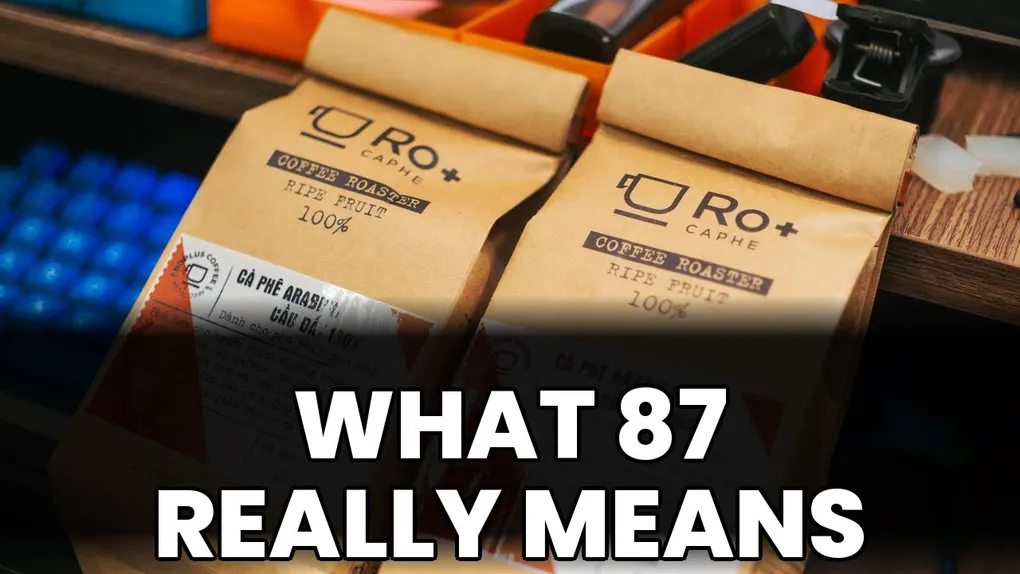
You’re standing in a coffee shop. One bag says “87 points.” The one next to it says “92” and costs twice as much. So you grab the 92 — bigger number, better coffee.
Not necessarily.
That score comes from a system most coffee drinkers have never seen explained. It was designed for traders and roasters, not consumers. And a lower-scored coffee might genuinely taste better to you than the expensive one — because the scoring system has a built-in preference for flavors that not everyone enjoys.
The 100-point scale is the invisible engine behind the entire specialty coffee industry. It determines which beans cost $2 a pound at export and which sell for $50. It shapes what farmers grow, how roasters buy, and what ends up on the shelf. But the system has serious problems — and the organization that created it just tore the whole thing up for the first time in two decades.
Here’s how coffee scoring actually works, what those numbers mean, and why the industry decided the old system wasn’t good enough.
How the 100-Point System Works
The scoring protocol was created by the Specialty Coffee Association (SCA) and used globally as the standard language for evaluating coffee quality. A trained evaluator — called a “cupper” — brews coffee using a precise ratio (8.25g per 150ml of water at 93°C) and evaluates it across ten specific attributes, each scored on a scale from 6 to 10 in quarter-point increments.
The first six attributes are what you’d expect:
- Fragrance/Aroma — how the coffee smells, both as dry grounds and after water is added
- Flavor — the overall taste impression mid-sip
- Aftertaste — how long positive flavors linger after swallowing
- Acidity — the brightness and liveliness on your tongue (not sourness — pleasant acidity is desirable in specialty coffee)
- Body — how the coffee feels in your mouth, from tea-light to syrupy
- Balance — whether all those qualities work together or fight each other
The next three — uniformity, clean cup, and sweetness — are tested differently. Five separate cups of the same coffee are brewed, and each cup is worth 2 points per attribute. If all five cups taste consistent, clean, and sweet, that’s 30 points. If one cup is off, you lose 2 points immediately from the relevant category.
Finally, there’s overall — the cupper’s personal holistic impression of the coffee.
The Defect System
The score isn’t just addition. Defects get subtracted, and they can be devastating. Off-flavors are classified as either a “taint” (minor, -2 points per cup affected) or a “fault” (major, -4 points per cup). Because five cups are evaluated, a single fault present across all five cups costs 20 points. One bad bean in the lot can potentially drop a coffee from specialty grade to commodity in a single cupping session.
This is why the 80-point specialty threshold is really about cleanliness and consistency as much as it is about flavor complexity. A coffee can taste interesting and still fail if it can’t deliver that taste reliably across multiple cups.
What the Scores Actually Mean
The magic threshold is 80. Score 80 or above and your coffee is officially “specialty grade.” Below 80, it’s commercial. That single point — 79 to 80 — is the most consequential line in the entire coffee industry.
Nobody scores 100. Even legendary coffees — the Panama Gesha varieties that sell for over a thousand dollars a pound — typically land between 94 and 97. A perfect score would mean the coffee has absolutely no room for improvement in any category. That coffee doesn’t exist.
Here’s the part that surprises most people: only 5-10% of all coffee grown worldwide qualifies as specialty grade. The 90+ tier represents less than one-twentieth of one percent of global production. An 80 isn’t a “B-minus.” It’s the top of a very steep pyramid.
For a detailed breakdown of what each score range actually tastes like in your cup — and whether paying more is worth it — see our companion guide: What Does an 87-Point Coffee Taste Like?
Who Decides: The Q Graders
These scores aren’t assigned by just anyone with a good palate. The coffee industry has its own version of a sommelier: the Q Grader.
Roughly 10,000 Q Grader certifications have been issued worldwide, though the number of currently active graders is smaller — the license lapses if you don’t recertify. To earn the title, you pass one of the hardest food evaluation exams on the planet — a six-day gauntlet across nine exam modules comprising roughly twenty individual tests. The pass rate hovers around 30%, and the course costs $1,500-2,000.
The tests include:
- Triangulation — three cups, two identical, one different. Identify the odd one out, across increasingly similar coffees.
- Olfactory identification — recognize specific scents from Le Nez du Café vials, essentially a perfume quiz for coffee.
- Organic acid identification — distinguish between citric, malic, phosphoric, and acetic acids in solution.
- Cupping evaluations — score multiple flights of coffee within a tight range of a control group.
That last part is critical. If you score a coffee at 85 but the group average is 80, you fail. It’s not enough to have a good palate — your palate has to agree with everyone else’s.
The rules during exam week are intense: no cologne, no perfume, no spicy food, nothing that might dull your senses. Once certified, Q Graders must recalibrate every three years or lose their license.
In October 2025, the program underwent its biggest change in two decades when the SCA took over administration from the Coffee Quality Institute and launched the “Evolved Q Grader” certification — same rigor, completely different scoring framework aligned with the new Coffee Value Assessment.
Follow the Money: What Scores Do to Price
Here’s where scoring stops being academic and starts being economic. The score on a coffee directly determines what it sells for at the export level — and the price curve isn’t gradual. It’s exponential.
| Score | Typical FOB Price/lb | Market Dynamics |
|---|---|---|
| Below 80 | $1.50-2.00 | Commodity market. Farmer has essentially zero price control. |
| 80-84 | $2.20-2.60 | Small premium above commodity. Still market-tethered. |
| 85-89 | $3.50-4.50 | Relationship coffee. Roasters sign forward contracts. |
| 90+ | $5.50-15.00+ | Farmer sets price. Auction lots regularly exceed $50/lb. |
For a farmer, this is life-changing — on paper. But the reality is more complicated. Milling, transport, export taxes, and exporter margins eat into the price. Farmers typically receive 60-80% of the FOB (free on board) price, depending on the country and trade model.
There’s another catch. Producing a 90-point coffee is expensive. It requires selective hand-picking of only the ripest cherries, experimental processing methods that risk ruining the entire batch, smaller lot sizes, and higher labor costs. A farmer might produce five bags of 90-point coffee alongside five hundred bags of 82-point coffee. The premium price only applies to those five bags.
The scoring system creates a powerful incentive structure. But the rewards are concentrated at the very top, and the risks of chasing high scores fall entirely on the farmer.
Why the System Is Under Fire
For all its influence, the 100-point system has come under serious criticism — and the complaints aren’t from outsiders. They’re from within the industry itself.
Subjectivity
Despite the calibration process, taste is biologically personal. Different Q Graders evaluating the same coffee can score it 2-3 points apart simply because of differences in sensitivity to acidity or bitterness. Professional sessions use panels and average the results, but single-grader scores on retail bags — the ones consumers actually see — should be treated as a range, not a fixed point.
Cultural Bias
The flavors that score well — bright acidity, clean cups, fruity and floral notes — reflect Western preferences. A natural-process coffee with funky, fermented characteristics — something prized in parts of Indonesia and Ethiopia — might get marked as “defective” by a Western-trained Q Grader.
Some producing countries have pushed back by creating their own descriptor systems. Taiwan developed a flavor wheel with 95 local descriptors, including minced pork sauce, dried longan, and smoked plum. Indonesia’s Gayo region created a wheel with 82 descriptors featuring jackfruit and local spices. These flavors don’t even have categories on the standard SCA wheel.
The system was built by and for one part of the world. That’s a problem when it determines pricing for farmers everywhere.
Score Inflation (“Pointwashing”)
Because higher scores command higher prices, there’s enormous pressure to score generously. An importer might grade a coffee at 88 to justify the price. The roaster who buys it finds it’s closer to an 85 when they cup it themselves. Over time, this inflates the entire scale and erodes trust in the numbers.
Reductionism
Can you really capture the full value of a coffee in a single number? An organic, women-produced, shade-grown coffee might score 82 and lose out to a conventional 85. The score says the 85 is “better.” But that number captures nothing about the farming practices, environmental impact, or social story behind the cup.
Here’s a telling example from another corner of coffee science: on the World Coffee Research Sensory Lexicon — the industry’s standardized flavor vocabulary — Folgers instant coffee scores higher on “overall impact” than specialty ground coffee. That’s because “impact” measures intensity of sensation, not quality. Strong doesn’t mean good. It’s a useful reminder that any single number can mislead if you don’t understand what it’s actually measuring.
The Fix: The Coffee Value Assessment
Beginning in 2024, the SCA rolled out a new framework — the Coffee Value Assessment (CVA) — to replace the cupping form that had been the global standard for two decades.
The biggest change: the CVA doesn’t try to squeeze everything into one number. It breaks evaluation into four separate dimensions, each covered by its own standard:
Physical Assessment (Standard 102) — Objective and measurable. Moisture content, bean size, defect count. No opinions involved.
Extrinsic Assessment (Standard 105) — Entirely new. Information that adds value but isn’t about taste: organic certification, altitude, variety, processing method, the story behind the farm. The old system ignored all of this. A shade-grown, bird-friendly coffee from a women’s cooperative scored exactly the same as a conventional plantation coffee if they tasted identical.
Descriptive Assessment (Standard 103) — Instead of scoring “good acidity” or “bad body,” the cupper records what the coffee actually tastes like: “high-intensity citric acidity” or “medium body with syrupy texture.” It’s description, not judgment. Available in seven languages to reduce the Western-descriptor problem. This approach builds on the WCR Sensory Lexicon 2.0, which already established a 110-attribute vocabulary designed to be descriptive rather than hedonic — measuring what’s present and at what intensity, not whether it’s “good.”
Affective Assessment (Standard 104) — This is where personal quality judgment lives, using a 9-point hedonic scale with a true neutral midpoint. “Do I like this coffee? How much?” The concept of a specialty quality threshold carries forward, but now it’s clearly labeled as opinion, separated from the factual description.
The fundamental shift: the old form conflated description and preference into a single score. A cupper might score “acidity: 8” meaning both “there is significant acidity” AND “I like this acidity.” The CVA separates these, so a buyer can look at the descriptive profile and decide whether those flavors match what their customers want — regardless of whether the cupper personally enjoyed it.
It’s early days. The industry is still adapting. But the direction is clear: the era of reducing coffee to a single number is ending.
What This Means for You
If you’re just trying to buy good coffee, here’s what matters:
Stop treating scores like school grades. An 80 isn’t a “B-minus.” It’s the top 5-10% of all coffee on the planet. An 82 from a good roaster is genuinely excellent.
Know your own palate. If you like your coffee chocolatey, nutty, and smooth, you might prefer an 82 over an 89. Higher-scored coffees skew bright, acidic, and complex — almost tea-like. That’s not better or worse. It’s different.
Look beyond the number. Ask what the score actually measured. Is the roaster sharing descriptive flavor notes — blueberry, dark chocolate, orange peel — or just slapping a number on the bag? The more information you get about what the coffee tastes like, the better you can match it to your preferences.
Remember who the system was built for. Coffee scoring exists to help traders and roasters communicate about quality in a standardized way. It was never designed to be a consumer buying guide. When a bag of coffee advertises its score to you, it’s using an industry tool as a marketing message.
Don’t chase points. Chase flavors. The best coffee isn’t the highest-scored one — it’s the one you look forward to drinking.
Frequently Asked Questions
- What is the SCA 100-point coffee scoring system?
- The Specialty Coffee Association's scoring protocol evaluates coffee across ten attributes — fragrance/aroma, flavor, aftertaste, acidity, body, balance, uniformity, clean cup, sweetness, and overall impression — each scored from 6 to 10 in quarter-point increments. Defect points are subtracted from the total. A score of 80 or above qualifies as "specialty grade," which represents only 5-10% of all coffee grown worldwide. Scores above 90 are classified as "outstanding" and account for less than 0.05% of global production.
- What is a Q Grader?
- A Q Grader is a licensed coffee professional certified to evaluate and score coffee using the SCA protocol — essentially the coffee industry's equivalent of a sommelier. Certification requires passing a six-day gauntlet across nine exam modules comprising roughly twenty individual tests, including blind triangulation, scent identification from Le Nez du Café vials, organic acid identification, and cupping evaluations where your scores must align with a control group. The pass rate is around 30%, and the course costs $1,500-2,000. Roughly 10,000 certifications have been issued worldwide, though the active count is lower since Q Graders must recalibrate every three years or lose their license.
- How do coffee scores affect price?
- The price curve is exponential, not linear. At the export level, an 80-point coffee typically sells for around $2.20-2.60 per pound — only slightly above commodity prices. An 85-point coffee commands $3.50-4.50/lb through relationship contracts. At 90+ points, prices jump to $5.50-15.00/lb or higher, with auction lots regularly exceeding $50/lb. For farmers, however, milling, transport, export taxes, and exporter margins mean they typically receive 60-80% of the export price.
- Why is the coffee scoring system considered biased?
- The flavors that score well under the traditional system — bright acidity, clean cups, fruity and floral notes — reflect Western taste preferences. Natural-process coffees with funky, fermented characteristics prized in parts of Indonesia and Ethiopia can be marked as "defective" by Western-trained evaluators. Several producing countries have responded by creating their own descriptor systems: Taiwan developed a wheel with 95 local descriptors, and Indonesia's Gayo region created one with 82 descriptors featuring jackfruit and local spices — flavors that don't have categories on the standard SCA wheel.
- What is score inflation ("pointwashing") in coffee?
- Because higher scores command higher prices, there's market pressure to score generously. An importer might grade a coffee at 88 to justify the asking price, while the roaster who buys it finds it cups closer to an 85. This gradual inflation erodes trust in the numbers and compresses the meaningful range of the scale. Self-reported scores on retail bags — where a roaster puts a number on their own product without third-party verification — are particularly susceptible.
- What is the Coffee Value Assessment (CVA)?
- The CVA is the SCA's new evaluation framework, rolled out beginning in 2024 to replace the 20-year-old cupping protocol. Instead of reducing coffee to a single number, the CVA breaks evaluation into four dimensions: physical assessment (objective measurements like moisture and defects), extrinsic assessment (origin story, certifications, farming practices — entirely new), descriptive assessment (what the coffee tastes like, without judgment, available in seven languages), and affective assessment (personal quality rating on a 9-point hedonic scale). The key innovation is separating description from preference. The concept of a specialty quality threshold carries forward into the affective dimension.
- Does a higher coffee score always mean better coffee?
- Not for every drinker. Higher-scored coffees (87+) tend to skew bright, acidic, and complex — almost tea-like with floral and fruity notes. If you prefer your coffee chocolatey, nutty, and smooth, you might genuinely enjoy an 82 more than an 89. The scoring system rewards specific qualities that don't align with every palate. The best coffee isn't the highest-scored one — it's the one that matches your personal flavor preferences.
- How can one bad bean drop a coffee's score so dramatically?
- The SCA protocol evaluates five cups of the same coffee. Defects are classified as "taints" (-2 points per cup affected) or "faults" (-4 points per cup). If a single fault appears across all five cups, that's a 20-point deduction — enough to drop an otherwise specialty-grade coffee well into commercial territory. This is why the 80-point threshold is as much about consistency and cleanliness as it is about flavor complexity.