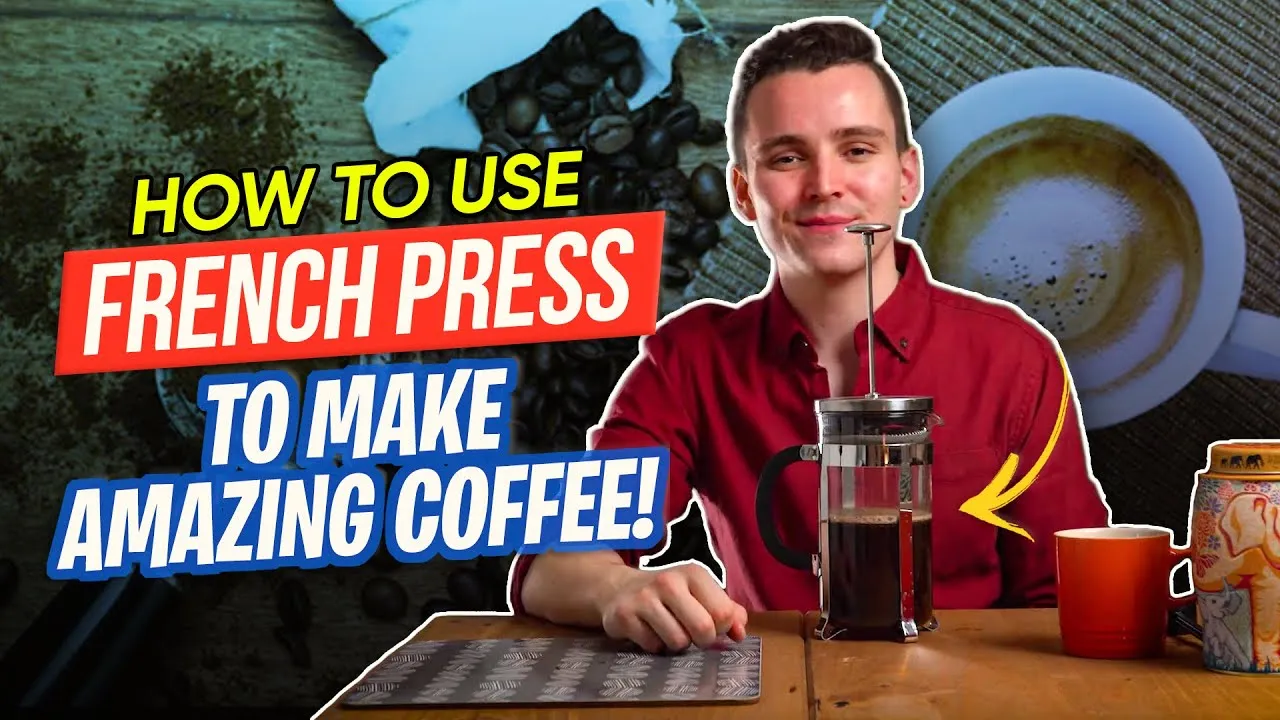
A French press steeps the coffee in all of its water, then a metal mesh holds the grounds back while you pour. The mesh lets some of the coffee’s oil and tiny pieces of coffee into the cup. James Hoffmann credits those for the press’s bigger, richer body, and blames them for its sludge, the silt at the bottom of the cup. Most of what follows is about keeping the body and losing the sludge.
I’ve been brewing with a French press for years, and the method I use now is radically different from what I started with. The biggest upgrade? I learned to stop pressing.
Our 2020 video shows the classic method: half the water to bloom, a stir at 30 seconds, the rest of the water, then a press at 4 minutes. The written recipe below is the no-press method, with its own numbers.
Hoffmann’s method: wait, don’t press
This is the technique that changed my French press coffee. It comes from James Hoffmann, the 2007 World Barista Champion, in his 2016 video “The Ultimate French Press Technique”; his book The World Atlas of Coffee gives the same steps with more coffee. The key is counterintuitive: you don’t press the plunger. Pressing stirs the silt at the bottom back up, as Hoffmann puts it, so instead you wait for it to settle and use the plunger only as a strainer.
- Coffee: 30 g, ground medium. “Ignore what most people say,” Hoffmann says in the video: don’t grind it super coarse.
- Water: 500 g, just boiled. Hoffmann doesn’t fuss over the temperature, as long as the water has boiled. That’s 60 g of coffee per liter, about 1:16.7 (calculated).
- Time: about 3 minutes to grind and weigh while the kettle boils, then 4 minutes of steeping, a moment to skim, and at least 5 more minutes of waiting, maybe 7 or 8: about 9½ to 12½ minutes from the first pour, and up to about 15½ minutes in all.
- Makes: up to about 440 g, or about 15 US fl oz (440 ml). That’s calculated: 500 g of water, less about 60 g held back by the grounds at roughly 2 g per gram of coffee. You’ll get a little less, because you leave the last of it in the press.
What about the coffee left in the press? Hoffmann writes that, made this way, it shouldn’t keep brewing or turn harsh, so you don’t need to decant the whole pot. Easto takes the opposite view for her method: the grounds keep extracting even after you press, so she pours it all off as soon as it’s done. If the last cup from a pot tastes harsher than the first, decant the rest into a carafe next time.
Easto’s eight-minute method, and our Brew Guide’s
Our Brew Guide doesn’t time Hoffmann’s settle-and-pour. It follows the eight-minute method in Jessica Easto’s Craft Coffee. Easto writes that most guides steep for four to five minutes, but that, thanks to barista Nick Cho, she found extremely coarse grounds and longer steeps, up to eight minutes, give a more even, delicate cup.
Her recipe is 28.5 g of coffee to 400 g of water (1:14), ground extra coarse (39 on a Baratza Virtuoso), with water just off the boil. At 30 to 45 seconds she stirs gently until most of the grounds sink, sets the plunger on top without pressing, and at 8:00 presses slowly and gently, because forcing it stirs up bitter, astringent flavors. Then she serves it straight away. She also gives a five-minute version: 25 g to 400 g (1:16), a coarse grind (34 on the Virtuoso), about ten stirs at 1:00, and a gentle press at 5:00. In her and co-author Andreas Willhoff’s home experiments, four minutes or less made a balanced cup too hard to get.
The Brew Guide uses Easto’s eight-minute steps at its own 1:15 ratio; her 1:14 is its Stronger setting. It sets the kettle by roast: 208°F (98°C) for light roasts, 205°F (96°C) for medium and 199°F (93°C) for dark.
What the French press makers say
The makers keep it shorter. Fellow’s recipe for its Clara press starts at 1:14 (1:12 for lighter roasts, 1:15 for darker), with water at 195–205°F (91–96°C), a 30-second stir and a 4-minute steep with the filter pressed down about 1 cm to keep the grounds under, then a plunge. Espro’s guide for its 18 oz press uses 1:15 for medium roasts (1:12 for light, 1:18 for dark), coarse coffee, 195–205°F, a steep of up to 4 minutes and a slow press to a count of 20.
So the makers press at about 4 minutes, Easto at 8, and Hoffmann doesn’t press at all. Each is a starting point; pick one and adjust from there. Our AeroPress vs French press comparison sets these makers’ methods beside an AeroPress.
How much coffee: the ratios side by side
Every source gives a different number, but they sit close together. The coffee per liter and the ratios in brackets are calculated from each source’s own figures.
| Source | Coffee to water | Coffee per liter | Steep |
|---|---|---|---|
| Hoffmann, 2016 video | Start at 60–70 g per liter; for example 30 g to 500 g | 60–70 g (1:16.7 to 1:14.3) | 4 min, then wait 5–8 |
| Hoffmann, World Atlas | 75 g per liter | 75 g (1:13.3) | 4 min, then wait 5 |
| Easto, eight-minute | 28.5 g to 400 g (1:14) | about 71 g | 8 min |
| Easto, five-minute | 25 g to 400 g (1:16) | 62.5 g | 5 min |
| Our Brew Guide | 1:15 (1:14 stronger, 1:16 lighter) | about 67 g | 8 min |
| Fellow (Clara) | 1:14 | about 71 g | 4 min |
| Espro (medium roast) | 1:15 | about 67 g | up to 4 min |
Hoffmann explains his book’s stronger figure: he uses a little more coffee in an immersion brewer if you want a cup as strong as a pour-over. If a well-made cup tastes balanced but too strong or too weak, change the ratio; if it tastes sour or bitter, change the grind first.
Whatever you choose, weigh the coffee and the water rather than using scoops; Hoffmann’s point is that you can only repeat a good cup, or fix a bad one, if you know what you did. Our guide to coffee scales compares a few, and the ratio guide gives amounts for other brewers.
Grind: medium or extra coarse?
This is where the methods really differ. Hoffmann grinds medium, which his book likens to caster (superfine) sugar. He writes that many people grind very coarsely for a French press, but he doesn’t think it’s necessary unless your grinder makes a lot of very fine pieces and your brews quickly turn bitter. Easto grinds extra coarse for her eight-minute steep, the approach she credits to Nick Cho (39 on a Baratza Virtuoso), and coarse for the five-minute one (34).
Our Brew Guide and Grind Guide follow Easto: extra coarse, like coarse sea salt, about 900 to 1,200 µm, moving toward the finer half for light roasts and the coarser half for dark ones. If you use Hoffmann’s method, start medium, as he does; if you use the eight-minute press, start extra coarse.
Whatever the setting, a burr grinder helps: a blade grinder makes a wide mix of sizes, and the finest pieces can pass through the mesh into your cup. Our guides to electric grinders and manual grinders compare burr grinders, and the grind size guide covers every brewer.
Water temperature
Every method here uses hot water, close to the boil. Hoffmann just boils the kettle. Easto takes the kettle off as it starts to boil and pours straight away. Fellow and Espro both say 195–205°F (91–96°C). Our Brew Guide starts at 205°F (96°C) for a medium roast, 208°F (98°C) for light and 199°F (93°C) for dark. Our brewing temperature guide goes further.
When the cup isn’t right
- Muddy or gritty. Use Hoffmann’s wait: at least 5 minutes after skimming, the plunger only to the surface, and the last of the pot left behind. If it’s still silty, grind a step coarser. For a very clean cup, pour it through a paper filter, which holds back fine particles.
- Bitter or harsh. Grind one step coarser. If you press, press slowly, as Easto warns; and if your cups get worse toward the bottom of the pot, pour the rest off the grounds as soon as it’s done.
- Sour or thin. Grind one step finer, and give it the full steep: Easto found four minutes or less too short to balance.
- Balanced but too strong or too weak. Change the ratio, using the table above.
Change one thing at a time, so you know which change helped.
Cafestol: the trade-off of a metal filter
The oils that a metal mesh lets through carry cafestol and kahweol, compounds that raise LDL cholesterol. A review by Rob Urgert and Martijn Katan found that paper filters hold them back, which is why paper-filtered coffee doesn’t raise LDL cholesterol while boiled and plunger (French press) coffee do.
A 2025 Swedish study by Erik Orrje and colleagues measured how much ends up in the cup. Paper-filtered drip coffee brewed at home from five brands had a median of about 12 mg of cafestol per liter. Their one French press brew measured about 87 mg per liter, about 7½ times as much (calculated). The authors note that this was lower than earlier studies, which found French press coffee closer to boiled coffee (939 mg per liter in their own sample).
If you drink several cups of unfiltered coffee a day and are watching your cholesterol, ask your clinician whether paper-filtered coffee is worth choosing. An AeroPress or a pour-over brews through paper.
Why I keep coming back
I own a V60, an AeroPress, an espresso setup, and a drip machine. The French press is still the one I reach for when I want the most satisfying cup of coffee.
It isn’t the cleanest cup; paper-filtered coffee wins there. But Hoffmann calls the French press probably the most underrated way to brew: cheap, easy and repeatable, and nearly everyone has one. With his long wait and gentle pour, it makes a cup with all of that body and much less of the sludge.
Sources
- James Hoffmann, “The Ultimate French Press Technique,” YouTube, October 2, 2016, 0:43–3:24 (ratio, grind, water, the 4-minute steep, skimming, the 5- to 8-minute wait and the pour): youtube.com
- James Hoffmann, The World Atlas of Coffee, revised edition (Mitchell Beazley, 2018), pp. 78–79, “The French Press” and “The French Press Method”
- Jessica Easto, Craft Coffee: A Manual (Agate Surrey, 2017), pp. 212–214, “The Eight-Minute French Press Method,” adapted for the Brew Guide; pp. 215–216, “The Five-Minute French Press Method”; p. 217 (Hoffmann’s 2007 World Barista Championship)
- Fellow, “The Classic: Clara French Press Recipe,” checked October 18, 2026: fellowproducts.com
- Espro, “18oz French Press Coffee Brewing Guide,” checked October 18, 2026: espro.com
- R. Urgert and M. B. Katan, “The cholesterol-raising factor from coffee beans,” Annual Review of Nutrition 17 (1997): 305–324: doi.org/10.1146/annurev.nutr.17.1.305
- E. Orrje, R. Fristedt, F. Rosqvist, R. Landberg and D. Iggman, “Cafestol and kahweol concentrations in workplace machine coffee compared with conventional brewing methods,” Nutrition, Metabolism and Cardiovascular Diseases 35 (2025): 103933, abstract, §2 and Table 1: doi.org/10.1016/j.numecd.2025.103933