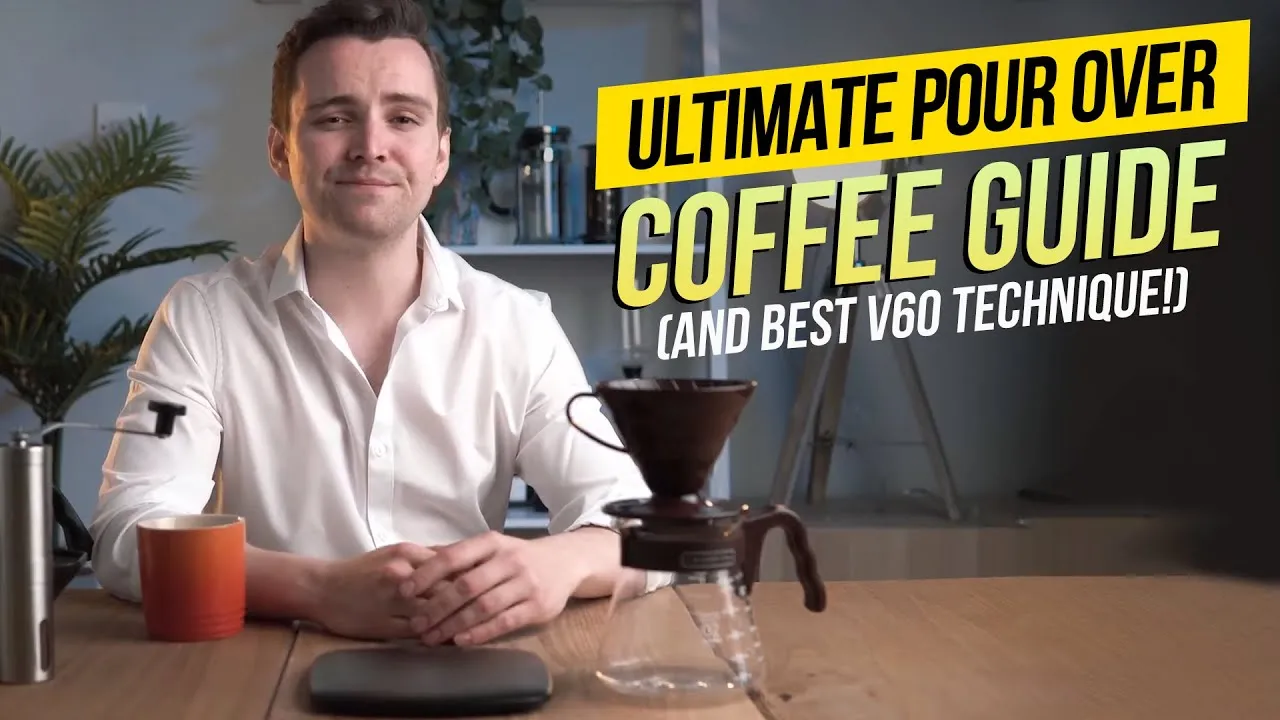
A V60 is a ribbed cone with one large hole, so it barely holds the water back: how fast and where you pour decides how the water moves through the coffee. That makes it rewarding to learn and easy to get wrong.
What you need
- A V60 and its paper filters. The cone’s spiral ribs keep the wet paper off the wall, so air can escape and coffee can drain.
- A burr grinder. It makes a more consistent spread of particle sizes than a blade grinder, which makes an even extraction easier.
- A scale with a timer. Everything below is by weight.
- A gooseneck kettle. A steady, controllable stream lets you pour where and as gently as you mean to.
- A server or mug to brew into.
Rinse the filter, white or brown. In Gagné’s comparison of V60 papers, the unbleached brown filter tasted like “wet cardboard”, the bleached white one less so, and after a thorough rinse he could barely tell them apart. Paper also holds back most of the coffee oils, including cafestol and kahweol, the compounds behind unfiltered coffee’s effect on LDL cholesterol (Urgert and Katan, 1997).
A complete V60 recipe
This is Jonathan Gagné’s V60 recipe from his Coffee ad Astra blog, with his numbers. Gagné is an astrophysicist who studies coffee brewing; his recipe is a good teacher because each step has a stated reason.
- Coffee: 22 g, ground medium-fine (about the texture of table salt)
- Water: 352 g, a 1:16 ratio, poured straight off the boil (don’t let the kettle rest)
- Time: about 2 minutes to set up, then 2½ to 3½ minutes from the first pour to the last drip, most of it spent pouring and watching; up to about 5½ minutes in all
- Makes: about 310 g, or about 10½ US fl oz (310 ml). That’s calculated: 352 g of water, less about 44 g held back by the grounds at roughly 2 g per gram of coffee.
Our Brew Guide tool uses the same 1:16 ratio with a simpler pattern, adapted from the continuous-pour method in Jessica Easto’s Craft Coffee: A Manual. At this dose it blooms with 56 g of water, makes one slow pour from 0:45, sets the kettle temperature by roast and finishes in about 3 to 4 minutes. Both work; pick one and repeat it.
Our 2020 video predates this revision; follow the written recipe above for quantities and timings.
What the bloom does
The bloom starts wetting the bed and lets carbon dioxide escape. Aim to wet all the grounds. Gagné blooms with three times the coffee’s weight in water and swirls straight away, and a brief, gentle swirl helps break up dry pockets.
Fresher and darker-roasted coffees often bloom more visibly, but the size of the bloom isn’t a reliable test of freshness. A dry patch after the bloom is always worth a swirl.
Water temperature: the kettle is not the brew
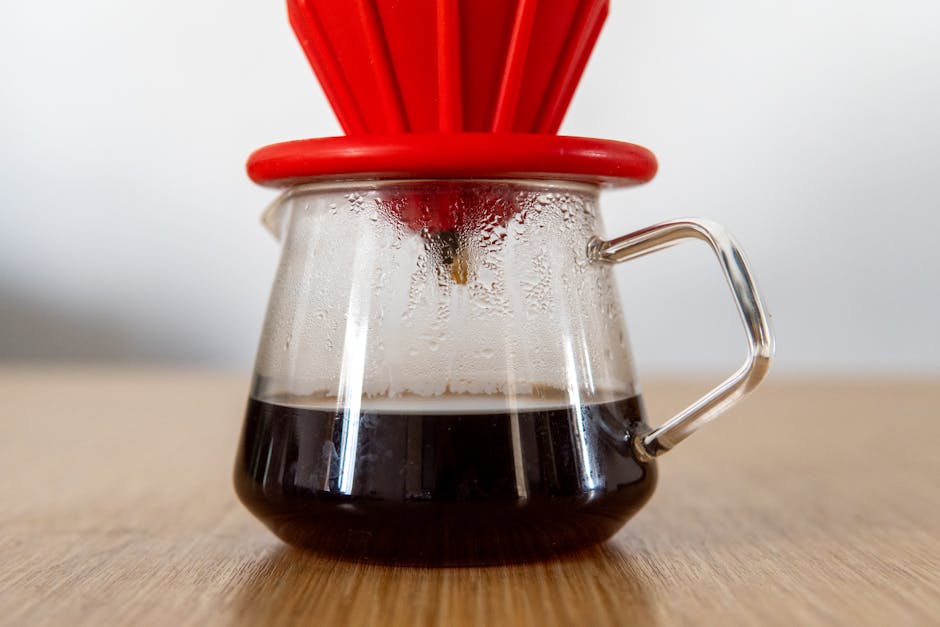
The coffee in the cone, the slurry, is always cooler than the water in your kettle. The water loses heat to the air, the paper, the cone and the room-temperature grounds. Gagné reports that even with water straight off the boil, the slurry in his V60 hardly ever gets above 199°F (93°C). It’s easy to fall below 196°F (91°C), which he finds can leave a cup under-extracted and sour. That’s why he brews straight off the boil and keeps the bed covered between pours, since a bed that drains between pours cools.
Our Brew Guide starts lower and steps down with the roast: 205°F (96°C) for light roasts, 201°F (94°C) for medium and 196°F (91°C) for dark. For a dark roast that’s a different starting point from Gagné’s boil; start with either, and adjust by taste.
If grinding finer makes the cup drying, go back one step. If that setting still tastes too sour, try hotter water on the next brew, up to Gagné’s boil, keeping everything else the same. Changing the temperature can change extraction and taste, so treat it as an experiment.
The cone’s material matters a little too. Gagné brews in the plastic V60 and notes that plastic holds heat in better than ceramic or glass, which take heat out of the first pours. A ceramic or glass V60 brews fine if you preheat it well with the rinse water, though ceramic gets hot to hold, which makes swirling awkward. Our brewing temperature guide goes further.
Swirling and pouring
A swirl is a small, gentle circle of the whole V60. Gagné calls it the Rao spin, after the brewer Scott Rao. It knocks dry grounds off the paper back into the slurry, lets the bed settle flat, and can help disrupt channels the pour has started. Keep it brief: in a guest post on Rao’s blog, Gagné cautions that hard or prolonged swirling can carry fines down and clog the filter. A flat bed at the end, with no crater or high ring of grounds on the paper, is a useful sign, though not proof of an even extraction underneath.
A few habits keep water flowing through the coffee rather than around it:
- Pour into the coffee, not onto the paper. Water that hits the filter can run down between the paper and the cone without passing through the grounds.
- Pour steadily: not a gush, not a trickle. A heavy stream digs a hole in the bed, and water follows the hole; a slow trickle lets the slurry cool.
Grind: the first thing to change
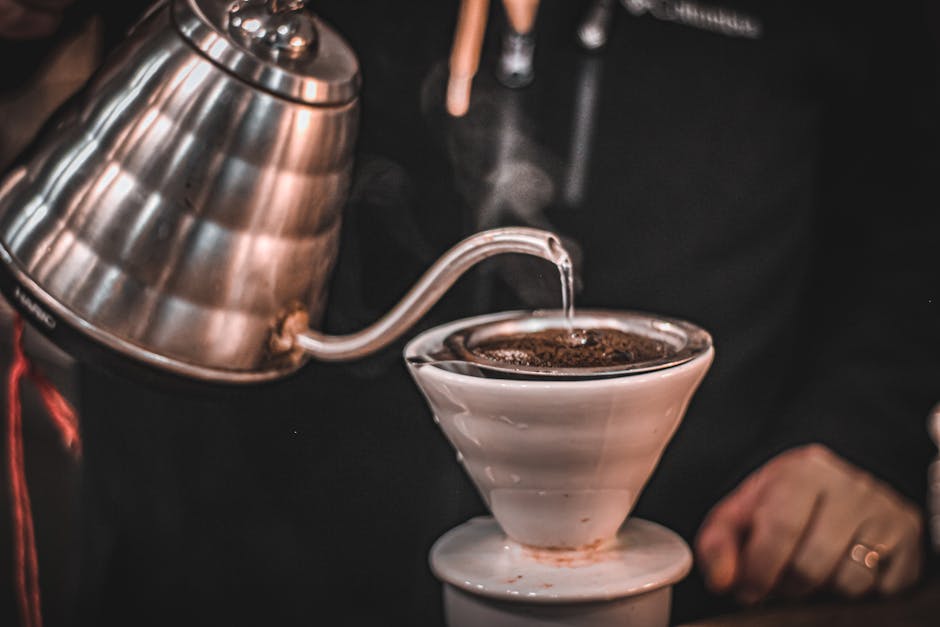
For a V60, start medium-fine, about the texture of table salt. The Brew Guide’s illustrative band for a V60 is about 450 to 650 µm. A particle size only becomes a setting on a specific grinder, though. For example, Baratza’s own chart puts the Virtuoso+ at setting 15 for a V60, and the Grind Calibrator shows published starting settings, with each setting’s source named.
For a sour or bitter cup, change the grind first, one step at a time, until the cup tastes right. It moves strength and extraction together, and you can repeat a grinder setting exactly. Gagné dials in the way Scott Rao suggests: grind finer until the cup turns drying and astringent, then go back one step.
How even the grind is matters too. Blade grinders produce a wide mix of sizes: the fines can clog the filter and slow the drawdown, while larger pieces extract more slowly. Better pouring can’t make the particles uniform. Our guides to manual grinders and electric grinders compare burr grinders.
V60 or a flat-bottom dripper?
The V60’s large outlet makes it responsive to your grind and pouring. A flat-bottom dripper such as the Kalita Wave holds the coffee in an even layer over three small outlets, which regulate the flow differently and can be forgiving while you learn. For a hands-off cup, an immersion brewer like the Clever Dripper steeps the coffee before it drains.
Fixing the cup by taste
On this recipe, a drain well under 2½ minutes or well over 3½ is a common sign, not a rule: the same time can taste great with one coffee and flat with another. Read it together with the taste, and change one thing.
| What you taste | What else you might notice | One change to try |
|---|---|---|
| Sour, thin | Often done before about 2:30 | Grind one step finer |
| Bitter, drying | Often still dripping after about 3:30 | Grind one step coarser |
| Sour and bitter at once, hollow | A crater or channels in the spent bed | Wet every ground in the bloom; swirl after each pour |
| Flat, papery | A papery smell, or an old roast date | Rinse the filter well; check the roast date |
| Too strong or too weak, but neither sour nor bitter | No obvious imbalance | Try the ratio first: keep 22 g and pour to 330 g (1:15, stronger) or 374 g (1:17, lighter) |
Sources
- Jonathan Gagné, “How to Brew Better Coffee with a V60,” Coffee ad Astra, 2018, §§4.5–4.8, 5 and 7.3 (the recipe, water temperature, filters and the V60): coffeeadastra.com
- Jonathan Gagné, “Why Spin the Slurry?”, guest post on Scott Rao’s blog, 2019: scottrao.com
- Jessica Easto, Craft Coffee: A Manual (Agate Surrey, 2017), pp. 246–248, “The #2 V60 Continuous Pour Method,” adapted for the Brew Guide
- Baratza, Virtuoso+ manual, v1.6, January 2023, p. 6, grind chart (Pour Over / V60): Baratza manual (PDF)
- R. Urgert and M. B. Katan, “The cholesterol-raising factor from coffee beans,” Annual Review of Nutrition 17 (1997): 305–324: doi.org/10.1146/annurev.nutr.17.1.305