Green coffee beans are almost flavorless — nothing more than a faint vegetable taste. Yet freshly roasted coffee is intoxicating, evocative, and delicious. Over 800 volatile aromatic compounds develop during roasting, transforming a pale, grassy seed into something extraordinary. Understanding how that transformation works is the key to understanding why your coffee tastes the way it does.
What’s Actually Happening Inside the Bean
Roasting is a series of chemical chain reactions, each triggered at a specific temperature. The roaster’s job is to control how far each reaction goes — and when to stop. Think of it as conducting an orchestra where each section enters at a different time, and pulling any one too far drowns out the others.
The Roast Profile: Stage by Stage
Stage 1: Drying (0-4 minutes, up to about 150C / 300F)
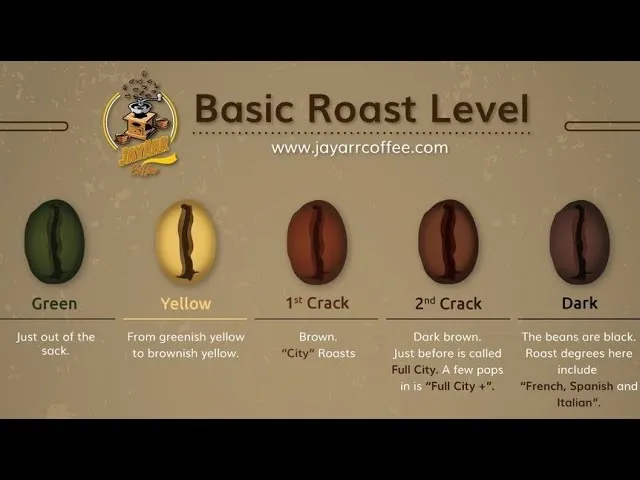
Green beans contain 7-11% moisture. Before any browning can happen, that water needs to go. The beans turn from green to yellow, with very little change in aroma. Nothing interesting is happening yet — the beans are just getting dry.
This phase is deceptively important. Apply too much heat too fast and the exterior dries before moisture has escaped from the interior. You get uneven roasting — dark outside, underdeveloped inside. Skilled roasters use lower heat here to let moisture escape gradually and evenly.
Stage 2: The Maillard Reaction (150-200C / 302-392F)
This is where roasting actually starts. The Maillard reaction is a non-enzymatic reaction between amino acids and reducing sugars — the same chemistry that gives a seared steak its crust, bread its golden color, and toast its flavor. In coffee, it produces hundreds of aromatic compounds: nutty, malty, caramelly, grainy, cocoa notes. Interestingly, cacao roasting follows a similar staged approach — the same Maillard chemistry drives flavor development in chocolate, though the temperature curves and timing differ significantly.
At this stage the outside of the bean may look adequately roasted, but the inside is still underdeveloped. If you stopped here, the coffee would taste grassy and sour with an unpleasant raw bitterness. The sugars haven’t broken down enough, and the amino acids haven’t fully reacted. This is a common mistake in home roasting — pulling the beans before they’re actually ready.
Stage 3: Caramelization (160-200C / 320-392F)
Overlapping with the Maillard reaction, caramelization breaks down the coffee’s natural sugars. This adds sweetness and depth — caramel, toffee, chocolate, honey notes. But here’s something counterintuitive: more caramelization actually produces less perceived sweetness. The longer sugars break down, the more they transform into bitter compounds. There’s a sweet spot (literally) where caramelization adds complexity without tipping into bitterness.
This is why roaster George Howell famously said: “Dark roast covers things like a heavy sauce. Light roast is the meat — dark roast is the sauce.” The sauce can be delicious, but at some point you’re only tasting the sauce.
Stage 4: First Crack (about 196C / 385F)
As browning accelerates, water vapor and CO2 build up inside the bean until the pressure causes it to crack open with an audible pop, roughly doubling in volume. First crack is the most important milestone in roasting — it’s loud, unmistakable, and it marks the moment the bean’s cellular structure has fundamentally changed.
This is where the roaster’s clock really starts. Everything from here is about how far past first crack you go.
Stage 5: Development (Between First and Second Crack)
After first crack, sugars continue caramelizing, oils migrate through the bean, and the flavor profile shifts rapidly. The roaster is making decisions by the second here. Medium roasts live in this window — the bean’s origin character is still present but increasingly layered with roast-derived sweetness and body.
Stage 6: Second Crack (about 212-218C / 414-424F)
The bean cracks again — a sharper, more brittle sound than first crack. The cell structure is breaking apart. Oils push to the surface (that’s why dark roast beans look shiny). At this point, acidity has largely disappeared and the flavors are dominated by the roasting process rather than the bean’s origin.
Once you’re well past second crack, you’re primarily tasting char and carbon. The bean’s identity has been erased.
Roast Levels: What They Actually Mean for Flavor
Light Roast (Pulled Shortly After First Crack)
Light roasts are the least processed and preserve the highest levels of the bean’s origin characteristics — the flavors that come from where the coffee was grown, the variety, and how it was processed.
Flavor: Bright acidity, fruit, floral, citrus, berry. Low bitterness. Complex and dynamic.
Best for: Pour-over, filter methods. If you’ve invested in a high-quality single-origin coffee, a light roast lets you taste exactly what you paid for. This is where an Ethiopian Yirgacheffe tastes completely different from a Kenyan AA.
The trade-off: Light roasts are denser and harder to extract. They need hotter water, finer grinds, or longer brew times. Under-extract a light roast and it tastes woody, bready, and sour — what roasters call “underdeveloped.”
Health note: Light roasts retain the highest concentration of chlorogenic acids — the main antioxidant in coffee. Dark roasting destroys over 90% of them.
Medium Roast (Between First and Second Crack)
Medium roasts balance origin character with roast-derived sweetness. You still taste the bean’s personality, but it’s wrapped in caramel, chocolate, and a fuller body.
Flavor: Balanced. Caramel, chocolate, some fruit and acidity still present. Fuller body than light roasts.
Best for: Drip coffee, automatic brewers, or anyone who wants complexity without extremes. Medium roasts are incredibly versatile and crowd-pleasing.
Why it’s popular: Medium is the sweet spot on what James Hoffmann calls the “sweetness bell curve.” Too light equals sour and grassy. Optimal equals sweet and complex. Too dark equals bitter and ashy. Medium roasts sit right near the peak.
Dark Roast (At or Past Second Crack)
Dark roasts have crossed the threshold where roast flavors dominate origin character. Chlorogenic acids have broken down almost completely — low acidity, high bitterness, heavy body. The oils on the surface can start to burn, and the sugars approach carbonization.
Flavor: Bold, smoky, toasty, tobacco, leather, chocolate. Low acidity, pronounced bitterness, full body.
Best for: Espresso (especially with milk), French press, cold brew. The intensity cuts through milk, and the smoothness works well for extended steeping methods.
The honest take: Dark roasts aren’t bad — they’re different. Some of the world’s best espresso blends are intentionally dark roasted. The problem is when dark roasting is used to mask low-quality beans. A great dark roast is a choice. A burnt, oily supermarket dark roast is usually a cover-up.
The Caffeine Myth
“Does dark roast have more caffeine?” is one of the most common coffee questions, and the answer is: it depends entirely on how you measure.
Roasting doesn’t create or destroy caffeine. What changes is the bean’s weight and size. Dark roast beans are lighter per bean (they’ve lost more moisture) and larger (they’ve expanded more). So:
- By weight (scooping with a scale): Dark roast has slightly more caffeine per gram, because each bean weighs less, so you need more beans to hit the same weight.
- By volume (scooping with a spoon): Light roast has slightly more caffeine per scoop, because the beans are smaller and more fit in the scoop.
The difference either way is small enough to be irrelevant for most people.
Roast Speed: Slow vs. Fast
Slow roasts (14-20 minutes) allow more complete chemical reactions and more even heat penetration. They tend to produce fuller body and more Maillard complexity due to extended browning at lower internal pressure. This is the approach most specialty roasters use.
Fast roasts (as quick as 90 seconds in commercial settings) preserve more acidity and brightness. They can be excellent but are harder to control — the margin for error shrinks dramatically when everything is happening in under two minutes.
The sweetness principle: The best roasters find the point where coffee is at its sweetest relative to roasting time. Whether that produces a bright, acidic cup or a muted, full-bodied cup depends on the specific bean.
Cooling: The Forgotten Step
Once roasting is done, beans must be cooled immediately. Residual heat continues cooking them — batches can go from perfectly roasted to burnt because the roaster didn’t cool them fast enough.
Small batches use cooling trays with fans that rapidly draw air across the beans. Large batches sometimes use a water mist to speed cooling. Some commercial roasters use excess water during cooling to increase the bean weight — a cost-cutting practice that reduces shelf life. If you’re buying from a roaster who cares, they’re cooling with air, not water.
The target: beans should go from roasting temperature to room temperature in 2-5 minutes.
What to Look for When Buying Roasted Coffee
Understanding roasting helps you make better buying decisions:
1. Look for a roast date, not a “best by” date. Coffee peaks 7-21 days after roasting. After that, it’s declining. A bag without a roast date is hiding something.
2. Oily beans aren’t “fresh.” Oil on the surface means oils have migrated out through the cell structure — it’s a sign of either dark roasting or age. Fresh beans at any roast level should look relatively dry.
3. Match roast level to brew method. Light roasts shine in pour-over. Dark roasts work well in espresso and milk drinks. Medium works everywhere. If you’re not sure which grind size or brewing temperature to use, those parameters also shift with roast level.
4. Ask about the roast profile. Good roasters are excited to talk about their approach. They track time and temperature curves for every batch. If a roaster can’t tell you anything about their process, that’s a red flag.
5. Darker roasts extract differently. They have fewer total available solubles and produce lower extraction yields. If you’re dialing in a dark roast and it tastes thin, it’s not necessarily under-extracted — there may simply be less to extract. Compensate with a higher dose or finer grind, not more water.
6. Consider the source. The same roast level applied to a high-quality single-origin or organic coffee tells a completely different story than applied to commodity beans. The roaster’s raw material matters as much as their technique.
Roasting Coffee at Home
Roasting coffee at home can be a fun and educational process, though achieving commercial-quality results takes practice. Raw (green) coffee beans are available from a number of online retailers — just keep in mind that green beans degrade over time and should ideally be roasted within a year of harvest.
Just about anything capable of producing consistent heat can be used. Everyday ovens or woks will work in a pinch, though controlling the process is difficult. Heat guns or modified popcorn machines generally produce better results by providing more even, controllable heat. The best outcomes come from dedicated home roasting machines, which let you monitor temperature and time while automating the cooling cycle.
The key is learning to hear first crack — that’s your reference point for everything that follows. Whether you pull shortly after first crack (light), in the middle of development (medium), or push through to second crack (dark) is your choice to make, batch by batch. For a full walkthrough — equipment, step-by-step instructions, and common mistakes — see the complete home roasting guide.
The Bottom Line
Coffee roasting transforms green, flavorless seeds into one of the most aromatically complex foods on the planet through a carefully controlled sequence of chemical reactions — drying, Maillard browning, caramelization, and structural breakdown. The roaster’s skill determines where your coffee lands on the spectrum from bright and origin-forward to bold and roast-dominant.
Neither end of that spectrum is inherently better. But understanding what roasting does helps you choose the right coffee for how you brew, recognize quality when you taste it, and have a more informed conversation with the people who roast what you drink.
Frequently Asked Questions
- Can you roast coffee beans at home?
- Yes, and you don't need expensive equipment to start. A hot air popcorn popper, a cast iron skillet, or a purpose-built home roaster all work. The key is consistent heat and the ability to hear first crack — that's your reference point for light-to-medium roasts. Expect a learning curve and some smoky batches, but home roasting gives you the freshest coffee possible.
- What temperature is coffee roasted at?
- Coffee roasting spans roughly 150-230C (300-450F). First crack happens around 196C (385F) and second crack around 212-218C (414-424F). The roaster controls how fast the beans move through these stages and when to stop — that timing is what determines your roast level and flavor profile.
- Why are some coffee beans oily and shiny?
- Oil on the surface means it has migrated out through the bean's cell structure. This happens with dark roasts (the cell structure breaks down at second crack) or with stale beans of any roast level. Fresh beans should look relatively dry. If your light or medium roast beans are oily, they're likely past their prime.
- How long do roasted coffee beans stay fresh?
- Peak flavor is roughly 7-21 days after roasting. After that, oxidation degrades aromatics and the cup flattens. Store beans airtight, cool, and dark. Whole beans last longer than ground — grinding dramatically increases surface area and accelerates staling. If you buy more than you'll use in three weeks, freeze portions in airtight bags.
- Does roast level affect how you should brew coffee?
- Significantly. Light roasts are denser and harder to extract — they need hotter water, finer grinds, or longer contact time. Dark roasts are more porous with fewer available solubles, so they extract quickly and can turn bitter with the same parameters. If you switch roast levels, adjust your grind and temperature rather than just swapping beans into the same recipe.
Some links above are affiliate links. If you purchase through them, we earn a small commission at no extra cost to you.