A hand grinder holds a dose or two and needs cranking, but it puts a full burr set in a small package. This is a research comparison from each maker’s published specs and grind charts, not a ranking.
What our 2020 video found
Our 2020 video compared ten hand grinders at a coarse setting, which shows a grinder’s flaws more plainly than a fine one, and picked the Porlex Mini as its overall favorite; the ROK’s grind was inconsistent at times when we tried it. This revision compares current models from their makers’ specs instead of re-ranking the video’s lineup.
Hand grinders, by their makers’ specs
Each grinder’s name links to its maker’s page or manual, checked October 15, 2026. “Per click” is how far the burr moves, as the maker publishes it; it is not the size of the grounds.
| Grinder | Burrs; capacity | Adjustment; espresso, per the maker |
|---|---|---|
| Timemore Chestnut C2 | Not given in the manual; under 20 g | Clicks from the start point, step not published; yes, 6–12 clicks |
| Timemore C3 | 38 mm stainless steel conical (S2C660); 20 g | Classic dial: 83.3 µm per click, 12 per turn; listed as suitable, finer on ESP models |
| 1Zpresso JX | 48 mm; 30–35 g | 30 clicks per turn, step not published; grouped under pour-over |
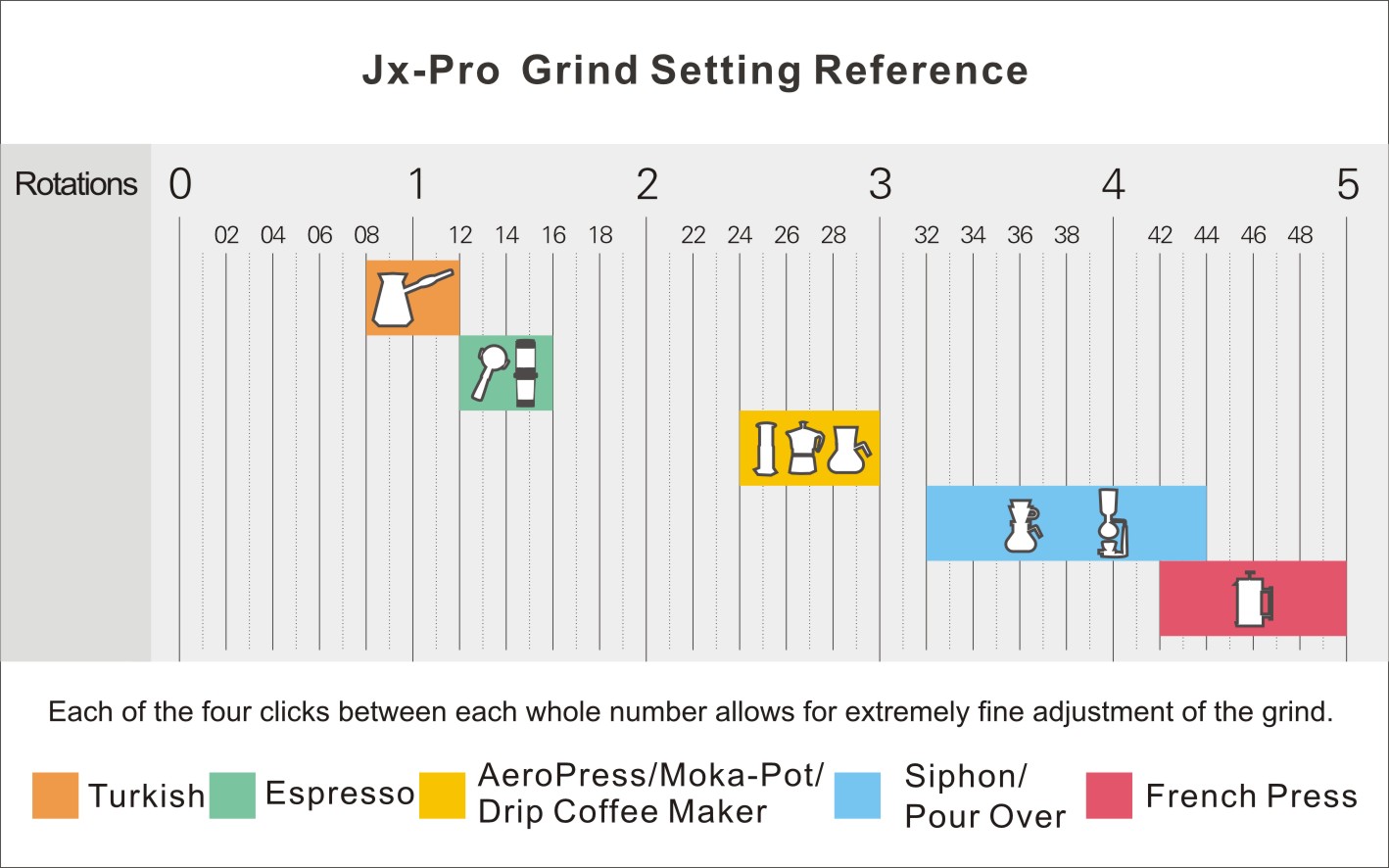
| 1Zpresso JX-Pro | 48 mm, the JX’s burr; 30–35 g | 12.5 µm per click, 40 per turn; yes, 12–16 on its chart |
| 1Zpresso K-Ultra | Heptagonal conical; capacity not on the page | 20 µm per click, 100 per turn; yes |
| Kinu M47 Classic | 47 mm conical; 40 g | Stepless, “as fine as 5 microns”; not charted |
| Comandante C40 MK4 | Nitro Blade stainless steel, size not published; at least 40 g | Clicks from zero, step not published; yes, 7–13 clicks |
| Hario Mini-Slim+ | Ceramic conical; 24 g of grounds | Not published; not charted |
A few notes on the rows:
- Timemore C2. It doesn’t appear in Timemore’s online store at timemore.com. Its settings come from Timemore’s 2020 manual for the Chestnut C family, which also warns: “DO NOT try to grind coffee beans at the finest 0–6 clicks to protect the Burr sharpness.”
- Timemore C3. Timemore says the C3 series is “fine enough for espresso”, and its ESP models use a finer dial, 23.3 µm per click with 30 per turn. The standard C3’s 83.3 µm is calculated from Timemore’s 0.0833 mm.
- 1Zpresso K-Max. Earlier versions of this guide covered the K-Max, which 1Zpresso now lists as discontinued; it moved 22 µm per click. The K-Ultra is the current model with the same kind of external dial.
- 1Zpresso JX-Pro S. 1Zpresso’s JX-Pro manual covers the S version, which adds a folding handle.
- Hario. The Mini-Slim+ replaces the Mini Mill Slim of earlier versions of this guide; Hario’s page publishes no grind chart for it.
What matters in a hand grinder
How far each click moves the burr
The smaller the step, the smaller the change you can make. That matters most for espresso, where Baratza, writing about its own grinders, notes that “very small changes to the grind size” are needed to fine-tune a shot. Baratza’s Encore ESP, for example, uses small steps across its espresso range and larger ones across its filter range.
Remember what the number measures: burr movement, not the size of the grounds. A 12.5 µm click on a JX-Pro and a 20 µm click on a K-Ultra are each maker’s figure for its own mechanism, so you can’t compare grind sizes across grinders by click count. Our grind size micron chart explains why.
Finding zero
Click counts start from a zero that each maker defines in its own way:
- Comandante. Hold the grinder level and close the burrs: click zero is the first setting where the handle no longer falls.
- 1Zpresso. The zero point is “where the handle starts to spin with resistance instead of the tightest position”.
- Timemore. Turn the dial clockwise to the end; that’s the start point.
Capacity
Most hand grinders hold one or two doses: 20 g in a standard Timemore C3, 30–35 g in a JX-Pro, 40 g in a Kinu M47. If you brew for four every morning, that’s several refills, and an electric grinder makes more sense.
Burr material
Steel burrs are standard on the 1Zpresso, Timemore, Kinu and Comandante grinders here. Hario uses ceramic, and says its conical ceramic burrs transfer less heat and shave the beans rather than cracking them like a blade grinder.
The grinders in more detail
Timemore Chestnut C2 and C3
The C2 and C3 are Timemore’s entry models. For the C2, Timemore’s Chestnut C manual gives 6–12 clicks for espresso, 15–24 for pour-over and 24 for French press, counted from the start point, and calls the table “for your reference only”. Note the overlap with its warning against grinding at 0–6 clicks: start at the coarse end of the espresso range.
For the C3, Timemore publishes the burr and dial specs above but no method chart that we could tie to the standard model, so the Grind Calibrator doesn’t cover it. Pair either with a coffee scale and you have the basics for weighing every brew.
1Zpresso JX and JX-Pro
The JX and JX-Pro share a 48 mm burr. 1Zpresso groups the JX with its pour-over grinders and the JX-Pro with its espresso grinders, and says the JX-Pro “is suitable for both pour-over and espresso”. The difference is the dial: the JX-Pro moves its burr 12.5 µm per click, 40 clicks to a turn.
1Zpresso’s JX-Pro chart counts in numbers, with 10 numbers to a turn and 4 clicks to a number: espresso at 12–16, AeroPress, moka pot and drip at 24–30, siphon and pour-over at 32–44, and French press at 42–50.
If I could own only one grinder, hand or electric, and I brewed both espresso and filter, the JX-Pro is one I’d seriously consider. If espresso is your main focus, check that your machine matches it; our budget espresso machine guide covers that side.
1Zpresso K-Ultra
The K-Ultra has an external adjustment ring, 10 numbers and 100 clicks to a turn, moving the burr 20 µm per click. 1Zpresso says it suits pour-over, espresso and other methods.
Kinu M47 Classic
Kinu’s M47 Classic has 47 mm conical burrs and a stepless dial that Kinu says adjusts “as fine as 5 microns”. With no clicks to count, returning to a setting means noting where the dial sits. Kinu lists it at 1,175 g, with a 40 g capacity.
Comandante C40 MK4
Comandante makes its Nitro Blade burrs from a high-nitrogen stainless steel and publishes no burr diameter or click size. Its FAQ gives starting points, with the advice to trust your taste buds:
- 3–8 clicks for ibrik;
- 7–13 for espresso;
- 14–20 for a stovetop pot;
- 18–35 for pour-over, depending on dose and brewer;
- 25–35 for cupping and French press.
Comandante also notes that its burrs can touch at finer settings by design, because the inner cone “floats” on the axle. Pair it with a pour-over setup; our V60 guide covers the brewing.
Hario Mini-Slim+
Hario’s Mini-Slim+ is a compact ceramic-burr grinder that holds 24 g of grounds. Hario calls it “a great grinder for beginners” and an upgrade from the original Mini-Slim, with a new handle and shaft coupling. With no published chart, finding your setting is trial and error.
Hand grinder or electric?
Choose a hand grinder if you brew one or two cups at a time, want portability, or enjoy the ritual.
Choose an electric if you brew for several people every day, or want speed: our electric grinder comparison covers those.
What I actually do: an electric grinder on weekday mornings when I’m in a rush, and a hand grinder on weekends when I want to slow down and engage with the process. Different grinders, different burrs, different cups; it isn’t redundant.
Where to buy
1Zpresso and Kinu sell from their own sites, and Hario through its US store. For the Timemore C3, this Amazon search names the model: Timemore C3 (Amazon search). Timemore sells the C3 in several versions, so check that the listing says which dial it has.
This is an affiliate link. If you buy through it, we earn a small commission at no extra cost to you.
Sources
Makers’ pages and manuals were checked on October 15, 2026.
- Timemore, Chestnut C Coffee Grinder User Manual (Chinese and English, 2020), “How to grind”, “How to adjust” and “Caution”: Timemore manual (PDF)
- Timemore, C3s / C3 Series page, tech specs: timemore.com; and Chestnut C3 configuration page: timemore.com
- 1Zpresso, J Series page (JX, JX-Pro, J-Max): 1zpresso.coffee; K Series page (K-Max discontinued): 1zpresso.coffee; K-Ultra page: 1zpresso.coffee
- 1Zpresso, “User Manual – JX-Pro,” March 25, 2021, adjustment and calibration: 1zpresso.coffee; and “JX-Pro Grind Setting Reference,” 2020: 1Zpresso chart (image)
- Kinu, M47 Classic product page, features: kinugrinders.com
- Comandante, FAQ, “What grind settings are suitable for different brewing methods?”, “Where is Zero?” and “My grinder’s burrs are touching”: comandantegrinder.com; and C40 MK4 Nitro Blade manual (2023), burr material and bean jar: Comandante manual (PDF)
- Hario, “Mini-Slim+” Ceramic Coffee Mill (MSS-1DTB) product page: hario-usa.com
- Baratza, Encore ESP Operations Manual, v1.0, January 2023, p. 5, on espresso adjustment: Baratza manual (PDF)