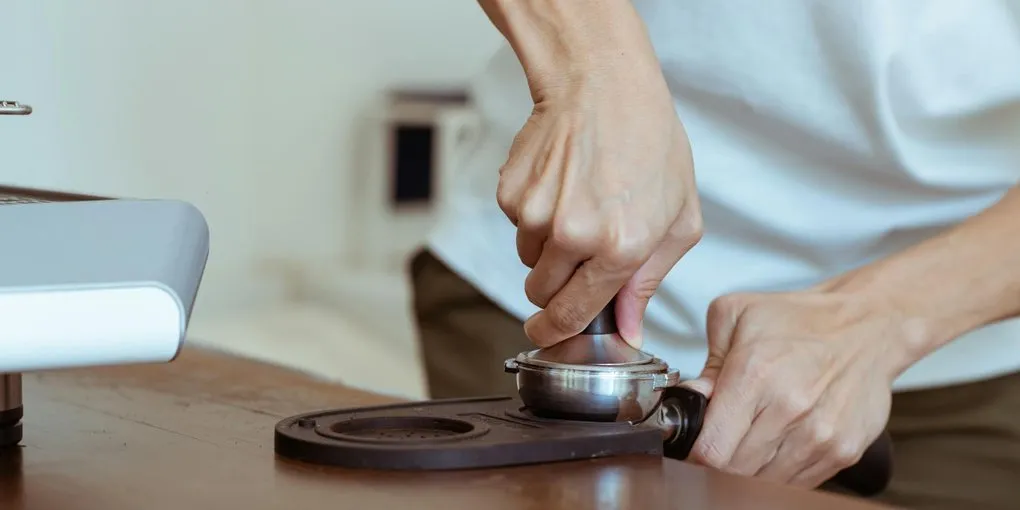
How hard should you tamp? Rao’s 2013 routine says 20 to 30 lb (9 to 14 kg); his 2008 handbook puts a firm tamp at about 50 lb. The measurements say the number matters much less than how even and level the coffee is. Force isn’t irrelevant, though, and the exceptions are worth knowing.
What the measurements show
| Source | What was varied | What it found |
|---|---|---|
| Cameron et al., 2020, Matter | A range of tamp pressures, in a café, at 6 bar | No appreciable change in shot time or extraction yield; flavor differences were noticed but not measured |
| Kuhn et al., 2017, Journal of Food Engineering | Grind size and tamping pressure, with a purpose-built sampling rig | Grind size changed how fast caffeine and trigonelline extracted; tamping pressure had no detectable effect |
Cameron’s team used an automated tamper set to 98 N (about 22 lb, or 10 kg, calculated) for the rest of their experiments once they found the pressure made little difference. They also note why tamping is needed at all: the coffee must be tamped to level the bed.
The books agree. In The Professional Barista’s Handbook, Rao writes that the difference in flow resistance between lighter and harder tamping is minimal: once the tamp has removed the large air pockets in the bed, more pressure won’t do much for extraction or flow. He gives two reasons:
- Wetting relieves it. Some or all of the tamping pressure is released as soon as the grounds get wet.
- The machine pushes much harder. His footnote works it out: 9 bar is about 130.5 psi, and over the 4.09 square inches of coffee in a 58 mm basket that’s about 534 lb, against roughly 50 lb from a firm tamp.
James Hoffmann makes the same case in The World Atlas of Coffee: tamping isn’t as important as people think, its job is to push the air out and leave the bed level and even, and once the air is out there’s little or no reward for pushing harder.
Where force still matters
- Too light a tamp. Both Rao and Hoffmann tamp to push the air out of the bed. Neither gives a minimum, so “tamp lightly” means firm enough to settle the coffee, not a token press.
- Timing, on some machines. A harder tamp compresses the bed more and leaves more empty space above it, which has to fill with water before full pressure arrives. Rao notes this delay can fool baristas into thinking a harder tamp slowed the shot. In Espresso Extraction he adds that on a pressure-profiling machine, the extra space delays the onset of full pressure and upsets the programmed curve, while a lighter tamp shortens preinfusion.
- Shared machines. For that reason, Rao writes that while he doesn’t think there’s an ideal tamping pressure, baristas sharing a profiling machine should all tamp to a common standard. A calibrated tamper, which presses with a set force, is one way to do that.
- Taste. Cameron’s team noticed flavor differences between tamping pressures that their instruments didn’t capture. The studies measured shot time, extraction and particular compounds on particular setups, not every machine and coffee.
What matters more: an even, level, sealed bed
Rao’s Handbook describes the bed a barista should aim for: a smooth, level surface, a tight seal against the wall of the basket and an even density throughout. Water takes the easiest way through the coffee, and a thin side, a loose edge or a less dense patch is an easy way. The water rushing through there over-extracts that coffee, while the denser parts under-extract; our guide to channeling covers the signs and fixes.
- Distribution comes first. Rao ranks being able to build an evenly distributed bed, consistently, as perhaps the most important skill a barista can have. Uneven distribution causes uneven extraction, whatever the tamp. Grinders that dose straight into the portafilter tend to leave clumps, which a WDT tool can break up.
- Level beats hard. A tilted puck is thinner on one side. Rao notes that tamping lightly makes a level tamp easier, and that with a tight-fitting tamper, a hard, tilted tamp is what makes the tamper stick. Hoffmann suggests leaving the tamper on the coffee and checking the angle of its handle.
- One tamp, no twist. Rao keeps the tamper level, presses once and sees no need for a twist or a second tamp. In Espresso Extraction he adds: lift the tamper out without tilting it.
- Dry basket. Rao wipes the basket dry before dosing, because moisture on its wall can encourage channeling around the edge.
Don’t tap the portafilter after tamping
Rao and Hoffmann both warn against tapping the side of the portafilter after the tamp, often done to knock loose grounds off the basket wall. Rao explains that the tap can break the seal between the coffee and the basket wall, leaving an easy channel around the edge, and in his experience a broken seal is hard, if not impossible, to fix with a second tamp. Hoffmann adds that a tap with the tamper can damage the tamper too. If grounds are stuck to the rim, wipe them off; Rao also locks the portafilter in gently, so the seal isn’t jolted.
That’s different from settling the grounds before the tamp. In Espresso Extraction, Rao’s dosing routine taps the portafilter on the counter a set number of times before grooming and tamping, to collapse air pockets in the loose coffee.
Tamper fit is a real variable
How well the tamper fits the basket matters more than how hard you press it. In Espresso Extraction, Rao writes that with a loose tamper, channeling happens often and isn’t always visible, and that this subtle channeling can easily lower extraction by 0.5 percentage point. His target is a tamper 0.25 to 0.30 mm narrower than the basket’s inside diameter, a gap of 0.125 to 0.15 mm all round: for his basket, which measured 58.7 mm inside, that meant a 58.4 mm tamper. Baskets differ, so the fit depends on yours.
He also tells of a friend who logged his shots with a refractometer for weeks and found that switching from a 58.0 mm to a 58.4 mm tamper was one of five changes that each raised his average extraction by up to 0.5 percentage point. That’s one person’s log, but it shows the size of the effect.
A tamping routine
- Dose evenly. Wipe the basket dry and fill it evenly, then break up clumps and level the grounds with a WDT tool or your usual grooming.
- Set the tamper level. Hold it with your wrist straight and your elbow above it, as Hoffmann describes.
- Press once, firmly enough to push the air out. Rao’s figure is 20 to 30 lb (9 to 14 kg); a bathroom scale under the portafilter will show you what that feels like.
- Check the angle before you lift. Hoffmann leaves the tamper on the coffee and checks that its handle stands straight.
- Lift straight up. No twist, no second tamp.
- Don’t tap. Wipe the rim and lock the portafilter in gently.
Then judge the shot, not the tamp. If it tastes sour and bitter at once, or the stream spurts or splits, look at distribution and level before reaching for more force. Our dial-in guide covers the rest of the routine and a shot log, and pressure profiling explains how a machine that varies its pressure changes the picture.
Sources
- Michael I. Cameron, Dechen Morisco, Daniel Hofstetter, et al., “Systematically Improving Espresso: Insights from Mathematical Modeling and Experiment,” Matter 2, no. 3 (2020): 631–648, “Brewing Espresso” and “Experimental Procedures”: doi.org/10.1016/j.matt.2019.12.019
- Michael Kuhn, Sandra Lang, Franziska Bezold, Mirjana Minceva and Heiko Briesen, “Time-resolved extraction of caffeine and trigonelline from finely-ground espresso coffee with varying particle sizes and tamping pressures,” Journal of Food Engineering 206 (2017): 37–47, abstract: doi.org/10.1016/j.jfoodeng.2017.03.002
- Scott Rao, The Professional Barista’s Handbook (2008), p. 4 (channels and the ideal bed), p. 11 (dosing and distribution), pp. 16–19 (“Tamping,” “How Hard to Tamp,” “To Tap or Not to Tap?,” “How to Tamp”)
- Scott Rao, Espresso Extraction: Measurement and Mastery (2013), ch. 6 “Tamper Fit,” ch. 10 “Doser Versus Doserless” (his dosing and tamping routine), ch. 11 “Pressure Profiling” (tamping pressure and preinfusion) and ch. 13 “The Benefits of Using a Coffee Refractometer”
- James Hoffmann, The World Atlas of Coffee, 2nd edition (Mitchell Beazley, 2018), pp. 99–100 (“Tamping” and making an espresso)