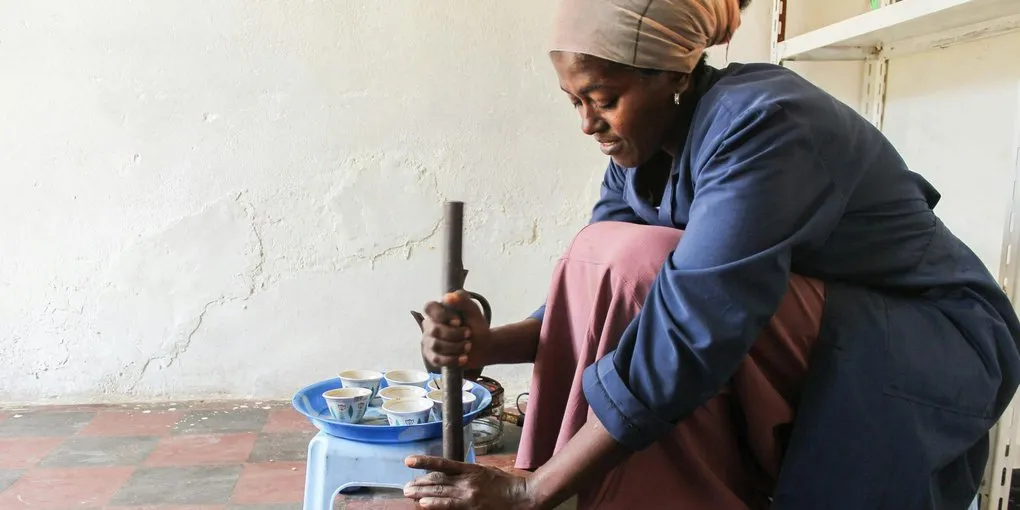
In an Ethiopian household, “let’s have coffee” is rarely a five-minute proposition. The everyday Amharic phrase buna tetu — literally “drink coffee” — has come to mean “let’s get together and talk.” A coffee ceremony unfolds over two to three hours, sweeps in neighbors and family, fills the room with frankincense smoke, and runs through three full rounds of brewing. It is the household ritual that anchors social life across most of Ethiopia, performed daily in many homes and on every occasion that matters.
For the Western specialty coffee world, which prides itself on optimizing extraction yields and shaving seconds off pour-over recipes, the ceremony is a useful corrective. Coffee was ritual long before it was commodity. It was communal long before it was a 12-ounce paper cup at a drive-through. The country where coffee began still treats it that way.
This article walks through what actually happens during an Ethiopian coffee ceremony — the three rounds, the equipment, the regional variations, the spiritual context — drawing on Jeff Koehler’s Where the Wild Coffee Grows, which contains the most detailed Western-language account of the ceremony as practiced in Sidamo and Kafa. The goal is not to romanticize a tradition that does not need romance, but to describe it accurately and place it in the deep history that produced it.
The Ethiopian coffee ceremony is a 2-3 hour ritual, traditionally led by the woman of the household
In a typical home, the host begins by spreading fresh grasses, flowers, and decorative leaves across the floor where the ceremony will take place. Nature must be present in the space. A small charcoal brazier is lit nearby, and on it the host places frankincense — almost always local Ethiopian frankincense, sometimes mixed with myrrh — which begins releasing its sharp, resinous smoke into the room. The smoke is not decoration. It is part of the sensory environment the ceremony is designed to create.
The woman of the household leads the ceremony. This is structural rather than casual. Across nearly all Ethiopian regions and ethnic groups, the coffee ceremony is performed by women, and the role is one of the central markers of household competence and hospitality. A young woman learning the ceremony is learning her place in the social fabric. Guests do not direct, do not help with the brewing, and do not rush. They sit, talk, and watch the ceremony unfold at its own pace.
The total time investment is two to three hours from setup to the final round. This is the design, not a side effect. The ceremony is not “having coffee” in the Western sense; it is creating space for sustained conversation that the brewing tempo enforces.
Green beans are roasted on an open flame minutes before brewing
The host begins with raw, unroasted green coffee beans — typically a handful at a time, sized for the number of cups planned. The beans are spread on a concave metal disk over the charcoal flame and stirred slowly with a small wooden paddle for approximately fifteen minutes. The beans crackle as they roast. The host periodically lifts the disk and walks it through the room so guests can inhale the deepening roast aroma — a gesture that explicitly invites everyone present into the act of brewing.
The roast level is medium-dark. The beans are pulled off the heat when they have visibly browned and started to release oils, which the host shows to the room. The fresh-roasted beans are then poured into a wooden mortar called a mukecha — typically a heavy hollowed-log mortar — and pounded with a long wooden pestle called a zenezena. There is no grinder. The host crushes the beans by hand for several minutes until the grounds are fine enough to brew, usually somewhere between filter and espresso grind, depending on regional preference.
The use of green-bean roasting on the spot is the most striking element of the ceremony for visitors. It establishes that coffee is not pre-prepared and stored; it is prepared from origin material, in front of guests, on the day of consumption. Roast freshness is built into the ritual at a level no Western specialty café can match. (For a sense of why fresh roast matters so much in cup quality, see our piece on coffee freshness from roast to stale.)
The jebena clay pot is the brewing vessel — long-necked, narrow, often unglazed
The brewing vessel is a jebena — a clay pot with a round bulbous body, a long narrow neck, and (in most regional styles) a small spout protruding from the front of the body just below the neck. The clay is typically unglazed inside, which means each jebena develops its own seasoned coffee-stained interior over many ceremonies. Some hosts maintain a single jebena for years; the seasoning becomes part of the flavor profile of their household’s coffee.
The host fills the jebena with water and places it directly over the charcoal brazier. When the water reaches a boil, the freshly pounded grounds are added — often through the long neck with a small funnel — and the mixture is allowed to come back to a boil. The brew is not steeped or filtered in the Western sense; it is essentially a Turkish-style decoction, with the grounds suspended in the water during boiling and then settling into the bulbous bottom of the pot when the jebena is set down briefly before pouring.
A note on regional variation: the Mankira jebena, used in Kafa (the original wild-coffee region), is slightly different — its neck is longer, narrower, and unflared, and it lacks the front spout entirely. The reason is functional. In Kafa, coffee is traditionally served with butter floating on the surface, and a flared spout would let the butter escape. The Mankira pot pours from the lip of the long neck, which naturally retains the butter on top.
The pot is poured slowly from a notable height, the host arcing the stream into small handleless cups arranged on a serving tray. The high pour is also functional: the grounds settle in the jebena’s belly, the long neck filters most particulate during pouring, and the height oxygenates the brew. The cups are small — typically 2 to 3 ounces — because each guest will drink three of them across the ceremony.
The ceremony has three rounds — abol, tona, and baraka — each with its own meaning
The defining structural element of the ceremony is that the same coffee grounds are brewed three times, producing three rounds of cups served to all guests. Each round has a name, and each carries a specific role in the ritual. The Amharic terms (used across most of Ethiopia) are abol, tona, and baraka; the Tigrinya equivalents (used in Eritrea and northern Ethiopia) are awel, kale’i, and baraka. The structure is constant across both languages.
Round 1: Abol (Tigrinya: awel). The first round is the strongest — fresh grounds, full extraction, the most caffeine and the most dissolved solids. Abol is essentially the “main” cup. In most regional variants this is the cup that signals the ceremony has formally begun. Conversation starts. The room settles into the rhythm of the ritual.
Round 2: Tona (Tigrinya: kale’i). The host adds more water to the same grounds in the jebena, brings the brew back to a boil, and pours the second round. The cup is lighter than abol — fewer dissolved solids, a less intense profile, but still recognizably coffee. By the second round the conversation has typically opened up. Topics that did not surface in the first round — practical matters, news, family business — find space in the second.
Round 3: Baraka. The third round is the blessing. Baraka means “blessing” in both Amharic and Tigrinya, borrowed from the Arabic. The grounds have given up most of their extractable material by this point, so the cup is thin — closer to a dilute herbal infusion than a strong coffee — but the social weight is heaviest here. To leave a coffee ceremony before baraka is rude. In Kafa, the social violation is named: bune marako gačheto, “you didn’t respect the coffee spirit.” When something goes wrong for someone afterward — a slip, an injury, an ill omen — the phrase is invoked. The third round is taken as protective. Skipping it leaves you exposed.
The structure of the three rounds — strong, lighter, blessing — mirrors the structure of the conversation itself. The opening cup is for greeting and pleasantries. The middle cup is for actual exchange. The closing cup is for sealing what was said. Western specialty coffee has nothing comparable to baraka. The closest analog is wine etiquette around a long meal, but even that does not carry the spiritual weight.
Regional variations bring spices, butter, and distinct vessel shapes
While the three-round structure is constant, what goes into the cup varies by region.
Kafa and southwestern Ethiopia. Wild ginger root is sometimes added to the brewing water. Coffee with butter — a pat of fresh, slightly salty butter dropped into the cup before pouring — is traditional. Coffee prepared with butter is one of the oldest documented preparations of coffee anywhere; the Scottish traveler James Bruce described it in his 1770s Ethiopian travels, and Ethnographers Friedrich Bieber (early 1900s) and Max Grühl (1920s) recorded similar preparations in Kafa. Kuti (the leaves of the coffee plant brewed as a tea-like infusion) and chamo (a complex Kafa infusion that can include wild garlic, ginger, rue, chili, wild cardamom, and clarified butter) are also traditional southwestern preparations sometimes served alongside the ceremony.
Sidamo and southern Ethiopia. Cardamom is the most common addition — a few cracked green pods in the water as it boils. Some preparations also use clove. The Sidamo style is closer to the contemporary Western image of “Ethiopian coffee” because Sidamo is one of the regions whose washed-process exports built the international Ethiopian specialty reputation. (For more on what makes those regional profiles distinct, see Ethiopian coffee flavors and varieties.)
Northern Ethiopia and areas near the Sudanese border. Cinnamon bark is the signature addition. Some regional traditions also use tena adam (rue) or other locally available aromatics.
Across regions. Coffee-honey balls — green coffee beans pounded together with butter and honey, sometimes with paradise pepper (grains of paradise) or cloves — are a portable form of coffee documented in Ethiopia for at least three centuries, with James Bruce’s 1770s account among the earliest detailed Western descriptions. Jeff Koehler describes these in Where the Wild Coffee Grows as essentially “the world’s first energy bar.” They are still made in some Kafa households today.
The unifying principle is that coffee in Ethiopia is rarely consumed black and rarely consumed alone. It is a beverage that absorbs whatever the household has on hand — butter, honey, cardamom, ginger — into its preparation, and the household serves all of it to the room.
The Kaldi origin legend — what is folklore and what is history
Every coffee book in the English-speaking world has told some version of the story of Kaldi the goat herder. The popular telling: a young Ethiopian goatherd notices his goats are unusually energetic after eating red berries from a particular shrub. He tries the berries himself, finds himself similarly energized, and brings them to a local monastery. The monks initially throw the berries into the fire, but the roasting smell is so appealing they pull them back out, brew the roasted beans in water, and discover coffee.
It is important to be clear about what this is. The story is folklore, not documented history. Its earliest known written record is a 1671 Latin treatise on coffee, De Saluberrima potione Cahue seu Cafe nuncupata Discurscus, by the Maronite scholar Antoine Faustus Nairon (also Latinized as Antonius Faustus Naironus), a professor of Oriental languages in Rome. Even the name “Kaldi” is not in Nairon’s text — Nairon described an unnamed camel or goat herder in the Kingdom of Ayaman. The name appears to have been popularized much later by William H. Ukers in his 1922 book All About Coffee. Local Ethiopian variants of the story collected in Kafa give the goatherd different names entirely (Kali Adu, Kalliti) and replace the European monastery-and-abbot frame with the king of Mankira or Kafa.
Popular retellings often place the discovery in the 9th century or around 850 CE. There is no documentary evidence supporting a specific date that early. The first concrete written records of coffee being brewed and drunk come from 15th-century Sufi monasteries in Yemen — and that’s where coffee, in the cup-of-coffee sense we’d recognize, can be reliably dated to. (For the next chapter of that story, see our Yemen coffee guide.) Ethiopia is unquestionably the botanical origin of Coffea arabica; what it is not, on present evidence, is the place where coffee-as-a-beverage was first developed. Coffee was eaten as a fruit, chewed as a stimulant, and pounded into honey-and-butter energy balls in Ethiopia for centuries before Yemen turned it into a brewed drink.
What is verifiable — and load-bearing for the ceremony’s history — is that the Kingdom of Kafa, which controlled the southwestern Ethiopian forests where wild Arabica grew, treated those forests as both economically and spiritually significant for centuries before the modern Ethiopian state absorbed Kafa in 1897. Koehler documents an unbroken Kafa royal line from roughly 1390 to 1897 — five hundred years of forest jurisdiction. Kafa religion included three coffee-specific sacrifices each year (at flowering, at green-berry stage, and at ripe-harvest stage), each with an animal offering matched to the color of the coffee at that growth stage. The local belief that “coffee is a gift from God because we did not plant it” reflects coffee’s status as a wild forest crop, distinct from cultivated grains like teff or maize.
The ceremony as practiced today carries the imprint of all of this. The role of the woman of the household as host, the emphasis on hospitality, the spiritual undertone of baraka, the use of frankincense — all of it traces back through layers of Ethiopian Orthodox Christianity, Islam (which arrived in coffee-growing regions early), and pre-Abrahamic local religions. It is impossible to fully separate the secular and spiritual components.
The ceremony is hospitality first, sometimes a marker of significant events
In daily practice, the coffee ceremony is the medium through which Ethiopians spend time with neighbors. A woman returning from market may set up a ceremony for whoever drops by that afternoon. A weekend visit between families almost always includes one. The phrase buna tetu — “come drink coffee” — has come to mean “let’s spend time together” in much the same way that “let’s grab a coffee” has, but with the structural weight of a 2-3 hour commitment behind it.
For significant events, the ceremony scales up. Engagements, weddings, funerals, baptisms, holiday gatherings, and the conclusion of significant business agreements all involve formal coffee ceremonies, often with multiple women preparing simultaneously to serve larger groups. The ceremony is not the celebration itself, but it is the ritual frame inside which celebration takes place. It marks that the time and the people gathered are significant.
In Ethiopian Orthodox Christianity, the Wednesday and Friday fasts (and the longer fasts during Lent and the Apostles’ Fast) traditionally exclude meat and dairy but not coffee. The ceremony continues through fasting periods, sometimes serving as one of the few sources of conviviality during weeks of dietary restriction. In Muslim households across coffee-growing regions, the ceremony is similarly persistent — coffee is not subject to the Islamic prohibitions on intoxicants and has been embraced across both religious traditions.
The ceremony also rarely travels alone. Bread is almost always served alongside — most often himbasha, a slightly sweet flatbread, or in many regions injera, the spongy fermented flatbread that anchors Ethiopian cuisine. (Our sister site has a longer piece on the cultural role of injera in Ethiopian bread tradition for readers who want the food side of the story.) Roasted barley snacks (kolo) and popcorn are also common ceremony accompaniments.
What the ceremony is not: a tourist performance. While some hotels and cafés in Addis Ababa and other major cities offer “demonstration ceremonies” for visitors, the genuine practice happens in homes, runs at its own pace, and is not designed as spectacle. A traveler invited to a real coffee ceremony in an Ethiopian home is being granted significant hospitality. The appropriate response is to sit, accept all three cups, and stay.
The contrast with Western specialty coffee culture is the point
Place the Ethiopian coffee ceremony next to a typical American specialty café experience and the contrasts are stark. Three rounds vs. one cup. Two to three hours vs. five minutes. Communal vs. individual. The woman of the household vs. a barista. Frankincense and fresh grass vs. minimalist white-tile interiors. Jebena clay vs. ceramic V60. Pounded green beans roasted on the spot vs. beans roasted at a remote facility weeks earlier and shipped vacuum-sealed. Conversation vs. headphones-and-laptop work mode.
Neither is wrong. The Western specialty model has produced extraordinary advances in extraction science, processing transparency, and sourcing relationships — see our third wave coffee history for the arc that produced it. The Ethiopian model has produced and preserved the social and spiritual infrastructure inside which coffee originally lived. They are different answers to different questions.
What gets lost in the optimization of Western coffee — the speed, the standardization, the to-go cup — is the recognition that coffee was, and in Ethiopia still is, a medium for sustained presence. The ceremony does not aim to extract the maximum aromatic compounds from the bean. It aims to create the conditions under which people stay in a room with each other for several hours. The conversation that emerges in baraka is the actual product. The coffee is the catalyst.
For the home enthusiast and the specialty professional, the Ethiopian ceremony is worth understanding for its own sake — as the deepest coffee ritual on Earth, practiced daily by tens of millions of people in the country where the bean originated. It is also worth understanding as a reference point against which any other coffee experience can be measured. The question of what coffee is for has more than one answer, and the Ethiopian one has been holding up for a very long time.
For deeper context on the Ethiopian regions whose coffee profiles built the international specialty market, see Ethiopian coffee flavors and varieties and Ethiopian heirloom vs. named varietals. For the broader question of why origin matters in the first place, what is single-origin coffee covers the framework.
Frequently Asked Questions
- How long does an Ethiopian coffee ceremony actually last?
- A traditional ceremony runs two to three hours from setup to the final round. The pacing is deliberate — green beans must be roasted from raw on an open flame (about fifteen minutes), pounded by hand in a wooden mortar called a mukecha, brewed in a clay jebena, served, and then re-brewed twice more for the second and third rounds. Conversation, frankincense incense, and unhurried hospitality fill the gaps between rounds. A 'quick' ceremony abbreviated below 90 minutes is possible but rare and is usually a sign that the host is working under unusual time pressure.
- Why does each round have a different name?
- Each of the three rounds carries a specific role and a specific name. In Amharic, the first round is abol, the second is tona, and the third is baraka. In Tigrinya (Eritrea and parts of northern Ethiopia), the equivalents are awel, kale'i, and baraka. Abol is the strongest — fresh grounds, full extraction. Tona is lighter as the same grounds are brewed a second time. Baraka — meaning 'blessing' in both languages, borrowed from Arabic — is thin in dissolved coffee but heaviest in social weight. Leaving the ceremony before baraka is considered rude across most of Ethiopia, and in Kafa specifically it is described as bune marako gačheto, 'you didn't respect the coffee spirit.'
- Why is the ceremony performed by women?
- The role of host is structurally assigned to the woman of the household across nearly all Ethiopian regions and ethnic groups. Learning to perform the ceremony is one of the central markers of household competence, and the responsibility traditionally passes from mother to daughter. The arrangement reflects deep historical patterns rather than any modern policy, and it remains constant whether the ceremony is daily practice or part of a major occasion like a wedding or funeral.
- What is the jebena and why does it have that shape?
- The jebena is the clay brewing pot used in the ceremony — round-bellied, with a long narrow neck and (in most regional styles) a small spout from the body. The shape is functional. Grounds settle into the bulbous bottom of the pot when it is removed from the heat, and the long neck filters most particulate when the host pours from height into small handleless cups. The pots are typically unglazed inside, which means each one develops its own coffee-stained interior over many ceremonies. The Mankira jebena from Kafa lacks the front spout and has a longer, narrower neck because traditional Kafa coffee includes butter floating on top, and a flared spout would let it escape.
- What spices or additives go into the brew?
- Regional variation is wide. In Kafa and the southwest, wild ginger root and butter (with honey, sometimes paradise pepper) are traditional. In Sidamo and the south, cardamom is most common — a few cracked green pods boiled with the water — sometimes with clove. In northern Ethiopia and near the Sudan border, cinnamon bark is the signature addition. Some traditions also use tena adam (rue) or other locally available aromatics. The Kafa preparation of green coffee pounded with butter, honey, and sometimes paradise pepper or cloves is one of the oldest documented coffee preparations on Earth, with James Bruce's 1770s Ethiopian travels among the earliest detailed Western records.
- Is the Kaldi goatherd story actually true?
- It's folklore, not documented history. The earliest known written version is a 1671 Latin treatise on coffee by the Maronite scholar Antoine Faustus Nairon, and even Nairon didn't name the herder Kaldi — that name was popularized much later, most prominently by William H. Ukers in his 1922 book All About Coffee. Local Ethiopian versions told inside Kafa give the goatherd different names entirely (Kali Adu, Kalliti) and replace the European monastery scene with the king of Mankira or Kafa. Coffee was certainly used in Ethiopia long before it was brewed in Yemen — but as fruit, chewing material, and butter-and-honey energy balls, not as a brewed beverage in the modern sense. The first reliable written records of brewed coffee come from 15th-century Yemen.
- What should I do if I'm invited to an Ethiopian coffee ceremony?
- Sit, stay, and accept all three cups. Don't direct, don't help with the brewing, and don't rush. The pace is part of the design — two to three hours is the point. Compliments to the host on the brewing and the smell of the roast are welcome. Leaving before baraka, the third round, is considered rude across Ethiopia and is taken seriously enough in Kafa that there is a specific phrase for the social violation. If you are served coffee with butter or with cardamom or cinnamon and you've never had it that way, drink it anyway — that's the household's tradition and it's part of what you are being included in.