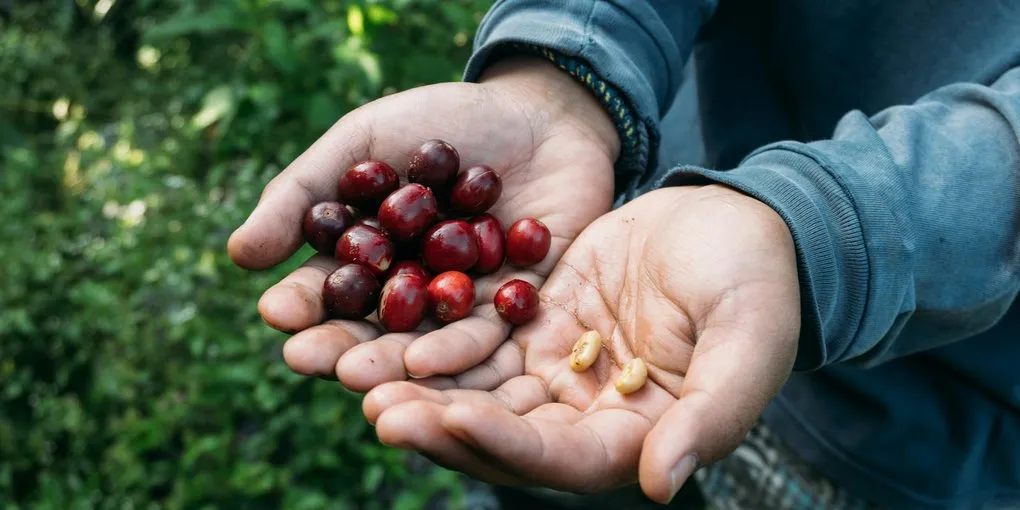
Most coffee drinkers can name Kona. Almost none can name its neighbor — Ka’u, the Big Island’s southernmost coffee district, tucked into the southeast slopes of Mauna Loa above an old sugar town called Pahala. For most of the twentieth century there was no Ka’u coffee industry to speak of. The land grew sugarcane. When the cane went, in 1996, the people who had worked it were handed five-acre lease lots and told to figure out something new. What grew on those lots over the next thirty years is one of the most improbable origin stories in specialty coffee.
Ka’u (also spelled Kaʻū) entered the Specialty Coffee Association of America’s Roasters Guild competition for the first time in 2007. Two of the fifteen Ka’u entries placed in the global top ten. Three years later, a Ka’u farm called Rising Sun won the SCAA’s Coffee of the Year award in the Hawaii-USA category and placed ninth globally with an 87.563 score, the highest of any Hawaiian coffee that year. By 2012 the region had its own processing mill, courtesy of a private trust that bought 13,000 acres of former cane land. Within two years of Sasa Sestic’s 2015 World Barista Championship win on a carbonic-macerated coffee, Ka’u producers were running CM trials with Sestic himself — work that Perfect Daily Grind documented from Pahala in 2017. By the late 2010s, Perfect Daily Grind was filing dispatches from Pahala about freezer fermentation and mineral-water washes that nobody else in Hawaii was attempting. None of this happened in Kona, the older, richer, more famous neighbor next door. It happened in the place no one had heard of.
This is a complete guide to Ka’u as an origin: where it is, why its terroir works, who farms there, what their coffees taste like, and how a region that didn’t exist as a coffee district before 1996 became the U.S. specialty market’s most active laboratory for experimental processing.
Where Ka’u Is
Ka’u is the southernmost district of Hawaii Island, the chain’s largest island (locally and almost universally called the Big Island). The district stretches from the saddle between Mauna Loa and Kīlauea down to Ka Lae, the southernmost point of the United States. Drive south from Kona along the Mamalahoa Highway and you eventually leave the resort coast behind and climb into ranchland. The road bends east, the coast disappears, and the land opens into the long, broad backside of Mauna Loa. That is Ka’u.
The Ka’u district is enormous — almost a thousand square miles, larger than Maui, larger than Oahu — but most of it is grassland, ranchland, ʻaʻā lava flows, or protected forest reserve. Coffee occupies a narrow band of upland on Mauna Loa’s southeast flanks, mostly in the hills above the town of Pahala. The principal farm cluster sits along Wood Valley Road, climbing from the old plantation grid up into a microclimate the locals call Cloud Rest — named for the heavy mist that settles on the hillsides most afternoons.
The growing band runs from roughly 1,500 to 2,500 feet elevation, with a few farms pushing higher. By global standards, that elevation is modest — Ethiopia routinely produces above 2,000 meters (6,500 feet) and Bolivia higher still. Hawaii compensates with latitude. At 19 degrees north, Ka’u sits much farther from the equator than most coffee regions, which lowers ambient temperatures enough to mimic higher-altitude conditions. The combination of unusual latitude and moderate altitude is what makes commercial coffee viable in Hawaii at all.
The soil under those farms is volcanic — young, mineral-rich Mauna Loa basalt, broken down by rainfall and root activity into a deep, dark, free-draining loam. Mauna Loa is still an active volcano (its most recent eruption was in late 2022), and the lava flows that shape Ka’u’s landscape are geologically recent. The soil profile is meaningfully different from Kona’s, on the older lava of Hualālai and Mauna Loa’s western flank — a distinction Ka’u producers will tell you matters.
The History — Sugar to Coffee
Coffee was first planted in Ka’u in the 1890s — accounts vary between 1894 and 1895, attributed to a planter named J.C. Searle. It didn’t take. The 1899 global price crash killed coffee almost everywhere in Hawaii outside Kona, and Ka’u in particular was already committed to a different crop: sugarcane. The Hawaiian Agricultural Company had begun planting cane around Pahala in 1880. By the early twentieth century, sugar was the only thing happening in Ka’u that mattered economically, and the town of Pahala existed largely to serve the mill.
For most of the next century, Ka’u was a one-industry plantation town. The cane consolidated through a series of mergers — Hawaiian Agricultural and Hutchinson Sugar combined in 1972 to become Ka’u Sugar Co. The C. Brewer corporation, one of the “Big Five” Hawaiian sugar conglomerates, took it over in the 1980s. And then, like every other Hawaiian sugar operation, it failed against cheaper imports and changing land economics. Ka’u Sugar Co. closed on March 27, 1996, ending 116 years of continuous cane production around Pahala and putting hundreds of plantation workers out of work in a town with no alternative employer.
What happened next was unusual. C. Brewer offered displaced workers the option to lease the cane land for five-acre plots at $150 per acre per year, with the first five years free. A handful of families — many of them second- or third-generation Filipino-American plantation workers — took the deal and planted coffee instead of trying to relocate. They had never grown coffee. There was no local coffee industry to apprentice into. The nearest commercial mill was in Kona, two hours away by truck on a winding road. They learned by doing.
The pioneer farms came online in the late 1990s and early 2000s. Rising Sun Farm (Will & Grace Tabios) was launched in 2000 on seven acres at the 1,700-foot elevation above Pahala. Rusty’s Hawaiian picked its first crop in 2002. The same year, those early farms organized themselves into the Ka’u Coffee Growers Cooperative. By 2006, when the cooperative’s founder, Rusty Obra, died unexpectedly, there were roughly forty struggling farms in the region, most under five acres each.
Then 2007 changed everything. Ka’u entered fifteen samples in the SCAA Roasters Guild Cupping Competition — its first time on a global stage. Will and Grace Tabios’s Rising Sun took sixth place worldwide. Marlon Biason’s Aroma Coffee Farms placed ninth. Two top-ten global finishes in your debut competition is the kind of result that gets phone calls returned. Ka’u was on the map.
The Terroir — Why Ka’u Coffee Tastes Different
A useful way to understand Ka’u terroir is to put it next to Kona and notice what is the same and what is not.
Both regions sit on Mauna Loa or her sister volcano Hualālai. Both grow predominantly Typica that arrived in Hawaii via Guatemala in 1892. Both farm at modest elevation (mostly 1,400–2,500 feet) compensated for by latitude. Both have the volcanic-soil minerality that Hawaiian coffee marketing emphasizes endlessly. So far, these are sister regions.
The differences are local and matter more than the similarities. Kona faces west, into the lee of the volcanoes; Ka’u faces southeast, directly into the trade winds. The trades carry marine humidity off the open Pacific and dump it onto the upper Mauna Loa slopes, producing a daily moisture pattern that Ka’u producers describe as “morning sun, afternoon clouds, evening rain.” That pattern — sometimes called the Cloud Rest effect — slows cherry ripening relative to the more sun-exposed Kona side. Slower ripening means more time for sugars and aromatic precursors to accumulate in the bean.
Mauna Loa’s southeast slopes are also younger lava flows than Hualālai’s western face — a few hundred to a few thousand years old, in some cases. The soil minerality profile is different from Kona’s, and producers on both sides of the island will describe their crops in language consistent with that geology: Kona reads round, balanced, classic, with a kind of polished smoothness; Ka’u reads rougher, more textural, with brighter acidity and a deeper sweetness when handled well.
CoolHunting’s tasting note on Ka’u Specialty Coffee’s signature Honey Dark Roast captures the region’s mainstream profile efficiently: “earthy taste with a slightly citrusy finish, rather mellow.” Earthy because the volcanic minerality and slow ripening produce a substantial mid-palate. Citrusy because Ka’u’s marine humidity supports more acidity than Kona typically expresses. Mellow because the dark roast tames it. Lighter Ka’u roasts from quality producers can read brighter and more complex than that dark-roast description suggests — closer to the caramel, fruit, and floral undertones that other Hawaiian retailers describe.
Wood Valley Farm and Ka’u Specialty Coffee
If Ka’u has a flagship producer in the U.S. specialty market — the operation that put a face on the region for mainland consumers — it is Ka’u Specialty Coffee (formally Ka’u Specialty, Inc.) on 96-2384 Wood Valley Road, Pahala. Founder Malian Lahey started the company in 2011 with what was, at the time, a slightly unfashionable thesis: that Ka’u farmers were producing coffee comparable to Kona’s but selling it for a fraction of Kona’s price, and that the gap could be closed by direct relationships with mainland specialty buyers rather than commodity-channel processing.
The CoolHunting profile that introduced Ka’u Specialty to many U.S. readers describes it as a “co-op… grown on a 280-acre farm on the Big Island.” In practice that means Wood Valley anchors a network of nearby family farms that Lahey’s company sources from, processes alongside, and helps to market under a unified Ka’u Specialty label. The model — small lead estate plus dispersed cooperative supply — is similar to how some Central American micro-mills operate. Their Honey Dark Roast is the company’s calling card and the bag most often pictured in mainstream coverage.
Wood Valley is one of several Ka’u farms that participated in the carbonic-maceration and experimental-processing trials that began drawing Perfect Daily Grind’s attention around 2017. Lahey’s company, like several other Wood Valley producers, was an early adopter of the methods that have since become more common across the region.
Experimental Processing in Ka’u
Here is the part of the Ka’u story that the broader coffee press has covered most extensively, because it is genuinely unusual: a small, young, geographically isolated region became one of the U.S. specialty market’s leading laboratories for experimental processing.
“Experimental processing,” in coffee, is a loose category that refers to anything beyond traditional washed, natural, or basic honey processing. The current taxonomy — carbonic maceration, anaerobic fermentation, thermal-shock processing, inoculated fermentation, co-fermentation, frozen-cherry, and nitrogen maceration — has emerged largely since the mid-2010s. Every World Barista Championship since 2023 has been won using one of these techniques on the competition coffee. (Want the full picture? Our coffee processing methods explainer lays out the underlying mechanics, and the honey process colors guide covers the yellow / red / black gradient specifically.)
Carbonic maceration is the technique that put Ka’u on the experimental-processing map. The method is borrowed from winemaking: whole intact cherries are sealed in CO₂-flushed stainless steel tanks, where intracellular fermentation occurs inside the cherry before the skin is broken. The resulting flavor profile is distinctive — confectionery sweetness, aromatic esters, often a wine-like or boozy quality, and stone-fruit and tropical-fruit notes that don’t typically appear in conventional Hawaiian processing. Sasa Sestic of ONA Coffee in Australia popularized carbonic maceration in coffee when he won the 2015 World Barista Championship using a CM-processed lot from Colombia. Within two years of that win, Sestic was working directly with Ka’u producers — including Ka’u Specialty Coffee — on CM trials in Pahala.
Perfect Daily Grind’s 2017 dispatch from Wood Valley described three experimental methods running simultaneously in the region: carbonic maceration, a freezer process that involves cooling cherries to slow and then redirect fermentation, and a mineral-water washed process that uses water sourced from springs in the Ka’u Forest Preserve on Mauna Loa’s slopes. PDG’s accompanying video on washed carbonic maceration was filmed in Ka’u and remains the most-cited single source on how the technique was being adapted in Hawaii at that time.
Why did Ka’u — not Kona, not the bigger producing regions of Latin America — become this kind of hub? A few structural reasons:
- Small farm sizes (most Ka’u farms are five to thirty acres) make experimentation cheap. A producer can run a 200-pound CM trial without risking the season’s whole yield. On a 100-acre Brazilian farm, the same proportional trial is a much larger commitment.
- Cooperative knowledge transfer. Because the Ka’u Coffee Growers Cooperative was founded in 2002 with the explicit purpose of sharing technique, novel methods spread between Ka’u farms faster than they tend to between unrelated producers in larger origins.
- A willingness to risk the cup. Hawaiian coffee already commands a price premium driven partly by what specialty coffee literature calls the “paradise premium.” Ka’u, as the upstart against Kona, had less reputation to protect and more upside in differentiation.
- Direct access to roaster networks. Sestic, ONA, Pacific Coffee Research, and a handful of other quality-focused buyers were willing to travel to Hawaii. The collaborations were short-distance, well-funded, and continuous.
The cup-table impact of the experimental work in Ka’u is consistent with what carbonic maceration and anaerobic fermentation produce elsewhere: confectionery sweetness, fermented-stone-fruit and tropical-fruit notes (mango, pineapple, passion fruit), wine-like aromatic complexity, and — at the edges — a deliberately polarizing fermenty quality that some judges love and others reject. The processing-side debates over where innovation crosses into flavor manipulation have been particularly active in Hawaii, where the state’s coffee identity has long been built on terroir rather than fermentation tricks.
Ka’u Producers Beyond Wood Valley
Ka’u is small enough that you can name most of the serious producers and large enough that the list keeps changing as new growers come online. The principal farms and operations to know:
- Ka’u Coffee Mill (96-2694 Wood Valley Road, Pahala). The regional processing hub, built in 2012 by Edmund C. Olson through the Edmund C. Olson Trust II at a reported cost of approximately $1.5 million. Olson, a private investor, had begun acquiring former Ka’u Sugar lands in 2006 and eventually held more than 13,000 acres in and around Pahala. The mill processes its own ~100 acres of coffee orchard plus services about sixty other local growers — a critical piece of regional infrastructure that ended the long truck haul to Kona for processing. Mill tours and a tasting room are open to the public.
- Ka’u Specialty Coffee (96-2384 Wood Valley Road, Pahala). Malian Lahey’s operation, described above; the most visible Ka’u brand in the U.S. mainland market and the region’s most consistent partner on experimental processing trials.
- Original Ka’u Coffee Farms — Lisa and Jimmy Dacalio’s operation at the Moa’ula farm, in the Cloud Rest area above Pahala. The Dacalios were among the first wave of post-sugar lessees and their farm gave the Cloud Rest microclimate its name in coffee marketing. They now operate a second farm, John Bull, alongside Moa’ula.
- Rising Sun Farm (Will & Grace Tabios). Seven acres at 1,700 feet, planted in 2000. Multiple SCAA top-ten finishes including the 2010 Coffee of the Year award in the Hawaii-USA category (ninth globally with a score of 87.563, the highest among Hawaiian coffees that year).
- Rusty’s Hawaiian (Lorie Obra and family). Founded by Rusty and Lorie Obra; first crop 2002. Lorie won back-to-back Hawaii Coffee Association Grand Champion titles in 2010 and 2011, the first time a Ka’u producer had taken the state’s top cupping prize.
- Aroma Coffee Farms (Marlon and Mely Biason). 2007 SCAA top-ten finalist; one of the two debut placements that put the region on the map.
- Miranda’s Farms (Jose and Berta Miranda). Ten-acre original plot in the Moaula Cloud Rest area, founded 2006; expanded with another twenty acres. A 2021 natural red Catuai from Miranda’s scored 86.60 in the Hawaii Coffee Association Cupping Competition.
- Will & Grace Coffee Farm — frequently confused with Rising Sun (it’s the same family); Paradise Roasters has reviewed lots from the farm at 1,900-foot elevation, planted to Guatemalan Typica and Bourbon.
- Kailiawa Coffee Farm (Bull and Jamie Kailiawa). 2009 SCAA Roasters Guild seventh-place finish.
The variety mix across these farms is dominated by Hawaiian Typica — the Guatemalan-derived Typica that has been Hawaii’s signature variety since 1892. Red Bourbon is increasingly planted following Rusty’s Hawaiian’s 2010-2011 Grand Champion runs with the variety, and Catuai appears in some natural-process lots. Some farms have begun planting Geisha and other auction-format varieties; output remains small.
Roya, the Coffee Berry Borer, and the Big Island Coffee Crisis
Two pest events have shaped twenty-first-century Hawaiian coffee, and Ka’u has been near the epicenter of both.
Coffee Berry Borer (CBB) — Hypothenemus hampei, a small beetle whose larvae feed inside the bean and destroy yield — was first detected in Kona in September 2010 and confirmed in Ka’u in May 2011. By the mid-2010s the borer had spread to virtually every coffee farm on the Big Island. Management is constant: pheromone traps, Beauveria bassiana fungal sprays, frequent harvesting (the most effective single intervention), and rigorous sanitation. CBB is now considered an endemic cost of doing business in Hawaiian coffee rather than a discrete crisis.
Coffee leaf rust (CLR) — Hemileia vastatrix, the orange fungal blight known throughout Latin America as roya — was a different kind of arrival. Hawaii was historically rust-free, one of the few coffee-producing geographies on Earth that had escaped the disease. The state spent decades enforcing strict plant-import quarantines specifically to keep CLR out. The rust was first turned in to the Hawai’i Department of Agriculture from the Haiku area of Maui in late October 2020 and confirmed by USDA on October 30, 2020. Eleven days later, on November 10, 2020, USDA confirmed CLR on a farm in Holualoa, just south of Kailua-Kona on Hawai’i Island — the first detection on the Big Island. By September 2021, the rust had reached Ka’u. By 2022, roughly 70% of Ka’u farms were infected, and 100% of surveyed Kona lots had tested positive. Estimated yield losses ran 30 to 80 percent on affected farms. Hawaii state agriculture authorities and CTAHR (the University of Hawaii’s College of Tropical Agriculture and Human Resources) moved quickly to provide fungicide protocols and to begin coordinating resistant-variety trials, but the economic impact was substantial — particularly devastating for small Ka’u producers whose entire farm income depends on the year’s crop.
The Ka’u response has been characteristic: coordinated through the Coffee Growers Cooperative, technically rigorous, slow but steady recovery. Yields began rebounding in the 2024 and 2025 crops as fungicide protocols matured. The next-generation question — whether to plant rust-resistant hybrids and lose some of Hawaii’s heirloom-Typica character — is unresolved and being argued in the cupping rooms.
Where to Buy Ka’u Coffee
Ka’u is small enough that buying it well requires knowing the producer, not just the region. A few reliable approaches:
- Direct from a Ka’u farm. Most named producers above will ship directly. Ka’u Coffee Mill, Ka’u Specialty Coffee, Rusty’s Hawaiian, Miranda’s Farms, and Original Ka’u Coffee Farms all run their own webstores and ship to the mainland.
- Through specialty roasters that source Ka’u. Several quality-focused roasters carry Ka’u lots seasonally — Big Island Coffee Roasters in Hilo, Pacific Coffee Research, Paradise Roasters (which has reviewed Will & Grace lots in CoffeeReview’s archives), and Origin Coffee Roasters on Maui, among others. When a roaster names the specific Ka’u farm rather than just labeling the bag “Ka’u,” that’s a good sign.
- At the Ka’u Coffee Festival. The annual festival is held in Pahala. The 2026 edition runs June 15–20, 2026, with the main Ho’olaule’a celebration at the Pahala Community Center as the closing weekend event. The festival includes a recipe contest, Mountain Hike & Lunch, a Coffee & Cattle Day, a stargazing event, and the Sensory Experience cupping. It is the single best place to taste a wide cross-section of Ka’u coffees side by side.
- On Amazon and through aggregators. Ka’u shows up irregularly on broader retailers. If you see a current-crop, freshly roasted lot from a named Ka’u farm, it’s worth grabbing. Search Ka’u coffee on Amazon for current listings; sources change month to month. (Some links above are affiliate links. If you purchase through them, we earn a small commission at no extra cost to you.)
Pricing as of the mid-2020s typically runs $30 to $60 per 12-ounce bag for quality Ka’u — slightly under Kona but firmly in Hawaiian-coffee premium territory, and well above Latin American specialty origins. As Hawaii Business Magazine documented, Ka’u coffee values doubled in the three years following the 2007 SCAA debut and have continued climbing as the experimental-processing reputation has matured. Top competition lots have appeared in Starbucks Reserve and have retailed in the $13 to $75 per pound range.
For brewing, Ka’u’s terroir-driven complexity rewards methods that preserve clarity. Pour-over is the natural fit for honey-process and lighter Ka’u roasts; AeroPress handles experimental fermentations particularly well, isolating the carbonic-maceration aromatics. The dark-roast Ka’u Specialty profile that CoolHunting reviewed translates well to French press or moka pot. Whatever the method, grind size dialed correctly for the brewer matters more on small-lot Hawaiian coffee than on most origins, because there is less margin to give up to bad extraction.
Ka’u vs Kona
The honest comparison.
Kona is older, more famous, more polished, and considerably more expensive. The cup is round, balanced, classic — milk chocolate, light citrus, mellow stone fruit, low acidity, smooth body, clean finish. It is what most American drinkers assume “Hawaiian coffee” tastes like, because for most of the twentieth century Kona was the only Hawaiian coffee they could buy. Kona is hand-picked, often Japanese-American family-owned, governed by tight labeling rules around the “100% Kona” designation, and priced accordingly: $50 to $90 per pound retail is normal, with peaberry and competition lots well above that.
Ka’u is younger, smaller, more variable, more experimental, and (mostly) less expensive. The cup runs more textural and brighter — earthier mid-palate, more vivid acidity, more complexity, a wider tasting envelope. A traditional honey-process Ka’u shares some DNA with Kona but reads more like a Costa Rican honey than a Kona washed; an experimental Ka’u carbonic maceration doesn’t read like anything else in Hawaiian coffee at all. Ka’u typically retails $30–60 per 12-ounce bag.
If you cup the two side by side from quality producers, the difference is unmistakable. Kona is a thoroughbred. Ka’u is a frontier. Specialty buyers who valued Kona’s polish in the 1990s have, in increasing numbers, drifted toward Ka’u in the 2010s and 2020s — partly on price, partly on novelty, but mostly because the cup has caught up. The gap that Malian Lahey identified in 2011 has narrowed. Some lots have closed it entirely.
What Kona has that Ka’u doesn’t, and won’t have for some time, is institutional gravity. Kona has the longer history, the legal labeling regime, the international name recognition, the tourism integration. Ka’u is making the coffee. Kona is still selling more of it, at higher prices, on reputation. Both can be true at once.
For the curious mainland buyer: try one bag of each from comparable producers, brewed identically. The Ka’u will tell you something about where Hawaiian coffee is going. The Kona will tell you where it has been. Both, brewed properly, are among the better cups you will pour at home.
Sources & Further Reading
- Perfect Daily Grind — Experimental Processing & Specialty Coffee in Ka’ū, Hawaii — the definitive 2017 dispatch on Wood Valley experimental trials and the Sasa Sestic collaboration.
- Perfect Daily Grind — Experimental Processing: Video on Washed Carbonic Maceration — the companion video filmed in Ka’u.
- Perfect Daily Grind — More Than Kona: 4 Things You Should Know About Hawaiian Coffee — useful broader context on Ka’u, Kaua’i, Maui, and other non-Kona Hawaiian regions.
- Ka’u Coffee Festival official site — annual festival in Pahala. The 2026 edition runs June 15–20.
- Hawaii Coffee Association — Ka’u page — the state-level association covering the region’s competition history and producer membership.
- Hawaii Business Magazine — The Rise of Kau Coffee — long-form business journalism on the region’s post-sugar transition.
- Big Island Coffee Roasters — Ka’u Coffee: History, Tasting Notes & Terroir — Hilo-based roaster’s region overview.
- Daily Coffee News — Coffee Leaf Rust Spreads to the Big Island of Hawaii (Nov 2020) — original CLR detection coverage.
- Hawaii Department of Agriculture — CLR Information — official state resource on the leaf-rust response.
- Olson Trust — Ka’u Coffee Mill — background on the Edmund C. Olson Trust holdings and the 2012 mill construction.
- Hawaii Coffee Education — Coffee Berry Borer — CTAHR-affiliated CBB management resource.
For deeper context on the region’s growing conditions and varieties, our guides to coffee at altitude, the global coffee harvest calendar, and single origin coffee fundamentals place Ka’u in the broader specialty landscape. For the processing side specifically, see our explainers on coffee processing methods and honey process colors.
Frequently Asked Questions
- What does Ka'u coffee taste like?
- Ka'u coffee at its most typical reads earthy and full-bodied with a brighter acidity than Kona — caramel and brown sugar sweetness, milk chocolate or pecan mid-palate, citrus or stone fruit on the finish, and a velvety body. CoolHunting's tasting note on Ka'u Specialty's Honey Dark Roast captured the mainstream profile as 'earthy taste with a slightly citrusy finish, rather mellow.' Lighter roasts and experimental-processed lots can read very differently — tropical fruit, wine-like aromatics, and confectionery sweetness from carbonic maceration.
- Is Ka'u coffee better than Kona?
- It's different, not strictly better. Kona is rounder, more polished, more classically balanced, with a longer institutional reputation and (typically) a higher price. Ka'u is more textural, brighter, more variable, and considerably more experimental — it has been Hawaii's leading region for carbonic maceration, anaerobic fermentation, and other novel processing methods. Specialty buyers increasingly prefer Ka'u for the variety and the cup-quality-to-price ratio; mass-market buyers still default to Kona on name recognition. Cup both side by side and pick what you actually like.
- Where exactly is Ka'u coffee grown?
- Ka'u coffee grows on the southeast slopes of Mauna Loa volcano on the Big Island (Hawaii Island), mostly in the hills above the town of Pahala. The principal farm cluster is along Wood Valley Road, climbing into a microclimate locally called Cloud Rest. Elevations run roughly 1,500 to 2,500 feet. The region is the southernmost coffee district in the United States — Ka Lae, the southernmost point of the U.S., is in Ka'u district.
- How did Ka'u become a coffee region?
- Ka'u was a sugarcane plantation district from 1880 until 1996, when Ka'u Sugar Co. closed. C. Brewer offered displaced sugar workers five-acre lease lots at $150 per acre per year with the first five years free, and a few dozen families planted coffee instead. The Ka'u Coffee Growers Cooperative formed in 2002. In 2007, Ka'u entered the SCAA Roasters Guild competition for the first time and immediately landed two top-ten global finishes (Rising Sun, Aroma Farms). The Ka'u Coffee Mill opened in 2012, and the region has been a consistent Hawaii Coffee Association and SCAA top performer since.
- What is carbonic maceration in coffee, and why is Ka'u associated with it?
- Carbonic maceration is a winemaking technique adapted to coffee: whole intact cherries are sealed in CO₂-flushed stainless steel tanks, where intracellular fermentation occurs inside the cherry before the skin is broken. The result is distinctive aromatic esters, confectionery sweetness, and tropical-fruit or wine-like notes. Sasa Sestic of ONA Coffee won the 2015 World Barista Championship using carbonic-macerated coffee, then partnered with Ka'u producers — including Ka'u Specialty Coffee at Wood Valley — on Hawaiian carbonic maceration trials. Perfect Daily Grind documented the work extensively in 2017. Ka'u's small farm sizes, cooperative knowledge sharing, and willingness to risk novel methods made it Hawaii's leading experimental-processing region.
- When is the Ka'u Coffee Festival?
- The Ka'u Coffee Festival is held annually in Pahala. The 2026 edition runs June 15-20, 2026, with the main Ho'olaule'a celebration at the Pahala Community Center on the closing weekend. Featured events include a recipe contest, the Mountain Hike & Lunch, Ka'u Coffee & Cattle Day, a stargazing night, and the Coffee Sensory Experience cupping. Details and registration are at kaucoffeefestival.com.
- How was Ka'u affected by coffee leaf rust?
- Coffee leaf rust (Hemileia vastatrix) was first detected in Hawaii in late October 2020 in the Haiku area of Maui, and USDA confirmed it on Hawai'i Island at a farm in Holualoa (south of Kailua-Kona) on November 10, 2020. By September 2021 the rust had reached Ka'u. By 2022, roughly 70% of Ka'u farms were infected and yield losses on affected farms ran 30 to 80 percent. Hawaii's state agriculture department and CTAHR coordinated fungicide protocols and resistant-variety research. Ka'u's response was organized through the Coffee Growers Cooperative, and yields began rebounding in the 2024 and 2025 crops as protocols matured. Coffee Berry Borer, which arrived in 2010, remains the region's other persistent pest.