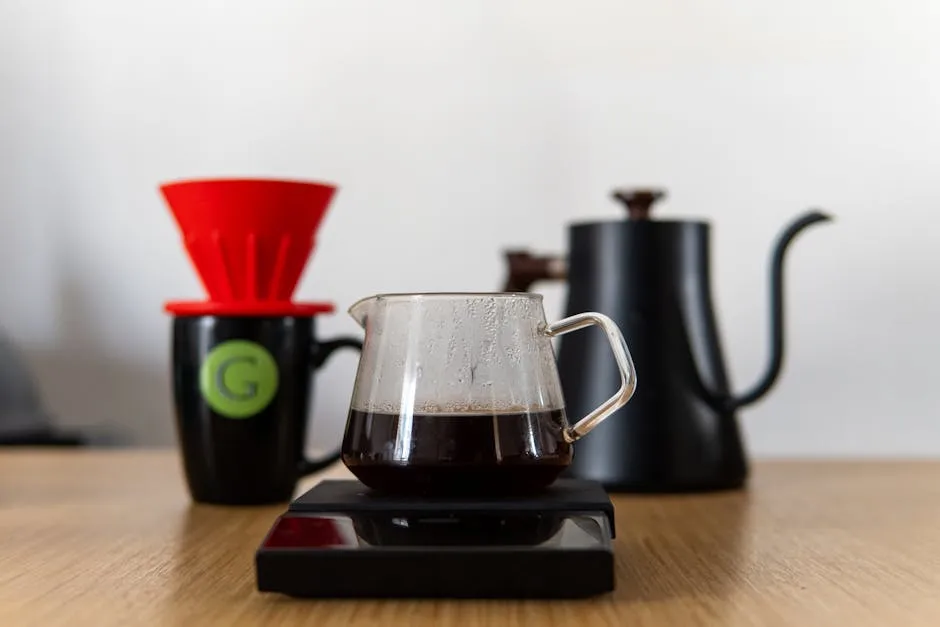
Pour-over coffee has a gear problem. The actual brewing technique isn’t complicated, but the dripper market is crowded with options that look nearly identical and supposedly produce dramatically different cups. Which ones live up to that claim, and which are just aesthetics?
I’ve brewed through all eight of the drippers in this guide — some for years, some long enough to know I’d never use them again. Here’s what actually differentiates them and which one belongs in your kitchen.
The Physics That Matter: Cone vs. Flat Bottom, and Why Flow Rate Is Everything
Before the individual reviews, two design principles explain most of what you’ll taste.
Cone drippers (V60, Chemex, Melitta, OXO, Blue Bottle) funnel water toward a central drain hole. The brewer controls extraction primarily through pour rate — slow, precise pours create longer contact time and more extraction; faster pours drain faster. This gives you tremendous control but demands technique. Pour sloppy and you’ll taste it.
Flat-bottom drippers (Kalita Wave, Origami in flat-bottom mode) have multiple small holes distributed across a flat surface. Water drains more evenly and at a more consistent rate regardless of your pour technique. This is forgiving. It’s also why flat-bottom drippers are often described as producing “sweeter” cups — the even extraction pulls more evenly from every particle rather than racing through the center.
Paper filter thickness changes the cup dramatically. Thicker filters (Chemex, Kalita Wave) slow flow, extend contact time, and absorb more oils. The result is a lighter-bodied, brighter, clearer cup. Thinner filters (V60 tab-less, most standard cone filters) let more pass through for a slightly fuller cup. The filter is part of the recipe.
With that context, here are the drippers.
1. Hario V60 — Best Overall
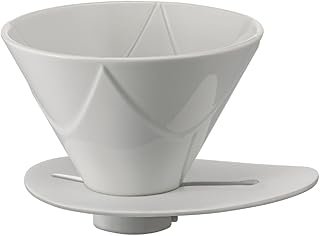
Price: $9–$45 depending on material | Filter type: V60-specific paper (widely available, about $0.12 each) | Flow rate: Fast — primarily controlled by pour technique | Learning curve: Steep
The V60 is the gold standard of pour-over drippers for one reason: its design gives you total control and punishes you when you don’t use it. The single large drain hole and spiral ribs mean the water drains as fast as you let it. Pour too fast and you underextract. Too slow and you choke the bed. Get it right and nothing in this guide will beat it.
Cup profile: Exceptionally clean and bright. High clarity, distinct acidity, light body. The V60 is at its best with light-to-medium roasts from high-altitude origins — think Ethiopian naturals, Kenyan washed, Guatemalan single-farms. Dark roasts work but the V60’s brightness doesn’t flatter them the way it flatters fruity, complex coffees.
Best for: Anyone serious about developing their pour technique. Once you can brew a consistent V60, everything else gets easier. It’s also the best value in this group — the plastic version at $9 actually outperforms ceramic thermally.
Starter kit: Plastic V60 02 + Hario paper filters + gooseneck kettle + any reliable burr grinder. Total: about $80–$120. This is the recommendation for anyone who wants to learn pour over properly.
2. Chemex — Best for Entertaining
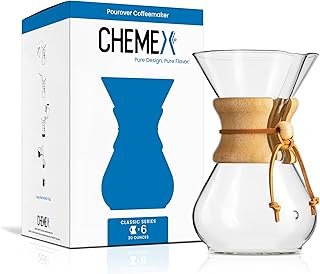
Price: $40–$55 for the classic 6-cup | Filter type: Chemex proprietary paper (thick, about $0.25 each — the ongoing cost adds up) | Flow rate: Slow — thick filter restricts flow heavily | Learning curve: Moderate
The Chemex is unique in this lineup because it’s simultaneously a dripper and a server. The hourglass carafe catches the brew, so you pour over the grounds above and serve directly from the vessel below. This is elegant for entertaining and annoying when you want to preheat a separate carafe.
The filter controversy is real: Chemex filters are 20–30% thicker than standard V60 paper. That thickness absorbs more coffee oils, slowing flow and producing a notably lighter, cleaner, almost tea-like cup. For some coffees — particularly delicate washed Ethiopians or high-clarity Kenyans — this is extraordinary. For coffees you want body from (a good Brazilian, a naturally processed Yirgacheffe), the Chemex strips too much.
Cup profile: Exceptional clarity. The lightest body of any dripper in this group. Very clean, very bright, very drinkable. If you want the cleanest possible cup that highlights delicate florals and fruit, nothing beats it.
The honest Chemex take: The filter cost is real ($25–$35 per year if you brew daily). The carafe means you can’t see your bed or easily adjust mid-brew. And for a dinner party or weekend brunch where you’re serving multiple people from a beautiful glass vessel? There’s nothing better. Buy it for that use case. Don’t buy it expecting it to replace a V60 for daily single-cup brewing — the economics and the form factor don’t work as well.
Starter kit: Chemex 6-cup + Chemex pre-folded filters (squares, not circles — they seal better) + gooseneck kettle + medium-coarse grind to account for the restricted flow. The Chemex is slightly more forgiving than a V60 because the slow flow self-corrects for imprecise pours.
3. Kalita Wave 185 — Best for Consistency
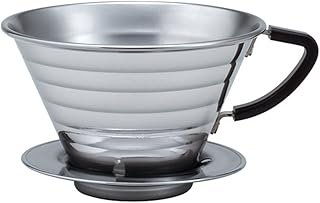
Price: $25–$45 | Filter type: Kalita Wave flat-bottom paper (less common in stores, order online, about $0.15–$0.20 each) | Flow rate: Moderate and consistent — three holes, flat bed, very even | Learning curve: Low
The Kalita Wave is the brewer serious home enthusiasts reach for when they want the best cup without the V60’s technique demands. The flat bottom ensures water touches every part of the coffee bed evenly before draining, which means more consistent extraction from pour to pour even when your technique isn’t perfect.
The Wave filter is corrugated (the “wave” pattern) to keep it off the dripper walls, allowing airflow and preventing the filter from suctioning flat and slowing flow. This design delivers excellent consistency — two brews with the same parameters taste nearly identical, which matters when you’re dialing in a new coffee.
Cup profile: Well-balanced. More body than a Chemex, slightly less clarity than a V60, but sweeter than both. The flat-bottom extraction pulls sugars and acids together in a way that reads as balanced rather than bright or heavy. It’s a versatile cup that works across roast levels.
Best for: The most underrated dripper in specialty coffee. If you’re brewing for yourself and want consistently excellent results without years of V60 practice, this is the one. The only real downside is filter availability — you need to order online rather than grab them at the grocery store.
Starter kit: Kalita Wave 185 + Kalita Wave 185 filters + gooseneck kettle. Grind slightly coarser than V60 (the even bed means you need a little more flow restriction to hit target brew time).
4. Melitta — Best Budget Option
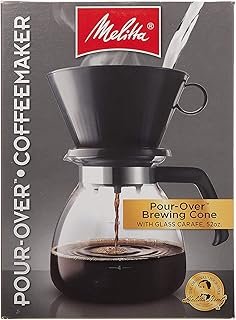
Price: $8–$15 | Filter type: Standard #2 or #4 cone (cheap, everywhere, about $0.06 each) | Flow rate: Restricted — small drain hole, slow | Learning curve: Very low
The Melitta is the original pour-over dripper — it’s been around since 1908. It’s cheap, uses filters you can find at any gas station, and makes a decent cup. Its small, off-center drain hole creates significant flow restriction, which extends contact time even if your pouring is sloppy. That forgiveness is the whole product.
Cup profile: Moderate body, moderate clarity, moderate brightness. The Melitta doesn’t excel at anything, but it also doesn’t fail. If you’re making coffee for an office or camping or any situation where excellence is optional and reliability is mandatory, this is fine.
Best for: Absolute beginners, travel brewing, situations where filter availability matters more than cup quality. Don’t expect the Melitta to produce a cup that justifies expensive single-origin coffee — the restricted, uneven flow doesn’t suit delicate beans. But for a morning cup of any decent roast, it delivers.
5. Origami Dripper — Most Versatile
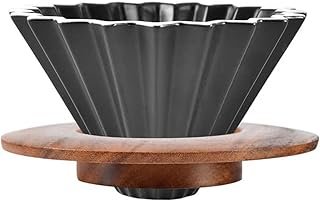
Price: $55–$75 | Filter type: Compatible with both Kalita Wave flat-bottom AND standard V60 cone filters | Flow rate: Variable — depends on which filter type you use | Learning curve: Moderate
The Origami is the most flexible brewer in this group, and also the most beautiful. The folded porcelain design is designed to use either flat-bottom Kalita-style filters or standard cone filters, making it genuinely two drippers in one. Use flat-bottom filters for the forgiving, sweet Kalita character. Use cone filters for V60-adjacent brightness.
In practice, the differences are real but subtle. The Origami sits in a silicone ring stand that raises it off the mug and creates airflow — this genuinely helps drainage consistency. The Hasami porcelain construction looks exceptional on a counter.
Cup profile: Depends on your filter choice. Flat-bottom mode: sweet, balanced, Kalita-adjacent. Cone mode: brighter, cleaner, V60-adjacent. Either way, the Origami produces excellent coffee.
Best for: Someone who wants to explore different brewing profiles without buying multiple drippers, or someone for whom aesthetics matter (no judgment — you see this thing every morning). The price is hard to justify purely on performance grounds since the Kalita Wave 185 achieves similar flat-bottom results for half the price.
6. Fellow Stagg [X] — Best Engineered
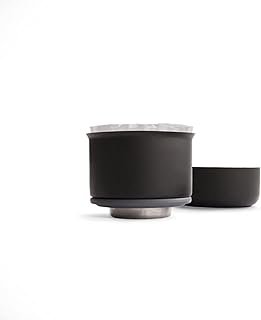
Price: $65–$75 | Filter type: Proprietary Stagg X filters (similar to Kalita flat-bottom, can often use Kalita Wave 185 filters) | Flow rate: Controlled — slotted flat-bottom design with specific flow rate engineering | Learning curve: Low to moderate
Fellow designed the Stagg [X] around a specific philosophy: the flat-bottom design should produce the most consistent extraction possible, with minimal technique variance. The dripper features a narrow opening at the top that forces slower pouring, internal ridges for airflow, and a patented drip-accelerator bottom that claims to produce “turbulence” in the slurry for even saturation.
The vacuum-insulated double-wall construction keeps the dripper warm throughout the brew — a real advantage over ceramic or glass that steal heat. In the pour-over guide, we cover how thermal stability is one of the underrated variables in consistent extraction.
Cup profile: Sweet, balanced, very consistent. The Stagg [X] is engineered to produce a reliably good cup rather than an exceptional cup at the expense of consistency. For most home brewers, that trade-off is the right one.
Best for: Coffee enthusiasts who’ve had the “my cup is different every morning” frustration and want a system-level fix rather than a technique fix. It’s expensive for a dripper, but if you’re already spending $18–$22 per bag on specialty coffee, the Stagg [X] protects that investment by maximizing your odds of a good extraction.
7. OXO Brew Pour Over — Best for Beginners
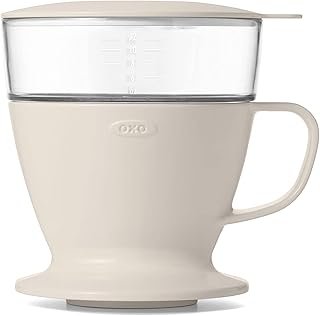
Price: $20–$30 | Filter type: Standard #4 cone (grocery store available, cheap) | Flow rate: Moderate — wider cone than Melitta, better flow | Learning curve: Very low
The OXO Brew sits exactly where its price suggests: between the Melitta’s pure accessibility and the V60’s performance ceiling. It uses the same cheap standard cone filters as the Melitta but the wider, more open cone allows better flow than Melitta’s restricted design. The result is a cup that’s noticeably better than Melitta without requiring much more skill.
We covered the OXO Brew in depth in a dedicated review. The short version: it’s the best first pour-over for someone who isn’t sure they’ll stick with the hobby. If you get into it and want to upgrade, the V60 or Kalita Wave is waiting.
Cup profile: Clean, balanced, no real weaknesses, no real peaks. Good daily driver for medium roasts. Struggles with delicate light roasts that need precise temperature and flow management to sing.
Best for: Beginners, people who want manual brewing convenience without V60 drama, households where multiple people brew at different skill levels.
8. Blue Bottle Dripper — Niche Pick
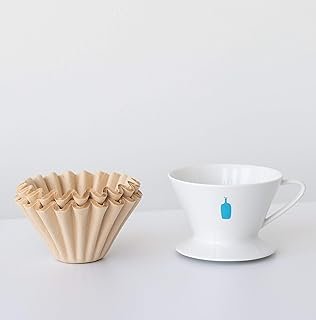
Price: $50–$60 | Filter type: Proprietary Blue Bottle paper (fine, uncommon outside Blue Bottle retail) | Flow rate: Fast — design is V60-adjacent, wide cone, single drain | Learning curve: Steep
Blue Bottle’s house dripper was designed around their preference for fast, high-temperature brews. The wide cone and open drain hole encourage rapid flow — Blue Bottle’s standard recipe brews a full 12oz in around 2.5 minutes. The filter is lighter than Chemex paper but similar weight to standard V60 paper.
Cup profile: Bright, clean, complex. Very V60-adjacent when brewed as intended. The emphasis on fast flow and high temperature suits their washed African and Central American coffees exceptionally well.
Best for: Blue Bottle fans or V60 brewers who want to explore fast-flow recipes. The proprietary filter is a real issue — availability outside Blue Bottle cafes and their website is limited. For the same performance, a plastic V60 with V60 paper costs $9 and uses widely available filters. It’s hard to recommend the Blue Bottle dripper to someone who doesn’t already have access to the filters.
Which Pour-Over Is Right for You?
The honest decision framework:
You want to develop technique and brew the best possible cup: Hario V60. Accept the learning curve. It pays off.
You want consistency without mastering technique: Kalita Wave 185. It’s the closest thing to foolproof at this performance level.
You’re serving multiple people or care about presentation: Chemex. It’s the right tool for that specific job.
You’re a beginner who isn’t sure about pour-over yet: OXO Brew. Low risk, upgrade later if you want to.
You want one dripper that works across multiple brewing styles: Origami Dripper (if budget allows) or Kalita Wave (if it doesn’t).
You want maximum consistency with minimum fuss: Fellow Stagg [X].
You just need something that works: Melitta. It’s fine.
Recommended Starter Kit for Each Dripper
No matter which dripper you choose, three things matter at least as much as the dripper itself:
-
A burr grinder. See our electric grinder guide and manual grinder guide. Pour over needs consistent particle size — blade grinders make this impossible.
-
A gooseneck kettle. Pour control is everything in cone drippers. A standard kettle works for flat-bottom designs (Kalita, Stagg X) but is genuinely limiting for V60 or Chemex.
-
A scale. Pour over is a ratio game. Brewing by weight makes your results repeatable. Our coffee scale reviews cover five reliable options.
For grind settings specific to each dripper, see our coffee grind size guide. The right coffee-to-water ratio matters just as much as the grind — small changes produce big flavor shifts. And water quality makes more difference than most people expect — for a deep look at why, see why water matters more than your coffee beans.
Brewing temperature is the last variable. Light roasts need 93–96 degrees C (200–205 degrees F). Dark roasts can go cooler (88–91 degrees C / 190–195 degrees F). Our guide to ideal brewing temperature covers the science.
Some links above are affiliate links. If you purchase through them, we earn a small commission at no extra cost to you.
Frequently Asked Questions
- Is the Hario V60 really that much harder than other pour-over drippers?
- Yes, but 'harder' means something specific: the V60 is sensitive to pour rate and consistency. If you pour unevenly or lose track of time, you'll taste it. Most beginners struggle with the first few brews, then find a rhythm within a week. The learning curve is real but short. If you want to skip it entirely, the Kalita Wave 185 produces a nearly comparable cup with much less technique dependency.
- Is the Chemex worth the expensive filters?
- At roughly $25–$35 per year for daily brewing, the filter cost is noticeable but not prohibitive. The real question is whether the Chemex's cup — exceptionally clean, light-bodied, almost tea-like — is what you actually want. If you love delicate light roasts and value clarity above all else, yes. If you want body or brew dark roast, the Chemex strips too much and the filter cost feels harder to justify.
- Do I really need a gooseneck kettle for pour-over?
- For V60, Chemex, and Blue Bottle: yes. Pour control in cone drippers directly affects extraction evenness — the gooseneck lets you pour in slow, precise circles that keep the bed saturated uniformly. For flat-bottom drippers like the Kalita Wave or Stagg [X], a standard kettle works adequately because the flat bed self-corrects for pour inconsistencies. If you're starting with a Melitta or OXO, a standard kettle is fine.
- What's the best pour-over dripper for beginners?
- The OXO Brew for absolute beginners who aren't sure about the hobby yet — it's forgiving, cheap, and uses filters from any grocery store. The Kalita Wave 185 for someone who's committed to pour-over and wants great results without years of technique development. Start with OXO, upgrade to Kalita or V60 when you're ready to go deeper.
- Can I use V60 filters in other drippers?
- Standard V60 cone filters work in any cone-shaped dripper with a similar taper angle — OXO Brew, Melitta, and many others. They don't work in flat-bottom drippers (Kalita, Stagg X). Chemex requires its own thick proprietary filters. The Origami is specifically designed to accept both flat-bottom and cone filter types, which is part of its appeal.