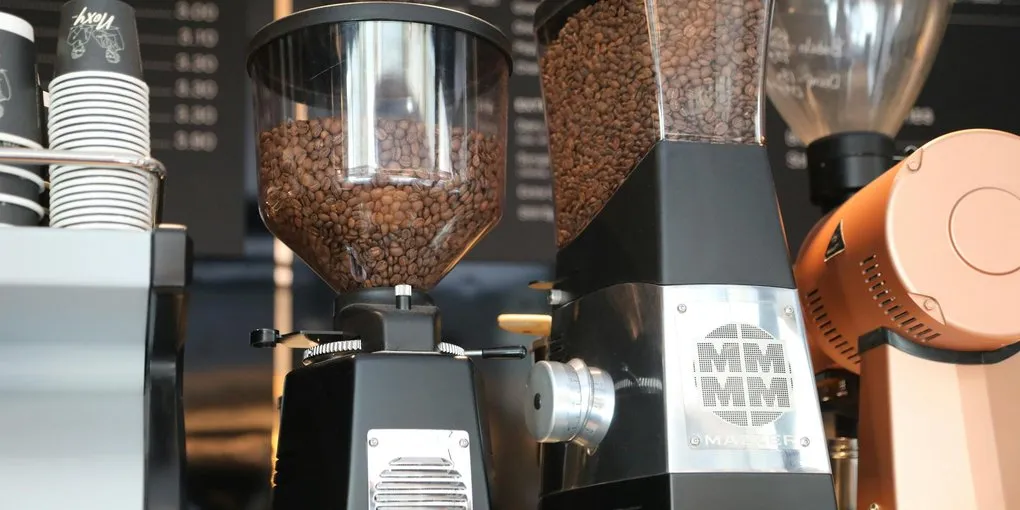
If you have spent any time in espresso forums, you have run into the burr-seasoning ritual. Buy a new grinder. Buy 5 to 10 pounds of cheap coffee. Run it all through. Then — and only then — start dialing in your real beans. The claim is that fresh burrs grind erratically, that microscopic edges need to break in, that distribution stabilizes only after enough coffee has worn the manufacturing burrs off the burrs. For a long time it lived as folklore, repeated by Scott Rao, propagated through Coffee Geek and Home-Barista, and treated as obvious wisdom by anyone with a high-end grinder.
Then in May 2019, Jonathan Gagné of Coffee Ad Astra did what coffee folklore rarely receives: he measured it. Twenty-four to twenty-eight pounds of coffee through a Kafatek Monolith Flat (EG-1) with SSP Ultra-Low Fines burrs, particle-size samples taken every 2 to 4 pounds via image analysis, roughly 15,000 particles measured per sample, 12 photos per measurement. A controlled experiment with hard numbers, not a forum opinion.
The verdict was nuanced. Seasoning is real. Seasoning matters less than alignment and burr quality. And the curve is not what most baristi assume. This article walks through Gagné’s data, what actually changes inside a freshly burred grinder over the first 16 pounds, and where seasoning falls in the larger hierarchy of grinder variables.
Burr seasoning is the practice of grinding coffee through new burrs to stabilize particle-size distribution
The standard protocol from the espresso community is straightforward: when you receive a new grinder or new burr set, do not start brewing real coffee through it immediately. Instead, run several pounds of inexpensive beans through the grinder first, dialing-in along the way and tracking how the grind setting and shot behavior shift. Once the dial-in stops drifting, the burrs are seasoned and you can start using your good beans.
The mechanism, as the community describes it, is microscopic. Newly machined steel burrs have a manufacturing surface — micro-roughness from the cutting and finishing process, sharp asymmetric edges from machining, and trace residue from cooling fluids or anti-corrosion coatings. As coffee passes through, the burrs polish themselves: rough spots smooth, edges round into a stable cutting profile, and any leftover manufacturing artifacts break off. Once that polishing settles, the burr produces a consistent particle size distribution shot after shot.
The amount of seasoning recommended varies. Rao mentions roughly 5 to 10 kilograms of coffee for most consumer burrs. Forum threads cite anywhere from 1 to 50 pounds depending on burr type, manufacturer, and coffee. Until Gagné’s 2019 measurements, none of those numbers carried evidence beyond personal experience.
Gagné measured burr seasoning on an EG-1 and found stabilization at about 16 pounds
The experimental setup mattered. Gagné used a Kafatek Monolith Flat (EG-1) — a high-end single-dose espresso grinder — fitted with Specialty Steel Projects (SSP) Ultra-Low Fines burrs. ULF burrs are designed for filter coffee and are known for producing exceptionally narrow particle distributions. Over 24 to 28 pounds of roasted coffee, Gagné pulled samples every 2 to 4 pounds, photographed roughly 15,000 particles per sample using image analysis, and computed a uniformity metric across the entire run.
The metric is what he called Q-factor: the average particle surface divided by the standard deviation of particle surfaces. Higher Q means a narrower, more uniform distribution. Lower Q means a wider distribution with more variance around the average.
The numbers Gagné reported tell a clear story. Pre-seasoning, the EG-1 with fresh ULF burrs had a Q-factor of 1.59 ± 0.02. After seasoning past about 16 pounds, that figure rose to 1.76 ± 0.02 — a 10 to 11 percent improvement in distribution narrowness. For comparison, an aligned Mahlkönig EK43, considered a reference for distribution quality, scored 1.45, and a Baratza Forté BG scored 1.53. The post-seasoning EG-1 was meaningfully outperforming both, but the unseasoned EG-1 was already in roughly Forté territory.
The progression itself had a distinct shape. In the early phase (the first several pounds), the average particle surface increased — the grinder was producing coarser grinds at the same setting. In the middle phase, the coarsening plateaued in what Gagné described as an “exponential approach to an asymptote” around 16 pounds. In the late phase, the average particle size held steady but the distribution itself narrowed — uniformity improved without the median shifting further.
Translated to a barista’s experience: in the first 5 to 10 pounds of seasoning, you will notice that you keep dialing finer to maintain the same shot time. After about 16 pounds, the dial-in stops drifting. After that, the grinder simply produces a more uniform grind at whatever setting you choose.
What actually changes during seasoning is microscopic burr surface evolution
The mechanism that drives the curve is wear on the burr surface itself. Fresh-milled steel burrs are not perfectly smooth. Grinding pressure forces coffee particles against the burr surface at high velocity, and the abrasive nature of dry coffee polishes the steel over time. Three things happen simultaneously over the first 16 pounds:
-
Manufacturing micro-roughness wears off. Sharp irregularities from the milling process round into smoother contours. This reduces the variance in cutting force across the burr face, which reduces the variance in particle size produced.
-
Cutting edges stabilize. Brand-new burr edges may have asymmetric profiles from the manufacturing process. As coffee passes through, the asymmetries wear off, and the edges settle into the geometry that the burr will hold for the rest of its working life.
-
Coffee oils and fines accumulate in trace amounts on the burr surface. A small layer of seasoning residue — primarily oils from the beans themselves — coats the steel and slightly modifies the cutting friction. This is why some baristi insist that switching from light to dark roast briefly destabilizes a long-seasoned grinder: the oil layer changes.
Note that the average particle size shifts coarser during early seasoning, not finer. This is counterintuitive. The reason is that fresh burrs with sharper, more aggressive edges actually grab and shatter beans more aggressively than a slightly polished, slightly worn burr. Once the edges round to their stable profile, they cut coffee with a more consistent cleavage instead of a more aggressive shatter.
The 23-day aging effect changes the seasoning curve in ways nobody expected
One of the most surprising findings in Gagné’s experiment was what happened after the seasoning was complete. He let the seasoned grinder sit unused for 23 days, then took another particle-size sample. The PSD had shifted finer and wider — the coffee was grinding to smaller, more variable particles than it had at the end of seasoning.
The hypothesis: the beans themselves had aged during those 23 days. Bean degassing, drying, and cellulose weakening change how the coffee fractures under burr pressure. Older beans are more brittle and produce more fines at the same grinder setting. The effect is similar to why decaf requires a coarser grind than caffeinated beans — the structural treatment changes how the bean behaves under cutting.
This means that “seasoning the burrs” and “bean age” are coupled variables. A grinder seasoned on a fresh roast will produce a slightly different distribution from the same grinder grinding the same brand of bean four weeks later. For most home baristi this is invisible — they re-dial daily anyway. But it explains why grinders sometimes seem to drift even after the seasoning curve should have completed: the beans, not the burrs, are doing the drifting.
For a deeper view of how aging affects fracture mechanics, our coffee freshness timeline guide covers the cellulose-weakening side of the equation.
Burr material affects how much seasoning matters — steel benefits most, ceramic least
Different burr materials wear differently and therefore season differently.
Hardened steel burrs (the dominant material in modern grinders — Mazzer, Mahlkönig, Eureka, Niche, DF64, Baratza, Fellow) season the most because they have the most malleable surface profile early in life. Manufacturing roughness wears off, edges stabilize, and the seasoning curve plays out roughly as Gagné observed it on the EG-1’s SSP burrs. Most steel burrs benefit from 1 to 5 kilograms of seasoning, with high-end SSP variants closer to 7 to 8 kilograms (the EG-1 study’s 16-pound figure converts to about 7.3 kilograms).
Specialty-coated steel burrs (titanium nitride, red-speed coatings, ULF, Lab Sweet, etc.) season slightly less because the coating is designed to be wear-resistant. The base geometry stabilizes faster, and the polishing effect from coffee abrasion is muted by the harder coating layer. These burrs hold their factory profile longer and also drift less over their working life.
Ceramic burrs (used in some hand grinders and a few electric models) season the least. Ceramic is harder than steel and resists wear from coffee abrasion, which means the manufacturing profile changes very little over the early life of the burrs. Ceramic burrs also wear out more abruptly when they finally reach end of life — they chip rather than gradually dull. For ceramic, a brief dialing-in period (1 to 2 pounds) is sufficient.
Conical vs. flat geometry does not meaningfully change seasoning duration. Both types follow similar curves, though conical burrs tend to produce slightly more fines per gram across their working life. Our conical vs. flat burr guide covers the geometry trade-offs.
Practical seasoning protocol — and why you don’t need 50 pounds
The forum recommendation of 50 pounds of seasoning before judging a grinder is, based on Gagné’s data, considerable overkill for most consumer setups. The asymptote in his EG-1 study landed at 16 pounds on a high-end grinder with specialty burrs. For a more typical consumer grinder — a DF64 with stock burrs, a Niche Zero, a Eureka Mignon — stabilization likely occurs sooner because the manufacturing tolerances are looser to start with and the burrs settle into a stable profile faster.
A reasonable protocol for a new grinder or new burr set:
-
Buy 2 to 5 pounds of inexpensive light or medium roast (not dark — the oils from dark roasts coat the burrs more aggressively and confound the seasoning curve). Inexpensive supermarket coffee or commodity-tier specialty coffee works fine. Do not use $40-per-pound microlots for seasoning.
-
Run all of it through the grinder at a medium-fine setting (somewhere between filter and espresso). This gives the burrs broad work across their cutting range. Some baristi prefer to grind at the espresso setting throughout to season specifically for espresso work; either approach is reasonable.
-
Track dial-in drift. Pull a single shot every half-pound or so on a target espresso recipe. Note the grinder setting, shot time, and approximate flavor. If you are dialing finer to hold the same shot time, you are still in the early-seasoning coarsening phase. Our how to dial in espresso guide covers the recipe targets.
-
Stop seasoning when dial-in stabilizes. For most consumer grinders this is somewhere between 2 and 5 pounds. For high-end SSP, ULF, or specialty-coated burrs, plan on closer to 7 to 8 pounds. You do not need to hit Gagné’s 16-pound asymptote to have a usable, predictable grinder.
-
Switch to your real beans and resume normal espresso dial-in. The grinder will continue subtle wear over its lifetime, but the dramatic early-life drift is finished.
The “do not season with expensive coffee” rule is worth taking seriously. Seasoning is, by definition, a process where the grinder is producing inconsistent output. The shots you pull during seasoning will not represent the bean’s true potential. Save your $40 microlot for after the dial-in drift stops.
Seasoning is real but it ranks below alignment and burr quality
The most important thing Gagné’s data shows is that seasoning is genuinely measurable and worth the brief investment of cheap coffee. It is also less important than two other variables that come up in the same conversation.
Burr alignment — the parallelism of the two burrs across their cutting surface — has a much larger effect on uniformity than seasoning. The aligned EK43 in Gagné’s comparison sample scored a Q-factor of 1.45, lower than the post-seasoning EG-1’s 1.76. But unaligned EK43s and other large grinders with off-axis burrs score considerably worse than aligned ones. A misaligned grinder can never season into uniformity — it will produce a wider distribution forever, because one side of the burr face is grinding finer than the other every revolution. Our burr alignment guide covers the marker test and shimming protocol that distinguishes alignment problems from seasoning problems.
Burr quality and design — the underlying geometry, steel grade, and edge profile — sets the ceiling of what a grinder can do. SSP ULF burrs in a well-aligned grinder will outperform stock budget burrs in a perfectly aligned grinder simply because the cutting geometry is better. A $200 grinder seasoned to 16 pounds will not outperform a $1,500 grinder out of the box. Seasoning closes the gap by some single-digit percentage, but it does not close the geometry gap.
The hierarchy, from largest to smallest impact on grind quality, is roughly:
- Burr design and material (a $1,500 grinder vs. a $200 grinder)
- Burr alignment (off-axis vs. true)
- Burr sharpness over working life (new vs. 30,000 shots in)
- Seasoning state (fresh vs. 16-pound asymptote)
- Bean age (fresh roast vs. 23-day aged roast)
Seasoning matters. It is also the smallest of the five for most home setups. If your grinder is producing inconsistent shots after 5 pounds of seasoning, the problem is almost certainly alignment, burr quality, or burr wear — not insufficient seasoning. Our conical vs. flat burr grinders guide and why grinder matters more than machine cover the higher-leverage variables.
When you do and do not need to season a new burr set
Some practical guidance on when seasoning is worth the cheap coffee and when it is not.
Definitely season:
- New espresso grinder with stock steel burrs (Niche Zero, DF64, Eureka Mignon, etc.)
- Replacement burrs in an existing grinder
- High-end specialty burrs (SSP, Mazzer, Etzinger, Lab Sweet, Red Speed) — these have the longest seasoning curves
- Used grinder where you cannot tell whether previous owner already seasoned it
Skip the seasoning ritual:
- Hand grinders with ceramic burrs (1 to 2 pounds is enough)
- Pre-owned grinders that have already been used for years (already seasoned — just dial in)
- Cheap mass-market grinders ($50 to $100 blade or low-end burr) — they will never produce consistent grind regardless of seasoning, so do not waste good coffee on them
If you have a $50 grinder and inconsistent shots, seasoning is not your problem. The grinder is your problem, and our budget grinder guide covers the upgrade path.
The reasonable home barista approach to seasoning, then, is straightforward: when you buy a new grinder, dedicate the first 2 to 5 pounds of cheap coffee to dialing-in and break-in. Track the drift. Notice when it stops. Then start drinking your real coffee. The 16-pound asymptote in Gagné’s lab is real, but the practical 80 percent of the benefit shows up in the first 3 to 5 pounds — and that is enough for any home espresso setup to start performing the way the grinder’s specs claim it can.
Some links above are affiliate links. We earn a small commission on qualifying purchases at no extra cost to you.
Frequently Asked Questions
- How many pounds of coffee should I run through new burrs to season them?
- Jonathan Gagné's measured study on a Kafatek EG-1 with SSP Ultra-Low Fines burrs showed the seasoning curve hits its asymptote at about 16 pounds, but most consumer grinders stabilize sooner. For typical stock steel burrs in a Niche Zero, DF64, Eureka Mignon, or similar, 2 to 5 pounds of cheap coffee is enough to capture roughly 80 percent of the seasoning benefit. High-end specialty burrs (SSP, Lab Sweet, Red Speed) benefit from closer to 7 to 8 pounds. Forum recommendations of 50 pounds are considerable overkill for any home setup.
- Will skipping the seasoning step damage my grinder?
- No. Skipping seasoning will not damage anything — it just means your first several pounds of espresso shots will be inconsistent because the grinder is still drifting. The dial-in setting will move and the particle size distribution will narrow over the early use period regardless of whether you call it 'seasoning' or simply 'the first few weeks of normal use.' The choice to deliberately season with cheap coffee is an economic one: avoid wasting expensive specialty coffee on shots that won't represent the bean's true potential.
- Can I season burrs with dark roast or should I use light?
- Use light or medium roast. Dark roasts have surface oils that coat the burrs and confound the seasoning measurement — you will be partly seasoning the steel and partly conditioning the burrs to a layer of dark-roast oil. When you eventually switch to lighter roasts, the oil layer will gradually wash off and the dial-in will drift again. Inexpensive light or medium roast (commodity-tier specialty coffee or solid supermarket brands) works best because the oils are minimal and you are mainly seasoning the burr surface itself.
- Does seasoning matter more for espresso or filter brewing?
- Espresso is more sensitive because uneven flow under 9 bar of pressure amplifies particle distribution problems into channeling, gushers, and missed extraction. Filter brewing tolerates a wider distribution because gravity-driven flow re-equilibrates across the bed. That said, Gagné's measurements were taken on a flat-burr grinder primarily used for filter, and the Q-factor improvement was visible regardless of brew method. If you only brew filter, 1 to 2 pounds of seasoning will be plenty. For espresso, plan on 3 to 5 pounds of cheap coffee through stock burrs or 7 to 8 pounds through specialty burrs.
- My new grinder is producing finer grinds at the same setting after a few pounds — is that normal?
- Counterintuitively, no. Gagné's data shows that fresh burrs produce slightly finer grinds than seasoned ones at the same setting because the sharper, more aggressive new edges shatter beans more aggressively. As the burrs polish and round into their stable cutting profile, the grind shifts coarser — meaning you have to dial finer to maintain shot time during the early seasoning period. If your grinder is producing finer grinds after several pounds at the same setting, the most likely explanation is that your beans have aged in the bag (Gagné observed a similar shift after 23 days of bean storage), not that the burrs are still seasoning.
- Are ceramic burrs worth seasoning at all?
- Barely. Ceramic burrs are harder than steel and resist the wear-driven polishing that drives the seasoning curve in steel burrs. The manufacturing surface of ceramic burrs changes very little over the early life of the grinder, so 1 to 2 pounds of dial-in is sufficient to confirm the grinder is producing predictable output. Ceramic burrs also wear out abruptly when they reach end-of-life — they chip rather than gradually dull — so the seasoning curve and the wear curve both look quite different from steel. Most ceramic burrs are found in hand grinders and a few entry-level electrics; high-end espresso grinders almost universally use steel.