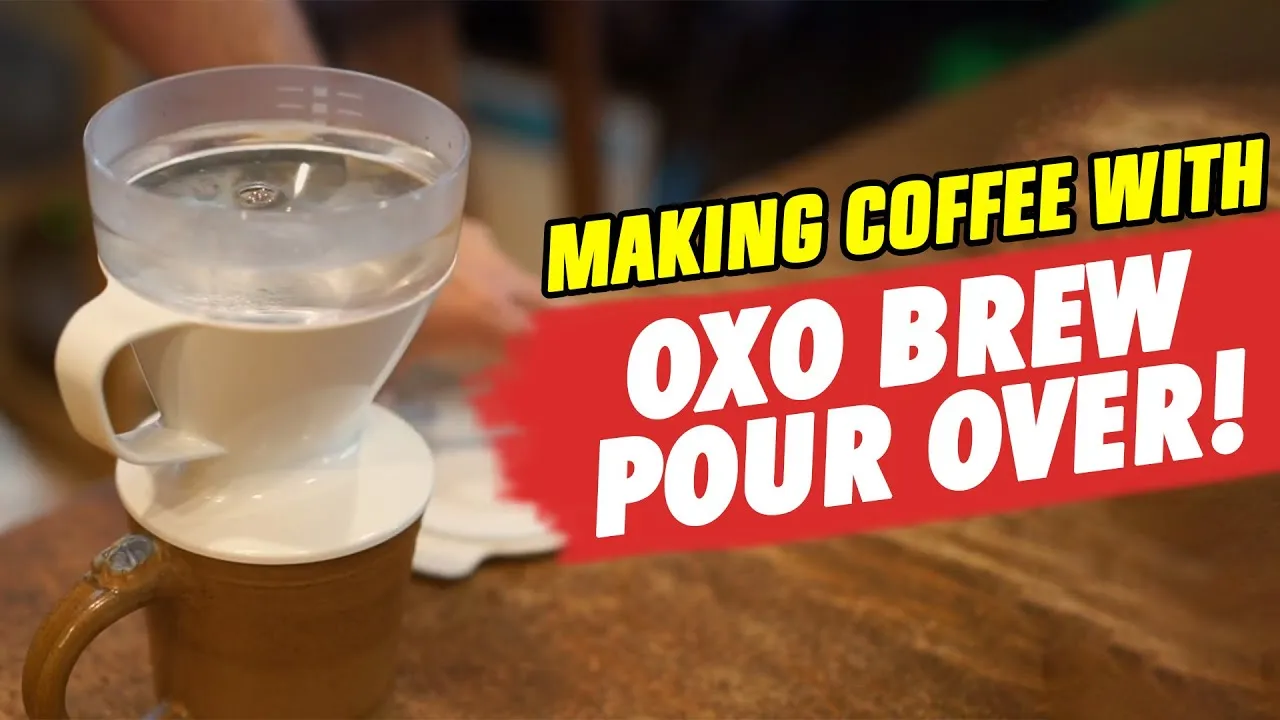
Not every pour-over brewer needs to be a precision instrument. The OXO Brew Pour Over is a compact, straightforward dripper that makes clean, flavorful coffee without demanding the technique that something like a V60 requires. If you want to try manual brewing without the learning curve, this is a strong starting point.
What Makes It Different
The OXO sits between a V60 and a Melitta cone — familiar enough to figure out intuitively, but with design choices that make it more forgiving. Its wider cone shape doesn’t restrict flow like narrower Melitta designs, and it lacks the spiral ridges of a V60 that demand precise pouring technique.
Accessibility is the selling point. The V60 is the gold standard in specialty shops but punishes sloppy technique — pour too fast or too slow and you’ll taste the difference. The Kalita Wave is forgiving but requires flat-bottom filters you can’t find everywhere. The OXO uses standard size-4 cone filters, available at any grocery store, and rewards good technique without demanding it.
The plastic construction makes it lightweight, virtually unbreakable, and great for travel. It heats up and cools quickly between brews, and the wide, stable base sits securely on mugs and carafes of varying widths.
Research on dripper design shows that flat-bottom drippers tend to produce sweeter, higher-extraction brews than conical designs — likely from more uniform water contact. The OXO’s conical shape trades some of that sweetness for simplicity and filter availability.
Brewing Guide
Grind: Medium — like the texture of sand. Too fine chokes the flow (bitter); too coarse rushes through (sour). Use a burr grinder for consistent particles. Blade grinders produce uneven sizes that create channeling — water finds easy paths through the bed instead of extracting evenly. Getting grind size right is the single biggest variable in manual brewing.
Water: 195-205°F (90-96°C). If you don’t have a thermometer, let boiling water sit for 30 seconds. A gooseneck kettle helps control the pour but isn’t required — the OXO is forgiving enough to work with a standard kettle. For a deeper look at why temperature matters, see our guide to ideal brewing temperature.
Ratio: 1:17 — one gram of coffee to 17 grams of water. For a single cup (~200ml), that’s roughly 12 grams of coffee. A kitchen scale costs $10 and makes a huge difference in consistency.
The pour: Add one-third of your water and wait 30 seconds for the bloom — the CO2 release that looks like the grounds rising and bubbling. This is crucial: trapped CO2 interferes with extraction, creating a sour, thin cup. After the bloom, pour the rest in slow circles over 2-3 minutes. Steady and controlled, not fast and frantic.
Result: A clean, bright cup that highlights the natural flavors of your beans. Paper filters remove oils (and the cholesterol-raising compounds cafestol and kahweol), producing the kind of clarity that lets you taste origin characteristics — fruit, floral, chocolate — rather than generic “coffee flavor.”
How It Stacks Up
| Brewer | Technique Demand | Filters | Best For |
|---|---|---|---|
| OXO Brew | Low | Standard cone (cheap, everywhere) | Beginners, daily brewing |
| Hario V60 | High | V60 specific | Maximum control, experienced brewers |
| Kalita Wave | Medium | Flat-bottom specific | Balanced sweetness, consistency |
| Chemex | Medium | Chemex specific (thick) | Cleanest cup, showpiece |
| Melitta | Low | Standard cone | Budget option, narrow flow |
What You’ll Need
- OXO Brew Pour Over ($20-30)
- Burr grinder (non-negotiable for consistency) — see our picks for electric grinders or manual grinders
- Size-4 cone filters (cheap, everywhere)
- Hot water (gooseneck kettle optional)
- Kitchen scale (highly recommended, $10)
Total setup cost: under $50 if you already have a grinder.
Who It’s For
Yes: Beginners, daily single-cup brewers, small kitchens, travelers, anyone who wants good coffee without obsessing over technique.
No: If you want maximum control over every variable (get a V60), need to brew for a crowd (it’s single-serve), or care about aesthetics (it’s plain plastic). If you want the hands-off approach taken even further, the Clever Dripper eliminates pour technique entirely.
The coffee won’t be quite as refined as a perfectly executed V60 in experienced hands, but it’ll be close — and you’ll be able to repeat it consistently without years of practice. The OXO gets out of your way and lets you focus on what actually matters: good beans, hot water, and a few minutes of your morning.
Frequently Asked Questions
- What filters does the OXO Brew Pour Over use?
- Standard size-4 cone filters — the same ones available at any grocery store for a few dollars. This is one of the OXO's biggest practical advantages. Specialty brewers like the V60, Kalita Wave, and Chemex all require proprietary filters that are harder to find and more expensive. With the OXO, you'll never be stuck without filters.
- How does the OXO Brew compare to a Hario V60?
- The V60 produces a slightly more refined cup in experienced hands — its spiral ridges and conical shape give maximum control over extraction. But it punishes sloppy technique. The OXO is more forgiving: it rewards good technique without demanding it, uses cheaper and more available filters, and produces consistently good results for daily brewing. Think of the V60 as a sports car and the OXO as a reliable sedan.
- Do you need a gooseneck kettle for the OXO Brew?
- No. A gooseneck kettle helps control pour rate and placement, but the OXO is forgiving enough to work with a standard kettle. The wider cone shape distributes water more evenly than a V60, so precise pouring matters less. That said, a gooseneck kettle ($30-60) is still one of the best investments in manual brewing if you want to improve consistency across any pour-over method.
- Why does my pour-over coffee taste sour or thin?
- Most likely under-extraction. Common causes: water too cool (use 195-205°F), grind too coarse, skipping the bloom (let CO2 escape for 30 seconds before the full pour), or pouring too fast. Try grinding finer, using hotter water, and slowing your pour. A kitchen scale ($10) also helps — eyeballing the coffee-to-water ratio leads to inconsistency.
Some links above are affiliate links. If you purchase through them, we earn a small commission at no extra cost to you.