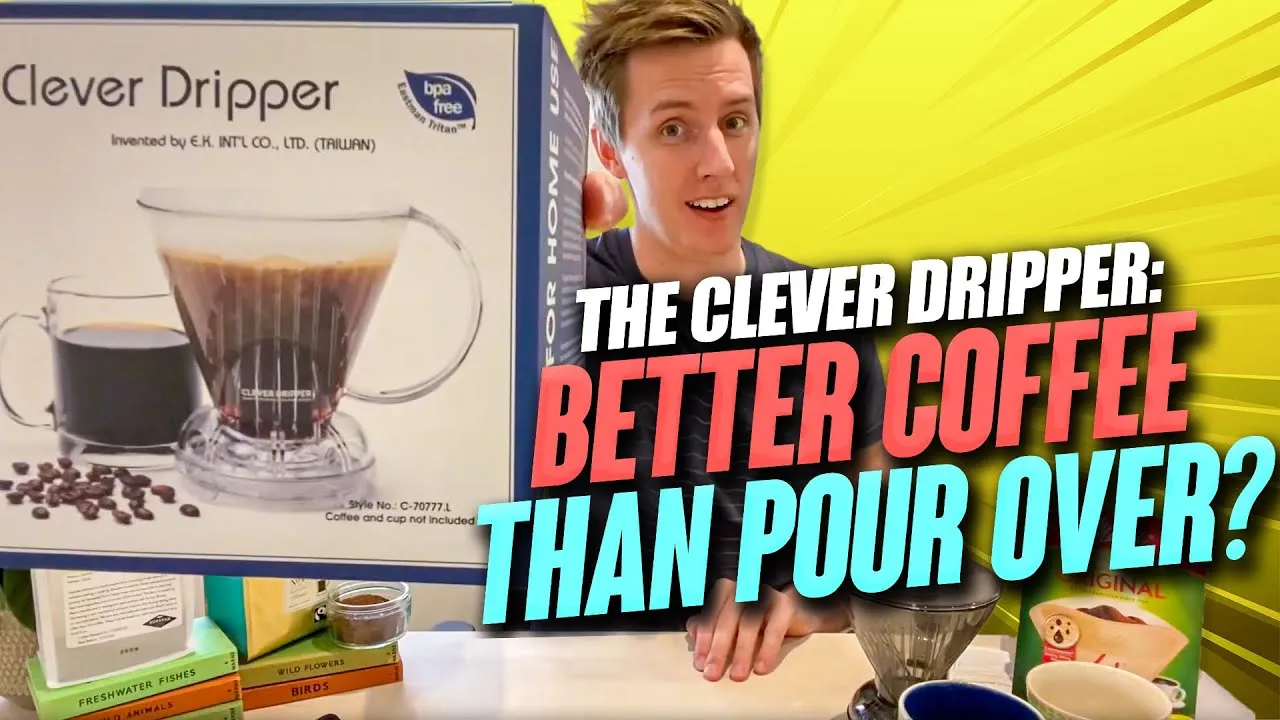
The Clever is made in Taiwan by EK International, whose first brand is Abid; Jessica Easto calls it the Abid Clever. The specifications below are as published by its North American distributor, Eight Ounce Coffee, on the Clever site it runs, and by the maker, checked October 18, 2026. The recipe and the verdict are from our 2020 video.
How it works
The Clever looks like a Melitta-style cone, flat across the bottom, but it brews like a French press. Its maker describes a patented shut-off system in the base. According to the distributor’s parts listings, silicone seals “keep the water in the brew chamber until you’re ready to decant,” and a release ring “triggers your brew to decant when placed on top of a vessel.” Easto describes the same thing: the base is watertight, and the slurry won’t drain until you set the Clever on a carafe or cup. Lift it off and it stops dripping, as our video shows.
So a Clever brew has two stages:
- A steep. The coffee and water sit together, like a French press. Jonathan Gagné, the astrophysicist who writes The Physics of Filter Coffee, explains why that’s forgiving: as an immersion goes on, the water fills with dissolved coffee and extraction slows down, which makes immersion brews “less sensitive to brew time and more easily repeatable.” The trade-off, he writes, is that immersion doesn’t extract as efficiently as fresh water flowing through the coffee.
- A drain. Set on a cup, the coffee runs down through the settled grounds and the paper. Gagné notes that for gravity brews the bed of coffee is the best filter for fines, and Easto explains that paper traps fine sediment and oils that a French press’s metal mesh lets through. Together they’re why a Clever cup comes out cleaner than a French press.
The specs, as published. The distributor lists the Clever Dripper at $25.50 (clear or black) when checked October 18, 2026, with a practical capacity of 500 ml (16.9 oz); Amazon listings call it the Large 18 oz. It’s made of BPA-free Eastman Tritan copolyester and takes standard #4 paper filters, the cone kind, not flat-bottomed basket filters. Easto suggests #4 Melitta cone filters. The distributor also sells the seal kit, release ring and lid as spares.
Our recipe (2020)
This is the recipe from our video, which followed the instructions that came in the box.
- Coffee: 20 g, ground medium to coarse. In the video we warned against an espresso grind; finer grounds can clog the filter, as Easto also found.
- Water: 300 g, just off the boil. The instructions in our box gave 196–205°F (91–96°C). That’s 1:15 (calculated: 300 ÷ 20).
- Time: about 2 minutes to set up, a 4-minute steep under the lid, then a minute or so to drain (Easto’s recipe drains in about a minute); about 7 minutes in all
- Makes: about 260 g, or about 8¾ US fl oz (260 ml). That’s calculated: 300 g of water, less about 40 g held back by the grounds at roughly 2 g per gram of coffee, our Brew Guide’s working figure.
- Set the Clever on your cup, put a #4 paper filter in it and pour hot water through to rinse the paper and warm the dripper and the cup. Pour the rinse away.
- Stand the Clever on the counter or its coaster and add 20 g of coffee, ground medium to coarse.
- Pour in 300 g of water just off the boil, stir briefly so all the grounds are wet, and put the lid on.
- Wait 4 minutes.
- Set the Clever on your cup or carafe. The valve opens and the coffee drains through the filter.
- When it has drained, lift the Clever off. It stops dripping as soon as you lift it.
There’s no bloom timing and no pouring pattern to learn. A short stir at the start is worth keeping: Gagné writes that in an immersion, a brief agitation lets all the coffee start extracting at the same time.
Two published recipes to try
| Our video | Easto, Craft Coffee | Eight Ounce Coffee | |
|---|---|---|---|
| Coffee and water | 20 g, 300 g | 26.5 g, 400 g | 18.5 g, 310 g |
| Ratio | 1:15 | About 1:15 | About 1:16.75 |
| Grind | Medium to coarse | Medium-fine (Virtuoso 14) | Not given |
| Steep | 4:00, lid on | Bloom, then lid on to 3:00 | Lid on to 1:10, stir |
| Done by | Not timed | About 4:00 | About 2:30–2:45 |
The ratios are calculated from each recipe’s amounts. Easto blooms with 50 g of water, pours to 400 g and drains at 3:00, with water just off the boil. Eight Ounce Coffee, the distributor, pours boiling water in first, adds the coffee, and stirs again at 1:10 as it sets the dripper on the carafe. Easto chose three minutes because long, French press-style steeps with very coarse grounds didn’t work well for her and Andreas Willhoff in the Clever: the longer hot water sits against the paper, she writes, the more a papery taste can creep in. She also blooms with less water than usual, because coffee can get trapped in the narrow neck under the filter early in the brew.
On strength, all three sit between James Hoffmann’s two starting points: he suggests about 60 g of coffee per liter for pour-over and a little more, about 75 g per liter, for immersion brewers if you want a similar strength. These recipes use 60 to 67 g per liter (calculated).
How it tastes
Clean and balanced. With a medium roast in our video (“kind of a 3 out of 5 roast,” we called it) we got subtle caramel, a little fruit and milk chocolate, with no bitterness or acidity, and the cup was crystal clear with no loose grounds.
The most impressive thing was consistency. We used it all week and the results barely varied, more steadily than our AeroPress brews. We deliberately changed the water temperature slightly one morning and still got a good cup. That fits Gagné’s account of immersion as less sensitive to time and easier to repeat; it isn’t a promise that every cup will be identical.
Clever vs V60, AeroPress and French press
vs a V60. A V60 is a percolation brewer: water flows through the coffee the whole time, and how you pour decides how evenly it goes. Easto calls it the most sensitive of the drippers she covers, and Gagné notes that percolation extracts efficiently but “can go wrong in more than one way,” leaving parts of the bed over- and under-extracted. The Clever takes most of the pouring out of it. Gagné adds that only percolation can typically make a very clean cup, free of undissolved particles, while immersion gives more body. So if you enjoy the pour and want the cleanest cup, the V60 gives you more to work with; if you want a steady cup without thinking about technique, the Clever is easier. Our V60 guide and our comparison of flat-bottom and cone drippers go further.
vs an AeroPress. Both steep and then filter through paper, and Gagné notes that an AeroPress also has an immersion step followed by a percolation step. The AeroPress pushes the coffee through by hand; the Clever lets gravity do it. AeroPress says its Original makes one 10 oz serving and calls it shatterproof, which makes it the better traveler. The Clever holds more and needs no pressing, but it’s bulkier, and its plastic and silicone valve make it a home brewer for us. Our AeroPress guide has the maker’s method.
vs a French press. Both are full immersion. The difference is the filter: a French press’s metal mesh lets oils and fine sediment into the cup, which gives it a heavier body, while the Clever’s paper traps them for what Easto calls a cleaner cup. Paper also holds back cafestol and kahweol, the coffee oils behind unfiltered coffee’s effect on LDL cholesterol (Urgert and Katan, 1997); if that matters to you, ask your clinician. If you like French press coffee but not the sludge, the Clever is a good next brewer. Our French press guide covers the press.
The downsides
These are from our week with it in 2020:
- The build feels cheap. It’s all plastic, the bottom part rattles, and the silicone seal didn’t look like it would last as long as an AeroPress. If it wears out, the distributor sells a replacement seal kit, listed at $2 when checked October 18, 2026.
- Occasional leaks. Moving it around, we had a few drips come through the seal, and if it isn’t sitting squarely on the cup some coffee can drip out.
- Bulky for what it is. It’s a big, clunky dripper for a single cup, and takes up more cabinet space than a V60 or an AeroPress.
- Not one for travel. The plastic body and the valve make it a home brewer; take an AeroPress on trips.
Easto adds two criticisms she’s heard from professionals: that the Clever loses too much heat, which she and Willhoff don’t think is well founded, and that fines clog the filter, which they did find with finer grinds.
Our verdict (2020)
The Clever made delicious, clean coffee with almost no technique, and it was consistent all week. But in our video we weren’t sure where it fits between an AeroPress and a pour-over, the build disappointed us, and we said it might spend more time in the cupboard than on the counter. Its one truly clever idea is that you can brew it without it sitting on a mug.
So it suits you if you’re new to specialty coffee and want forgiving results, if you like French press flavor but not the sediment, or if you’d rather not learn pour-over technique. If you already have an AeroPress or a V60 you’re happy with, or you enjoy the ritual of pouring, it adds little.
An earlier version of this page called the Clever “the best brewer for people who want great coffee without learning technique.” That was stronger than our video’s verdict, and the comparisons above now rest on published sources rather than a ranking.
If you’re buying one, the Clever Coffee Dripper, Large 18 oz (Amazon search) is the size the distributor sells, and you can buy it from the distributor directly too.
Some links above are affiliate links. If you buy through them, we earn a small commission at no extra cost to you.
Sources
- Clever Coffee Brewers (Eight Ounce Coffee, the North American distributor), “CLEVER Dripper” product listing (capacity, material, #4 filters, price and recipe) and the listings for its replacement seal kit, release ring and lid, plus the #4 filter listings, checked October 18, 2026: cleverbrewing.coffee
- EK International Co., Ltd., Abid and HandyBrew site (the “amazing shut off system,” the Abid brand), checked October 18, 2026: abid.com.tw
- Our video, “The Clever Dripper: Better Coffee than Pour Over?”, JayArr Coffee, July 15, 2020: recipe, temperature range, tasting notes, consistency and build quality
- Jessica Easto, Craft Coffee: A Manual (Agate Surrey, 2017): p. 52, “How Do Filters Factor In?”; pp. 65–66, “The Abid Clever”; pp. 70–71, “The Melitta”; pp. 80–81, the V60; and pp. 224–226, “The Clever Dripper Method”
- Jonathan Gagné, The Physics of Filter Coffee (2021): §1.5, “Immersion and Percolation,” pp. 12–13; p. 17 (the AeroPress’s immersion and percolation steps); p. 71 (percolation’s advantages and risks); p. 85 (agitation in immersion brews); and §5.1, “The Coffee Bed as a Self-Filter,” p. 105
- James Hoffmann, The World Atlas of Coffee, revised edition (Mitchell Beazley, 2018), p. 79 (75 g/l for infusion brewers) and p. 83 (60 g/l for pour-over)
- AeroPress, AeroPress Original product page and FAQ (one 10 oz serving, shatterproof), checked October 15, 2026: aeropress.com
- R. Urgert and M. B. Katan, “The cholesterol-raising factor from coffee beans,” Annual Review of Nutrition 17 (1997): 305–324: doi.org/10.1146/annurev.nutr.17.1.305