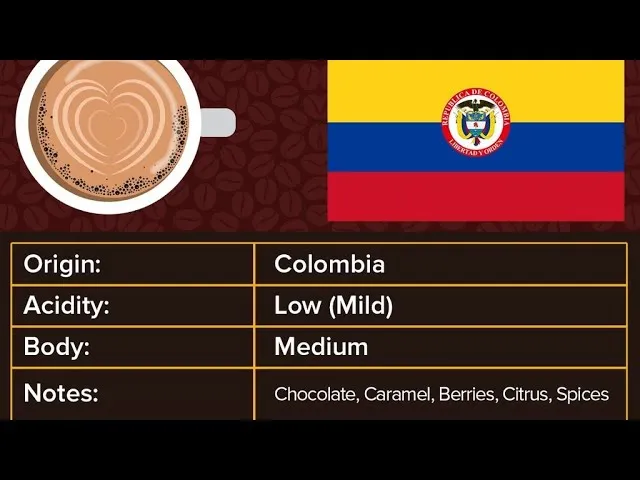
Colombia produces 14.2 million bags per year — roughly 12% of global coffee — and the flavor range across its growing regions is wider than most people realize. What many drinkers think of as “Colombian coffee” is actually just one slice of an enormously diverse origin. Three Andes cordilleras run through the country, creating hundreds of distinct microclimates — different elevations, rainfall patterns, temperatures, and soil compositions. A coffee from southern Nariño at 2,200 meters and a coffee from Antioquia at 1,400 meters are effectively from different worlds, even though they share a country.
If you want to go deeper on how Colombian beans stack up in practice, check out our 6 Colombian coffees reviewed.
The General Profile
Colombian coffee has several recurring characteristics: smooth and vibrant, low to moderate acidity, medium balanced body, fruity or citrusy aromas with hints of spice and cocoa, high clarity, and pleasant sweetness. Most of this comes from washed processing, which strips away heavy body and fruit intensity in favor of exceptional clarity — you taste the terroir and variety more distinctly.
The sweetness is fundamental, not accidental. It comes from careful processing and the slow development of beans at altitude, where cooler temperatures extend cherry maturation and allow more complex sugars to develop. Coffee scientist James Hoffmann identifies sweetness as the single most important quality indicator: “All good coffee should taste sweet. If it doesn’t, something went wrong.” Colombian coffee, at its best, has sweetness to spare.
The acidity is predominantly citric — clean, lemon-bright, pleasant — with some lots showing malic acid characteristics (smooth and apple-like). Neither is as intense as Kenya’s sparkling phosphoric acid or as sharp as some African origins. This moderation is what makes Colombian coffee so approachable across the full range of coffee drinkers.
The Regions That Matter
Huila (Southern Colombia)
The most prestigious region. Altitudes up to 2,100 meters, volcanic terrain. Bright citric acidity with tropical fruit, berry, and floral undertones. Multiple Cup of Excellence winners come from here — and in 2023, 16 of the top 28 Colombian Cup of Excellence coffees were Geisha variety, many from Huila and surrounding southern departments.
Huila’s altitude advantage is measurable. Research from Jonathan Gagné’s Physics of Filter Coffee shows that about 25.6% of variation in extraction yield can be explained by elevation — higher altitude means slower cherry development, more concentrated solubles in each bean, and ultimately more flavor per gram. When you brew a high-altitude Huila, you’re getting a denser, more complex extraction than lower-grown coffees.
Nariño (Far South, Near Ecuador)
Extreme elevations of 1,700-2,200 meters — some of the highest in Colombia. Deep fruit notes: black cherry, plum, stone fruit. More body and richness than Huila with complex sweetness that lingers on the finish. The narrow mountain valleys create dramatic temperature swings between day and night — sometimes 25°C or more variation — which stresses the cherries in productive ways, building sugar complexity that few other regions can match.
Antioquia (The Coffee Triangle)
The “Eje Cafetero” — what most people picture when they think of Colombian coffee. Smooth body, mild acidity, clean sweetness. This region best exemplifies “smooth Colombian coffee” and is the profile that the FNC’s famous Juan Valdez campaign (launched in January 1960) marketed to the world. We trace the full institutional story in our Juan Valdez and the FNC history. If your mental model of Colombian coffee is nutty, balanced, and approachable, that’s Antioquia talking.
Tolima (Central Colombia)
Versatile, splitting the difference between multiple profiles. Depending on microclimate, you might get tropical fruit (pineapple, passion fruit) or more subdued berry character. Excellent as both single-origin and blend component. Increasingly showing up in competition lots.
Sierra Nevada (Northern Coast)
Rare but exceptional. The world’s highest coastal mountain range produces coffees with bright acidity, complex fruit, and occasionally floral or spice character. Indigenous Arhuaco and Kogi communities grow much of this coffee using traditional methods with minimal intervention — organic by practice rather than certification. Worth seeking out if you find it.
The Varieties
Caturra — A Bourbon mutation with bright citric acidity and crisp fruit. Clean, excellent in light roasts where you want clarity. Dwarf plant that allows higher-density planting on Colombia’s steep mountain terrain. Cup quality is rated “Very Good” by the World Coffee Research Varieties Catalog.
Castillo — Colombia’s workhorse variety, developed by the FNC for disease resistance. The Castillo controversy is one of specialty coffee’s recurring debates: early versions drew criticism for simpler cup profiles, and specialty buyers balked at farmers being pushed toward Castillo over heritage varieties. But newer Castillo selections have genuinely improved. The variety is productive, resilient to rust, and represents better economics for farmers who can’t afford to lose a crop. At higher elevations with careful processing, Castillo can produce very good cups — and the quality gap with Caturra has narrowed significantly.
Bourbon — The heritage variety that arrived in Latin America via Spiritan missionaries in the mid-1800s. The lineage: Ethiopia → Yemen → Réunion Island → Africa → Brazil (1860) → Central America. Sweet, complex, delicate cups with crisp acidity. Yields 20-30% more than Typica but remains susceptible to rust and CBD (coffee berry disease).
Typica — The original variety. Its journey to the Americas reads like a novel: Ethiopia → Yemen → India (late 1600s) → Java (Dutch, 1696/1699) → Amsterdam (1706) → Louis XIV’s greenhouse in Paris (1714) → Martinique (1723) → Jamaica (1730) → eventually through the Caribbean to South America. Complex, balanced, tea-like and floral with gentle malic acidity. Lower yielding, increasingly rare, and worth seeking out when you find it.
Geisha — Not traditional in Colombia, but increasingly planted at the highest elevations for competition lots. Commands extraordinary prices. Jasmine, bergamot, tropical fruit, tea-like body. The 2025 Best of Panama saw Gesha lots reach $30,204 per kilogram — and Colombian producers are chasing similar premiums.
Processing Methods
Washed — The dominant method. Clean, bright cups with high clarity. Colombia’s washed coffees are the standard by which many other origins are judged.
Honey — Growing in popularity. Partial mucilage left on during drying adds sweetness and body without the fermentation risk of full naturals. The spectrum runs from white honey (cleanest) to black honey (most fruity).
Natural — Still uncommon in Colombia but gaining ground among innovative producers. Whole-cherry drying amplifies fruit character. Well-done Colombian naturals can be spectacular — wine-like, berry-forward, full-bodied.
Anaerobic/experimental — Colombia has become a hub for experimental processing. Sealed fermentation tanks with controlled oxygen levels, yeast inoculation, and thermal shocking are producing competition-winning coffees. The 2024 World Barista Championship winner (Mikael Jasin) used a yeast-inoculated, thermal-shocked Ethiopian landrace processed by a Colombian farm — a sign of how processing innovation is blurring the lines between origin character and processing character. This is the cutting edge, and it’s controversial: purists argue it masks terroir, while innovators argue it unlocks untapped potential.
To understand how roast transforms these flavors, see our complete guide to how coffee is roasted.
Roast Level Versatility
Colombian coffee works across the full roast spectrum, which is rare and reflects genuine structural quality in the beans:
Light roast: Maximum clarity. Citrus and floral notes pop, regional differences become most vivid. A light-roasted Huila tastes noticeably different from a light-roasted Tolima. Be careful not to go too light — underdeveloped roasts taste like wood and bread, and that’s a roasting problem, not a bean problem.
Medium roast: The sweet spot for most Colombian coffee. Maillard reaction sweetness — chocolate, caramel, toasted nuts — develops while origin character remains clear. Sweetness follows a bell curve through roasting: too light and it’s sour, optimal and it’s sweet and complex, too dark and it’s bitter and ashy.
Dark roast: Bold, comforting. Acidity mellows as chlorogenic acids decompose into quinic acid. Excellent as espresso — smooth enough not to be bitter, assertive enough to cut through milk.
The fact that Colombian coffee tastes good across this entire spectrum tells you something important about the raw material. Many origins are best at one roast level and merely passable at others. Colombia’s versatility makes it an ideal starting point for exploring how roast transforms flavor.
How to Brew Colombian Coffee
Colombian coffee’s versatility means it works across brew methods, but different methods bring out different strengths:
Pour-over (V60, Kalita Wave, Chemex): The best way to explore regional differences. Light to medium roast, medium-fine grind, 200°F water. A flat-bottom dripper like the Kalita Wave produces more uniform extraction that emphasizes sweetness — ideal for showcasing Colombian caramel and chocolate notes. Use this method when you want to compare a Huila against a Nariño.
Drip brewer: Works well, especially SCA-certified machines (OXO Brew, Technivorm Moccamaster) that maintain proper temperature. Colombian coffee’s balanced character means it’s forgiving with automated brewing. The most practical daily method for Colombian coffee.
French press: Emphasizes body over acidity. The immersion brewing brings out more chocolate and nutty notes while softening brightness. Excellent for medium-roast Antioquia or Tolima coffees. For step-by-step guidance, see our French press tutorial.
AeroPress: Remarkably versatile with Colombian beans. A concentrated, higher-dose recipe brings out espresso-like richness. A diluted recipe gives pour-over-like clarity. Colombian coffee rewards AeroPress experimentation.
Espresso: Medium to dark roast Colombian makes excellent espresso — smooth, sweet, and clean. Assertive enough to cut through milk without being bitter. Works beautifully as both straight shots and in lattes. Colombian is the default “safe choice” espresso origin for a reason.
For any brew method, grind size is one of the most important variables — our coffee grind size guide covers the full spectrum.
What to Look For on the Bag
“Colombian coffee” on a label is almost meaningless — you want specificity:
- Region (at minimum — Huila, Nariño, Antioquia, etc.)
- Altitude (higher = more complex, generally)
- Variety (Caturra for brightness, Castillo for value, Bourbon for body)
- Processing method (washed = clarity, honey = more sweetness, natural = fruit)
- Roast date (peak freshness is 7-21 days post-roast)
Look for Cup of Excellence winners or coffees from roasters who source directly. The best Colombian coffees aren’t necessarily the most expensive — they’re the ones with real traceability. See our guide to what single origin coffee actually means for more on reading labels intelligently.
A Quick Buying Guide by Taste Preference
| You Like… | Buy This |
|---|---|
| Bright, complex, exciting | Huila, light-medium roast, washed Caturra |
| Smooth, classic, nutty | Antioquia, medium roast, washed |
| Rich, fruity, full-bodied | Nariño, medium roast, honey or natural |
| Strong espresso | Antioquia or Tolima, medium-dark roast |
| Best value | Look for Castillo variety — similar quality, better prices |
Storage: Never refrigerate — coffee absorbs odors and moisture condenses. If you find an exceptional lot, freeze portions in airtight bags. Properly frozen beans can stay excellent for months, with oxidation dropping roughly fifteen-fold. Grind while still frozen if you can — cold beans fracture more uniformly, producing more even extraction.
Start here: A medium roast from Huila or Antioquia. The first shows you Colombia at its most exciting; the second shows you Colombia at its most approachable. Once you can taste the difference between those two regions, you’ll never think of “Colombian coffee” as a single thing again.
Some links above are affiliate links. If you purchase through them, we earn a small commission at no extra cost to you.
Frequently Asked Questions
- What does "single origin Colombian" mean vs. just "Colombian coffee"?
- "Colombian coffee" on a label is vague — it could be a blend of beans from anywhere in the country. "Single origin" means all beans come from one specific region, farm, or cooperative. Look for a region name (Huila, Nariño, Antioquia), altitude, variety, and processing method. The more detail on the bag, the more someone cared about what's inside. Generic "Colombian" is usually a blend optimized for consistency, not character.
- Is Castillo variety coffee good or bad?
- It's better than its reputation. Early Castillo selections drew criticism for simpler cup profiles, but newer generations have genuinely improved. At higher elevations with careful processing, Castillo produces very good cups — the quality gap with heritage varieties like Caturra has narrowed significantly. It's also rust-resistant and higher-yielding, which means better economics for farmers. Don't dismiss a coffee just because it's Castillo; taste it on its merits.
- What's the difference between Huila and Nariño Colombian coffee?
- Huila (up to 2,100m) produces bright citric acidity with tropical fruit, berry, and floral undertones — it's Colombia at its most exciting and complex. Nariño (1,700-2,200m, some of Colombia's highest elevations) delivers deeper fruit notes — black cherry, plum, stone fruit — with more body and a rich, lingering sweetness. Huila is brighter; Nariño is richer. Both are excellent, just different personalities.
- Why is Colombian coffee so popular for espresso?
- Colombian coffee's low-to-moderate acidity, medium body, and clean sweetness make it ideal for concentrated brewing. It's smooth enough not to be bitter, assertive enough to cut through milk, and works across roast levels. The balanced profile means it rarely produces harsh or sour shots even with imperfect technique. It's the default "safe choice" espresso origin for good reason — reliability without sacrificing flavor.