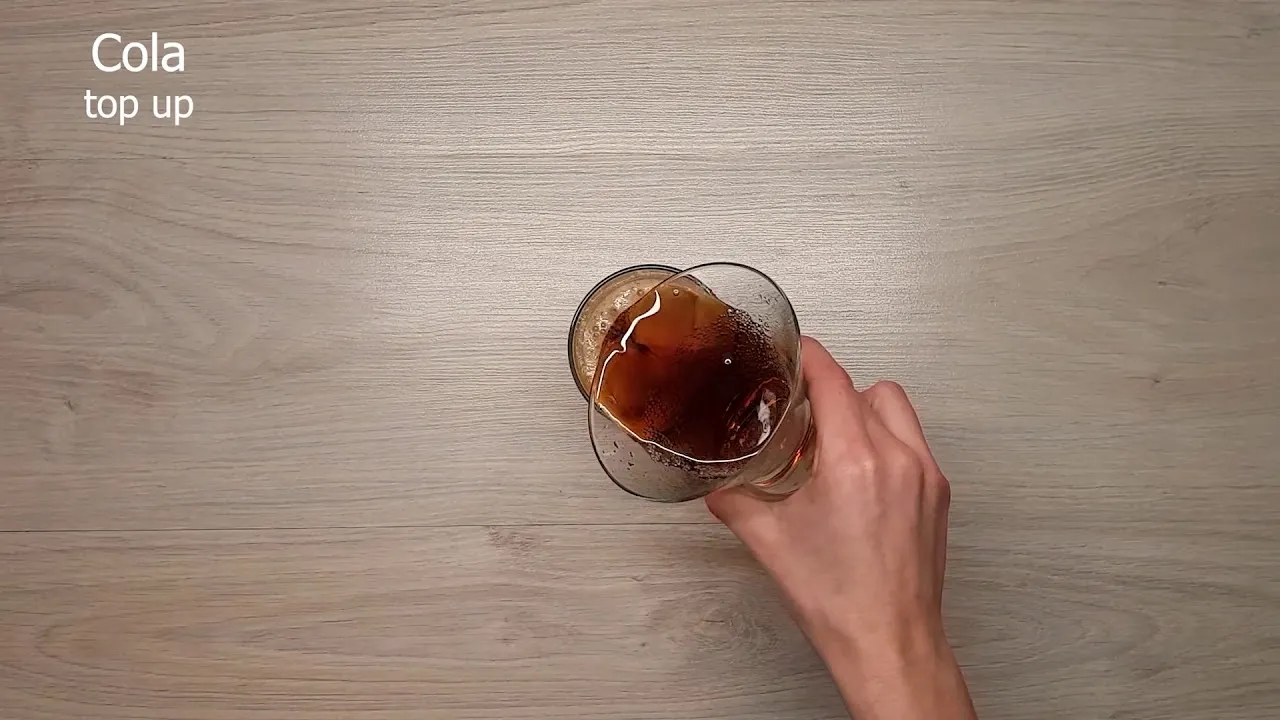
Our 2020 video calls this the C&C Ice Cream Float: coffee, cola and ice cream. It uses a scoop of soy ice cream, and its description says to choose your favorite, soy or dairy. The video gives a scoop, a shot and “top up” rather than measured amounts, so the cola amount below is our estimate for a 12 fl oz glass. The video predates this revision.
The float
For one float, in a 12 fl oz (355 ml) glass:
- Ice cream: 1 scoop, dairy or soy.
- Espresso: 1 single shot, about 1 fl oz (25–30 ml).
- Cola: about 6 fl oz (180 ml), chilled, to top up. The video’s description lists Coca-Cola.
- Time: about 3 minutes, plus pulling the shot.
Method:
- Scoop the ice cream into the bottom of a tall glass.
- Pour the shot of espresso over the ice cream.
- Top up with cola, pouring it slowly down the side of the glass to keep the foam down.
- Stir gently and serve with a straw.
The video’s description warns that cola and espresso “can result in a lot of fizz,” and says to keep every component, and the glasses, very cold.
The float starts as an affogato, espresso poured over ice cream, before the cola goes in. Our affogato guide covers that half on its own.
Hot or cold coffee?
Here the shot goes in freshly brewed, as the video’s description has it, but it lands on the ice cream first. For drinks where the soda goes straight onto the coffee, our advice is to use chilled coffee instead. Carbon dioxide dissolves less in warmer water. Stir a 1 fl oz shot at about 158°F (70°C) into 6 fl oz of soda from the fridge at 39°F (4°C), and the mix lands near 56°F (13°C), counting both as water and leaving out the glass and the ice. Using NIST’s constants for pure water, the equilibrium dissolved CO₂ concentration at about 56°F (13.4°C) is roughly 25% lower than at 39°F (4°C) at the same CO₂ partial pressure. This simplified calculation illustrates the temperature effect; it does not measure how much fizz the drink loses while you make it. A hot shot costs fizz; cold coffee keeps more of it.
If you’d rather not use a hot shot at all, pour 2 to 3 fl oz of chilled cold brew over the ice cream instead. It melts the ice cream more slowly, and the float tastes of cold brew rather than espresso.
How much caffeine?
The Caffeine Calculator puts a single espresso at 60–75 mg. Six fl oz of regular Coca-Cola adds 17 mg, giving about 77–92 mg from those two ingredients. Add any caffeine in the ice cream, especially coffee or chocolate flavors. A bigger glass takes more cola, and each extra fl oz of Coca-Cola adds about 3 mg (calculated). The same 6 fl oz of cola also adds about 20 g of sugar, from Coca-Cola’s 39 g per can (calculated); the ice cream’s label gives its own.
For less caffeine, Coca-Cola also makes Coca-Cola Caffeine Free. Its Mexico version is made with cane sugar instead of high fructose corn syrup, and Coca-Cola says it contains caffeine too. Decaf espresso still has a little caffeine; our decaf guide explains how much.
Swaps
- Root beer in place of the cola makes a root beer float; our coffee and root beer page has a cold brew drink built on it.
- Cream soda in place of the cola gives a vanilla float; for a drink without ice cream, see our coffee and cream soda.
- Coffee ice cream makes it taste more of coffee.
Sources
- JayArr Coffee, “Delicious Coffee and Cola Ice Cream Float!”, YouTube, January 28, 2020 (the recipe shown on screen; the soy-or-dairy choice and the “very cold” advice are in its description): youtube.com
- The Coca-Cola Company, “Coca-Cola Original Soda: Explore Nutrition Facts & Ingredients” (a 12-ounce can has 34 mg of caffeine, 39 g of sugar and 140 calories; Coca-Cola Mexico uses cane sugar instead of high fructose corn syrup and contains caffeine; Coca-Cola Caffeine Free), checked October 18, 2026: coca-cola.com
- National Institute of Standards and Technology, NIST Chemistry WebBook, SRD 69, “Carbon dioxide,” Henry’s Law data (k°H 0.034 mol/(kg·bar) at 298.15 K; temperature dependence 2,400 K): webbook.nist.gov