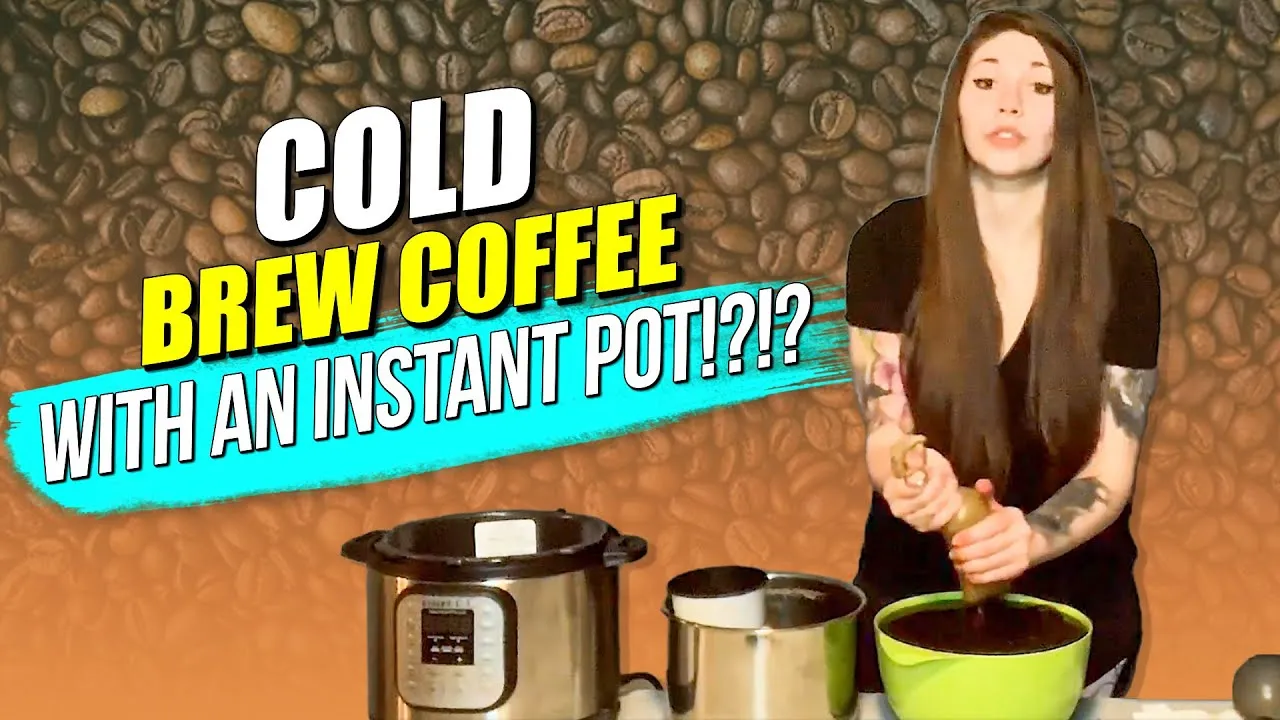
Real cold brew steeps in cold or room-temperature water for hours. An Instant Pot does the opposite: it heats the water under pressure. What it gives you is a big batch of hot-brewed coffee, cooled for iced coffee, and that’s how this page treats it. If you want true cold brew, our cold brew concentrate guide has a jar recipe, and the Toddy, the CoffeeSock and the PuckPuck are three gadgets for it.
The recipe below is the one in our 2020 video, with the amounts it measured. The notes on what the pot is doing come from Instant’s own manuals.
Does an Instant Pot have a cold brew setting?
Not the models we checked. Instant’s current manuals for the Duo (version 5, September 2025) and the Duo Plus (version 4, June 2025) list their programs, and neither has cold brew. The Duo Plus’s pressure programs are Custom, Chicken, Pasta, Soup, Beef, Beans, Egg and Sterilize, alongside Slow Cook, Rice, Steam, Sauté, Yogurt, Sous Vide, Cake and Keep Warm. The Duo’s are Soup/Broth, Meat/Stew, Bean/Chili, Poultry, Rice, Multigrain and Porridge, plus Steam, Slow Cook, Sauté, Yogurt and Keep Warm.
What both do have is a plain pressure setting with a choice of High or Low, which is all this method needs. The pot in our video calls it Manual; the current Duo calls it Pressure Cook, and on the Duo Plus it’s Pressure Cook, then the Custom program. The video’s description says any 6- or 8-quart Instant Pot will do.
Instant does sell a cold brew machine, but it isn’t a pressure cooker. The Instant Cold Brewer is a separate countertop appliance that Instant says makes “true cold brew” in under 20 minutes, compared with traditional 24-hour cold brewing, without heat, and holds up to 32 oz, as published by the maker on its US store when checked October 18, 2026.
What the pressure cooker is actually doing
Instant’s Duo Plus manual puts it simply: pressure cooking “uses pressure to raise the temperature in the cooking pot.” The coffee isn’t in that hot water for just 5 minutes, either. The 5 minutes is the time at pressure. Before that, the pot has to heat up and build pressure, which Instant’s manuals say takes 10 to 15 minutes in a Duo Plus and up to 30 in a Duo. After it, a natural release lets the pressure fall slowly, up to 40 minutes or more, the Duo manual says. Then our method leaves the grounds in the cooling coffee for about 2 hours. From start to strainer, that’s close to 3 hours of steeping, most of it hot or warm.
That makes it a long, hot immersion brew, and it won’t have cold brew’s chemistry. When Niny Rao and Megan Fuller brewed the same coffees hot and cold, the hot brews had more total acid and higher antioxidant activity, in their 2018 study of six light roasts; in their 2020 study of one Colombian coffee at three roast levels, the hot brews also had more of the browned compounds that come from roasting and more dissolved solids. Both studies brewed their hot coffee with just-boiled water for 6 minutes in a French press, not a pressure cooker, so they show the direction of the difference, not its size here.
The cup can still be good. In our video it came out “so smooth,” “creamy” and “not at all watery,” a “rich full cup” over ice. Just don’t expect it to taste like cold brew, or to share cold brew’s lower acidity.
Our Instant Pot method
- Coffee: 1½ cups, ground medium: the video asks for a regular grind, neither coarse nor fine. We measured by volume, not weight; at the 1 cup to about 3 oz (85 g) that CoffeeSock uses for dry ground coffee, that’s about 128 g.
- Water: up to the inner pot’s max line, which took about 16 cups (3.8 L) in our pot. A different size of pot will take a different amount, so keep the coffee in proportion. The video says tap or filtered water both work, and that filtered water tastes smoother.
- Time: about 5 minutes to set up, the pot’s heat-up, 5 minutes at high pressure, a natural release, about 2 hours of cooling, then straining; about 3 hours in all
- Makes: about 3.5 kg, close to a gallon (about 119 US fl oz). That’s calculated: 3,785 g of water, less about 255 g held back by the grounds at roughly 2 g per gram of coffee, our Brew Guide’s working figure.
- Put 1½ cups (about 128 g) of medium-ground coffee in the inner pot.
- Add water up to the max line, about 16 cups (3.8 L) in our pot, and no higher.
- Lock the lid and set the steam release to Seal.
- Choose Manual (Pressure Cook on current models), High pressure, 5 minutes, and start it.
- When it finishes, leave the steam release at Seal and let the pressure come down on its own until the pot says it’s safe to open.
- Let the coffee cool with the grounds in it until it’s about room temperature, about 2 hours in our video.
- Ladle it through a reusable coffee filter, or a colander lined with cheesecloth, into a bowl, then pour it into jars.
- Refrigerate it. Taste it before you dilute it: our video mixed it one to one with water over ice.
The video notes that the longer it cools on the grounds, the stronger it gets, in flavor and in caffeine.
The pot’s own rules
These come from Instant’s current Duo and Duo Plus manuals:
- Never fill past the line marked PC MAX (or Max PC Fill). Overfilling, the manuals warn, can clog the steam release pipe and valve and build excess pressure.
- Stop at the ½ line for foods that expand, or that “foam, froth and sputter,” such as oatmeal, pasta, applesauce and split peas. Coffee isn’t on the list, and neither manual mentions coffee. Our video filled to the max line.
- Natural release is the Duo manual’s choice for foods that can simmer, like stews, beans and oatmeal; both manuals keep quick release for foods that overcook, like vegetables and seafood. Our video used natural release, and we’ve found it gives a cleaner-tasting cup; we’d keep to it for a pot this full of liquid.
- Don’t open the lid until all the pressure is gone and the pot says it’s safe.
How strong it is
Not very, by the numbers. About 128 g of coffee in about 3,785 g of water is roughly 1:30 (calculated, with the estimated weight above). Our Brew Guide brews a drip machine at 1:17 and a V60 at 1:16, so this has a little over half the coffee per liter of ordinary hot coffee. A cold brew concentrate is stronger still: the Brew Guide’s runs 1:5.5 to 1:7. Mixing this coffee one to one with water halves it again.
Our video called it a concentrate and mixed it one to one, and the cup tasted rich, not watery. Because we measured by volume, your batch may come out differently. Taste it straight before you add anything; if it’s already the strength you like, drink it as it is over ice.
| Instant Pot method (our video) | Cold brew (Easto, via the Brew Guide) | |
|---|---|---|
| Water | Heated under pressure | Cold, in the fridge |
| Time in the water | About 3 hours, mostly hot or warm | 12 hours |
| Coffee to water | About 1:30 (estimated) | About 1:6 |
| Serve | Taste first; our video mixed it one to one | One to one with water or milk |
| Keeps | Our video kept it for the week | One to two weeks (Easto) |
Keeping it
Our video kept its batch in the fridge for the week. We found no study of how long pressure-brewed coffee keeps, and the cold brew research on our concentrate guide is about cold-steeped coffee, not this.
For cooling, the general food-safety rule applies. FoodSafety.gov, the US government’s food safety site, says to refrigerate perishable food within 2 hours, or within 1 hour above 90°F (32°C), to put leftovers in shallow containers so they cool quickly, and to keep the fridge at 40°F (4°C) or below. That guidance is written for food in general, not coffee in particular. Our method’s 2-hour cool runs right up to that limit, so on a hot day, or if you want to stay inside it, strain sooner and finish cooling the coffee in shallow containers in the fridge. Straining sooner also makes it a little weaker, since it spends less time on the grounds.
If it isn’t right
- Too weak: skip the dilution, or use more coffee next time. Weighing the coffee makes the next batch repeatable.
- Too strong or harsh: dilute it more, or strain it sooner; our video found that a longer cool makes it stronger.
- Gritty: use a finer filter, such as a paper one, or line your strainer with cheesecloth as the video suggests.
The video also suggests the coffee for frappuccinos and for baking.
Sources
- Our video, “Cold Brew Coffee…with an INSTANT POT!?!?”, JayArr Coffee, May 30, 2020: amounts, settings, cooling time, straining and tasting notes
- Instant Pot Brands, Instant Pot Duo Plus User Manual, version 4 (June 2025): contents and Pressure Cook programs, “Overfill During Pressure Cooking,” “How to release steam,” “About pressure cooking” and preheating time, from the Duo Plus 6QT product page, checked October 18, 2026: instantpot.com
- Instant Pot Brands, Instant Pot Duo Multi-Cooker User Manual, version 5 (September 2025): control panel and smart programs, overfill safeguards, preheating time and “How to release steam,” from the Duo 6QT product page, checked October 18, 2026: instantpot.com
- Instant Pot Brands, “Instant Pot® Cold Brewer” product page, checked October 18, 2026: instantpot.com
- FoodSafety.gov, “4 Steps to Food Safety,” Chill section, last reviewed September 18, 2023: foodsafety.gov
- Niny Z. Rao and Megan Fuller, “Acidity and Antioxidant Activity of Cold Brew Coffee,” Scientific Reports 8 (2018): 16030, abstract and Methods (hot brew experiments): doi.org/10.1038/s41598-018-34392-w
- Niny Z. Rao, Megan Fuller and Meghan D. Grim, “Physiochemical Characteristics of Hot and Cold Brew Coffee Chemistry: The Effects of Roast Level and Brewing Temperature on Compound Extraction,” Foods 9, no. 7 (2020): 902, section 2.3 and Table 1: doi.org/10.3390/foods9070902
- CoffeeSock, “Instructions” (3 oz by weight, or 1 cup dry, per 32 oz), checked October 15, 2026: coffeesock.com/instructions
- Jessica Easto, Craft Coffee: A Manual (Agate Surrey, 2017), p. 60 (keeping one to two weeks) and pp. 217–218, “The French Press Cold Brew Method”