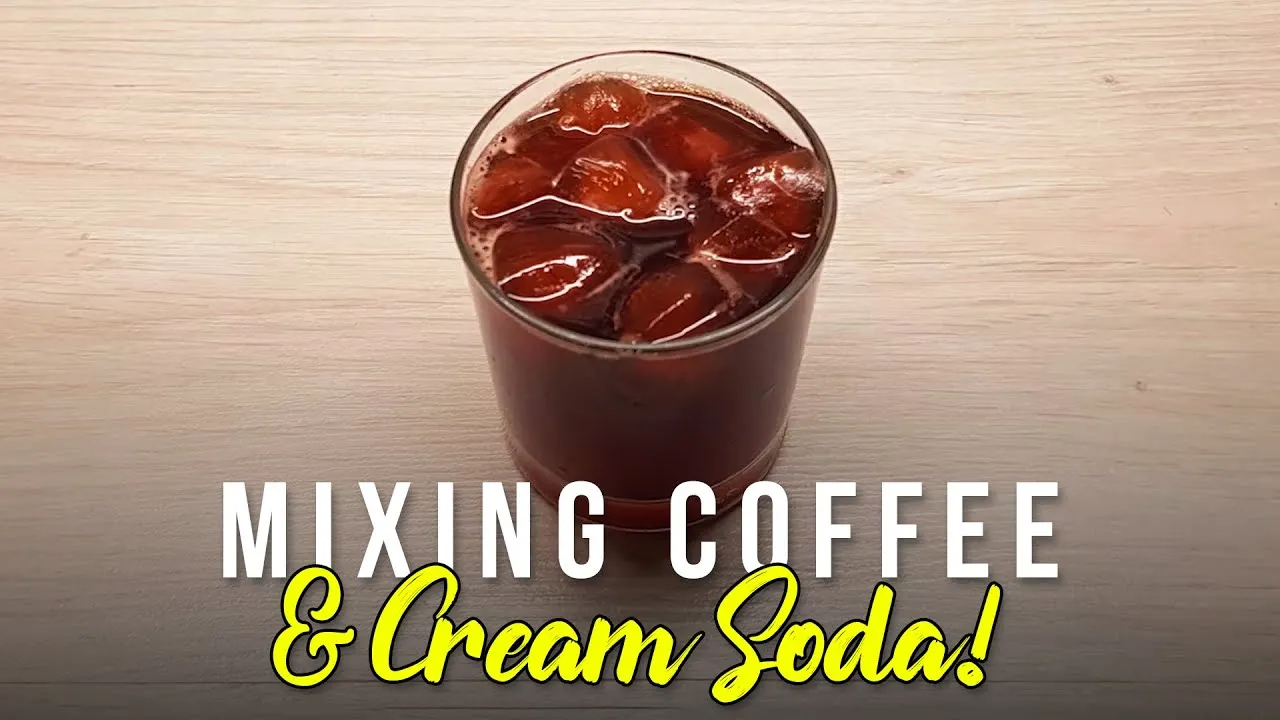
Cream soda is, in Merriam-Webster’s definition, a carbonated soft drink flavored with vanilla, so this is, in effect, a fizzy vanilla iced coffee. Our 2020 video calls it the Charged Up Cream Soda. The amounts below are the ones on the video’s screen; the video predates this revision.
The Charged Up Cream Soda
For one drink:
- Coffee ice cubes: a handful. Freeze cold coffee in an ice cube tray ahead of time. As they melt they add coffee, not water.
- Ice-cold coffee: 100 ml (about 3½ US fl oz). The video’s description uses cold brew. If yours is concentrate, mix it one to one with cold water first, as Jessica Easto’s recipe and our cold brew concentrate guide do. Hot-brewed coffee chilled in the fridge works too, or brew it straight onto ice as in our Japanese iced coffee guide.
- Ice-cold cream soda: 100 ml (about 3½ fl oz).
- Makes: 200 ml (about 6¾ fl oz) plus the ice, calculated from the amounts above.
- Time: about 2 minutes, with the coffee and the ice cubes already made.
Method:
- Put the coffee ice cubes in a glass.
- Pour in 100 ml of ice-cold coffee.
- Slowly pour 100 ml of ice-cold cream soda down the side of the glass, so the foam doesn’t overflow.
The video’s description also chills the glass first: put it in the freezer for an hour or so. Equal parts coffee and soda is the video’s mix; use more soda for a sweeter drink, or more coffee for a stronger one.
Hot or cold coffee?
Our advice: chill the coffee for any drink where the soda goes straight onto it, as here, and save a hot shot for floats, where it lands on the ice cream first. Carbon dioxide dissolves less in warmer water. Stir a 1 fl oz shot at about 158°F (70°C) into 6 fl oz of soda from the fridge at 39°F (4°C), and the mix lands near 56°F (13°C), counting both as water and leaving out the glass and the ice. Using NIST’s constants for pure water, the equilibrium dissolved CO₂ concentration at about 56°F (13.4°C) is roughly 25% lower than at 39°F (4°C) at the same CO₂ partial pressure. This simplified calculation illustrates the temperature effect; it does not measure how much fizz the drink loses while you make it. A hot shot costs fizz; cold coffee keeps more of it.
How much caffeine?
The caffeine is the coffee’s, plus any that the cream soda’s label lists. Cold brew’s caffeine varies a lot with the beans and the recipe, so the calculator gives a range, and the coffee ice cubes add more as they melt.
More coffee and soda
Our coffee and root beer refresher uses cold brew, root beer and cream of coconut over crushed ice. For dessert, the coffee and cola ice cream float pours a shot of espresso over ice cream before the cola goes in.
Sources
- JayArr Coffee, “Mixing Coffee and…Cream Soda?!?”, YouTube, January 28, 2020 (the recipe and the amounts shown on screen; cold brew and the chilled glass are in its description): youtube.com
- Merriam-Webster, “cream soda” (definition), checked October 18, 2026: merriam-webster.com
- Jessica Easto, Craft Coffee: A Manual (Agate Surrey, 2017), pp. 217–218, “The French Press Cold Brew Method” (the concentrate diluted one to one with cold water)
- National Institute of Standards and Technology, NIST Chemistry WebBook, SRD 69, “Carbon dioxide,” Henry’s Law data (k°H 0.034 mol/(kg·bar) at 298.15 K; temperature dependence 2,400 K): webbook.nist.gov