Most coffee drinkers know what they like in negative space — not too sour, not too bitter, not too watery. Specialty cafés ask the question more directly, but rarely with structure. The Coffee Profilers Method is the structured version: five axes, plain-English distinctions, mapped onto the same vocabulary professional cuppers use on the Specialty Coffee Association cupping form. Walk through the axes honestly and the result is a coordinate — your personal bean identity — that predicts which coffees, which brewing methods, and which roasters will reliably read as “yours.” The method takes its name from a Berlin café that pioneered the conversational version of the same approach in the mid-2010s; the café is closed, but the framework is the cleanest practical tool for figuring out what you actually like.
The Coffee Profilers Method
The SCA’s current evaluation framework — the Coffee Value Assessment, released in provisional form in June 2024 — separates a coffee’s sensory character into eight attributes: fragrance, aroma, flavor, aftertaste, acidity, sweetness, mouthfeel, and an overall impression. The 2004 form before it used most of the same categories (calling mouthfeel “body” and treating sweetness as binary). Both are still in industry use, and the categories are stable enough to anchor a preference framework.
What a normal drinker has to decide is narrower. Five axes, in plain English, will get you most of the way to a working personal bean identity.
1. Bright vs. balanced acidity
Acidity in coffee is the perceived sour, tart, or fruit-bright sensation — the quality that gives a Kenyan AA its blackcurrant snap or an Ethiopian Yirgacheffe its lemon-citrus lift. Useful cafe descriptors include juicy, fruit-like, bright, tart, sharp, winey, vinegary, herbal, grassy, and dry; the SCA’s CVA development history is more cautious here, and the June 2024 provisional standard removed the earlier “dry acidity” and “sweet acidity” CATA boxes for lack of grounding references.
The question for you is simpler: do you experience a bright lemon-or-blackcurrant quality as exciting, or as sour and unpleasant? Drinkers who reach for lighter washed African coffees want more of that character. Drinkers who reach for Brazilian, Sumatran, or Indonesian profiles want less. If a Kenyan SL28 or a Yirgacheffe natural reads as a thrill, you are bright-acidity-leaning; if it reads as too sharp and you’d rather have a Brazilian Cerrado or a washed Honduran, you are balance-leaning. Most people sit somewhere in between and have weather for both.
2. Light vs. medium body
“Body” — what the SCA now calls mouthfeel — is the tactile weight of the coffee on the palate, separate from flavor. The CVA mouthfeel CATA boxes are rough, oily, smooth (velvety, silky, syrupy), mouth-drying (astringent), and metallic. Most drinkers experience body on a simple light-to-heavy scale.
Lighter body — what filter drinkers often prefer — is the tea-like clarity of a paper-filtered V60 or an AeroPress brewed clean. Heavier body — what French-press and espresso drinkers prefer — is the syrupy, coating tongue-weight of immersion brewing or a properly-developed espresso shot. If you find yourself reaching for a French press and a pour-over reads “thin,” you are body-leaning. If you find pour-over revelatory and French press muddy, you are clarity-leaning. This is one of the most useful preference axes for predicting which brewing method someone adopts.
3. Washed vs. natural process
Processing — what happens to the cherry between picking and shipping — has the most dramatic effect on a coffee’s flavor profile. The two endpoints are washed processing (cherry pulped, fermented in water, washed clean, dried; clean, articulated, transparent flavor) and natural or dry processing (cherry dried whole around the seed; fruit-forward, sweeter, more aromatic, sometimes wine-like). Honey processing sits between. Anaerobic fermentation and carbonic maceration are newer controlled-fermentation techniques that can be combined with washed, honey, or natural workflows and often push character further into wine-like and fruit-forward territory. The mechanics are in our coffee processing methods explainer, and the honey process colors guide covers the gradient.
The preference question is direct: when a coffee reads obviously fruity — strawberry, blueberry, mango, fermented-stone-fruit, sometimes a slightly winey character — does that excite you or feel off? Drinkers who love Ethiopian naturals, Brazilian naturals, and anything carbonic-macerated are natural-leaning. Drinkers who prefer the cleaner clarity of a Kenyan AA, a washed Colombian, or a Guatemalan Antigua are washed-leaning. This is the axis that splits a specialty café’s regulars most cleanly.
4. Single-origin vs. blend
A single-origin usually comes from one identifiable place — a farm, estate, cooperative, washing station, region, or specific lot. A blend combines beans from multiple origins, usually engineered around a target profile — a chocolate-forward espresso blend, a balanced filter blend, a seasonal house blend that smooths the year-round bar.
Single-origin coffees showcase distinctiveness. A Kenyan AA tastes like a Kenyan AA: bright blackcurrant, structured acidity, often a savory tomato or bell-pepper note. A Yirgacheffe tastes like a Yirgacheffe. The preference question is whether you want the cup to be specific (fun, sometimes weird, rewards attention) or reliable and balanced (what a well-built blend delivers). Most drinkers want both: single-origin filter at home, a house espresso blend for the daily bar shot. (Our single-origin primer covers the definitions and the marketing edges.)
5. Espresso-leaning vs. filter-leaning
The last axis is the simplest and the most underrated. Espresso and filter are different drinks from the same raw material. Espresso concentrates the cup into roughly 30 grams of liquid through pressurized 9-bar extraction; filter dilutes the same dose across 200-plus grams of water with gravity flow. The chemistry, body, and mouthfeel are different. A drinker who loves a balanced espresso will not necessarily love a clean V60 of the same origin.
If you naturally reach for milk drinks — flat white, cortado, latte — and rarely brew filter at home, you are espresso-leaning, best served by a roaster’s espresso program with medium roast development. If you naturally reach for pour-over at home and find espresso “too intense” or “too short,” you are filter-leaning, best served by lighter-roast single-origin filter coffees that articulate origin character.
Your personal bean identity is the coordinate that comes out. One drinker might land at bright acidity, light body, washed, single-origin, filter-leaning — for whom a Kenyan AA pour-over is the platonic cup. Another lands at balanced acidity, medium body, natural, blend-tolerant, espresso-leaning — happiest with a roaster’s natural-anaerobic espresso blend in milk. You can map yourself with a notebook and three or four bags from a roaster you trust. The coffee varietal guide maps how varietal preferences slot onto these axes, and the altitude profile of your beans explains why higher-grown coffees usually carry more acidity.
Where the Method Came From
The Coffee Profilers Method takes its name and its conversational framing from a Berlin specialty café that ran at Karl-Marx-Allee 136 in Friedrichshain from mid-2015 to roughly 2018. The café was a collaboration between Stefanos Domatiotis — who had won the 2014 World Brewers Cup Championship in Rimini representing Greece — Yiannis Taloumis, owner and CEO of Taf Coffee in Athens, Nora Šmahelová, co-owner of Berlin’s Chapter One in Mitte, and barista trainer Stavros Domatiotis. The address later became K. LIEBLINGs and is currently OM Coffee & Brunch; the original Coffee Profilers brand was retired with the founders’ departure.
Their thesis was simple. Most multi-roaster specialty cafés rotate beans from several roasteries on the bar to showcase variety. Domatiotis argued this obscured each roaster’s perspective — “You must follow the personality of the roaster, and bring that to the front.” The café therefore served only Taf Coffee from Athens, and every bag, espresso lot, and filter offering was profiled in detail on the packaging: origin, varietal, altitude, processing method, mill, harvest, and a tasting note in language designed to map onto how the customer might experience the cup.
That bean-by-bean profiling was where the café’s name came from. “Coffee Profilers” referred first to what the café did to the beans — built a profile of each one — and second to what it did to its customers. The barista’s job, when a regular came in, was to read the customer’s stated preferences against the available bean profiles and recommend a match. Over time, regulars accumulated a sense of which axes of bean character they actually responded to. Welcher Kaffee bist du? — “Which coffee are you?” — was the question, and the answer was a coordinate inside that small mapped space.
A customer who said they wanted “something fruity” would be asked whether they meant berry-fruity (cooler, washed African) or stone-fruit-fruity (warmer, natural-process Ethiopian or Honduran). A customer who said they wanted “strong” would be asked whether they meant intense in body or intense in flavor. The terms were the café’s own, but they map cleanly onto the Specialty Coffee Association’s cupping vocabulary — the same framework professional cuppers use to evaluate green coffees on the SCA cupping form. That mapping is what makes the concept reproducible. You don’t need the café to do it. You need the vocabulary, and the honesty about what you’ve already tasted.
Why the Coffee Profilers Method Endures
Coffee Profilers ran for roughly three years before becoming K. LIEBLINGs and, later, OM Coffee at the same address. The brand is dormant. The method is not. It outlived the café because it was useful: the acidity-body-processing-origin-format axes used here overlap with the SCA’s Coffee Value Assessment vocabulary without pretending to be a formal CVA scorecard. Acidity and mouthfeel are sensory attributes; origin, variety, and processing are extrinsic attributes; brew format is a customer-preference layer. That vocabulary scales from a competition cupping table to a customer at a counter without losing structure.
Any specialty roaster’s bag today encodes much of the same information — origin, variety, altitude, processing, roast development, tasting notes — and any specialty barista, asked the right way, will help you read it. What Coffee Profilers added was the explicit invitation. Most specialty cafés expect the customer to do the preference work silently; Coffee Profilers made the conversation the service. That is the part that was distinctive at Karl-Marx-Allee 136 in 2015, and the part you can run on yourself the next time you walk into any well-curated bar. Welcher Kaffee bist du? Pick a coordinate on the five axes. The right cup will find you.
Berlin’s Specialty Coffee Scene — Where the Method Was Born
Berlin’s specialty wave started a few years before Coffee Profilers and grew up around it. Bonanza Coffee Roasters, opened by Yumi Choi and Kiduk Reus in 2006, was the earliest of the city’s third-wave operations — its Prenzlauer Berg location on Oderberger Straße opened years before The Barn, and a larger Bonanza roastery-café later opened on Adalbertstraße in Kreuzberg. The Barn, founded by Ralf Rüller in 2010, became the most-distributed flagship — a Mitte espresso bar that grew into a multi-café Berlin network plus international outposts. Five Elephant, founded in 2010 by Kris Schackman and Sophie Schackman (née Weigensamer), runs its main café and roastery on Glogauer Straße in Kreuzberg and is at least as well known for its Philadelphia-style cheesecake as for its coffee program.
By 2015 those three roasters had defined the broad shape of the city’s specialty identity — small, light-roast-leaning, traceability-conscious, more Nordic than Italian — and the next generation was filling in around them. Father Carpenter on Münzstraße in Mitte built its reputation around lightly roasted seasonal coffees plus full-service breakfast and lunch. Röststätte Berlin runs a Mitte roastery on Ackerstraße plus a café in the Hackesche Höfe. Distrikt Coffee, opened in December 2014 by London-born Sophie Hardy at Bergstraße 68, anchored a slightly different end of the scene — a multi-roaster bar with Fjord from Berlin, Workshop from London, and Koppi from Sweden alongside an all-day brunch program.
In Friedrichshain itself, the cluster is smaller and tighter. Silo Coffee, opened in 2013 by Australian-born Morgan Love and his cousin James Maguire at Gabriel-Max-Straße 4 near Boxhagener Platz, became the neighborhood’s defining brunch destination — Australian-style breakfast, cast-iron pans, coffee from Fjord Coffee Roasters, the Marzahn-based roastery Love and Maguire co-founded in 2016 with Father Carpenter’s Kresten Thøgersen. Tres Cabezas runs a roastery and café on Boxhagener Straße. The Coffee Profilers / K. LIEBLINGs / OM Coffee address lineage at Karl-Marx-Allee 136 is the boulevard-side version of the same scene.
Berlin’s specialty identity is more interconnected than territorial. A Friedrichshain regular can move between Silo, Five Elephant, Father Carpenter, and The Barn in the same week; the roasters know each other’s staff. What makes Friedrichshain distinctive is partly atmospheric — Stalinist-monumental Karl-Marx-Allee versus squatter-grit Rigaer Straße — and partly historical, but the specialty coffee itself is part of a shared city, alongside Klaus Thomsen’s Coffee Collective in Copenhagen, the broader third-wave movement, and Berlin’s place in the global specialty city map.
Slow Coffee — The Atmospheric Argument
One of the things that distinguished Coffee Profilers, and the broader Berlin specialty scene around it, is an unhurried atmosphere the German press at the café’s opening described as deliberately oppositional — neither the standing-at-the-bar Italian espresso ritual nor the laptop-grinding American workspace café. The Berlin lifestyle press of the mid-2010s wrote about the Coffee Profilers room as a place where, if you weren’t in a hurry to get to the office, you could let yourself be told more about your coffee than the three minutes a normal commute affords. Big windows, quiet, an open brew bar, a barista who actually expected to talk to you: these were the design.
That is what slow-coffee philosophy looks like in practice. The phrase overlaps with Carlo Petrini’s broader slow-food movement out of Italy in the 1980s and lands in specialty coffee as a set of small, defensive ritual choices: manual brewing instead of automatic, pour-over instead of a quick espresso, conversation instead of a transaction. The Coffee Profilers Method is the structural version of that posture — a deliberate slow-down for the moment of choosing, rather than the moment of drinking.
A Friedrichshain Coffee Walk
If you’re in Berlin and want to walk the neighborhood where the method was born, the itinerary is short. Start from Warschauer Straße S-Bahn / U-Bahn. Walk three minutes north to Boxhagener Platz for Silo Coffee at Gabriel-Max-Straße 4 — Australian-style brunch, in-house Fjord. A few minutes east is Tres Cabezas for the roastery experience.
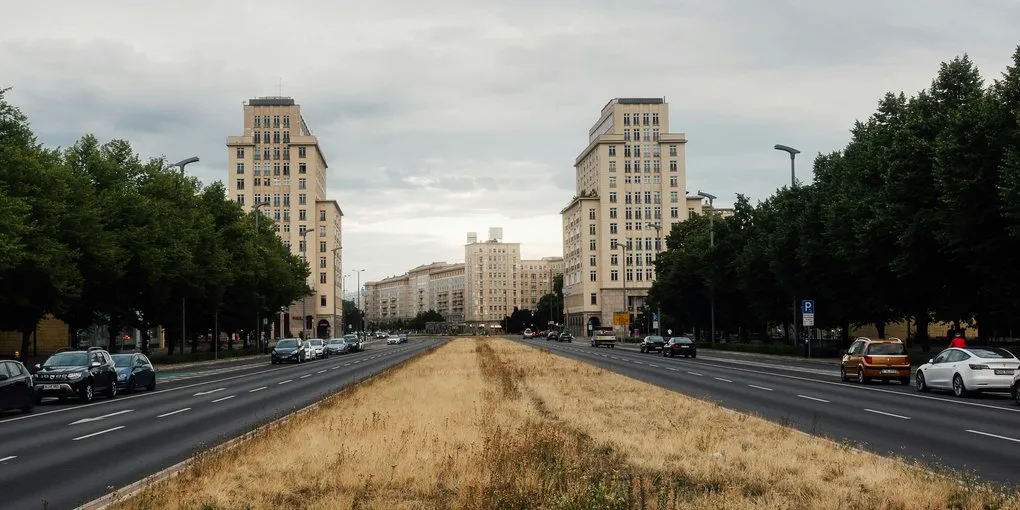
Then walk roughly fifteen minutes north-northwest, up Frankfurter Allee, to Frankfurter Tor and turn onto Karl-Marx-Allee westbound. Number 136 is the old Coffee Profilers / K. LIEBLINGs address; current listings show OM Coffee & Brunch in the space. The boulevard from there to Strausberger Platz is a slow twenty-minute walk through the Karl-Marx-Allee ensemble itself: protected-monument Stalinist apartment blocks, columned ground-floor arcades, surviving GDR-era neon signs that have become an unlikely subset of the city’s heritage list.
If you have a longer afternoon, continue west on the U5 from Strausberger Platz to Rosenthaler Platz in Mitte for Distrikt Coffee at Bergstraße 68, Father Carpenter at Münzstraße 21, or Röststätte Berlin on Ackerstraße. South to Kreuzberg gets you to Five Elephant on Glogauer Straße and Bonanza Coffee Roasters at Adalbertstraße 70. The single best way to test your own personal-bean-identity coordinate is to order the same drink at three different bars on the same morning — a flat white at Silo, a flat white at Father Carpenter, a flat white at Bonanza. Three different roasters, three different espresso programs. One palate, one milk-fat percentage. By the third cup you will know which roaster you actually want.
Sources & Further Reading
- Sprudge, “Berlin: Coffee Profilers Brings Taf Coffee From Athens, With Love” — original 2015 opening profile.
- Daily Coffee News, “Coffee Roasted in Greece and Scandinavian Design at Coffee Profilers in Berlin” — July 2015 launch coverage.
- ceecee.cc, “Coffee Profilers: Finding Your Personal Bean Identity” — Berlin lifestyle press feature on the bean-identity concept.
- Coffee Circle, “Coffee Guide: 4 Tips for Real Good Coffee in Berlin-Friedrichshain” — Friedrichshain specialty mapping that documents the Coffee Profilers / K. LIEBLINGs handover.
- OM Coffee, official site — current café at Karl-Marx-Allee 136.
- SCA, Coffee Value Assessment — current SCA cupping framework (provisional standard, June 2024) defining fragrance, aroma, flavor, aftertaste, acidity, sweetness, mouthfeel, overall.
- Barista Magazine, “Taf Coffee in Greece: Among the Best Roasters in the World” — context on the Athens roastery whose beans Coffee Profilers served.
- Perfect Daily Grind, “5 Winning World Brewers Cup Performances” — Stefanos Domatiotis’s 2014 World Brewers Cup-winning routine.
- The Barn Coffee Roasters, official locations page.
- Bonanza Coffee Roasters, bonanzacoffee.de.
- Five Elephant, Kreuzberg location.
- Father Carpenter, fathercarpenter.com.
- Röststätte Berlin, roeststaette.com.
- Silo Coffee, silo-coffee.com.
Frequently Asked Questions
- What is the Coffee Profilers Method?
- The Coffee Profilers Method is a five-axis framework for identifying what coffee you actually like, mapping personal preference across (1) bright vs. balanced acidity, (2) light vs. medium body (mouthfeel), (3) washed vs. natural processing, (4) single-origin vs. blend, and (5) espresso-leaning vs. filter-leaning. The axes overlap with the Specialty Coffee Association's Coffee Value Assessment vocabulary without being a formal CVA scorecard. The method is named for Coffee Profilers, a Berlin café that pioneered the conversational version of the same approach in the mid-2010s.
- How do I figure out what kind of coffee I like?
- Walk through five preference axes honestly. (1) Bright vs. balanced acidity — does a Kenyan AA's blackcurrant snap thrill you or feel sour? (2) Light vs. medium body — do you prefer the tea-like clarity of pour-over or the syrupy weight of French press / espresso? (3) Washed vs. natural processing — does an Ethiopian natural's berry-and-fermented-stone-fruit character excite you or feel 'off'? (4) Single-origin vs. blend — do you want a cup that's distinct (a specific Yirgacheffe lot) or reliable (a roaster's house espresso blend)? (5) Espresso-leaning vs. filter-leaning — do you reach for milk drinks or pour-over at home? Your five-axis coordinate is your personal bean identity. The fastest way to test it is to order the same drink at three different specialty bars on the same morning and notice which one you'd repeat.
- What is personal bean identity?
- Personal bean identity is the output of the Coffee Profilers Method — a five-axis coordinate that summarizes a coffee drinker's individual preferences across acidity, body, processing, single-origin vs. blend, and espresso-leaning vs. filter-leaning. The phrase comes from Berlin's Coffee Profilers café in the mid-2010s, where the German question 'Welcher Kaffee bist du?' — literally 'Which coffee are you?' — drove the customer-facing service. The axes overlap with SCA sensory and extrinsic vocabulary, but the framework is reproducible without a barista to guide you.
- Where did the Coffee Profilers Method come from?
- The method takes its name and conversational framing from Coffee Profilers, a specialty café that operated at Karl-Marx-Allee 136 in Berlin-Friedrichshain from mid-2015 to roughly 2018. The café was a collaboration between 2014 World Brewers Cup Champion Stefanos Domatiotis, Taf Coffee CEO Yiannis Taloumis from Athens, Chapter One co-owner Nora Šmahelová, and barista trainer Stavros Domatiotis. After the founders moved on, the address operated as K. LIEBLINGs and is currently OM Coffee & Brunch. The brand is dormant; the method is the part that proved durable.
- Is Berlin good for specialty coffee?
- Yes. Berlin is one of Europe's leading specialty coffee cities, with a third-wave scene that began with Bonanza Coffee Roasters (founded 2006 in Prenzlauer Berg), The Barn (founded 2010, now a multi-location Berlin network plus international outposts), and Five Elephant (founded 2010 in Kreuzberg). The 2010s next generation added Father Carpenter, Distrikt Coffee (Mitte, December 2014), Silo Coffee with Fjord Coffee Roasters (Friedrichshain, 2013/2015), Coffee Profilers and its K. LIEBLINGs successor period at Karl-Marx-Allee 136, and Röststätte Berlin. The aesthetic is more Nordic than Italian — light roasting, single-origin filter focus, traceable sourcing — and the operations are tightly interconnected across the Mitte / Kreuzberg / Friedrichshain / Prenzlauer Berg districts.
- What's distinctive about Friedrichshain coffee compared to other Berlin districts?
- Friedrichshain is a former East Berlin working-class district that gentrified through the 2000s and 2010s. Its specialty coffee scene is smaller and tighter than Mitte's or Kreuzberg's, anchored around Boxhagener Platz (Silo Coffee, Tres Cabezas) and the Karl-Marx-Allee boulevard address where Coffee Profilers later became K. LIEBLINGs. The atmospheric distinction from other Berlin districts is partly architectural — Karl-Marx-Allee's Stalinist-monumental ensemble is unlike anything else in the city — and partly tonal, with a slower, less-hurried café culture that the Berlin lifestyle press of the mid-2010s described as deliberately unhurried. The specialty coffee itself is part of the citywide network rather than a separate scene.