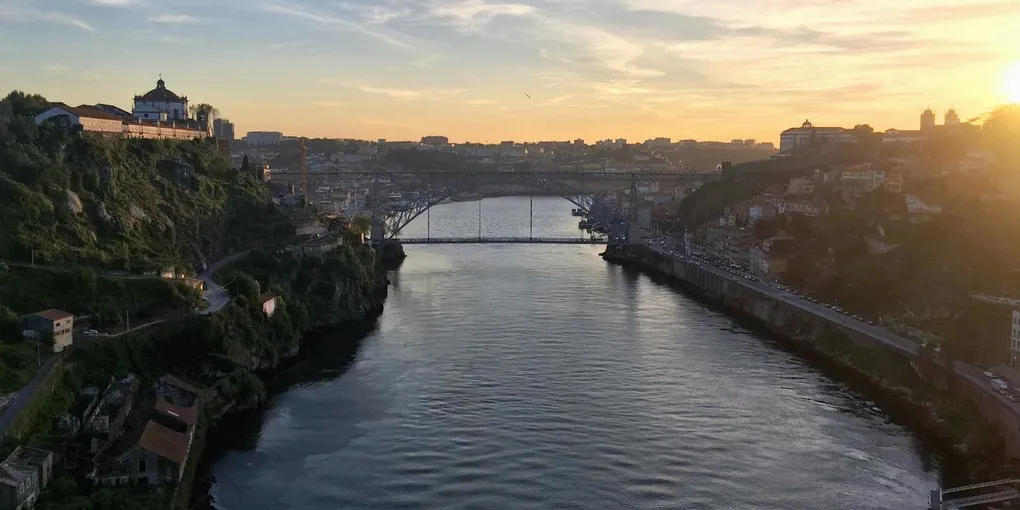
The first thing to know about specialty coffee in Porto is that, to find it, you have to leave Porto.
Cross the river. Walk down through the Ribeira’s medieval crush of bacalhau restaurants and port-wine touts. Find the lower deck of Ponte Dom Luís I — the double-deck iron bridge that has spanned the Douro between Porto and Vila Nova de Gaia since 1886 — and walk west across it. On the south bank you are no longer in Porto. You are in Vila Nova de Gaia, an officially distinct municipality with its own mayor, its own postal codes, and historically its own industry: the port-wine cellars stacked in long, low warehouses against the river. Walk past them. Climb up out of the cellar district onto the residential streets above. About fifteen to twenty minutes from where you started, on a quiet block at Rua de França 52, the door of 7g Roaster opens onto one of greater Porto’s most consistently cited specialty coffee bars.
That sentence — “the best coffee in Porto isn’t in Porto” — is the structuring fact of this article. It is also, in different forms, the structuring fact of specialty coffee in most second-city European tourist economies. The tourists hold the historic center; the roasters take the cheaper rents across the river. Lisbon has the same dynamic with Cais do Sodré and the further-out Alvalade and Marvila neighborhoods. Berlin has it with Friedrichshain and Neukölln. Porto’s version is unusually clean because the geographic split is a literal river crossing. To get to specialty, you commit. You walk over an iron bridge that an Eiffel partner designed in 1886, look down a hundred and seventy feet at the Douro, and choose a side.
This is a guide to that crossing — the city, the bridge, the roastery, the man who built it, and the broader Portuguese third-wave story he and his peers are writing one cup at a time.
Where Porto’s Specialty Coffee Actually Is
Porto is one city the way Manhattan and Brooklyn are one city — administratively two, functionally one, separated by a span of water that takes ten minutes to cross and changes the rent by a factor of two. The river is the Douro. The two municipalities are Porto (north bank, the historic city) and Vila Nova de Gaia (south bank, the port-wine cellars and residential hills above them). Together they make the Greater Porto metropolitan area, the second-largest in Portugal after Lisbon.
The tourist coffee in Porto sits in the historic center. That coffee is mostly traditional Portuguese cafe culture — espresso at the bar, pastel de nata, a second espresso, a galão if you have time to sit. It is in many cases excellent of its kind. The grand 19th-century cafes — Majestic Café on Rua de Santa Catarina, Café Guarany, Café Piolho — are real institutions, social spaces with a hundred years of layered patina, and they serve a particular dark-roast Portuguese espresso that locals have drunk every working day of their lives. None of it is what specialty coffee professionals mean by “specialty.”
Specialty in the contemporary cafe sense — traceable coffees, more transparent roasting, single-origin filter options, and brewing decisions made by taste and extraction rather than by inherited ritual alone — arrived in Porto later than in Lisbon and considerably later than in Copenhagen, Oslo, London, or Berlin. When it arrived, it mostly did not arrive in the historic center. It arrived around the edges. The first wave of specialty venues that opened in Porto from roughly 2014 onward took rooms in Bonfim, in Cedofeita, on Avenida da Boavista, and across the river in Vila Nova de Gaia. They picked locations that working Portuenses passed daily and tourists rarely did.
The reason is partly real estate and partly clientele. Tourist coffee turns over reliably at any quality level — the pastel de nata–and–espresso transaction is structurally insensitive to whether the espresso is good. Specialty depends on the second visit and the fifth and the fiftieth. It needs a daily clientele. That clientele lives in the residential neighborhoods, not in the cellar streets where the river-cruise crowds queue. When Mesa 325 — Cafetaria opened on Avenida de Camilo 325 in Porto’s eastern Bonfim/Campanhã district — founded by Mário and Leonor Espinha, who lived above the cafe with their two children — it was widely described in the European specialty press as Porto’s first specialty coffee bar. The Espinhas had been inspired by repeated visits to London. They opened in a residential block, well off the Ribeira tourist track, and built a daily community of locals one cortado at a time. Mesa 325 still operates today.
Mesa 325 also became, by the simple fact of being first, the cafe that visiting specialty drinkers hit first when they came to Porto looking for the scene. And it is a Mesa 325 barista who, in one of the more widely retold anecdotes in Porto specialty-coffee tourism, sent a pair of Polish coffee journalists across the bridge to Vila Nova de Gaia and told them — bluntly, in the way Porto baristas can be — that the best coffee in Porto was not in Porto. It was at 7g Roaster. The Polish blog Coffeeplant ran the trip diary, and it became one of the canonical retellings of the Gaia / Porto split.
That walk — Mesa 325 in Porto’s east, then west to Ribeira, then south across Ponte Dom Luís I, then twenty minutes up the Gaia hill to Rua de França 52 — is the most efficient one-day specialty coffee tour the city offers.
The Bridge, Briefly
Ponte Dom Luís I was designed by Théophile Seyrig, a Belgian engineer who had been Gustave Eiffel’s partner at Eiffel et Cie before going independent. (The persistent tour-guide claim that Eiffel himself designed the bridge is wrong. Eiffel designed the older, single-deck Maria Pia railway bridge upstream, which opened in 1877; Seyrig, by then with the Belgian firm Société de Willebroek, won the public contract for the road bridge a few years later.) Construction began November 21, 1881; King Luís I, whose name the bridge carries, opened it on October 31, 1886. Its 172-meter arch span was the longest of its type in the world at completion.
What matters for coffee tourism is the two-deck design. The upper deck carries the Porto Metro Line D and pedestrians; the lower deck carries cars, buses, and pedestrians. Walking across either deck is free and takes about ten minutes; the lower deck deposits you at the foot of the Gaia cellar district, from which the climb to Rua de França 52 is another ten minutes uphill. Twenty minutes total from the Ribeira riverfront to 7g Roaster’s door.
7g Roaster — David Coelho’s Roastery
The brand is 7g Roaster, written exactly that way: lowercase “7g,” capitalized “Roaster.” The “7g” is the standard espresso dose — seven grams of ground coffee per single shot — and the play on it has worked well as a name. (The associated apartment side of the business plays the same trick: 7 Gaia Roaster Apartments, seven units, in Gaia.)
The operation occupies a multi-story building at Rua de França 52, 4400-174 Vila Nova de Gaia. The ground floor is the cafe and the espresso bar. A small in-house roastery sits visible behind the counter. The upper floors house seven branded short-stay apartments — coffee-themed lodging, marketed to specialty-coffee tourists who want to wake up two flights above their own roastery. The whole concept — cafe plus roastery plus boutique lodging, vertically stacked into a single Gaia townhouse — was, when it opened, an unusual format in Portugal. It still is.
The operation began with Carla Pinho’s 7g hospitality idea, with David Coelho joining as the coffee lead. Pinho identified the gap — Porto had no dedicated specialty roastery serving the Vila Nova de Gaia side of the river — and built the apartment-and-cafe business model around it. Coelho is the head of the coffee program. He runs the barista team. He sources the green coffee. He roasts. He has, since the operation opened, been the public face of 7g Roaster in the international specialty press.
Coelho’s bio, in his own words, on Barista Magazine’s 2017 World Barista Championship competitor preview: “I am the roaster and head barista of 7g Roaster in Portugal! I love all things about coffee and I love to learn more about it every day!” His Instagram, then and now: @david_coelho_barista.
The coffee program at 7g Roaster is recognizably Northern European third-wave in its outlines. Light to light-medium roasting. Single-origin filter as the central educational pour. Espresso run at modern parameters — longer ratios than the Portuguese cimbalino tradition, brighter cup, more clarity, less roast caramelization. Public roaster listings and past coverage show coffees from origins including Brazil, Panama, Ethiopia, Colombia, Kenya, and Guatemala, with Brazil fitting especially naturally into Portugal’s long Brazilian-coffee tradition. The cafe runs an all-day brunch alongside the coffee — a deliberately broad offer, because the apartment guests upstairs need somewhere to eat, and because Gaia in 2017 did not have enough specialty-only foot traffic to sustain a coffee-only operation.
The roastery side of the business sells beans through 7groaster.pt and through European specialty-coffee marketplaces including Kofio. The cafe is, at the time of writing in May 2026, very much open and operating — Tripadvisor lists it as a Travelers’ Choice cafe and the #1 Coffee & Tea spot in Vila Nova de Gaia, with a 4.6 average rating across hundreds of reviews.
David Coelho and the 2017 World Barista Championship
The narrative spine of 7g Roaster, in the international specialty press, is Coelho’s barista-competition career.
Coelho was the Portuguese Barista Champion three times: 2014, 2016, and 2017. He competed for Portugal at the World Barista Championship in three different host cities. In 2014 it was Rimini, Italy. In 2016 it was Dublin, Ireland. In 2017 it was Seoul, South Korea — the edition that the international coffee press covered most heavily, because it coincided with the rapid Asian expansion of specialty coffee and was held inside the major Café Show Seoul trade fair.
The 2017 World Barista Championship was held in Seoul on November 9–12, 2017. Nearly sixty national champions competed; six advanced to the final round. The eventual winner was Dale Harris of the United Kingdom, then with Hasbean Coffee, who took the title on November 12. Miki Suzuki of Japan placed second. Dale Harris’s win was a first-time-finalist, first-time-champion result of the kind the WBC throws up every few years — a national champion winning the title in the same year he won his country’s national. (Hasbean’s owner, Stephen Leighton, also happens to be the partner of Joanna Alm at Drop Coffee in Stockholm, which gives the story an extra Nordic-British thread for anyone tracing the European specialty cluster.)
Coelho competed in the heats. He did not advance to the final six. That outcome is, in the day-to-day language of the WBC, simply how the championship goes for most national champions most years — nearly sixty competitors, six final-round slots, most of the field goes home. What matters about a small country sending a single roaster’s barista to the world stage is not whether that barista wins. It is that the barista was there at all, with a routine that had to compete on the same fifteen-minute clock against Dale Harris’s eventually-winning routine, and that the experience reshapes everything the barista does afterward back home.
What the press the next day wrote about, when they covered Portugal’s appearance, was 7g Roaster — the brand, the address, the apartments, the cafe. European Coffee Trip’s day-one and day-two WBC dispatches both put Coelho’s name in front of an audience that had probably never been told that Portugal had specialty coffee at all. Barista Magazine’s competitor-preview series ran his bio with the 7g Roaster brand attached to every mention. Coffee-trip blogs from Poland to France filed the same shape of story afterward: walked Ribeira, crossed the bridge, found 7g, drank the best coffee in Porto. The WBC appearance, in other words, did the work that the WBC appearance is supposed to do for a small-country competitor — it made the home roastery legible to the global specialty press.
This is, broadly, what serious barista competition does for the broader specialty coffee economy. (For a closer look at how the same dynamic played out a generation earlier with Denmark’s Klaus Thomsen and Coffee Collective in Copenhagen, and how a 2006 World Barista Championship win became the platform for the most influential Nordic specialty roaster of the next two decades, our companion profile traces the arc.)
The Vila Nova de Gaia Coffee Walk
For visiting specialty drinkers, here is the practical itinerary the local scene effectively suggests.
Start in Porto’s Ribeira. The riverfront is the obvious orientation point. From the Ribeira, the lower deck of Ponte Dom Luís I is fifty meters away. Cross on the lower deck — pedestrians are welcome, the views over the Douro are better, and you arrive at the cellar district directly. (The upper deck is reserved for the metro and pedestrians; if you take the upper, you arrive in the higher Gaia residential blocks and have to descend.)
Cross the river. Approximately ten minutes on foot. You enter Vila Nova de Gaia at the cellar district — a long stretch of port-wine warehouses lined up along the south bank, including Sandeman, Graham’s, Taylor’s, Cálem, Ramos Pinto, and a dozen others. If you have port-wine business, you can do it here, but specialty coffee is not in this stretch; the cellars belong to the wine economy and nobody is brewing third-wave espresso between port tastings.
Walk west and uphill. Out of the cellars, up onto the residential streets above. Signage is workmanlike rather than tourist-oriented; this is a working Portuguese neighborhood. Rua de França runs roughly parallel to the river, set back several blocks from the waterfront. Number 52 is on a quiet stretch, easy to miss if you are not looking for it. Look for the small wooden signage at the door.
Spend an hour at 7g Roaster. Order a filter coffee at the brew bar. Watch the roaster behind the counter if it is running. Talk to the barista about the day’s pour, which is the right way to be introduced to whatever single-origin the team is featuring that week. If you have time, stay for brunch.
Return to Porto via the upper deck. Going back, take the upper deck of Ponte Dom Luís I — the views from up there, with the river below and the Ribeira’s terracotta roofs ahead, are the postcard view of Porto and worth the walk. Drop down to Mesa 325 for an afternoon coffee if you have not already; the easternmost point of the Porto specialty cluster and the cafe whose baristas effectively run intake for the whole scene. A few stops on the metro from Ribeira gets you there.
The rest of Porto’s specialty. A short list of other venues worth checking against current hours before you go: C’alma — Specialty Coffee Room, a small brew bar open since 2018 and sometimes called Porto’s best coffee shop; Combi Coffee Roasters in Bonfim, run by brothers Gonçalo and Francisco Cardoso, which began as a 2014 mobile Mercedes-van coffee operation; Fábrica Coffee Roasters, which roasts on-site; My Coffee Porto, on the staircase descending to Ponte Dom Luís I’s lower deck (opened July 2019); A Certain Café on Rua da Torrinha, filter-only; and Comum inside the CRU Creative Hub. Together they give a serious visitor a full day’s tasting.
How to Order Coffee in Portugal
Specialty venues in Porto operate in English without difficulty — Coelho and most of the 7g Roaster team will switch to English the moment they hear the question — but knowing the local Portuguese coffee vocabulary helps everywhere else, including in the specialty venues themselves on a quiet morning when the conversation drifts.
Two important regionalisms first. Portugal has different names for the same drink in Lisbon and Porto. A standard espresso in Lisbon is uma bica — folk-etymologized from beba isto com açúcar, “drink this with sugar,” and now the standard Lisbon term. In Porto, the same drink is um cimbalino — a local coinage from the La Cimbali brand of Italian espresso machines that arrived in Porto cafes in the mid-20th century. Order a cimbalino in Lisbon and you will get blank looks; order a bica in Porto and you will be marked as a tourist or a Lisboeta. In a serious specialty venue like 7g Roaster, neither term is the right one — you order an espresso, or a filter, or a specific origin — but in a traditional Porto cafe, cimbalino is the local form.
The standard Portuguese coffee menu beyond espresso:
- Abatanado — espresso lengthened with hot water, Portugal’s version of an Americano.
- Garoto — a cimbalino with a splash of milk, in a small cup. The name means “boy” or “kid,” and the drink is sized like one.
- Meia-de-leite — half coffee, half steamed milk in a small cup; the closest Portuguese parallel to a small Italian cappuccino, with less foam.
- Galão — a tall glass of coffee with milk, roughly one-quarter coffee to three-quarters milk. A Portuguese latte served in glass.
- Carioca — a deliberately weaker espresso, traditionally pulled long; the drink for an afternoon when you have already had three.
In a Porto specialty venue you will not order from this menu; you will order a filter, a flat white, an espresso pulled to specific parameters, or a bag of beans. But knowing the local vocabulary tells the barista you have done some work.
Why Specialty Took Root Across the River
The Vila Nova de Gaia / Porto specialty split is not unique to Porto, and the reasons it happened are the same reasons it happens elsewhere. They are worth naming.
Real estate. Porto’s historic Ribeira, Sé, and São Bento districts are UNESCO-listed and tourist-priced. A specialty cafe with a single-origin filter program and a 30-kilo roaster needs floor space, ventilation, and rent it can pay on a daily-trade rather than a tourist-trade volume. Vila Nova de Gaia’s residential streets above the cellar district offer all three at meaningfully lower cost.
A daily clientele. The Ribeira’s foot traffic is largely cruise-ship passengers and weekenders — high volume, low repeat, indifferent to bean traceability. Vila Nova de Gaia’s residential blocks deliver a smaller daily flow that returns. Coffee Collective figured the same calculation in Copenhagen’s Nørrebro in 2008. Tim Wendelboe in Oslo’s Grünerløkka, April Coffee Roasters in Copenhagen’s Nordvest, The Barn in Berlin-Mitte’s quieter blocks: every successful third-wave operation has built itself on the daily clientele rather than the tourist crush.
A regional Portuguese third-wave wave. Coelho’s WBC representation slots into a broader Portuguese specialty arc that has been compounding since the early 2010s. Lisbon has parallel venues — Copenhagen Coffee Lab, Hello Kristof, Wish Slow Coffee House, Comoba — most in non-tourist neighborhoods. Portugal runs an annual national barista competition that feeds the WBC pipeline. The country went from essentially zero specialty roasteries in 2010 to a working cluster a decade later, and the pattern is consistent across the map: quiet residential blocks, second cities, the south bank rather than the cathedral side. Porto is an unusually clean instance of Portugal’s third-wave wave because the geography is so legible — wine cellars on one side of the river, the specialty roastery on the other, the iron bridge in the middle.
Tourism as opportunity rather than obstacle. The seven branded apartments above 7g Roaster pay the building’s mortgage; the cafe and roastery feed a daily local clientele plus the apartment guests; the WBC presence brings the international specialty press through. The whole system is recursive — it pays for itself.
This combination — daily clientele plus second-tier rents plus a barista with WBC standing — is broadly what’s required for specialty coffee to take root in any second-city European tourist economy. Porto, since the mid-2010s, has been doing it. Whatever else specialty drinkers say about Porto’s cafe scene now, Porto deserves a place on any specialty coffee city list.
What’s Brewing Now
The Rua de França bar still anchors the operation. The roaster remains part of the cafe experience, the seven apartments upstairs still frame 7g as a coffee-tourism project, and the Polish blogs and European Coffee Trip dispatches from 2017 still read mostly true today — a thing that cannot be said for most cafe coverage from the late 2010s, since many of the operations the same dispatches profiled across Europe have since closed.
For visitors, the practical advice is simple: cross the bridge, walk twenty minutes, order whatever Coelho is brewing, and ask the barista what to drink next. If you stay long enough, ask about single-origin filter coffee and what the next week’s lot will be. Most baristas at 7g Roaster will give you a longer answer than you were expecting.
What’s across the river is, depending on whom you ask, the best coffee in Porto. The Mesa 325 barista who first sent the Polish journalists across the bridge was not exaggerating, and a decade later the line still holds.
Sources & Further Reading
- Barista Magazine — Meet the 2017 World Barista Championship Competitors, Part Three (Portugal–Vietnam) — Coelho’s pre-WBC bio with 7g Roaster brand affiliation and Instagram handle.
- Barista Magazine — The 2017 World Barista Championship Finals and Winner — Dale Harris (UK) wins in Seoul on November 12, 2017; Miki Suzuki (Japan) takes second.
- 7g Roaster official site — current address, 7g concept, cafe / roastery / apartment structure, and team background.
- Tripadvisor — 7g Roaster — current public listing, Travelers’ Choice status, Vila Nova de Gaia ranking, and review count.
- European Coffee Trip — 7 Gaia Roaster Apartments — feature on the seven branded apartments above the roastery.
- European Coffee Trip — 7groaster Porto — roastery profile.
- European Coffee Trip — Day 1 of the World Barista Championship 2017 and Day 2 — daily WBC dispatches that put Coelho’s 7g Roaster in front of an international specialty audience.
- Barista Magazine — An Updated Guide to Porto, Portugal: 5 Must-Try Cafés — December 2025 guide covering 7g Roaster, Comum, So Coffee Roasters, A Certain Café, and Von & Vonnie.
- The Coffeevine — Mesa 325 Porto review — Mário and Leonor Espinha’s cafe, often credited as Porto’s first specialty venue.
- Mesa 325 official listing — current address and operating-hours listing.
- Coffeeplant.pl — Kawiarnia specialty w Porto — Polish coffee-trip blog whose Mesa 325 barista directed the writers across the bridge to 7g Roaster as the city’s best.
- Coffeeplant.pl — Kawa w Portugalii — companion Portugal coffee-trip diary.
- Wikipedia — Dom Luís I Bridge — Théophile Seyrig’s 1881–1886 design and engineering history.
- Portugalist — Coffee in Portugal: What to Order & How — Portuguese cafe vocabulary including bica, cimbalino, abatanado, galão, and meia-de-leite.
For broader specialty coffee context, our pieces on the third-wave coffee movement and the global specialty coffee city map place Porto in the wider European scene, and the Copenhagen profile of Klaus Thomsen and Coffee Collective covers the parallel WBC-to-roastery arc a generation earlier in Denmark.
Frequently Asked Questions
- Where is 7g Roaster?
- 7g Roaster is at Rua de França 52, 4400-174 Vila Nova de Gaia, Portugal — on the south bank of the Douro, across Ponte Dom Luís I from Porto's Ribeira district. The walk from the Ribeira riverfront across the lower deck of the bridge and uphill to Rua de França takes about 20 minutes. The operation includes a cafe and brunch bar, an in-house specialty roastery, and seven branded short-stay apartments (7 Gaia Roaster Apartments) on the upper floors of the same building.
- Who is David Coelho?
- David Coelho is the head barista and roaster at 7g Roaster in Vila Nova de Gaia. Carla Pinho developed the 7g hospitality concept, and Coelho joined as the coffee lead. He was the Portuguese Barista Champion in 2014, 2016, and 2017, and represented Portugal at the World Barista Championship in three editions — Rimini 2014, Dublin 2016, and Seoul 2017. The 2017 WBC was won by the United Kingdom's Dale Harris on November 12, 2017. Coelho's Instagram handle is @david_coelho_barista.
- Is the coffee in Porto good?
- It depends what you mean by good. Traditional Portuguese cafe coffee — a cimbalino at a tile-lined neighborhood cafe, the way Porto has done coffee for a hundred years — is widely available and excellent of its kind. Contemporary specialty coffee — traceable coffees, lighter or more transparent roasting, single-origin filter options, and brewing decisions made by taste and extraction — is newer to Porto and is concentrated in non-tourist neighborhoods. The best-known specialty venues are in Vila Nova de Gaia (7g Roaster), Bonfim (Mesa 325), Cedofeita (Combi Coffee Roasters), and a handful of other residential blocks across the city. C'alma, Fábrica Coffee Roasters, My Coffee Porto, A Certain Café, Comum, and Von & Vonnie round out the working specialty cluster as of 2026.
- What's the difference between Porto and Vila Nova de Gaia?
- They are two distinct municipalities on opposite banks of the Douro River, connected by Ponte Dom Luís I and several other bridges. Porto, on the north bank, is the larger and older city, home to the UNESCO-listed Ribeira historic district. Vila Nova de Gaia, on the south bank, is historically the home of the port-wine cellars (Sandeman, Graham's, Taylor's, Cálem, and others). Together they form the Greater Porto metropolitan area. Visitors usually call the whole thing 'Porto,' but for postal addresses, taxes, and local government they are separate. 7g Roaster is in Vila Nova de Gaia.
- How do I get from Ribeira to specialty coffee in Vila Nova de Gaia?
- Walk. From the Ribeira riverfront, cross Ponte Dom Luís I on the lower deck — about ten minutes on foot, with views straight up the Douro. You arrive in Vila Nova de Gaia at the port-wine cellar district. From there, walk west and uphill along the residential streets above the cellars; Rua de França runs roughly parallel to the river, several blocks back. Number 52 — 7g Roaster — is about another ten minutes from the bridge. Total walking time from the Ribeira to the 7g Roaster espresso bar is about 20 minutes. Returning, take the upper deck of the bridge for the postcard view of Porto.
- What is a cimbalino?
- Cimbalino is the Porto-specific local term for a standard espresso. The name comes from the La Cimbali brand of Italian espresso machines that arrived in Porto cafes in the mid-20th century — cimbalino literally means 'little Cimbali.' In Lisbon, the same drink is called a bica. In specialty venues like 7g Roaster, neither regionalism is typically used; you simply order an espresso, a filter, or a specific origin. But in a traditional Porto cafe, cimbalino is the local form, and using it correctly tells the barista you are paying attention.
- Who designed Ponte Dom Luís I?
- Ponte Dom Luís I was designed by Théophile Seyrig, a Belgian engineer who had been Gustave Eiffel's partner at Eiffel et Cie before going independent. Construction began on November 21, 1881, and King Luís I of Portugal opened the bridge on October 31, 1886. Its 172-meter arch span was the longest of its type in the world at the time of opening. Eiffel himself did not design Ponte Dom Luís I — he designed the older Maria Pia railway bridge upstream — though the persistent confusion is understandable, given Seyrig's prior partnership with him.