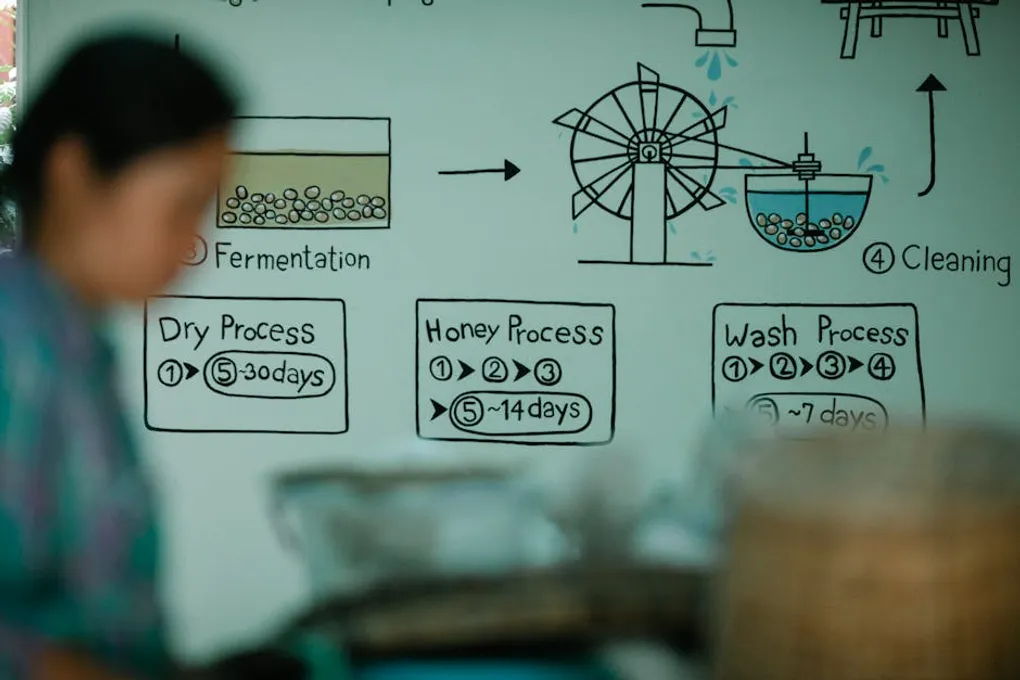
You see “honey process” on a coffee bag and think it tastes like honey. It doesn’t — at least not because of the name. The term comes from mucilage, the sticky golden layer of fruit pulp that clings to the coffee bean after the cherry skin is removed. It looks like honey. It feels like honey. But the flavor it creates depends entirely on how much of it is left on during drying.
That’s what the color labels — yellow, red, black, and sometimes white — are telling you. They’re not about the color of the bean or the roast. They describe how much mucilage the producer left intact, which determines how long the coffee takes to dry, how much fermentation happens along the way, and ultimately, what ends up in your cup.
This is the most controllable spectrum in coffee processing. And once you understand it, you’ll know exactly what to expect before you brew a single cup.
What Makes Honey Processing Different
Every coffee cherry has the same basic anatomy: outer skin, a thick layer of sweet mucilage, parchment, silverskin, and the bean (seed) inside. The three dominant processing methods handle the mucilage differently:
- Washed: Mucilage is completely removed by fermentation in water tanks, then rinsed clean. Clean, bright cup.
- Natural: The entire cherry dries intact. Maximum fruit contact, maximum fermentation. Bold, fruity cup.
- Honey: The skin is mechanically removed, but some or all of the mucilage stays on during drying. Everything in between.
Honey processing was developed in Costa Rica, where the micro-mill revolution gave small producers the equipment and control to experiment with mucilage levels. The color classification system — which grades honey coffee by how much mucilage is retained — emerged from those Costa Rican mills. It gave producers a language for a spectrum that had previously been described vaguely as “pulped natural.”
If you want to understand how Costa Rica became the birthplace of this technique, our deep dive into Costa Rican coffee covers the micro-mill culture that made it possible. Brazil, for the record, has been doing essentially the same thing for decades under the name “pulped natural.” The process is functionally identical. Costa Rica formalized the color grades.
Why It’s Called “Honey”
The name has nothing to do with honey flavor or sweetness in the cup. It comes from the mucilage itself. When the cherry skin is removed, the beans are coated in a translucent, viscous, amber-gold substance sticky enough to glue your fingers together. It looks like honey. It behaves like honey. The name stuck.
Many honey-processed coffees do taste sweet — sometimes honey-sweet, sometimes caramel or brown sugar. But that sweetness comes from fermentation chemistry during drying, not from the name.
The Color Spectrum
The color system is a gradient, not a set of rigid categories. Some producers blend the lines. But the general framework is consistent enough to be useful.
White Honey
Mucilage retained: about 10-15% (almost none)
Drying time: 5-7 days, typically full sun
White honey is the least common label in the spectrum. The bean is pulped aggressively, stripping away nearly all the mucilage — only a thin film remains. Some producers wash briefly after pulping, making this barely distinguishable from a washed coffee.
Flavor profile: Clean, bright, high clarity. Citrus, light floral notes, snappy acidity. Side by side with a washed coffee from the same farm, many drinkers wouldn’t notice the difference.
Risk level: Very low. Fast drying and minimal mucilage mean almost no defect risk.
Yellow Honey
Mucilage retained: about 25%
Drying time: 8-10 days, often in direct sun
The most common honey grade. About a quarter of the mucilage stays on after pulping. Direct sunlight accelerates drying, limiting fermentation time and keeping the cup relatively clean.
Flavor profile: Clean foundation with noticeably more sweetness and body than washed. Mild caramel, honey sweetness, light stone fruit — peach, apricot. The acidity is present but rounder. Think of it as washed coffee with the sweetness turned up.
Best for: People who prefer clean coffee but want a little more body and sweetness. A natural gateway from washed to the rest of the honey spectrum.
Red Honey
Mucilage retained: about 50%
Drying time: 12-14 days, partial shade
Half the mucilage remains. The beans are dried in partial shade — under tarps, shade structures, or during overcast periods — which slows the drying process. More time means more fermentation, more sugar breakdown, more flavor development.
Flavor profile: This is where the honey spectrum starts to show its teeth. Distinct sweetness — brown sugar, ripe stone fruit, sometimes tropical notes creeping in. Fuller body than yellow, with a syrupy mouthfeel. The acidity softens further, becoming juicy rather than bright. Plum, mango, red grape, dark honey.
Risk level: Moderate. Slower drying means the window for mold and over-fermentation is wider. Producers need to turn the beans regularly and monitor moisture levels closely.
Best for: Drinkers who want sweetness and fruit complexity without committing to the wilder territory of naturals. Red honey is the sweet spot of the spectrum — balanced enough for everyday drinking, interesting enough to reward attention.
Black Honey
Mucilage retained: about 100% (all of it)
Drying time: Up to 3 weeks, mostly in shade
The entire mucilage layer stays on. Drying happens mostly in shade, extending the timeline to three weeks as microbes work through the sugar-rich coating. The most labor-intensive and highest-risk honey grade.
Flavor profile: The most complex and polarizing end of the spectrum. Heavy body, pronounced sweetness, deep fruit — dark berries, dried fig, chocolate, molasses, wine-like notes. It approaches natural-process territory but tends to be cleaner and more structured. Where a natural might go wild and funky, black honey stays rich and sweet with better-defined edges.
Risk level: High. Three weeks of slow drying with a full sugar coating is an open invitation for mold, over-fermentation, and bacterial contamination. Producers must turn the beans multiple times daily and make judgment calls about shade levels, airflow, and timing. A single rain event or temperature spike can ruin a lot.
Best for: Adventurous drinkers. If you love naturals but wish they were a little more disciplined, black honey is your coffee.
The Science Behind the Spectrum
The flavor gradient isn’t arbitrary. More mucilage means more sugar available on the bean surface during drying. More sugar means more food for the microorganisms — yeasts, lactic acid bacteria, acetic acid bacteria — that colonize the drying beans. These microbes metabolize the sugars in the mucilage and produce organic acids, esters, and alcohols that are absorbed into the bean. Those compounds become the flavor precursors that roasting later develops.
Here’s the chain:
More mucilage retained → more sugar available → more microbial activity → longer fermentation window → more flavor compounds produced → more complexity in the cup
But that chain has a dark side. The same conditions that produce complexity also produce defects. Extended fermentation with abundant sugar can generate acetic acid (vinegar), butyric acid (rancid), or mold. The line between “complex and sweet” and “contaminated” is a function of producer skill, climate, and constant monitoring. This is why black honey is rare and expensive — the margin for error is razor-thin.
Where Honey Processing Thrives
Costa Rica is ground zero. The color classification system originated here, driven by a wave of micro-mills that gave small producers the equipment to control mucilage levels precisely. Costa Rica also banned Robusta cultivation by law, which means arabica producers compete on quality and processing innovation rather than volume. Honey processing is one result of that competitive pressure.
El Salvador has seen growing adoption, especially with Bourbon and Pacamara varietals at high altitude.
Brazil pioneered the underlying technique as “pulped natural” decades before Costa Rica formalized the color grades. Brazilian pulped naturals are functionally honey-processed — skin removed, mucilage retained during drying. The principle is identical; the scale is vastly larger.
Guatemala and Honduras are increasingly adopting honey processing as specialty coffee culture expands across Central America.
The Producer Perspective
Honey processing sits in a practical sweet spot for producers. Washed processing requires 15-20 liters of clean water per kilogram of green coffee, plus fermentation tanks and wastewater management. Honey processing uses water only for pulping. No tanks, no washing, no wastewater. Water use drops by 80% or more.
The tradeoff is labor. Mucilage-coated beans are sticky, clump together on drying beds, and must be turned frequently — every few hours for black honey — to prevent mold. Rain or humidity spikes can ruin a lot. A producer running black honey is committing to weeks of hands-on monitoring per batch.
The economics work because honey coffees command premium prices. A well-executed red or black honey can sell for significantly more than a standard washed lot from the same farm. The extra labor pays for itself — when the lot doesn’t develop defects.
How to Brew Honey-Processed Coffee
Honey coffees are forgiving brewers. Their inherent sweetness and body mean you don’t need to chase extraction the way you might with a delicate washed Ethiopian. A few adjustments help them shine:
Grind size: Medium. Slightly coarser than you’d use for the same coffee washed. The extra body doesn’t need aggressive extraction. See our complete grind size guide if you’re dialing this in.
Water temperature: 195-200°F (90-93°C). Slightly below the 205°F standard. Honey coffees already carry sweetness from processing — very hot water can over-extract and push bitterness.
Method: Pour-over works beautifully, letting the sweetness and fruit notes come through cleanly. See our V60 pour-over guide for technique. But the body and sweetness of honey coffees really shine in immersion methods — French press especially. The full immersion and metal filter let the oils and body pass through unfiltered, amplifying the syrupy mouthfeel that makes honey coffees distinctive.
What to avoid: Very fine espresso grinds with aggressive pressure can push honey coffees into bitter, astringent territory. If you’re pulling espresso, err toward a longer, gentler shot.
Reading the Bag
If a bag says “honey process” without specifying a color, it’s most likely yellow or red. Black honey is rare enough that producers and roasters almost always call it out explicitly — it’s a selling point. White honey is uncommon as a label in most markets.
Look for the color on the bag alongside the origin. A Costa Rican red honey or a Salvadoran black honey Pacamara are specific enough to set real expectations about the cup. Generic “honey process” is still useful — you can expect more sweetness and body than washed — but the color is where the real information lives.
The honey spectrum is one of the clearest examples of how processing shapes coffee flavor. Same bean, same farm, same season — change the mucilage percentage and you get a different coffee. That’s not marketing. That’s microbiology.
Frequently Asked Questions
- What is honey process coffee?
- Honey process coffee has its cherry skin removed but retains some or all of the sticky mucilage layer during drying. The mucilage — which looks and feels like honey, hence the name — ferments as the bean dries, adding sweetness, body, and fruit complexity that washed processing strips away. The amount of mucilage retained determines the color grade: white, yellow, red, or black. More mucilage means more fermentation, more sweetness, and more risk of defects during the longer drying period.
- What is the difference between red honey and yellow honey coffee?
- Yellow honey retains about 25% of the mucilage and dries quickly in direct sun over 8-10 days, producing a clean cup with mild sweetness and light stone fruit notes. Red honey retains about 50% of the mucilage and dries more slowly in partial shade over 12-14 days, giving microbes more time to work through the sugars. The result is noticeably more body, deeper sweetness (brown sugar, plum, dark honey), and a syrupy mouthfeel that yellow honey doesn't reach. Red is the middle of the spectrum — more complex than yellow, less intense than black.
- What does black honey coffee taste like?
- Black honey retains 100% of the mucilage and dries slowly in shade for up to three weeks, making it the most complex and richest end of the honey spectrum. Expect heavy body, pronounced sweetness, and deep fruit notes — dark berries, dried fig, chocolate, molasses, and sometimes wine-like character. It approaches natural-processed coffee in intensity but tends to be cleaner and more structured. Black honey is also the most labor-intensive and defect-prone grade, which is why it's rare and commands premium prices.
- Why is it called honey process if it doesn't taste like honey?
- The name comes from the mucilage layer that coats the bean after the cherry skin is removed. This mucilage is translucent, amber-gold, and extremely sticky — it looks and behaves like liquid honey. Producers working with honey-process lots literally have their hands coated in a warm, viscous, honey-like substance throughout the drying phase. Some honey-processed coffees do taste sweet or honeyed, but that flavor comes from fermentation chemistry during drying, not from the name itself.
- Is honey process the same as pulped natural?
- Functionally, yes. Brazil developed the pulped natural method decades before Costa Rica formalized the honey process color grades. Both remove the cherry skin and dry the bean with mucilage still attached. The difference is mainly in language and precision — Costa Rica's system classifies by mucilage percentage (white, yellow, red, black), while pulped natural in Brazil typically doesn't specify how much mucilage is retained. If a bag says pulped natural from Brazil, expect a flavor profile somewhere in the yellow-to-red honey range: more body and sweetness than washed, cleaner than a full natural.