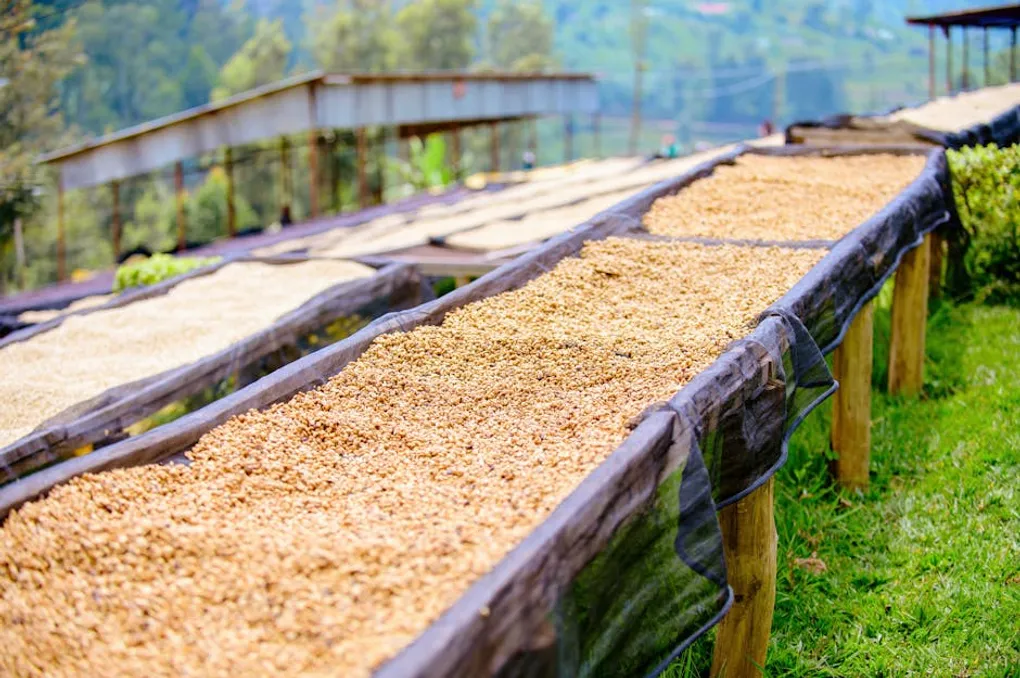
The label on your coffee bag says “washed” or “natural” or “anaerobic carbonic maceration” — and you’re supposed to know what that means. Most people don’t. Processing is the most underappreciated variable in coffee flavor. It determines more about what ends up in your cup than roast level, and arguably as much as the varietal itself.
Processing is everything that happens between picking a ripe coffee cherry and producing a dried green bean ready for export. The cherry is a fruit — a thin skin, a layer of sweet sticky mucilage, parchment, silverskin, and finally two seeds inside. How you remove those layers, and what you allow to ferment along the way, creates radically different flavor outcomes from the same raw material.
Here’s every major processing method, what it does, and what to expect when you see it on a bag.
The Traditional Methods
Washed (Fully Washed / Wet Process)
The process: Ripe cherries are pulped — the skin is mechanically removed within hours of picking. The beans, still coated in mucilage, go into fermentation tanks filled with water. Over 12–72 hours, naturally occurring microbes break down the mucilage. The beans are then washed clean and dried on raised beds or patios to about 11% moisture content.
Flavor profile: Clean, bright, high acidity. Floral and citrus notes come through clearly. Washed processing is often described as a “transparent” method — it lets terroir and varietal characteristics speak without adding much of its own voice. This is why most single-origin specialty coffees from East Africa, Central America, and Colombia are washed.
Defect risk: Low when done well — the washing stage removes floaters and over-fermented beans. But if fermentation runs too long, you get “stinker” beans with a rotten chemical taste.
Water/cost: High water use — roughly 15–20 liters per kilogram of green coffee. Acidic wastewater creates pollution problems near processing stations. Requires pulping machinery, fermentation tanks, clean water supply, and labor to monitor timing.
On the bag: If a bag just says the origin with no processing note, it’s almost certainly washed. Expect clarity, brightness, and acidity.
Natural (Dry Process)
The process: The oldest method. Whole cherries are spread on raised beds or concrete patios and dried intact in the sun for 2–4 weeks, turned regularly to prevent mold. The fruit ferments around the bean as it dries. Once the moisture drops to about 11%, the dried husk is mechanically removed.
Flavor profile: Fruity, full-bodied, lower perceived acidity. Blueberry, strawberry, tropical fruit, wine-like, sometimes funky or fermented. The extended contact with the fruit sugars during drying imparts flavors that washed processing strips away. Ethiopia and Brazil produce the most celebrated naturals.
Defect risk: High. Uneven drying, mold, over-fermentation, and insect damage are constant threats. The line between “pleasantly funky” and “defective” is thin. Naturals were historically considered inferior because most were defective — modern raised-bed drying and careful sorting have changed that.
Water/cost: Near-zero water use. Low infrastructure cost but high labor (constant turning and sorting over weeks). Risk of total crop loss if rain hits during drying.
On the bag: Expect bold fruit. If a reputable roaster is selling a natural, they’ve already sorted out the defects. These coffees are meant to be expressive.
Honey Process (Miel)
The process: A Costa Rican innovation that splits the difference between washed and natural. The cherry skin is removed by pulping, but some or all of the mucilage is left on the bean during drying. The amount of mucilage retained determines the “color”:
- Yellow honey: about 25% mucilage left. Dries fastest (often in direct sun). Closest to washed — bright, clean, with a touch more body.
- Red honey: about 50% mucilage. Slower drying, partial shade. Noticeable sweetness and fruit layered over clean acidity.
- Black honey: about 100% mucilage retained. Slowest drying (up to 2 weeks), requiring shade and constant attention. Heaviest body, most fruit-forward — approaching natural territory.
Flavor profile: The spectrum runs from “washed-plus” (yellow) to “clean natural” (black). Common notes: caramel, brown sugar, stone fruit, honey sweetness. The mucilage contributes body and sweetness without the wild fermentation character of a full natural.
Water/cost: Much less water than washed (pulping only, no tanks). Higher labor than washed — sticky beans are difficult to handle and must be turned frequently.
On the bag: Expect sweetness. Honey coffees are crowd-pleasers — accessible fruit and body without the polarizing funk of naturals. Costa Rica is the pioneer here.
Wet-Hulled (Giling Basah)
The process: Unique to Indonesia — primarily Sumatra, Sulawesi, and surrounding islands. Cherries are pulped and briefly fermented by the farmer, then sold to a collector while still at about 30–35% moisture (far wetter than other methods). The collector removes the parchment layer while the bean is still soft and wet, then finishes drying to about 11%. This early parchment removal while wet is what distinguishes Giling Basah from every other method.
Flavor profile: Heavy body, earthy, herbal, low acidity, cedary, sometimes mushroomy or tobacco-like. The wet parchment removal causes the bean to swell and partially crack, creating the characteristic dark, bluish-green color of Sumatran beans. Polarizing: some love the depth, others find it muddy.
Water/cost: Moderate water use. Low cost — the method exists because it’s fast. Farmers need cash quickly and the humid climate makes prolonged drying impractical. It’s an economic adaptation, not a flavor-driven choice.
On the bag: If it says Sumatra, Sulawesi, or Flores, it’s almost certainly wet-hulled. Expect earthy depth, not bright fruit.
The Experimental Methods
The last decade has seen an explosion of processing innovation, largely borrowed from winemaking and fermentation science. These methods share a common principle: controlling the fermentation environment to steer flavor development.
Anaerobic Processing (Washed or Natural)
The process: Coffee — either whole cherries (anaerobic natural) or pulped beans in mucilage (anaerobic washed) — is sealed in airtight vessels. Steel tanks, plastic drums, or even GrainPro bags with one-way valves are used. As naturally present microbes consume sugars, they produce CO2, which purges the remaining oxygen. Fermentation proceeds in this oxygen-free environment for 24–96 hours, sometimes longer, at controlled temperatures.
Why it matters: Without oxygen, aerobic bacteria are suppressed. Anaerobic yeasts and lactic acid bacteria take over, producing different metabolic byproducts — more esters, more lactic acid, less acetic acid. The result is intensified fruit character and a distinctly “juicy” mouthfeel.
Flavor profile: Intensely fruity, tropical, wine-like, confectionery. Passion fruit, mango, strawberry candy, red wine, cinnamon. The same origin processed traditionally versus anaerobically can taste like two completely different coffees.
Cost to producer: High. Sealed vessels, pressure-release valves, pH and Brix meters, and technical knowledge to monitor fermentation curves. Not available to most smallholders without cooperative infrastructure.
Carbonic Maceration
The process: Borrowed directly from Beaujolais winemaking. Whole, intact cherries are placed in sealed tanks that are then flushed with CO2 to create an entirely oxygen-free environment (rather than relying on fermentation to purge oxygen, as in standard anaerobic). The key difference: because the cherries are intact, fermentation begins inside each cherry at the cellular level (intracellular fermentation) before the skin eventually ruptures. This produces a distinct set of aromatic esters not found in other methods.
Sasa Sestic, founder of ONA Coffee in Australia, pioneered carbonic maceration in coffee and won the 2015 World Barista Championship using a CM-processed coffee. That single competition result launched a global wave of processing experimentation.
Flavor profile: Confectionery sweetness, tropical fruit esters, floral complexity. CM coffees often have a “perfumed” quality and a round, syrupy body. The intracellular fermentation creates flavor compounds chemically distinct from external fermentation.
Thermal Shock
The process: Pioneered by Diego Samuel Bermudez at Finca El Paraiso in Cauca, Colombia. After anaerobic fermentation, beans are washed with hot water (about 40°C) to expand the cellular pores, then immediately plunged into cold water (about 12°C). The rapid contraction is theorized to “lock in” volatile flavor compounds that would otherwise dissipate during drying. 2024 World Barista Champion Mikael Jasin used a thermal-shocked coffee in his winning routine.
Flavor profile: Intensely aromatic with high flavor clarity — the thermal shock reportedly preserves delicate floral and fruit volatiles, creating coffees that are simultaneously complex and clean.
Lactic Fermentation
The process: Coffee is fermented under conditions that favor lactic acid bacteria (LAB) — the same organisms that produce yogurt, sourdough, and kimchi. Producers can inoculate with specific LAB strains (such as Lactobacillus). 2024 World Brewers Cup champion Martin Wolfl used a two-stage fermentation: first wine yeast (Saccharomyces cerevisiae), then lactobacilli. Recent research shows that co-inoculation (yeast + LAB simultaneously) produced the highest cup scores.
Flavor profile: Creamy, yogurt-like body. Stone fruit, tropical fruit, but with a distinctive smooth, almost dairy-like mouthfeel. Less aggressive acidity than standard anaerobic.
Other Emerging Methods
Nitrogen maceration: 2025 World Barista Champion Jack Simpson used nitrogen gas instead of CO2 to create the anaerobic environment. Nitrogen is less reactive than CO2 and creates different fermentation dynamics. Still extremely rare at commercial scale.
Frozen cherry: Cherries cooled to 5–8°C and fermented slowly over about 8 days. The low temperature dramatically extends fermentation time, allowing slow flavor development.
Co-fermentation: Coffee fermented alongside fruit pulp (passion fruit, pineapple, mango) or cacao. This sits in a gray area between “processing” and “flavoring” — the 2024 Best of Panama excluded coffees “altered from their natural DNA expression by foreign additives.”
The Fermentation Science (Briefly)
All coffee processing involves fermentation. Even washed coffee ferments in the tank. The question is always: which microbes, for how long, under what conditions?
What the microbes are doing: Yeasts and bacteria consume the sugars in coffee mucilage (glucose, fructose, sucrose) and produce organic acids, alcohols, esters, and CO2 as metabolic byproducts. Those byproducts penetrate the parchment and the bean, creating flavor precursors that survive roasting. Cacao undergoes an even more extended version of this microbial fermentation — five to seven days versus coffee’s 12–96 hours — and the same yeast-to-LAB succession determines whether the chocolate will be worth eating.
Why oxygen control matters: In the presence of oxygen, Acetobacter bacteria convert alcohol to acetic acid (vinegar). In oxygen-free environments, yeasts and lactic acid bacteria dominate, producing ethanol, lactic acid, and aromatic esters instead. Controlling oxygen is controlling which metabolic pathway wins.
Temperature effects: Fermentation rate roughly doubles for every 10°C increase. At 35°C and above, fermentation is so rapid that it’s nearly impossible to stop before defects develop. At 15–20°C, fermentation is slow and controllable. This is why altitude matters for processing — cooler temperatures at higher elevations give producers more control. Understanding these variables is part of what goes into how coffee is roasted as well — the flavor precursors set during processing survive through the roast.
The Controversy: Innovation or Gimmick?
Not everyone is celebrating. The specialty coffee world is split on whether experimental processing is genuine innovation or a shortcut that masks terroir.
The case for: A conventionally washed lot from Colombia might sell for $3–5/lb green. The same farm’s anaerobic or CM lot can fetch $15–50/lb. For farmers on razor-thin margins, processing innovation is economic survival. And the flavors are real — these methods produce genuinely different chemical compounds, not artificial flavoring.
The case against: When processing dominates flavor so completely, does origin matter? An anaerobic natural from Colombia and one from Kenya can taste more similar to each other than either does to a washed coffee from the same farm. Critics argue this erodes specialty coffee’s core promise: the connection between place and cup.
Where the industry landed (so far): The 2024 Best of Panama excluded coffees “altered from their natural DNA expression by foreign additives.” The SCA changed WBC rules in 2023 to allow co-fermented coffees, then by 2025 specified no additives after the green coffee stage. The line is still being drawn.
The competition data tells its own story. Every recent WBC winner used experimental processing: Sestic (2015, carbonic maceration), Boram Um (2023, anaerobic Geisha), Mikael Jasin (2024, thermal shock), Jack Simpson (2025, nitrogen maceration). Traditional processing is no longer competitive at the absolute top.
The best experimental coffees are extraordinary. The worst are expensive gimmicks. Processing method signals flavor direction, not quality. A well-processed washed Ethiopian will always beat a poorly executed anaerobic from anywhere.
Origins and Their Signature Processes
- Ethiopia: Washed (Yirgacheffe, Sidamo) and natural (Harrar, Guji). Both methods have deep tradition here.
- Colombia: Washed traditionally, now the global leader in experimental processing. Finca El Paraiso is ground zero for thermal shock.
- Brazil: Natural and pulped natural dominate. Growing experimental sector.
- Costa Rica: Honey process pioneers. Yellow, red, and black honey widely available.
- Kenya: Almost exclusively washed. Complex, wine-like acidity.
- Indonesia (Sumatra, Sulawesi): Wet-hulled (Giling Basah). Earthy, full-bodied.
- Panama: Washed Gesha dominates the auction circuit.
- Yemen: Natural process with unique local fermentation traditions.
What to Look For When Buying
The processing method on a bag isn’t a quality guarantee — it’s a flavor direction signal. Here’s how to use it:
- If you want clarity and origin character: Washed. Let the bean speak.
- If you want fruit and body: Natural. Accept some variability.
- If you want sweetness without wildness: Honey. The accessible middle ground.
- If you want intensity and novelty: Anaerobic or CM. Be prepared for flavors that don’t taste like “traditional” coffee.
- If you want earthy depth: Wet-hulled Indonesian. A completely different experience.
The best approach is to try the same origin processed two different ways — a washed and a natural Ethiopian, for example. That comparison teaches you more about processing impact than any article can. You can browse a solid selection of naturally processed and washed coffees from specialty roasters to run your own comparison.
If you’re building out your understanding of what goes into a great cup, coffee grind size is the next variable worth mastering — grind consistency amplifies the differences processing creates.
Frequently Asked Questions
- What is the difference between natural and washed coffee?
- Washed coffee has its cherry skin and mucilage removed before drying — the bean ferments in water tanks for 12–72 hours, then is washed clean. Natural coffee dries inside the whole cherry for 2–4 weeks, fermenting as it dries. The result: washed coffees taste clean, bright, and acidic with clear origin character. Naturals taste fruity, full-bodied, and sometimes funky, because the prolonged contact with fruit sugars adds flavor the washing stage strips away. Neither is inherently better — they're fundamentally different flavor directions from the same raw material.
- What does anaerobic coffee mean?
- Anaerobic coffee is fermented in sealed, oxygen-free containers — steel tanks, plastic drums, or sealed bags with one-way CO2 valves. Removing oxygen suppresses acetic acid bacteria and lets yeasts and lactic acid bacteria dominate, producing different flavor compounds (more esters, more lactic acid). The result is intensely fruity, tropical, wine-like, and often confectionery-sweet coffee that tastes dramatically different from the same bean processed traditionally. Fermentation times typically run 24–96 hours at controlled temperatures. It's the most common experimental processing method and increasingly available from specialty roasters.
- What is carbonic maceration coffee?
- Carbonic maceration is a technique borrowed from Beaujolais winemaking. Whole intact coffee cherries are sealed in tanks flushed with CO2 gas, creating an oxygen-free environment. The key difference from standard anaerobic: because the cherries are unbroken, fermentation starts inside each cherry at the cellular level (intracellular fermentation) before the skin ruptures. This produces distinctive aromatic esters and a perfumed, confectionery sweetness not found in other methods. Sasa Sestic won the 2015 World Barista Championship using carbonic maceration coffee, launching a global wave of processing experimentation.
- Why are some specialty coffees so expensive because of processing?
- Experimental processing methods like anaerobic fermentation, carbonic maceration, and thermal shock require sealed vessels, CO2 or nitrogen tanks, temperature monitoring equipment, pH and Brix meters, and the technical knowledge to use them. A conventionally washed lot might sell for $3–5/lb green, while the same farm's anaerobic or CM lot can fetch $15–50/lb. The higher price reflects genuine additional cost and risk — an experimental fermentation that goes wrong can destroy an entire lot. That said, processing method alone doesn't guarantee quality. A well-executed washed coffee from a great origin will always beat a poorly controlled anaerobic from anywhere.
- What is honey-processed coffee?
- Honey process — developed in Costa Rica — removes the cherry skin but leaves some or all of the sticky mucilage on the bean during drying. It has nothing to do with actual honey. The amount of mucilage retained determines the color grade: yellow honey (about 25% mucilage, cleanest), red honey (about 50%, balanced sweetness), and black honey (about 100%, most fruit-forward, closest to natural). Honey coffees split the difference between washed and natural — more body and sweetness than washed, cleaner and more consistent than natural. They're excellent entry points if you want to explore how processing affects flavor.
Some links above are affiliate links. If you purchase through them, we earn a small commission at no extra cost to you.