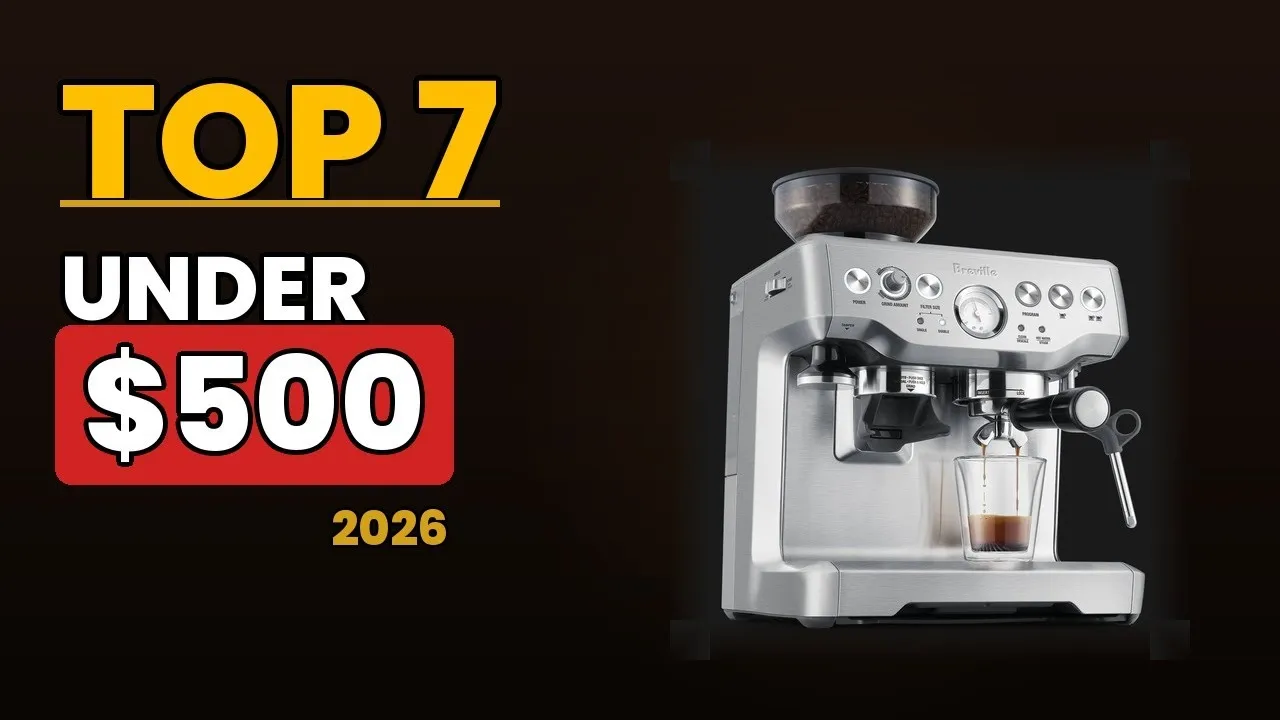
Under $500 buys a pump espresso machine with a steam wand, or a lever press you power by hand. It doesn’t buy the grinder, and for espresso the grinder matters as much as anything else on the counter. This page compares machines from their makers’ own specifications and US prices, checked on October 15, 2026, and from the data behind our Espresso Machine Chooser. It’s a research comparison, not a test of each machine.
Budget for the grinder first
Scott Rao calls the grinder “the most important piece of equipment in an espresso bar.” Espresso needs a fine, even grind, and a grinder that changes it in small steps is how you fix a shot that runs too fast or too slow. Every machine listed under $500 here needs a separate grinder; only the Barista Express, listed at about $700 when checked, has one built in.
Our Espresso Machine Chooser counts the grinder in your budget for any machine that needs one. In its data, the lowest-priced espresso grinders, the Baratza Encore ESP and the Breville Smart Grinder Pro, were each listed at about $200 when checked October 15, 2026. So a machine listed at about $300 is about a $500 setup (calculated) before a scale or a tamper. Our guides to espresso grinders and manual grinders compare options, and why the grinder matters more than the machine goes further.
What to compare at this price
Heating: brewing, then steaming
A thermoblock heats water in a small flow path; a single boiler keeps a small tank hot. Either way, one heater does both jobs, so the machine brews, then changes temperature to steam, one after the other. Breville says the ThermoJet in the Bambino and Bambino Plus reaches extraction temperature in 3 seconds. De’Longhi lists Thermoblock technology for the Dedica DeLuxe and a stainless steel boiler for the Stilosa.
Gaggia’s Classic Pro E24 has a single brass boiler. Its manual has you run a cup of water through the brew group after steaming, to bring the boiler down before the next shot; otherwise, it warns, the coffee may taste burnt.
Temperature control
The chooser’s data lists PID temperature control, an electronic controller that holds the brew temperature, for the Bambino, the Bambino Plus and the Barista Express. For the De’Longhi and Gaggia machines, the makers’ pages and manuals we checked don’t list one. Our Brew Guide starts espresso at 199°F (93°C) for a medium roast.
Pressure: what “15 bar” means
Most of these machines advertise a 15-bar pump. That’s the pump’s rating, not the pressure on your coffee. Breville describes low-pressure pre-infusion followed by extraction at 9 bar; Gaggia North America lists a 15-bar pump with its over-pressure valve set to 9 bar. Rao explains why more isn’t better: flow through the coffee peaks somewhere between 7 and 9 bar at the group, because extra pressure compacts the bed.
Baskets: single wall or dual wall
Breville includes both kinds with the Bambino and Bambino Plus. Its manual says to use the single-wall baskets with freshly ground beans, which let you “experiment with grind, dose and tamp”, and the dual-wall baskets with pre-ground coffee: they regulate the pressure and, Breville says, help optimize the extraction whatever the grind, dose, tamp pressure or freshness. Gaggia’s Classic Pro E24 comes with one pressurized filter and traditional filters for one and two cups. A basket that evens out the grind also mutes the effect of changing it, so with an espresso grinder and fresh beans, Breville’s advice points to the single-wall baskets.
Milk: manual wand, frothing wand or automatic
A manual steam wand gives you the most control over milk, with practice. A frothing wand (a panarello) adds air for you but is less precise. The Bambino Plus textures milk automatically. The chooser shows which each machine has, from the makers’ descriptions; our milk-steaming guide covers the technique.
Eight machines compared
| Machine | Listed at about (checked Oct 15, 2026) | Milk system |
|---|---|---|
| De’Longhi Stilosa EC260BK | $150 | Frothing wand |
| Flair Classic | $160 | None |
| De’Longhi Dedica Duo EC890M | $250 | Manual wand |
| De’Longhi Dedica DeLuxe EC685M | $280 | Frothing wand |
| Breville Bambino BES450 | $300 | Manual wand |
| Breville Bambino Plus BES500 | $500 | Automatic wand |
| Gaggia Classic Pro E24 | $550 | Manual wand |
| Breville Barista Express BES870 | $700 | Manual wand |
The milk systems are as the chooser records them. Prices are from each maker’s US site, or Gaggia’s US importer, Gaggia North America, and they change. The rows that follow give each machine’s specs as published by its maker.
De’Longhi Stilosa EC260BK
As published by the maker: a 15-bar pump, a stainless steel boiler, a “manual milk frother”, filters for single and double espresso, a 33.81 oz (1 L) water tank and 1100 W. Its listed size is about 8 in (20.5 cm) wide. De’Longhi’s page doesn’t give the portafilter’s diameter.
The lowest-priced pump machine here. De’Longhi calls its milk system a manual milk frother, and the chooser records it as a frothing wand. It suits someone who wants to find out whether home espresso sticks before spending more. De’Longhi says to descale it about every 200 coffees with De’Longhi descaler.
Flair Classic
The link above opens an Amazon search.
As published by the maker: “a 100% human-powered, direct lever espresso press” with “no plugs or electronics.” You heat the water in your own kettle. The kit includes a pressure gauge, a bottomless portafilter and a flow-control portafilter, and takes a 12 to 18 g dose. Flair listed it at about $160 when checked October 15, 2026.
There’s no milk system, and every shot needs water from a kettle. In return, you control the pressure through the shot with your own arm, and the gauge shows it. Flair says a burr grinder is essential for its bottomless portafilter. The Flair Classic isn’t in the chooser’s data, which covers Flair’s 58 models.
De’Longhi Dedica Duo EC890M
As published by the maker: a 15-bar pump, a commercial-style “My LatteArt” steam wand, presets for espresso, double espresso and cold brew, and 1450 W. De’Longhi’s manual gives its width as 5.8 in.
A narrow machine, 149 mm in De’Longhi’s metric figures, with a manual steam wand. The chooser shows its heating as a thermoblock: the specs on De’Longhi’s US page don’t name the heating system, but the product data behind that page lists Thermoblock technology. Descale when the B5 indicator lights, De’Longhi says; the cycle takes about 30 minutes.
De’Longhi Dedica DeLuxe EC685M
The link above opens an Amazon search.
As published by the maker: a 15-bar pump, Thermoblock technology, an “Adjustable manual milk frother”, a 37.2 oz water tank, 1300 W, compatibility with ESE pods and a 15 cm (about 6 in) width.
With the Dedica Duo, it’s one of the two narrowest machines here, both about 15 cm (6 in) wide by De’Longhi’s figures. De’Longhi calls its milk system an adjustable manual milk frother, and the chooser records it as a frothing wand, so it can suggest the DeLuxe if you take milk.
Breville Bambino BES450
As published by the maker: a ThermoJet heating system ready in 3 seconds, low-pressure pre-infusion and then 9-bar extraction, a 54 mm portafilter with single- and dual-wall baskets for one and two cups, an 18 g dose, PID temperature control and a manual steam wand. Breville’s manual gives a 1.4 L tank.
A fast-heating machine for someone who wants to learn milk steaming by hand. Breville suggests 12 in of countertop clearance; we don’t quote its printed width or depth, because Breville’s listed sizes conflict with its own clearance guidance. Cleaning and descaling are one combined cycle, flagged when the 2 Cup button flashes; there’s no separate backflush.
Breville Bambino Plus BES500
As published by the maker: everything above, plus automatic milk texturing with “3 adjustable milk temperatures and 3 levels of texture”, or manual texturing if you’d rather. Breville’s manual gives a 1.9 L tank.
The automatic milk texturing genuinely changed our opinion about machine-steamed milk: you set the jug under the wand, press a button and the machine textures the milk. If most of your drinks have milk and you don’t want to learn steaming first, this is the machine on the list built for that. It has the same 54 mm portafilter and the same 12 in suggested clearance as the Bambino. Its cleaning cycle uses a cleaning disc and tablet and comes due after 200 extractions.
Listed just over $500
Gaggia Classic Pro E24
As published by the maker and its US importer: a 58 mm stainless filter holder, a three-way solenoid valve that releases pressure after the shot and leaves drier pucks, a single lead-free brass boiler, a 15-bar pump with the over-pressure valve at 9 bar, and a 2.1 L tank. Gaggia North America listed it at about $550 in stainless and $600 in colors when checked October 15, 2026.
Gaggia North America calls it “the newest version” of the Classic Pro; Gaggia’s own site, and our chooser, call it the Classic E24. The chooser’s data records the earlier Classic Pro and Classic Evo Pro as replaced generations. Gaggia’s product page lists a professional stainless steel steam wand, and Gaggia North America a commercial-style wand with a two-hole tip. Gaggia’s manual describes “a steam wand just like professional machines,” and the chooser records it as a manual steam wand. With no PID listed, you manage the boiler’s temperature with the manual’s routine described above. Gaggia says to descale every 2 months, with its own descaler only. Our comparison of the Classic Pro, Bambino Plus and Philips 3200 goes into it further.
Breville Barista Express BES870
As published by the maker: a built-in grinder with steel conical burrs and 16 grind settings, a Thermocoil heating system, PID control that lets you adjust the default brew temperature by ±4°F in 2°F steps, low-pressure pre-infusion, a 54 mm portafilter, a manual steam wand and a 2 L tank. Breville listed it at about $700 when checked October 15, 2026.
It’s over this page’s budget, but the chooser counts it differently. With the grinder built in, its budget band is the machine alone, about $700, the same as a machine listed at about $500 plus a $200 grinder (calculated). Breville suggests 16 in of countertop clearance.
Our video on this topic was made with an earlier version of this page. Models and prices have changed since, so use the written comparison above for specs and prices.
Which machine fits how you drink
- Mostly milk drinks, no wish to learn steaming yet: the Bambino Plus, with its automatic wand.
- Milk drinks, and you want to learn to steam by hand: the Bambino, or the Dedica Duo with its manual wand.
- The least counter width: the Dedica Duo or the Dedica DeLuxe, each about 15 cm (6 in) wide.
- Straight espresso, no electricity, and a slower routine: the Flair Classic.
- A 58 mm portafilter and a three-way valve, just over budget: the Gaggia Classic Pro E24.
- One box, grinder included: the Barista Express, if the budget stretches to about $700 (listed price, checked October 15, 2026).
Once you have a machine and a grinder, our dial-in guide takes you from a first shot to a good one, and our cleaning and maintenance guide sorts out which care steps your machine needs. For a lower budget, see our guide to espresso machines listed under $200.
Some links above are affiliate links. If you purchase through them, we earn a small commission at no extra cost to you.
Sources
- Scott Rao, The Professional Barista’s Handbook (2008), p. 4, “The Grinder’s Role”
- Scott Rao, Espresso Extraction: Measurement and Mastery (2013), chapter 3, “Pump Pressure”
- Breville, product pages and US manuals, checked October 15, 2026: Bambino BES450 (product page; manual, M26, p. 10, “Filter Baskets”, and pp. 14–16, “Care & Cleaning”), Bambino Plus BES500 (product page; manual, Y25) and Barista Express BES870 (product page; manual, X26)
- Breville, Espresso Comparison Chart (US, code I25), suggested countertop clearance: Breville comparison chart (PDF)
- De’Longhi US product pages, checked October 15, 2026: Stilosa EC260BK, Dedica Duo EC890M and Dedica DeLuxe EC685M, with the Dedica Duo page’s product data (“Thermoblock technology”) checked October 19, 2026; the Dedica Duo US manual, §11, technical data, and the Stilosa manual, §9, descaling, as recorded in the chooser’s data
- Gaggia, “Classic E24” product page, checked October 15, 2026: gaggia.com; Gaggia, Classic E24 US manual (6420-010-43466, Rev 00), p. 9 (the steam wand), p. 20, “How to lower the boiler temperature,” and p. 22, “Descaling”: Gaggia manual (PDF)
- Gaggia North America (Importika), “Gaggia Classic Pro E24,” checked October 15, 2026: gaggia-na.com
- Flair Espresso, “Flair Classic,” checked October 15, 2026: flairespresso.com
- Baratza, “Encore ESP,” checked October 15, 2026: baratza.com
- JayArr Coffee Espresso Machine Chooser data (
machines.json), built from the makers’ pages and manuals, checked October 15, 2026