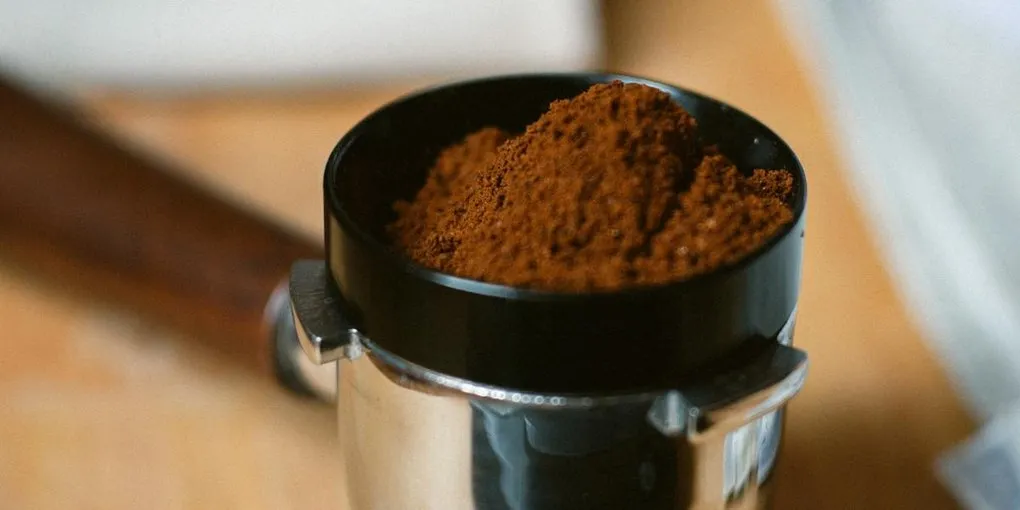
Freshly ground espresso often lands in the basket as clumps with air pockets between them, and an uneven bed gives the water uneven paths through the puck. Stirring the grounds with fine needles before you tamp breaks the clumps up and spreads the coffee more evenly. That stir is the Weiss Distribution Technique, or WDT, and the tool is just a holder for the needles.
Where WDT came from
WDT is named for John Weiss, a computer science professor and home espresso enthusiast who started stirring his grounds around 2004, while chasing even extractions from a bottomless portafilter he had cut himself. In a 2022 interview with Daily Coffee News, he recalled that “good grinds distribution in the basket was a critical factor in pretty extractions.” His tool was a dissecting needle left over from college, with a cut-down yogurt cup as a funnel. He shared the technique on CoffeeGeek in December 2005, then on Home-Barista later that month.
His Home-Barista how-to puts the method in a sentence: stir the grounds “with a thin object (such as a dissecting needle) to break up clumps and even the distribution,” and “get all the way down to the bottom of the basket.”
Why clumps form at all:
- Grinder design. Scott Rao, in Espresso Extraction (2013), writes that he had yet to see a doserless grinder that doesn’t create too much clumping; the old doser mechanism had broken clumps up, probably unintentionally.
- Static. Grinding charges the coffee, and charged particles stick together. In a 2024 study in Matter, darker roasts and finer settings charged the most. Our RDT guide covers that study and the drop of water some people add to the beans.
Depth matters more than the tool
The best public data on WDT depth comes from Jonathan Gagné, an astrophysicist who studies coffee. In a 2021 study, he logged the hydraulic resistance of 24 shots on a Decent DE1, all 18 g of the same coffee ground on a Niche Zero, and compared two ways of stirring with an eight-needle tool:
| Method | What he did | What he found |
|---|---|---|
| Surface WDT | Stirred only the top third of the bed, as Scott Rao had shown | Peak puck resistance varied by about 40% from shot to shot |
| Deep WDT | Pushed the needles to full depth, stirred in circles, worked up and finished at the surface | Peaks closer together, and most of the worst fast-running shots gone |
He kept using deep WDT. He also noted its limits: the shots that still stood out were the slow ones, about 15% to 25% of them, and “no style of WDT really fixes underlying problems in ground distribution during grinding.”
Does WDT raise extraction? Sometimes, but there’s no guarantee. In a 2022 post, Gagné wrote that deep WDT, a paper filter under the puck and a puck screen all reduced the dark spots under his spent pucks and, he reported, raised his average extraction. Grinding into his grinder’s dosing cup and stirring there before a second, deep WDT in the basket raised his extraction by about 1 percentage point, but over two shots, which he flagged as only two data points. Results like these depend on the grinder, the coffee and the routine.
Needle size, count and length
Makers sell needles in a range of sizes. Daily Coffee News puts most modern tools between 0.1 and 0.5 mm in diameter, and Normcore’s V3 ships with both 0.25 mm and 0.3 mm needles so you can choose.
- Diameter sets stiffness. A thin steel needle bends more easily than a thick one. For two needles of the same steel and length, stiffness rises with the fourth power of the diameter, so a 0.25 mm needle is about half as stiff as a 0.3 mm one (calculated: (0.25 ÷ 0.3)⁴ ≈ 0.48). None of the sources here measured how diameter changes the shot, so pick by feel; a thicker needle is just harder to bend if you knock it.
- Count is preference. Weiss used one needle, and told Daily Coffee News that he now uses an inexpensive four-needle keycap puller. Gagné preferred an eight-needle tool whose wide spread made the grounds easier to distribute evenly.
- Length decides depth. The needles have to reach the floor of your basket through your dosing funnel. Measure your funnel and basket before you buy; a tool that only reaches the top of the bed does surface WDT whatever you intend.
How to use a WDT tool
- Put a dosing funnel on the basket. Weiss used a yogurt cup with the bottom cut off; any funnel that sits snugly keeps the grounds in.
- Grind into the basket, or pour in your weighed dose.
- Push the needles to the bottom and stir in small circles across the whole basket, working up and finishing at the surface. That’s Gagné’s deep WDT; Normcore’s V4 product page says the same, to stir “from the lower layer upward.”
- Lift the tool out, remove the funnel and level the surface.
- Tamp level. Our tamping guide covers how hard.
If you use a paper filter under the puck, keep the needles from catching it; Gagné makes sure he doesn’t displace his.
If shots still taste sour and bitter at once, uneven extraction is a likely cause, and puck preparation is the first thing to check.
Three WDT tools, as their makers describe them
This is a research comparison from the makers’ own product pages, checked October 15, 2026, not a test. The specs are as published by each maker.
| Tool | Needles, as published | Design |
|---|---|---|
| Normcore WDT Distribution Tool V3 | Nine at a time, 0.25 or 0.3 mm (both sizes in the box); 50 mm long | Swappable needles; stand included |
| Normcore WDT Tool V4 | Up to 14, plus seven spares; 47 mm working length; diameter not stated | A twist extends or retracts the needles |
| Weber Workshops Moonraker | 316 stainless steel with copper springs; size not stated | A geared base moves the needles in a “spirographic” pattern |
- Normcore V3. The swappable needles let you choose 0.25 mm or 0.3 mm, or mix them.
- Normcore V4. Retracting the needles protects them, and you can fit fewer for a lighter stir or more for wider coverage, Normcore says. Its page doesn’t give the needle diameter.
- Moonraker. Weber says that with ordinary tools the needles stay on a circular track, so extra turns press grooves into the bed, while its geared movement randomizes the grounds more with each turn; it says two or more turns is enough in its testing.
Normcore’s US site listed the V3 at about $37 on sale ($50 regular) and the V4 at about $50, and Weber’s listed the Moonraker Ultra at $485, when checked October 15, 2026.
You don’t need to buy anything to try WDT. Weiss’s first tool was a single dissecting needle and a cut-down yogurt cup, and a few thin needles in any handle will do the same stir.
For the rest of the routine, our espresso dial-in guide starts from the Brew Guide’s recipe, 18 g of coffee to a 36 g shot in 25 to 30 seconds, and our guide to channeling covers the other causes of uneven shots.
Sources
- Howard Bryman, “What is WDT in Espresso? We Talked to Its Creator, John Weiss,” Daily Coffee News, December 14, 2022: dailycoffeenews.com
- John Weiss, “How to Banish Uneven Extractions” (the Weiss Distribution Technique), Home-Barista.com how-to: home-barista.com
- Jonathan Gagné, “A Study of Espresso Puck Resistance and How Puck Preparation Affects it,” Coffee ad Astra, January 16, 2021 (edited February 7, 2021): coffeeadastra.com
- Jonathan Gagné, “More Even Espresso Extractions,” Coffee ad Astra, July 16, 2022: coffeeadastra.com
- Scott Rao, Espresso Extraction: Measurement and Mastery (2013), chapter 10, “Doser Versus Doserless”
- J. Méndez Harper et al., “Moisture-controlled triboelectrification during coffee grinding,” Matter 7, no. 1 (2024): 266–283: doi.org/10.1016/j.matt.2023.11.005
- Normcore, product pages for the WDT Distribution Tool V3 and the WDT Tool V4 (specifications), checked October 15, 2026: normcorewares.com
- Weber Workshops, Moonraker product page (overview and technical specifications), checked October 15, 2026: weberworkshops.com