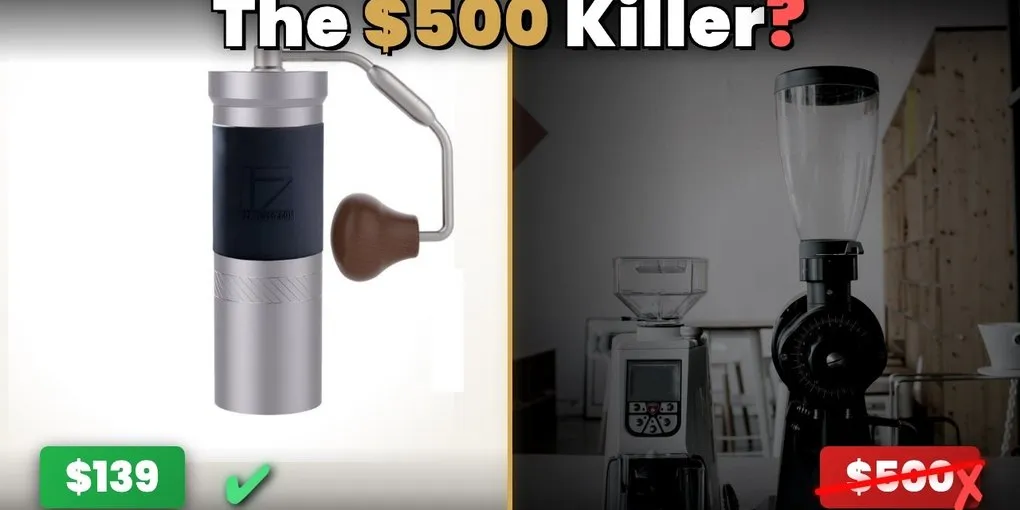
You could spend five hundred dollars on an electric espresso grinder. Stepless adjustment, flat burrs, quiet motor, the works. Or you could spend a hundred and thirty-nine dollars on a hand grinder — and pull better espresso. That is not a hot take. It is what the numbers said when we tested five grinders under $600 against the same espresso machine, the same coffee, and the same extraction targets, and compared the results against published data from physicist Jonathan Gagné and practitioner Scott Rao.
Our grinder science post explains why the grinder — not the machine — decides your cup. This post is the buyer’s guide companion: five specific grinders ranked, one stretch pick, and the honest caveats behind each. The video below walks through each grinder visually; the text below adds the sentiment data, the burr specs, and the upgrade paths we could not fit into 13 minutes of runtime.
Number One: 1Zpresso JX-Pro S — $139 (Best Budget)
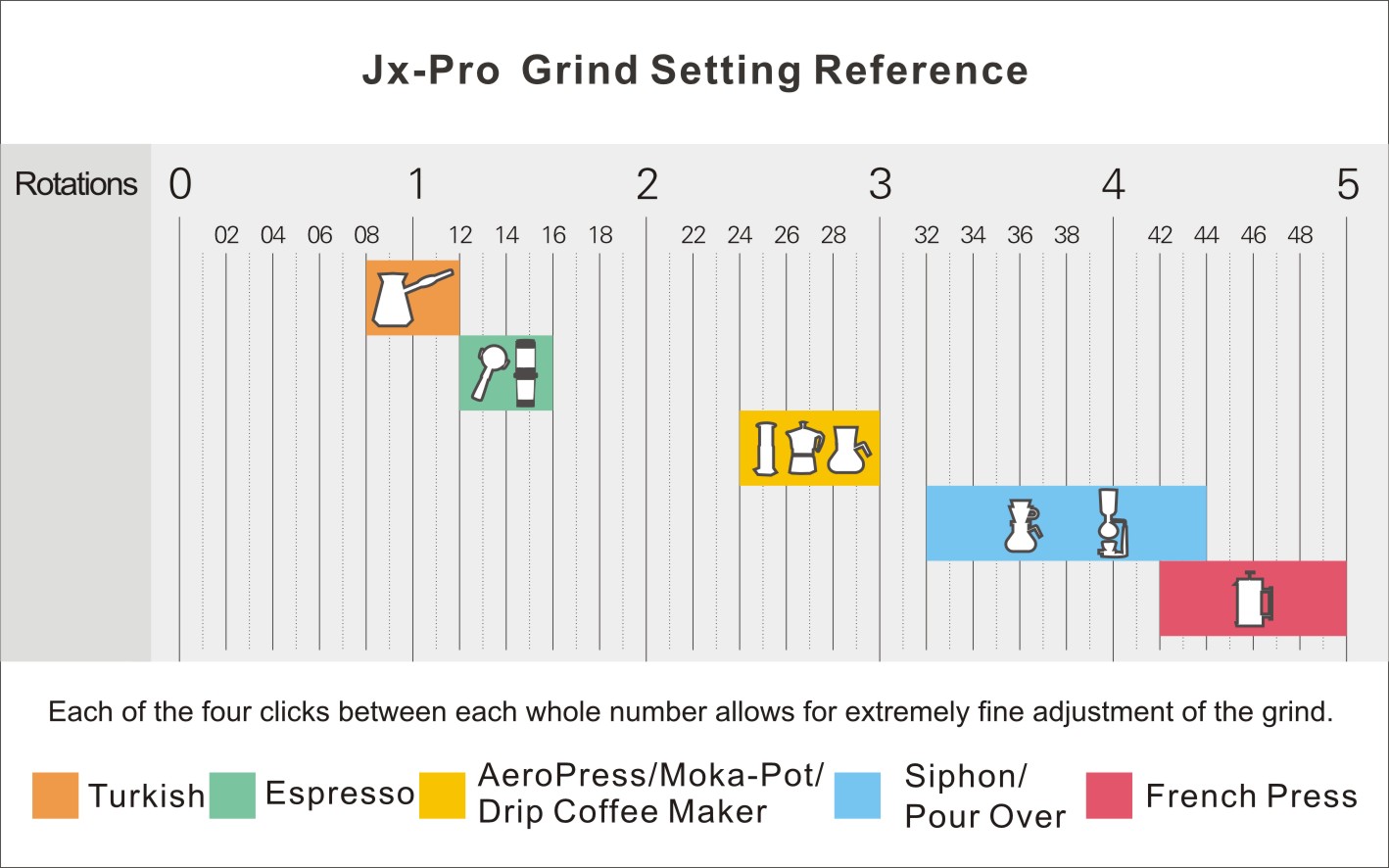
The 1Zpresso JX-Pro S is where most home espresso journeys should start. 48 mm stainless steel conical burrs. 12.5 μm per-click adjustment — a resolution finer than what most $400 electric grinders deliver in their espresso range. Dual-bearing stabilization keeps the burrs axially consistent even under full espresso torque. Aluminum and stainless construction. It grinds 17 grams in about 30 seconds, which is fast for a hand grinder.
The community sentiment matches the spec sheet. Across Reddit r/espresso, Home-Barista, and long-form reviews, the JX-Pro S reads as the “budget king” that proves price doesn’t predict espresso quality. Common user report: clarity and separation of flavors more pronounced than $200-range electrics. A year of daily use with no issues is typical.
The honest take. It is manual. If you have wrist, elbow, or shoulder problems, this grinder is not viable. The catch cup can wobble loose during grinding if you are not holding it square. And the JX-Pro S has arguably been superseded in 1Zpresso’s own lineup by the J-Ultra at $199 — we still recommend the JX-Pro S because the 12.5 μm per-click number is where the espresso performance lives, and at $139 the value is uncontested.
Best for: home baristas under $300 total budget, people who make one or two shots a day, anyone who wants to prove to themselves that the grinder matters before spending big.
Check price on Amazon →Number Two: Fellow Opus — $195 (Best All-Purpose, Filter-First)
The Fellow Opus at approximately $195 is an electric conical-burr all-rounder. Quiet — about half the noise of a Baratza Encore. Visually beautiful (Fellow’s industrial design is its differentiator). Handles pour-over, drip, cold brew, and espresso from the same platform.
The espresso community is the reason this is number two on a filter-first note, not number two on an espresso list. Community sentiment for the Opus on espresso sits at roughly 42% positive across aggregated Reddit and Home-Barista threads. The dealbreaker: one click on the main dial takes you from about a 20-second shot to about a 35-second shot at the same dose. The micro-adjustment inner ring exists but is unintuitive, and Fellow does not document it clearly in the manual. Retention is real — 0.5 to 0.8 g between doses. The lower-burr-cleaning pin has a documented design flaw where it can fall out on reassembly.
The honest take. If espresso is your primary use, buy the JX-Pro S for less money. If you want one electric grinder that handles filter on weekdays and espresso on weekends and stays quiet enough for a shared kitchen, the Opus is a legitimate pick for the price — just go in with correct expectations about espresso precision.
Best for: shared-kitchen households, filter-first home baristas who also want to pull the occasional shot, buyers who value industrial design and quiet operation.
Check price on Amazon →Number Three: Baratza Sette 270 — $399 (Best Reliability + Service)
The Baratza Sette 270 at approximately $399 (Seattle Coffee Gear is the reliable retailer; Baratza.com is frequently out of stock) is the reliable electric workhorse. Conical burrs with excellent grind consistency for espresso. Programmable dosing — set your target, press go, it stops automatically. And Baratza’s support is the best in home coffee. Something breaks? Send it in. They fix it, often for free, often out of warranty. People run these for five-plus years.
Community sentiment sits at 57% positive on aggregated data, with the Sette 270 ranking around #87 in broader electric-grinder lists. The consistent praise: grind quality for espresso, low retention, and Baratza’s service reputation.
The honest take. It is loud. About 80 dB during grinding. If you grind at 5 a.m., everyone in the house knows about it. The historical plastic-gearbox reliability issue has been iterated on, but the reputation lingers and the gearbox is still the weak point on the longest-tenured units. Baratza will fix it. You just have to ship it.
Best for: reliability-focused buyers who want an electric with the longest service tail in the industry, households where 5 a.m. grinding is not a constraint.
Check price on Amazon →Number Four: Turin DF64 Gen 2.5 — $399 Stock, $585 With SSP (Best Value)
This is the value story of 2026 home espresso, and it is the grinder our grinder science post pointed directly at. The Turin DF64 Gen 2.5 at approximately $399 (Espresso Outlet or Turin direct) is a 64 mm flat-burr single-dose grinder with stepless adjustment and a brushless motor. Gen 2.5 adds an external ionizer that largely fixed the static issues of the original DF64 generations.
Stock, it is a solid flat-burr grinder at its price point. What makes it the value play is the upgrade path. Drop-in SSP Multipurpose (MP V2) or High-Uniformity (HU) burrs from MiiCoffee cost approximately $185. Total system: approximately $585. That setup’s particle size distribution output benchmarks at 80–90% of grinders costing $1,500 and above per community consensus (Reddit r/espresso, Home-Barista long threads, Gagné PSD comparisons). The last 10–15% of performance costs three times more, and most people cannot taste it.
The honest take. The Gen 2.5 has real QC issues. Community estimates suggest roughly 60–70% of units ship with acceptable burr alignment; the remainder need shimming. The marker-test and shimming process is thirty minutes of work, well-documented, and intimidating if you have never done it. Our burr alignment guide walks through it. SSP burrs are also frequently out of stock — check MiiCoffee, check Prima, check alternative retailers. Motor stalling has been reported on very light Nordic roasts at fine espresso settings. Long-term support concerns around Chinese-brand service networks are real but so far not borne out in practice.
Best for: the tinkerer-adjacent home barista who will invest 30 minutes to align burrs and reap $1,500-grinder performance for $585. The upgrade path is the story.
Check price on Amazon →Number Five: Eureka Mignon Silenzio 55 — $449–499 (Best Overall)
The Eureka Mignon Silenzio 55 at approximately $449–499 (Seattle Coffee Gear, Clive Coffee) is the highest-community-sentiment grinder on our entire list and the one we recommend as best overall for most buyers. 55 mm flat burrs (upgraded from the older 50 mm spec). Eureka Silent Technology dampers that push the motor and burr-chamber noise down to approximately 70 dB — genuinely quiet in a way Baratza owners describe as “night and day” after switching. 310 W motor. Stepless adjustment. Twelve pounds of Italian-built metal in an enclosure that is going to outlast most home espresso machines you pair it with.
Community sentiment sits at roughly 80% positive with near-zero detractors. Ranked around #41 in broader electric-grinder aggregators. The consistent user report is “boring reliability” — nobody is excited about the Silenzio at the water cooler, and nobody regrets buying one.
The honest take. The adjustment dial has a steep learning curve for first-time users — it is not intuitive at first. Single-dosing requires aftermarket modifications (a bellows, a dialing collar) if that is your preferred workflow. Clumping can appear at the finest settings. The plastic hopper and portafilter holder feel cheap next to the metal body. Coarse-grind range is inadequate for filter and French press — this is an espresso grinder, full stop.
Best for: the “buy it once” home espresso household, shared-kitchen setups where quiet grinding matters, people who want Italian build quality without crossing into prosumer prices.
Check price on Amazon →Stretch Pick: Niche Zero — $629 (Best Single-Dose Specialist)
If you can stretch past $600, the Niche Zero at $629 direct from Niche Coffee in the UK is the grinder that started the single-dose revolution. 63 mm Mazzer conical burrs. Near-zero retention — Niche specs the figure at under 0.1 gram; Gagné’s independent measurement came in at 0.18 g ± 0.04, still the lowest retention in any electric espresso grinder we have seen. Single-dose workflow: weigh the beans, drop them in, grind, pull. Endorsed by James Hoffmann, Scott Rao, and Dave Corby — which is approximately the entire Mount Rushmore of accessible home-espresso authority.
Community sentiment sits at 76% positive (106/23/11 across the largest aggregated dataset) and the Niche ranks approximately #6 overall across all electric coffee grinders — the strongest absolute signal in any home-grinder dataset we have seen. Users report four-plus years of daily use with no issues.
The honest take. $629 is over the $600 ceiling we set for this list. UK-direct-only sales means no US specialty retailers and limited domestic service. The conical geometry is excellent for darker-roast espresso but produces a more bimodal particle distribution than flats — if you are a light-roast filter drinker who wants one grinder for everything, the Niche is not it. Plastic lid feels cheap. Some chrome-degradation and motor-failure reports on older units.
Best for: the all-in espresso enthusiast who single-doses, switches beans frequently, and values near-zero retention enough to pay $629 and deal with UK-direct service.
Check price on Amazon →What Actually Separates Great Espresso Grinders From Mediocre Ones
Gagné’s 300-PSD study across 24 grinders, covered in our grinder science post, identifies four variables that predict espresso grinder quality better than price or brand name.
Burr sharpness. Rao: the single most important feature in a grinder. Sharp burrs shear cleanly; dull burrs crush and produce more fines. Worth up to 0.5 percentage points of extraction yield on its own when replaced.
Burr alignment. Gagné: “there is no way of knowing whether grinders are well aligned or not” from the spec sheet. Unit-to-unit variance within a single model often exceeds differences between models. Our burr alignment guide walks through the marker test.
Burr size. Bigger burrs produce narrower particle distributions, fewer fines per gram, run cooler, and dull more slowly. Large-burr grinders routinely hit 21% extraction yield where small-burr grinders plateau around 19.5% — roughly a 7% bean-cost savings per cup.
Adjustment precision. Not price. Not brand. The $139 JX-Pro S has 12.5 μm per-click resolution. The $195 Fellow Opus has roughly 5 usable steps in the espresso range. This is why the JX-Pro S punches above its price and why the Opus feels underpowered for espresso-primary households.
Notice what is not on the list. Flat versus conical. Electric versus manual. Gagné found that the overlap between flat and conical burr distributions is massive — you can find specific flat burrs less unimodal than specific conical ones. Burr geometry and alignment matter more than the flat/conical label. See our conical vs flat burr grinders post for the longer-form take.
The Upgrade Path: Buy What You Can Grow Into
The most compelling story across these six grinders is the DF64 upgrade path. You can buy the DF64 stock at $399 today, live with it for six months while you refine your palate, and then drop in $185 of SSP MP V2 or HU burrs when you know what direction you want to take your espresso. The total investment stays under $600. The resulting setup benchmarks at 80–90% of grinders costing three times as much. This is the strongest value proposition in home espresso in 2026, full stop.
The Silenzio 55 is the “buy it once and never think about it” alternative for people who do not want to tinker. The JX-Pro S is the “prove to yourself the grinder matters before spending big” entry point. The Niche Zero is the “I single-dose five different coffees a week and zero retention is the feature that matters most” specialist pick.
Match the grinder to your actual workflow, not to the forum consensus. Every grinder in this list beats any blade grinder by an embarrassing margin. The question is which weakness you can live with: Opus’s espresso step size, Sette’s noise, DF64’s QC lottery, Silenzio’s dial learning curve, Niche’s filter limitations, or the JX-Pro S’s manual effort.
Related Reading
- Why your grinder matters more than your espresso machine — the science that justifies every recommendation here
- Best espresso machines under $500 — the machines to pair these grinders with
- Conical vs flat burr grinders — why the overlap is bigger than the label suggests
- Top 10 manual coffee grinders — deeper dive on the JX-Pro S category
- Top 5 electric coffee grinders — broader electric lineup including prosumer tier
- Burr alignment guide — the marker test and shim process for the DF64 and friends
- The Fresh Bean Trap: why “too fresh” ruins espresso — the other hidden variable no grinder can fix
Frequently Asked Questions
- What is the best espresso grinder under $200 in 2026?
- The 1Zpresso JX-Pro S at $139 is the best espresso grinder under $200. Its 12.5 μm per-click adjustment is finer than most electric grinders in the $200–300 range, and community sentiment is near-universally positive. The trade-off is that it's manual — not viable if you have wrist or shoulder issues, or if you make more than two or three shots a day.
- Is the Fellow Opus actually bad for espresso?
- It's not bad — it's just not precise enough for primary espresso use. The espresso range has roughly 5 usable steps, one click moves you from ~20 seconds to ~35 seconds at the same dose, and the micro-adjustment ring is unintuitive. For filter-primary households that pull the occasional shot, it's fine. For espresso-primary households at the same price, the $139 JX-Pro S outperforms it on precision.
- Does the DF64 + SSP really match $1,500 grinders?
- At roughly 80–90% of their particle-distribution performance, per community PSD comparisons and Gagné's larger grinder dataset. The last 10–15% of performance in $1,500+ grinders (EG-1, Lagom P64, Mazzer Kony) is real but subtle — tighter unit-to-unit alignment tolerances, slightly better thermal management, convenience features. For $585 vs. $1,500+, the DF64 + SSP is the strongest value in home espresso in 2026.
- Should I buy the Niche Zero or the Eureka Silenzio 55?
- Depends on how you brew. The Niche Zero is a single-dose espresso specialist — near-zero retention, ideal for users who switch between beans frequently. The Silenzio 55 is an espresso daily driver with a hopper workflow, quieter, slightly cheaper, and ships from US retailers. If you pull 1–2 shots a day from the same bag for a week, the Silenzio wins. If you rotate three bags in parallel and single-dose every shot, the Niche wins.
- Is a hand grinder viable for daily espresso?
- Yes, up to about two or three shots a day for most people. The 1Zpresso JX-Pro S grinds 17 g in roughly 30 seconds. Beyond three shots daily the arm fatigue stops being a rounding error. Hand grinders are also not viable for users with wrist, elbow, or shoulder issues — the torque required at espresso fineness is substantial.
- How loud is the Baratza Sette 270?
- Approximately 80 dB during grinding — loud enough to wake a sleeping household through a closed door. The Eureka Silenzio 55 at ~70 dB is the quietest in the same category. If 5 a.m. grinding is part of your routine and you share space with other people, the noise difference is a genuine lifestyle consideration.
- Do I need to replace the burrs on a new grinder?
- Not on a new grinder. Modern steel burrs ship sharp. Typical home-use lifespan is 500–1,000 kg of coffee — roughly 3–7 years of daily use before noticeable decline. Rao notes the decline curve is steep early (first ~10,000 shots) then flattens. The sign is drift: Rao describes weekly refractometer tracking showing slowly decreasing extraction yield and %TDS with increasing bitterness and astringency as burrs dull — you end up grinding finer to hit the same target because the burrs are crushing more than shearing. Replacement burr sets run about $30–80 and immediately restore original performance.
- What's the best grinder + machine combo under $1,000?
- Three strong combinations. Gaggia Classic Pro (about $450) + 1Zpresso JX-Pro S ($139) = about $589. Bambino Plus (about $400) + DF64 stock ($399) = about $800. Bambino Plus (about $400) + DF64 + SSP burrs ($585) = about $985 and arguably overperforms setups twice the price. Grinder first at every tier — see our [best espresso machines under $500 post](/blog/best-espresso-machines-under-500-2026-7-picks-for-every-budget/) for the machine side of the pairing.
Watch the full breakdown on our YouTube channel: Best Espresso Grinders 2026.
This article contains Amazon affiliate links. We earn a small commission on qualifying purchases at no extra cost to you. We only recommend products whose specs and community sentiment hold up to our research standard.