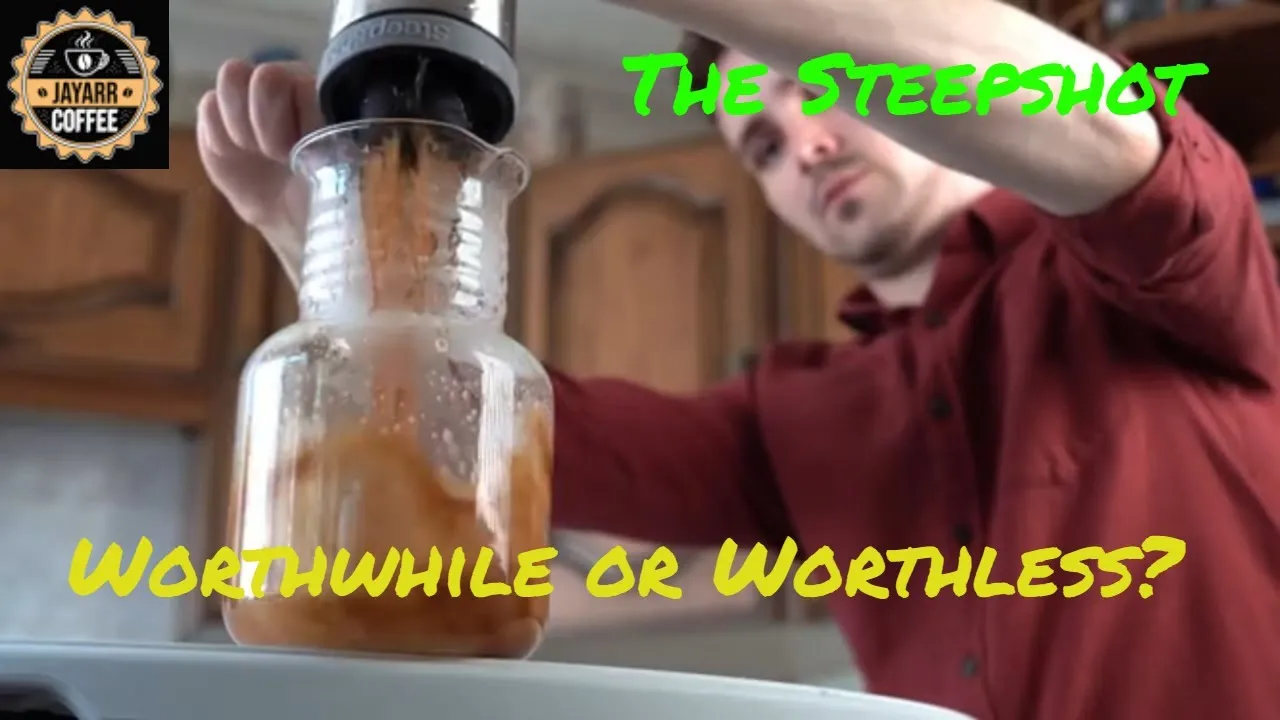
The SteepShot promises to brew coffee in 30 seconds using pressurized immersion. Invented by Ari Halonen in 2015 and backed by respected barista Tim Wendelboe, it raised 36,000 euros on Kickstarter before shipping in 2020. We paid over £100 (including shipping and customs) to find out if it delivers.
How It Works
The SteepShot is a sealed double-walled stainless steel chamber. Add grounds, pour boiling water quickly, screw on the lid. Pressure builds inside from heat and trapped air. After 20-30 seconds, flip it upside down, open the valve, and pressurized coffee flows into your cup.
It’s a hybrid brewer — immersion brewing accelerated by pressure. The sealed environment forces water through the grounds faster than passive steeping, which is how it claims to match extraction in 30 seconds that normally takes minutes.
The Test
Attempt 1: Following Instructions
14g coffee, 200g boiling water, mesh disc filter, 30-second steep. The SteepShot absolutely delivers on speed — the pressing action is satisfying and fast.
The coffee? Burnt and under-extracted at the same time. Cloudy, lighter than expected, an odd combination of flavors. Not terrible, but nothing close to what these beans could produce.
Attempt 2: Adjustments
Paper filter instead of mesh, medium-coarse grind, 95°C water (not boiling), 40-second steep. Noticeably better — much clearer, acceptable taste. Still light in color for the bean.
The takeaway: the SteepShot markets itself as simple and fast, but getting decent coffee requires the kind of dialing-in that somewhat defeats the simplicity pitch. You need to test grind sizes, water temperatures, steep times, and filter types — more experimentation than a brewer promising 30-second simplicity should require. Our grind size guide and brew temperature explainer helped us dial it in faster than most users would manage.
The Pros
Speed is real. Once dialed in, it’s genuinely 35-40 seconds from water to cup. If your mornings are truly time-constrained, this has value.
Built to last. Double-walled stainless steel, compact, portable. Won’t shatter, travels well, feels premium in hand.
Easy cleanup. Components rinse out straightforwardly with no tiny crevices.
The Cons
The coffee is just okay. This is the fundamental problem. It produces passable coffee — better than instant, worse than an AeroPress, pour-over, or even a good French press. The flavor tends toward muted, with less clarity than percolation methods and less body than traditional immersion.
Missing filter on arrival. Our unit shipped without the metal filter that’s supposed to be included. We had compatible AeroPress filters on hand, but a first-time buyer without backup filters would be stuck. At this price, that’s unacceptable.
The price. Over £100 all-in for a brewer that produces average coffee is hard to justify when an AeroPress costs a quarter of that and makes noticeably better coffee.
Build quality inconsistency. Visible machining marks on the top section, looking almost 3D-printed. Early production run, but at premium prices, fit and finish should be premium too.
What £100 Could Buy Instead
- An AeroPress ($35) + a quality burr grinder ($80-100) — superior coffee, money left over
- A Hario V60 starter set + a Fellow Opus grinder (about $70-80 combined) — exceptional pour-over
- Several months of excellent coffee beans — which improve your cup more than any brewing device
The SteepShot doesn’t outperform any of these alternatives. It occupies an awkward middle ground: not the fastest, not the cheapest, not the best-tasting.
The Verdict
The SteepShot is a brilliant idea that isn’t quite there yet. The concept of pressurized 30-second immersion brewing is genuinely interesting, and Tim Wendelboe’s involvement lends credibility. But the coffee quality doesn’t match the promise or the price.
If a future version addresses flavor consistency, drops the price, and ships complete, it could become a real contender. For now, buy an AeroPress. It makes better coffee, costs a quarter as much, and brews in under two minutes — not 30 seconds, but close enough that the quality difference more than compensates.
Frequently Asked Questions
- Does the SteepShot actually brew coffee in 30 seconds?
- The brewing cycle is about 30-40 seconds, yes. But '30-second coffee' is misleading — you still need to heat water, measure and grind coffee, and dial in your settings. And the out-of-box instructions produce mediocre coffee; getting decent results requires experimenting with grind size, water temperature, and steep time, which adds trial-and-error sessions. The speed is real once dialed in, but the simplicity pitch is overstated.
- Is the SteepShot better than an AeroPress?
- No. The AeroPress produces noticeably better coffee at about a quarter of the price ($35 vs. £100+). The AeroPress brews in under two minutes — not 30 seconds, but close enough that the quality difference more than compensates. The SteepShot is faster and more durable (double-walled stainless steel), but coffee quality is what matters, and the AeroPress wins clearly.
- Why does the SteepShot cost so much?
- It's a niche product with double-walled stainless steel construction, precision machining, and small-batch production. Plus shipping and customs from Finland add significantly to the cost. The materials and build quality are genuinely premium — the price reflects manufacturing costs and small scale, not markup on cheap components.
- Who should buy a SteepShot?
- Someone who values speed above all else and is willing to spend time dialing in their recipe. If your mornings are truly time-constrained and you can't spare two minutes for an AeroPress, the SteepShot's 30-40 second cycle has real value. But for most people, the AeroPress at $35 is the smarter buy.
Some links above are affiliate links. If you purchase through them, we earn a small commission at no extra cost to you.