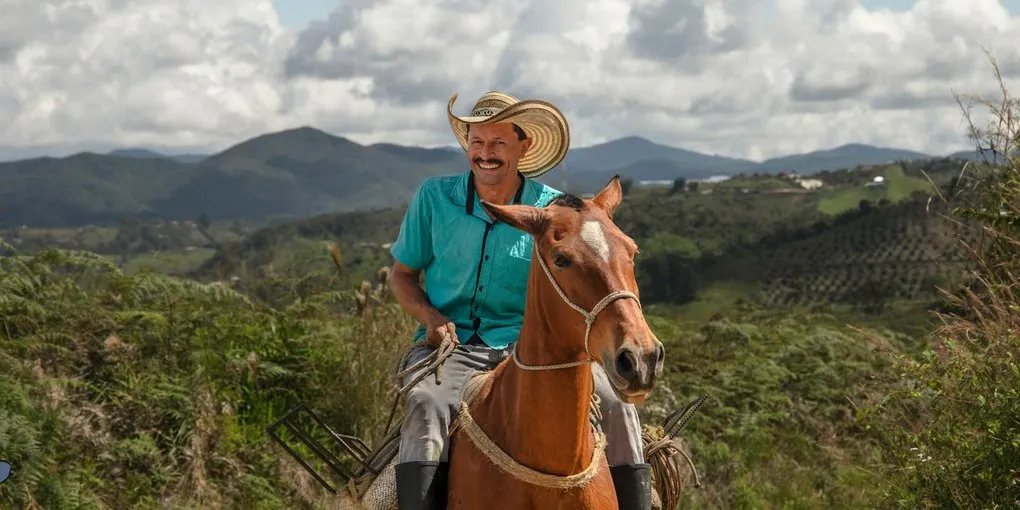
In January 1960, a fictional Andean coffee farmer in a sombrero with a mule named Conchita walked into American living rooms via a New York advertising agency, and over the next six decades he became the most recognized coffee mascot in the world — outpolling the logos of Nike and Michelin in some FNC surveys. His name was Juan Valdez, and the campaign that introduced him is the most successful national commodity branding effort in advertising history.
Juan Valdez wasn’t created to sell a brand. He was created to sell a country. By the late 1950s, Colombian coffee had been losing ground for decades — anonymously blended into American grocery cans, undifferentiated from Brazilian or Central American beans, and only 4% of US consumers could even name Colombia as a coffee-producing country. The Federación Nacional de Cafeteros de Colombia (FNC) decided to change that with a fictional farmer.
The campaign worked beyond anyone’s projections. Within five months, identification of Colombian coffee as “the world’s finest” rose 300%. Within five years, more than 40 US brands and 20+ European roasters featured all-Colombian packages. Today, Juan Valdez Café is a global retail chain with roughly 600+ stores across about 18–20 markets — including 370+ in Colombia, 68 in Ecuador, 26 in Turkey, and a US expansion underway. This article traces how that became the textbook case study for marketing an agricultural commodity. For the flavor side of the story — what Colombian coffee actually tastes like, region by region — see our Colombian coffee flavor profile guide. And for the parallel story of Brazil — Colombia’s much larger neighbor and the country whose price swings the FNC was built to insulate growers from — see our Brazilian Coffee Kingdom history.
Colombian coffee was anonymous before 1960, despite being a top-two producer.
By the 1950s, Colombia was the world’s second-largest coffee exporter behind Brazil — but you wouldn’t have known it from American grocery shelves. A widely cited 1963 audit of “one of the finest blends” sold in the US (almost certainly Folgers) showed 20% Brazilian, 40% Colombian, 30% Central American, and 10% African Robusta. Colombian beans were doing the heavy lifting in those cans, but the consumer never saw “Colombian” on the front of the package.
The structural problem went deeper than packaging. Coffee is a commodity, and commodity buyers don’t pay for origin. Brazilian, Colombian, and Central American beans were graded and traded on the New York Coffee Exchange (“C” market) by physical type and screen size — not by farm, region, or even reliably by country once blended. American roasters used Colombian beans for the body and clean acidity that made their blends drinkable, then advertised the brand name (Maxwell House, Folgers, Hills Brothers) — never Colombia.
This invisibility was expensive. The 1954 Brazilian frost drove Colombian green coffee to record highs (about $0.80/lb at the time), but as Brazilian production recovered through the late 1950s, prices crashed and Colombian growers — roughly 200,000 small mountainside farming families — had no way to defend their margin. They were selling generic coffee in a generic market.
The Federación Nacional de Cafeteros (FNC) was the institutional vehicle for the campaign.
Colombia is the only major coffee country built around a single dominant producer organization. The Federación Nacional de Cafeteros de Colombia, founded in 1927 at the Second National Congress of Coffee Growers in Medellín, was given administrative authority over a per-bag export tax through Law 76 of 1927 — a tax whose proceeds the federal government formally committed to the FNC by contract on October 15, 1928. That funding stream still underwrites the institution today.
The FNC’s scope is unmatched anywhere else in the coffee world. It owns and operates:
- Cenicafé — the National Coffee Research Center, founded by the FNC in 1938 in Chinchiná, Caldas. Cenicafé bred the rust-resistant Castillo variety (released for production in 2005 after 23 years of breeding work) and most recently the climate-resilient Castillo 2.0 (December 2024).
- Almacafé — the FNC’s inventory and warehousing arm.
- Banks, insurance, and cooperatives — local cooperatives buy coffee directly from smallholders at a federation-guaranteed price, smoothing out the cash-market volatility that crushes growers elsewhere.
- Extension services — agronomic advisors who work directly with farmers in the field.
- Procafecol — the FNC subsidiary that runs the Juan Valdez Café retail chain (created in 2002).
The FNC’s existence is what made the Juan Valdez campaign possible. No other coffee-producing country has a single body with the authority and budget to commission a marketing campaign on behalf of all its farmers. Brazil tried similar branding in the 1950s, but the federal-state-grower coordination problems made consistent execution impossible. Costa Rica, Guatemala, and Kenya never built equivalent national institutions. Only the FNC could write a $1 million-per-year ad budget on behalf of an entire country’s coffee sector. As Pendergrast notes in Uncommon Grounds, by 1927 A&P alone was already buying about one-tenth of Colombia’s total coffee output — averaging 4,000 bags per week — and the federation’s founding mission was to make sure Colombian growers captured more of the value of that volume rather than shipping it as anonymous commodity.
The FNC today represents roughly 500,000 coffee-growing families across Colombia’s three Andes cordilleras — the producer base for everything that follows.
Juan Valdez was invented by Doyle Dane Bernbach in New York and launched in January 1960.
The FNC contracted Doyle Dane Bernbach (DDB) — the same Madison Avenue agency that built “Think Small” for Volkswagen and “We Try Harder” for Avis — to create the character. DDB’s creative team developed Juan Valdez as a mustachioed Andean coffee grower in a sombrero and traditional peasant garb (poncho, white shirt, dark pants), accompanied by his mule Conchita carrying jute coffee bags.
Sources differ slightly on the exact launch year. The character was designed in 1958 (William Bernbach himself led the brief, per DDB’s own archive), the trademark was registered with the USPTO in 1960, and the campaign as most readers experienced it — print ads in ten major US markets followed by national television — debuted in January 1960. The opening headline read: “We don’t know who’s more stubborn — Juan Valdez or his mule.” Year-one ad spend exceeded $1 million.
The character has been portrayed on screen by three actors:
- José F. Duval (1960–1969) — a Cuban-American actor who played Juan Valdez in print and television campaigns through the first decade. (Mark Pendergrast’s Uncommon Grounds names him as the original portrayer; later sources sometimes overlook Duval entirely.)
- Carlos Sánchez (1969–2006) — a Colombian coffee farmer from Antioquia who became the iconic public face of the character. He held the role for roughly 37 years and is the actor most readers picture when they imagine Juan Valdez. He died in 2018 at age 83.
- Carlos Castañeda (2006–2024) — also a Colombian coffee farmer from Antioquia, selected through a global casting search after Sánchez retired. Castañeda died in May 2024 at age 58.
The genius of the character was that the advertising hype matched reality. Most Colombian coffee really was produced on small mountainside fincas — roughly 200,000 family farms at the time of the launch, around 500,000 today — by men whose work day looked recognizably like Juan Valdez’s. The mule wasn’t a fiction; coffee picked at altitude in the Andes routinely traveled by mule down to wet mills before mechanization. DDB didn’t have to invent a fantasy. They translated an unfamiliar Colombian reality into a sympathetic, American-readable image.
Five months of advertising changed how Americans thought about Colombian coffee.
Five months into the campaign, the FNC’s tracking data showed a 300% increase in US consumers identifying Colombian coffee as “the world’s finest.” Awareness of Colombia as a coffee-producing country jumped from the pre-campaign 4% baseline. Willingness to pay a premium for “Colombian Coffee” labeled products rose roughly 60% in follow-up FNC research.
By 1962 the campaign expanded into Canada and Europe. By the end of 1963 the television campaign had gone national in the United States, and the character had been given a son, Ramón, to extend the family-farm visual narrative.
The product-level breakthrough came in 1964, when General Foods switched its high-end Yuban brand to 100% Colombian coffee — the first major US grocery brand to differentiate explicitly on origin. Within five years of Juan Valdez’s debut, more than 40 US brands and 20+ European roasters featured all-Colombian packages. The “100% Colombian” label became a brand signal in its own right.
By 2001, the FNC’s tracking research found 60% of US consumers were aware of Juan Valdez as a Colombian coffee mascot, with visual logo recognition (Juan with his mule) reaching about 85% in some FNC-commissioned surveys. For a fictional character representing a commodity, those numbers were extraordinary.
In 2002, Juan Valdez left the advertising world and became a coffeehouse chain.
For its first 42 years, Juan Valdez existed only in advertising — a marketing character associated with bagged coffee on grocery shelves. In 2002, the FNC launched Juan Valdez Café as a coffeehouse chain operating under the same brand, through a newly created subsidiary called Procafecol. The first store opened on December 14, 2002, at Bogotá’s El Dorado International Airport. The model was direct competition with Starbucks, which had grown from a single Seattle storefront in 1971 to a global chain after its 1992 IPO.
The retail strategy was structural, not symbolic. By 2002, Vietnam had overtaken Colombia as the world’s #2 coffee producer (driven by an aggressive Robusta planting program through the 1990s), and Colombia’s share of global coffee revenue had been falling. Owning the retail experience — selling Colombian coffee directly to consumers as branded coffee shops — was a way to capture more of the value chain than the pure commodity export model allowed.
The expansion was fast. By the mid-2010s, Juan Valdez Café had crossed into Ecuador, Chile, Mexico, Spain, the United States, the Middle East, and parts of Asia. The flagship roastery opened in Bogotá; the brand introduced specialty single-origin Colombian offerings alongside its core blends.
The chain has 600+ stores in 2026 — but the US growth is the watch story.
As of 2026, Juan Valdez Café operates roughly 600–630 stores across about 18–20 international markets, with the largest concentrations in:
- Colombia — 370+ locations (the home market and global flagship).
- Ecuador — 68 locations.
- Turkey — 26 locations (the largest European footprint).
- Spain — 9 locations.
- Middle East — locations across Kuwait, the UAE, Egypt, and Qatar through the MENA partnership.
- United States — store count expanding rapidly in 2025–2026.
In April 2025, the company announced plans to open 16 additional US locations, and in February 2026 it opened its first global flagship store in Colombia. The expansion strategy emphasizes airport stores in Europe, retail consumer products (instant coffee, capsules, ground coffee), and direct e-commerce.
For a coffeehouse brand owned by a national producer federation rather than a private corporation, this footprint is unprecedented. Starbucks operates roughly 36,000 stores globally — Juan Valdez is nowhere near that scale. But the comparison misses the point. Juan Valdez Café isn’t trying to be Starbucks; it’s trying to be the retail arm of Colombian coffee farmers, capturing margin that would otherwise go to Maxwell House, Folgers, and other roasters who buy Colombian beans without paying a brand premium back to the people who grew them.
The FNC’s other moves: Castillo, “100% Colombian,” and EU geographic protection.
Beyond Juan Valdez, the FNC has executed three other branding interventions that compound the campaign’s effect.
The “100% Colombian” certification. Anchored by the Juan Valdez visual (Juan with Conchita, the federation seal), this label appears on cans of coffee whose beans are entirely from Colombian farms — regardless of which company roasts and sells the final product. It says nothing about cultivar, region, or quality grade, but it has carried genuine consumer trust since the Yuban switch in 1964.
Castillo. Cenicafé released the leaf-rust-resistant Castillo variety in 2005 after a 23-year breeding program — a five-generation backcross from a Caturra × Hibrido de Timor cross via the earlier “Colombia” variety. After the 2008–2013 leaf rust wave hit Colombia hard (production fell from 11 million to about 7.5 million bags), the FNC pushed Castillo replanting aggressively. The variety became controversial in specialty coffee circles — early Castillo lots were criticized for thinner cup character than Caturra — but newer selections have narrowed the gap meaningfully. Castillo 2.0, released in December 2024, targets climate resilience and is the FNC’s current flagship agronomic recommendation.
EU Protected Geographical Indication. In September 2007, the European Union granted Protected Geographical Indication (PGI) status to “Café de Colombia” — the first non-EU agricultural product ever to receive that designation. The protection prevents non-Colombian roasters from misleadingly labeling blends as “Colombian Coffee” in EU markets, and it lets the FNC police downstream branding (it has successfully blocked European chains from trademarking confusingly similar names). The UK extended equivalent protection in 2020 after Brexit; Switzerland recognized the geographical indication in 2013.
Together, the Juan Valdez character, the “100% Colombian” certification, Castillo’s continued agronomic success, and the EU PGI form an integrated branding stack that no other origin country has built. The combination is what people mean when they call Colombia the most successful branded origin in coffee.
Why this is THE textbook case study for marketing a commodity.
Marketing professors and advertising historians cite Juan Valdez for a specific reason: it accomplished what is normally considered impossible — building brand value into an undifferentiated commodity.
Coffee, like wheat, sugar, or copper, is a fungible commodity at the trading level. A bag of Brazilian Santos and a bag of Colombian Excelso of the same screen size move on the New York “C” market at near-identical prices, distinguishable only by the most knowledgeable buyers. Branding a commodity at the consumer level — getting the end drinker to ask for one country’s beans over another — was supposed to be impossible.
Juan Valdez did it through three moves the FNC executed almost perfectly:
- A narrative anchor that matched reality. A real Colombian farmer, on a real mountainside, with a real mule. American consumers could project sympathy onto him because he wasn’t a fiction in any morally important sense — he just looked unfamiliar without the visual translation DDB provided.
- Single-buyer institutional commitment. The FNC’s per-bag export tax meant every Colombian grower funded the campaign whether they wanted to or not, and the organization’s longevity meant the budget never disappeared. Most commodity branding fails because budgets are episodic; Juan Valdez had a 60+ year budget.
- Product-level reinforcement. The “100% Colombian” label, printed on cans of Yuban (1964) and dozens of other brands, gave consumers a way to vote for Colombian coffee at the grocery shelf. The character lived in advertising; the certification lived in the product. Each reinforced the other.
The result is the only mascot in commodity history that is simultaneously a marketing character, a retail brand, and a recognized symbol of national identity for the producing country. The closest equivalents — California raisins, Idaho potatoes, Florida orange juice — never crossed national borders the way Juan Valdez did.
For drinkers, the lesson is more subtle. The Juan Valdez campaign taught a generation of American consumers that coffee origin matters — that Colombian coffee tastes different from Brazilian, that geography has flavor consequences, that paying attention to where your beans come from is a legitimate consumer act. The single-origin specialty coffee movement that took off after 1990 owes a structural debt to Juan Valdez. Without four decades of Americans being taught that “100% Colombian” meant something, it would have been much harder to convince them, in 1995, that “Yirgacheffe” or “Antigua” meant something too. For more on how that specialty wave actually played out, see our third wave coffee history; for the practical end of the story — what to do with Colombian beans once you have them in your kitchen — see our reviews of six Colombian roasters and our Colombian flavor profile guide. The wider arc of Colombian variety politics — including the Castillo controversy — overlaps with our piece on arabica vs robusta differences.
Frequently Asked Questions
- Was Juan Valdez a real person?
- No. Juan Valdez is a fictional character created by the Doyle Dane Bernbach (DDB) advertising agency in New York for the Federación Nacional de Cafeteros de Colombia (FNC). The character was designed in 1958, the trademark was registered in 1960, and the print and television campaign launched in major US markets in January 1960. However, the visual archetype was deliberately accurate to reality: most Colombian coffee in 1960 was produced on small mountainside fincas by roughly 200,000 family farmers whose work day looked recognizably like the character's. The mule (Conchita in the campaign) was a real piece of Colombian coffee logistics — beans routinely traveled by mule from altitude down to wet mills before mechanization. The character was a translation, not a fabrication.
- Who has played Juan Valdez over the years?
- Three actors. José F. Duval, a Cuban-American actor, played him in print and television from the 1960 launch through 1969. Carlos Sánchez, a Colombian coffee farmer from Antioquia, took over in 1969 and held the role for roughly 37 years until his retirement in 2006; he is the face most consumers picture when they think of Juan Valdez. He died in 2018 at age 83. Carlos Castañeda, also a Colombian coffee farmer from Antioquia, was selected through a global casting search to replace Sánchez and held the role from 2006 until his own death in May 2024 at age 58.
- What does the "100% Colombian" label actually guarantee?
- The "100% Colombian Coffee" designation, certified by the FNC, requires that 100% of the beans in the package come from Colombian farms. It says nothing about cultivar (Caturra, Castillo, Typica, or a mix), processing (almost always washed), region within Colombia, or quality grade — those vary widely. The certification was the product-level reinforcement of the Juan Valdez advertising campaign starting in the early-to-mid 1960s, and General Foods' Yuban brand was the first major US grocery brand to switch to 100% Colombian (1964). The logo appears on packages from many roasters who buy FNC-traded coffee.
- How many Juan Valdez Café locations exist in 2026?
- As of early 2026, Juan Valdez Café operates approximately 600–630 stores across roughly 18–20 markets. The largest concentrations are in Colombia (370+ locations), Ecuador (68), and Turkey (26). The brand is expanding aggressively in the United States in 2025–2026, with announced plans for 16 additional US locations, and opened its first global flagship store in Colombia in February 2026. The chain launched in December 2002 — 42 years after the advertising character was created — when the FNC moved into direct retail to capture more of the coffee value chain.
- Is Juan Valdez Café actually owned by Colombian coffee farmers?
- Yes — through the FNC, which is funded by a per-bag export tax (Law 76 of 1927) on Colombian coffee exports. The FNC represents roughly 500,000 coffee-growing families and operates Juan Valdez Café through its subsidiary Procafecol, with profits flowing back into the National Coffee Fund and FNC programs (research at Cenicafé, extension services, cooperative banking, infrastructure). This is structurally different from Starbucks or other private chains: Juan Valdez Café is the retail arm of a national producer federation, not a corporation buying coffee from anonymous suppliers. Whether individual farmers see meaningful direct income from the chain's success is a separate, contested question — the FNC reinvests centrally rather than distributing profits as dividends.
- Did the FNC develop the Castillo coffee variety?
- Yes. Castillo was bred by Cenicafé — the FNC's national coffee research center, founded in 1938 — and released for commercial production in 2005 after 23 years of breeding work. It's a five-generation backcross descended from Caturra × Hibrido de Timor (the same cross that produced the earlier 'Colombia' variety), engineered for leaf rust resistance. Castillo was controversial in specialty coffee circles when first released — early lots were criticized for thinner cup quality than Caturra — but newer Castillo selections have narrowed the gap. Castillo 2.0, released December 2024, targets climate resilience and is now the FNC's flagship agronomic recommendation.
- Why did the EU give 'Café de Colombia' Protected Geographical Indication status?
- In September 2007, the European Union granted Café de Colombia Protected Geographical Indication (PGI) status — the first non-EU agricultural product ever to receive that designation. The FNC pursued PGI because it gives the federation legal standing to block European chains, roasters, and product lines from misleadingly labeling non-Colombian coffee as 'Colombian' in EU markets. The UK extended equivalent protection after Brexit (2020); Switzerland recognized the indication in 2013. Together with the Juan Valdez character and the '100% Colombian' certification, the PGI completes the FNC's integrated branding stack.
Sources: Mark Pendergrast, Uncommon Grounds: The History of Coffee and How It Transformed Our World (Basic Books, 3rd ed. 2019), Chapters 8 and 14; Robert Thurston, Coffee: A Comprehensive Guide (Rowman & Littlefield, 2013), Chapter 26 on Colombia; Federación Nacional de Cafeteros official archive (federaciondecafeteros.org); Juan Valdez Café corporate communications (juanvaldez.com); JayArr Coffee Knowledge Synthesis.