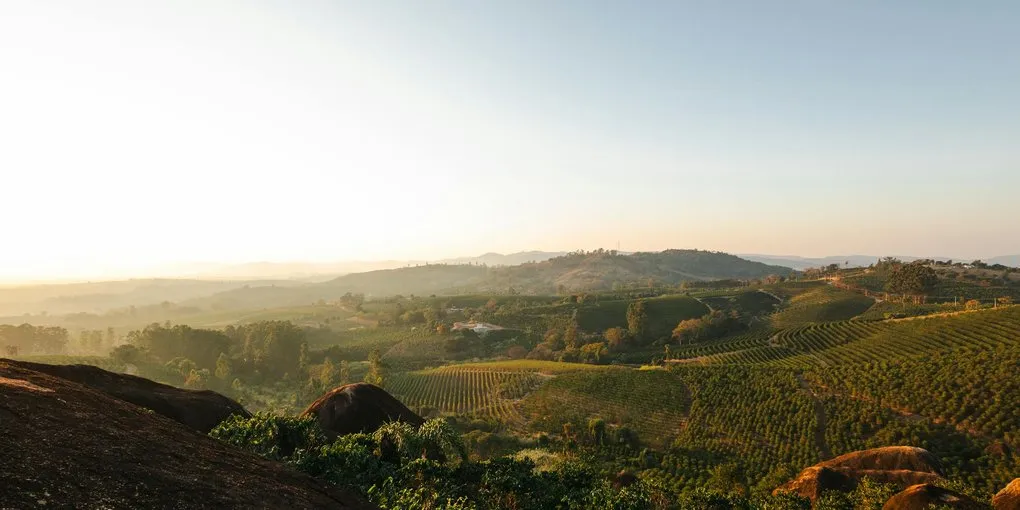
For most of the last two centuries, Brazil has supplied somewhere between a third and three-quarters of the world’s coffee. That dominance is not an accident of climate. It is the product of a specific 140-year political project — built first on the bodies of two million enslaved Africans, then on a pressed-down stream of Italian and Japanese immigrants, then on a series of state interventions to support prices that culminated in the most extraordinary act of agricultural destruction in modern history: between 1931 and 1944, Brazil burned, dumped, or industrially repurposed roughly 78 million bags of coffee — equivalent to about three full years of total world consumption at the time.
The story of how Brazil became a coffee superpower has three protagonists. The first is the slave-and-immigrant labor system that built the great fazendas of the Paraíba Valley and São Paulo state in the 1800s. The second is Hermann Sielcken, the German-American broker who in 1906 helped engineer the world’s first international coffee price-support scheme — the valorização — and who testified to the U.S. Congress with a snap of his fingers. The third is Getúlio Vargas, the populist who took power in 1930, established the Departamento Nacional do Café, and turned coffee destruction into a tool of state consolidation.
Mark Pendergrast’s Uncommon Grounds is the standard narrative of this period. What follows compresses Pendergrast’s Chapters 2, 5, and 9 into the chronology that explains why Brazil today still produces more coffee than any other country on earth — a profile that makes Brazilian beans the workhorse of espresso blends and the smooth, low-acid baseline you can read about in our is Brazilian coffee any good guide.
Coffee Reached Brazil Through a Colonial Border Dispute in 1727
Brazil acquired its first coffee plants because of a colonial border dispute. In 1727, Portuguese officer Francisco de Melo Palheta was sent to French Guiana to arbitrate a frontier disagreement between French and Dutch Guiana. He left for Brazil with a farewell bouquet from the wife of the French governor — by the durable telling, Madame Claude d’Orvilliers — inside which she had hidden ripe coffee berries. He planted them in Pará, in the tropical north. (Modern historians treat the seduction details as folkloric — by 1727 Palheta was 57 and Madame d’Orvilliers about 50 with four children — but the diplomatic mission, the smuggled cuttings, and the Pará planting are the documented core.)
Coffee’s Brazilian engine, however, was not in tropical Pará. It was 2,000 miles south, in the hills behind Rio de Janeiro. A Belgian monk introduced coffee to the Paraíba Valley in 1774, and the bean found in the valley’s iron-rich red soils — the famous terra roxa — exactly the conditions it needed. The land had not been farmed because of the gold and diamond mining boom of the early 1700s; depleted gold-mining mules now carted the cherries down existing tracks to the sea, and surviving mining slaves became coffee harvesters.
The political backbone for the coffee economy arrived in November 1807, when Napoleon’s forces captured Lisbon and the Portuguese royal family fled by British ship to Rio de Janeiro. King John VI declared Brazil a kingdom, set up coffee experimentation at the Royal Botanical Gardens in Rio, and distributed seedlings to planters. Brazilian independence followed in 1822 under his son Dom Pedro I, and in 1840 the 14-year-old Pedro II took the throne. Under Pedro II’s long reign, as Pendergrast puts it, “coffee would become king in Brazil.”
The Coffee Kingdom Was Built on Slavery
Brazil’s coffee boom of the 1800s ran on enslaved labor. The numbers Pendergrast cites for Brazilian slave imports during this period are stark:
- 1825 — 26,254 enslaved Africans imported.
- 1828 — 43,555.
- By the late 1820s, well over one million enslaved people labored in Brazil — nearly one-third of the country’s population.
- 1831 — Brazil formally outlawed slave importation to placate the British, but did not enforce.
- 1848 — about 60,000 slaves per year still being imported.
- 1850 — British warships began capturing slave ships; Brazil enacted a true ban. Two million Africans already in the country remained in bondage.
Conditions in the great Paraíba Valley fazendas were close to those of the worst U.S. cotton plantations and worse than most. Pendergrast writes that slaves “died after an average of seven years” and that “the owners found it cheaper to import new slaves than to maintain the health of existing laborers.” Pre-dawn prayers at 4 A.M. began a 17-hour workday, with seven hours locked at night in separate-gender quarters. Beatings, murder, and the sale of children away from parents were routine.
A Brazilian member of parliament summarized it in 1880, in a sentence Pendergrast reports verbatim: “Brazil is coffee, and coffee is the negro.”
The transition out of slavery was slow. Pedro II — who had freed his own personal slaves three decades earlier — signed the Law of the Free Womb in 1871, guaranteeing freedom for every child born to a slave mother. In 1884 the Paulista coffee growers won federal funding to import European immigrant labor as replacements. On May 13, 1888, while Pedro II was abroad, his daughter Princess-Regent Isabel signed the Lei Áurea (Golden Law), freeing the remaining Brazilian slaves. The next year, the coffee planters of São Paulo and Minas Gerais helped depose Pedro II and installed a republic in their own image.
Italian Colonos Replaced Slaves on the Paulista Fazendas
The end of slavery did not end the Brazilian coffee labor problem; it transformed it. From 1884 to 1914, more than one million mostly Italian colonos arrived in São Paulo plantations under a federally subsidized passage-payment scheme. Most were poor, many returned to Italy, some eventually bought land of their own. Japanese immigrants began arriving in 1908.
The colono system was technically wage labor but practically a form of debt peonage. Workers were paid in chits redeemable only at the plantation store; the chits never quite covered the bill. Capangas — armed guards — patrolled the plantations to prevent flight. Pendergrast reports the case of Francisco Augusto Almeida Prado, “a much-hated owner” who was “hacked to pieces by his colonos when he strolled through his fields unprotected.”
Even with the labor problem partly solved, the production scale of the Paulista coffee economy in the late 19th century was unlike anything the world coffee market had seen:
- 1867 — First Santos-region railway line built specifically to move coffee.
- 1874 — Submarine cable connects Brazil to Europe; coffee orders move in hours instead of weeks.
- 800 miles of track in 1874 → 6,000 miles by 1889.
- Production: 5.5 million bags in 1890 → 16.3 million bags in 1901.
- By 1900 — over 500 million coffee trees grew in São Paulo state alone.
- Francisco Schmidt, a German immigrant who arrived in the 1880s, eventually owned 20 huge fazendas with 16 million coffee trees, a private railway and phone system, and thousands of colonos.
This was the era of cafeicultura — the political dominance of the coffee oligarchy. Brazilian federal politics for the half-century after 1890 ran on what historians later called café com leite — “coffee and milk” — the alternating presidencies of São Paulo (coffee) and Minas Gerais (cattle/dairy) elites.
The 1906 Valorization Engineered the World’s First Coffee Price Support
Brazil’s overproduction crashed coffee prices repeatedly through the late 1890s and early 1900s. The 1901 harvest alone pushed visible global stocks to 11.3 million bags — over two-thirds of total world consumption — and the price hit 6¢ per pound. Brazilian planters began demanding government action.
What they got, on February 26, 1906, was the Taubaté Accord — an agreement among the presidents of São Paulo (Jorge Tibiriçá), Minas Gerais (Francisco Antônio de Sales), and Rio de Janeiro (Nilo Peçanha) to buy surplus coffee and hold it off the market. Pendergrast’s accounting:
- August 1, 1906 — the Disconto Gesellschaft Bank of Berlin lent £1 million for one year via its Brazilian subsidiary.
- October 1906 — buying began at the Santos port at an average of 7¢/lb. The bank syndicate paid 80% (effective price 5.6¢/lb), São Paulo paid 20%. By year-end the syndicate had purchased 2 million bags.
- December 14, 1906 — a £3 million bailout loan from J. Henry Schroeder & Company (London) and National City Bank (New York). The German-American broker Hermann Sielcken represented the U.S. side and personally covered $250,000.
- Late 1908 — a £15 million ($75 million) consolidation loan. A committee of seven took control of the remaining valorized stock; Sielcken was one of the seven. Even São Paulo had only one seat.
The plan worked. The price rose from 6–7¢/lb in 1906 to nearly 11¢ by December 1910 and over 14¢ in 1911, peaking in 1912 — exactly as the Brazilian economist J. F. de Assis-Brasil had predicted at the 1902 New York Coffee Exchange conference.
Sielcken, on his own account to Congress later, called it “the best loan I have ever known.” His Baden-Baden estate at the height of his career held four villas, a bathhouse, a rose garden with 168 varieties on 20,000 bushes, an orchid greenhouse, and grounds maintained by six professional gardeners and forty assistants.
Sielcken Snapped His Fingers at Congress
The 1906 valorization scheme was, in U.S. legal terms, a transnational price-fixing cartel. American coffee prices roughly doubled between 1906 and 1912. Congressional reaction was sharp.
In March 1911, Representative George W. Norris (Nebraska) introduced a House resolution demanding investigation of a “monopoly in the coffee industry.” On May 16, 1912, Sielcken testified before the congressional “Money Trust Investigation” subcommittee. Pendergrast records the exchange.
The subcommittee’s lawyer, Samuel Untermyer, asked whether dumping 4 million bags would move the market. Sielcken snapped his fingers twice and answered: “Not that much.”
The U.S. government sued. On May 17, 1912, Attorney General George Wickersham formally filed against Sielcken, the New York Dock Company, and foreign syndicate members. In April 1913, a new attorney general — J. C. McReynolds — quietly dropped the suit over the objections of the staff lawyers who had built the case. Sielcken was off the hook.
Final accounting: 3.1 million bags remained in European warehouses through 1916; nearly two million more sold after WWI, with proceeds impounded in Berlin and recovered only in 1921, when Germany paid Brazil 125 million marks under the Versailles Treaty. Sielcken himself died in October 1917; his U.S. property, worth over $3 million, was seized under the Alien Property Act and returned to his widow four years later. His estate exceeded $4 million.
Brazil Repeated the Valorization Three More Times
The perceived success of 1906 made price-support intervention a fixture of Brazilian coffee policy. Pendergrast tracks subsequent valorizations in 1917, the early 1920s, and finally under the Permanent Coffee Defense Institute (Instituto do Café), founded in 1924. None of them solved the underlying structural problem — that Brazilian planters kept planting trees faster than the world could consume the beans — and Brazil’s share of world coffee production, near 80% in the early 1900s, slowly eroded as Colombia, Central America, and East Africa expanded.
Then came the 1929 Wall Street Crash, which severed Brazilian access to foreign credit at the same moment another bumper crop hit the global market. The price collapsed from 22.5¢/lb in 1929 to 8¢ by 1931, and eventually to 5¢. The Instituto do Café’s stockpile was unsellable. The valorization model, run on borrowed dollars and pounds, was finished.
Vargas Burned 78 Million Bags of Coffee
In October 1930, Getúlio Vargas seized power in a Brazilian military-civilian coup. One of his first acts was to consolidate the Instituto do Café and its various state successors into the Departamento Nacional do Café (DNC), with a single charge: support the price by physically removing coffee from the world market.
What followed, between 1931 and 1944, is one of the most extraordinary peacetime acts of state-managed agricultural destruction in modern history. Pendergrast’s tally: Brazil destroyed over 78 million bags of coffee — roughly three years of the entire world’s consumption — in a mass incineration program.
The coffee was:
- Heaped into open pyramids and doused with kerosene, then burned.
- Dumped into the ocean off the Brazilian coast.
- Used as locomotive fuel on Brazilian railways.
- Paved into roads as fill.
- Processed into cellulose and plastic substitutes at experimental mills, in efforts to absorb the surplus through industrial use rather than destruction.
In 1937 alone, Brazil burned 17.2 million bags — at a time when global annual consumption was 26.4 million bags. That single year, only about 30% of Brazil’s harvest reached the world market.
The DNC’s revenue from the export tax on coffee that did reach market funded both the destruction program and the broader Vargas state-building project: industrialization, infrastructure, and military modernization. The coffee crisis became, in Pendergrast’s reading, the financial engine for the Brazilian state’s transformation under Vargas’s authoritarian Estado Novo (1937–1945).
The Inter-American Coffee Agreement Ended the Brazilian Era of Solo Action
By the late 1930s, Vargas’s price-support strategy was visibly failing. In September 1940, coffee hit 5.75¢/lb — the lowest price in recorded history. The destruction program could not keep pace with the planting; Colombia and Central America had taken so much market share that Brazilian unilateral action no longer set the world price.
Colombia’s Federación Nacional de Cafeteros asked the U.S. State Department to broker a multilateral accord. The U.S. agreed for a different reason: as Europe fell to the Axis, Washington wanted to keep the Latin American producer countries economically tied to the United States and prevent Axis-aligned trade. In November 1940, the Inter-American Coffee Agreement set U.S. market quotas for 14 producing countries, with Brazil as the dominant but no longer solo player. Brazil’s wartime coffee leadership soon transferred — in political terms if not production volume — to Colombia’s FNC.
Why Brazil Still Produces More Coffee Than Anyone Else
The Brazilian Coffee Kingdom of 1800–1940 left three structural legacies that explain why, in 2026, Brazil still produces about a third of all coffee on earth.
Latifundia scale. The 1800s fazenda system created plantations of a size unmatched anywhere else. By 1900, São Paulo state had over 500 million coffee trees — more than the entire combined production of Central America and Colombia at the time. Even after the post-1930 consolidations, Brazilian operations are an order of magnitude larger than Central American smallholdings. Mechanical harvesting, which works on Brazil’s flat-to-rolling terrain, drives unit costs lower than any other origin can match.
State intervention as norm. Vargas’s Departamento Nacional do Café and its later successors set a permanent template: the Brazilian state will intervene to support prices when needed. The modern agencies that succeeded the DNC continue to coordinate stockpiles, export quotas (where international agreements allow), and producer credit. Other producer countries copied the model — most successfully, Colombia’s FNC — but Brazil ran the playbook first.
Genetic and processing dominance. Brazil pioneered the dry-processing method at scale (cherries dried whole on patios) and developed mechanized post-harvest sorting — for a wider look at how that compares to washed and honey methods, see our coffee processing methods explained. The dominant Brazilian cultivars — Mundo Novo, Catuai, Bourbon — were bred or selected for the country’s specific climate and topography. Brazilian agronomists’ identification of zinc and boron as essential coffee micronutrients, made through Rockefeller-funded research at IBEC labs in the 1960s, opened the previously barren cerrado to cultivation and added enormous new acreage. (Pendergrast, Ch. 15.)
The cup quality is a separate matter. Brazilian arabica, grown mostly below 3,000 feet, has historically been criticized for low acidity and lower body — geography that matters more than most drinkers realize, as our coffee altitude guide walks through. About 95% of Brazilian coffee comes from below 3,000 feet of elevation, which Pendergrast notes is the geographic reason for the country’s reputation for “lacking acidity and body.” But the country’s specialty sector — and the Cup of Excellence competition that George Howell launched in Brazil in 2000 — has steadily reshaped that reputation. Specialty Brazilian lots from Cerrado Mineiro, Mantiqueira de Minas, Sul de Minas, and Mogiana now compete at top auction prices, and Brazil remains the anchor of the third wave specialty coffee story by sheer volume.
Sources
- Mark Pendergrast, Uncommon Grounds: The History of Coffee and How It Transformed Our World, 3rd ed. (Basic Books, 2019), Chapters 2, 5, 9, 10.
- Karl Marx, “Speech on the Question of Free Trade” (1848), as quoted in Pendergrast Ch. 2 epigraph.
- Warren Dean, With Broadax and Firebrand: The Destruction of the Brazilian Atlantic Forest (1995).
Frequently Asked Questions
- How many bags of coffee did Brazil actually destroy under Vargas?
- According to Mark Pendergrast's Uncommon Grounds, Brazil destroyed over 78 million bags of coffee between 1931 and 1944 — roughly three full years of total world consumption at the time. The coffee was burned in open pits, dumped into the ocean, used as locomotive fuel on Brazilian railways, paved into roads, and processed into experimental cellulose and plastic substitutes. In 1937 alone Brazil destroyed 17.2 million bags against world consumption of 26.4 million; only about 30% of that year's Brazilian crop reached the world market.
- Who was Hermann Sielcken and why did Congress investigate him?
- Sielcken was a German-American coffee broker who became the dominant figure in the 1906 Brazilian valorization scheme — the world's first international coffee price-support program. He represented the U.S. side of a multi-million-pound bank syndicate that bought up surplus Brazilian coffee and held it off the market, doubling the world price between 1906 and 1912. Congress investigated him for monopoly practices in 1911. When asked under oath whether dumping 4 million bags would move the market, he snapped his fingers twice and said, 'Not that much.' The Justice Department sued in 1912 but quietly dropped the case in 1913. Sielcken's estate at his death in 1917 exceeded $4 million.
- Why did Brazil have so many slaves compared to other coffee countries?
- The plantation economy in Brazil scaled with cheap, expendable labor longer than anywhere else in the Americas. Brazilian slave imports actually rose during the early coffee boom — 26,254 in 1825, 43,555 in 1828, around 60,000 per year by 1848 — even after Brazil formally banned slave importation in 1831 (the ban was unenforced). British naval pressure finally ended the trade in 1850, but by then about two million enslaved Africans were already in country. Pedro II's Law of the Free Womb (1871) freed children born to slave mothers; the Lei Áurea (Golden Law) of May 13, 1888, signed by Princess Isabel, ended slavery completely. Brazil was the last country in the Americas to abolish slavery, and the abolition was a precondition for the immigrant colono labor system that built the São Paulo coffee economy of the 1890s and 1900s.
- What does café com leite mean in Brazilian politics?
- Literally 'coffee with milk' — the alternating presidential domination of Brazil by the coffee oligarchy of São Paulo and the cattle-and-dairy oligarchy of Minas Gerais, roughly from the founding of the republic in 1889 until the Vargas coup of 1930. The two state elites traded off the presidency, controlled federal patronage, and used the coffee export tax to fund national infrastructure. The Wall Street Crash of 1929 broke the model when the coffee economy collapsed; Vargas's revolution displaced the oligarchy and centralized power in Rio.
- Why is Brazilian coffee considered lower quality than Colombian or Central American coffee?
- Mostly because of altitude. About 95% of Brazilian coffee is grown below 3,000 feet, which Pendergrast notes is the geographic reason for the country's historical reputation for 'lacking acidity and body.' Colombian, Costa Rican, Guatemalan, and Ethiopian coffees are mostly grown above 4,000 feet, where slower cherry maturation produces more concentrated organic acids and aromatic precursors. Brazil's specialty sector — Cerrado Mineiro, Mantiqueira de Minas, Sul de Minas, Mogiana — has produced excellent coffees in recent decades and now competes at top Cup of Excellence auction prices, but the country's commodity-grade reputation comes from the lowland geography its 1800s plantation system was built on.
- Who first brought coffee to Brazil?
- Francisco de Melo Palheta, a Portuguese officer, brought the first coffee plants to Brazil in 1727. Sent to French Guiana to arbitrate a colonial border dispute, he left for Brazil with seeds hidden in a farewell bouquet from the French governor's wife. He planted them in Pará, in the tropical north. The bean did not become a major Brazilian crop until 1774, when a Belgian monk introduced it to the iron-rich terra roxa soils of the Paraíba Valley behind Rio de Janeiro — the actual cradle of the Brazilian coffee industry.