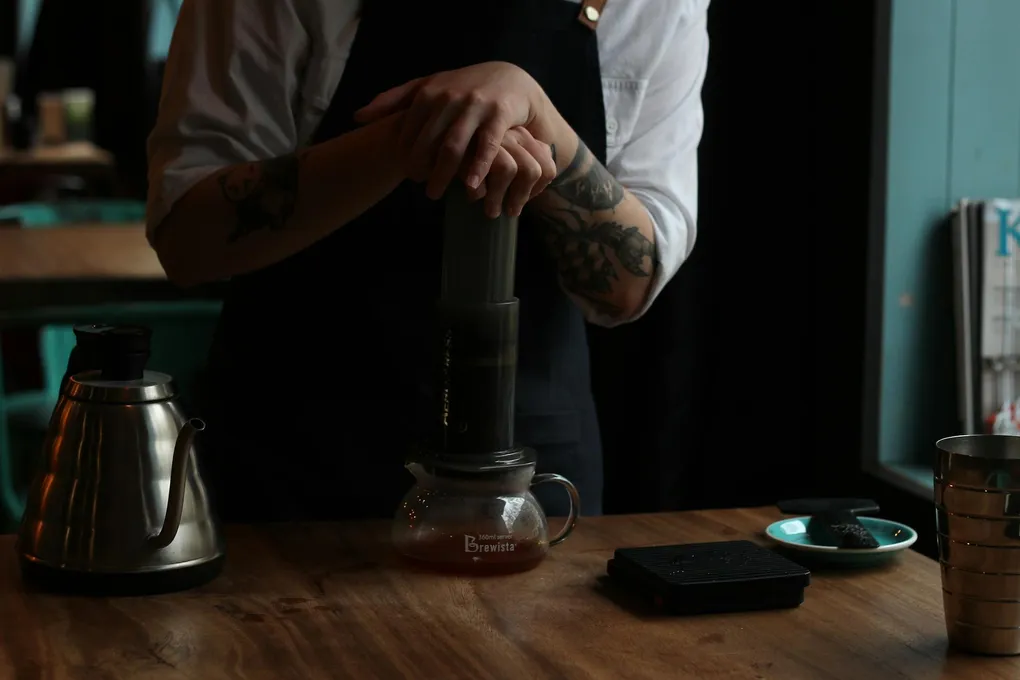
The AeroPress and French press both make excellent coffee. They’re also fundamentally different devices with different strengths, different use cases, and — this matters more than people realize — different flavor profiles even when you’re brewing the same coffee in both. One is not better than the other in any absolute sense. But one is almost certainly better for you.
This comparison covers everything: brew mechanism, cup character, filter options, practicality, portability, and real use cases. By the end you’ll know which one belongs in your kitchen — and whether you need both.
How They Work: Different Mechanisms, Different Cups
Understanding how each brewer works explains most of the taste differences without you needing to brew anything first.
The French press is pure immersion. Coffee grounds sit submerged in hot water for 4-12 minutes (depending on method), then the metal mesh plunger separates grounds from liquid. The key detail is what that metal mesh doesn’t do: it doesn’t filter oils. Coffee lipids — cafestol, kahweol, volatile aromatic compounds — pass straight through into your cup. This is why French press coffee tastes heavier, richer, and more textured. It’s also why there’s sediment at the bottom of your mug. The metal mesh catches large particles but lets fines through.
The AeroPress is a hybrid: short immersion followed by pressure filtration. Grounds steep for 60-120 seconds (much shorter than French press), then you push a plunger and force the liquid through a paper filter (or metal filter, more on that later). The paper filter traps oils and fines, producing a clean, sediment-free cup. The short steep time prevents overextraction. The gentle pressure helps extract efficiently at that compressed timeline.
The result is two philosophically different cups:
- French press: full body, rich texture, noticeable weight on the palate, some sediment, complex and rounded
- AeroPress (with paper filter): clean, bright, clear, lighter body, zero sediment, more distinct individual flavors
These aren’t better and worse. They’re different drinks, and which one you prefer comes down to whether you value body or clarity.
The Filter Question: Paper vs. Metal in the AeroPress
Before comparing the two brewers, you need to understand that the AeroPress is actually two different brewers depending on which filter you use. This changes the comparison entirely.
AeroPress with paper filter: No oils, no sediment, high clarity. The cup is clean and bright, closer to a pour over in character than a French press. This is what most people are imagining when they compare AeroPress to French press.
AeroPress with metal filter: Oils pass through, more body, some fine sediment — now the AeroPress cup character gets much closer to French press territory. You lose AeroPress’s clarity advantage but gain the body and texture of immersion brewing. Popular metal filter options include the Aesir disk filter or the Fellow Prismo attachment.
If you own a metal filter AeroPress, you’re essentially brewing a faster, single-cup, more temperature-flexible French press. The comparison shifts.
For the head-to-head below, I’m using AeroPress with paper filter (the default setup) against French press — because that’s the realistic comparison for 90% of people.
Brew Guides: Same Coffee, Optimal Parameters for Each
To make this comparison concrete, here are optimized recipes for both methods using the same coffee: 15g of a medium-roast Colombian washed single-origin.
AeroPress Recipe (Standard Upright Method)
Dose: 15g coffee Grind: Medium-fine (table salt texture) Water: 200g at 90C (194F) — medium roast doesn’t need full boil Total time: ~2 minutes
- Pre-rinse paper filter in cap with hot water. Assemble cap on chamber, place on mug.
- Add 15g coffee. Shake gently to level.
- Start timer. Pour 200g water in 20-30 seconds.
- Stir 10 seconds to ensure full saturation.
- Place plunger on top to create a seal (prevents dripping, don’t press yet).
- At 1:00, begin pressing steadily over 20-30 seconds.
- Stop at the hiss of air. Do not force the last drops through.
Optional bypass: For a cleaner, more defined cup, brew with 100g of water, press, then add 100g of hot water to the concentrate. This is the approach competition brewers often use.
What it tastes like brewed this way: Clear, balanced, medium-bright. The Colombian’s caramel and mild stone fruit flavors come through distinctly. Mouthfeel is light-to-medium. Zero sediment.
French Press Recipe (Hoffmann Method)
Dose: 30g coffee (brewing ~500ml — scale up for bigger presses) Grind: Coarse (raw sugar or coarse sea salt texture) Water: 500g at 96-100C (205-212F) — just off the boil Total time: 9-12 minutes
- Add 30g coffee. Pour all 500g water at once. Do not stir.
- Wait 4 minutes. A crust of grounds will form at the surface.
- At 4:00, gently stir the surface 3 times. Use two spoons to scoop off foam and floating particles — discard them.
- Wait an additional 5-8 minutes undisturbed. Gravity settles fine particles to the bottom.
- Place plunger just below the surface (don’t press all the way down). Pour slowly into cups. Stop pouring when you reach the last inch of liquid.
For a deeper breakdown of why this method works and why not pressing is counterintuitive but correct, see the full French press guide.
What it tastes like brewed this way: Full, rich, textured. The same Colombian coffee tastes rounder and heavier — less distinct acidity, more integrated sweetness, creamy mouthfeel. There’s some sediment at the bottom of the cup after the last sip; this is normal. The cup is warm and enveloping in a way the AeroPress version isn’t.
The Taste Comparison: What the Same Coffee Tastes Like in Each
Running the same coffee through both methods and comparing is the fastest way to understand what the brewer itself contributes to flavor.
Acidity: AeroPress (paper) highlights acidity more distinctly. The clean, sediment-free cup lets bright citrus or berry notes read clearly. French press softens acidity — the oils and body create a more rounded, less cutting experience. Neither is better; high-acidity coffees suit AeroPress, full-bodied coffees suit French press.
Sweetness: French press often reads as sweeter. This is partly the lipid content creating mouthfeel that registers as sweetness, and partly the longer extraction pulling more complex sugars. AeroPress sweetness is cleaner and more precise.
Complexity: AeroPress can produce more distinct, layered flavor — individual notes are easier to pick out in a cleaner cup. French press flavors integrate more, producing something more unified and harder to deconstruct.
Aftertaste: French press lingers. The oils coat the palate and the coffee stays with you. AeroPress fades relatively quickly and cleanly. If you love that lingering warmth after a sip, French press is unmatched. If you want each sip to feel fresh, AeroPress has the advantage.
Head-to-Head: Every Variable That Matters
Body: French press wins decisively. The oil content and metal filter produce maximum texture. AeroPress (paper) is lighter-bodied.
Clarity: AeroPress wins. Paper filter, no sediment, clean cup. French press has oils and fine sediment.
Sediment: AeroPress: zero (paper filter) or minimal (metal filter). French press: always some sediment at the bottom — less with the Hoffmann method, but it’s still there.
Brew time: AeroPress: 2 minutes. French press: 9-12 minutes (Hoffmann method). If you’re brewing before full consciousness, AeroPress wins.
Serving size: This is where French press has a real structural advantage. The AeroPress brews one cup at a time — around 250ml (8oz) at standard strength, or a small concentrate you dilute. Want two or three cups? You brew sequentially. A standard 34oz (1-liter) French press serves 3-4 people in one batch. A large 1.5-liter French press serves 5-6 people from a single brew. For households or hosting, French press is significantly more practical.
Portability: AeroPress is purpose-built for travel. It’s plastic, it’s lightweight, it fits in a carry-on or a backpack, and it’s nearly indestructible. French press glass carafes crack and shatter. Travel French presses exist (insulated stainless steel versions), but they’re heavier and less compact than the AeroPress. For camping, hotel rooms, or office drawers, AeroPress is the obvious choice.
Durability: The AeroPress chamber and plunger are BPA-free polypropylene — essentially indestructible. Rubber seals wear out after about 1,000 brews and can be replaced cheaply. Glass French press carafes break. Stainless and ceramic versions are more durable but heavier and more expensive.
Versatility: AeroPress is the clear winner. You can approximate pour-over clarity (fine grind, short steep, paper filter), French press body (metal filter, coarser grind, longer steep), cold brew (room temperature water, coarse grind, 12-24 hours), or espresso-adjacent concentrate (fine grind, hot water, press immediately). No other single brewer covers that range. The full AeroPress guide covers the inverted method and bypass technique for even more control.
Cleanup: AeroPress takes 30 seconds: pop the cap, push the puck out over a trash can, rinse the chamber. French press requires knocking out the grounds (wet and messy), rinsing the filter and chamber separately, and occasional full disassembly of the plunger mechanism to clean properly. AeroPress is meaningfully easier.
Health: Both are fine. If you have cholesterol concerns and drink multiple cups daily, French press’s cafestol/kahweol content (unfiltered coffee lipids that raise LDL) is worth knowing about. Paper-filtered AeroPress removes over 90% of these compounds. This doesn’t make French press “unhealthy” — the overall evidence for coffee’s health benefits is strong regardless of method — but it’s a real difference for high-volume drinkers.
Price: AeroPress Go (smaller, travel-optimized): about $35. Full-size AeroPress: about $40. AeroPress XL: about $50. A quality French press ranges from about $15 (Bodum plastic) to about $50 (Bodum Chambord glass) to $80+ (Fellow Clara or Espro for insulated stainless). The AeroPress is always cheaper per unit than premium French presses.
Real Use Cases: Which One Wins
You’re making coffee for one, weekday mornings: AeroPress. Speed, cleanup, no batch waste.
You’re making coffee for multiple people: French press. One brew, multiple cups, no sequential brewing.
You’re traveling — plane, camping, hotel: AeroPress. It fits in a bag, won’t break, works anywhere you can get hot water.
You want the richest, most satisfying cup: French press. The body and mouthfeel are unmatched by any filtered method.
You want to explore specialty coffee and taste its nuances: AeroPress (paper filter). The clean cup lets you actually hear what the coffee is saying.
You want something forgiving: Both are forgiving, actually. The AeroPress is forgiving because the short steep time makes overextraction nearly impossible. The French press is forgiving because immersion brewing naturally slows as grounds and water approach equilibrium — you’d have to steep for 20+ minutes to over-extract badly.
You want to impress someone on a lazy Sunday: French press. There’s something about the ritual — coarse grounds, the pour, the long wait, the gentle press — that reads as deliberate and unhurried. It’s a very different experience from AeroPress’s two-minute urgency.
You’re setting up a coffee station at an office: French press. Larger batch, everyone can pour their own cup, carafe keeps coffee warm. The AeroPress’s single-serving size is frustrating in group settings.
The Clear Recommendations
Buy the AeroPress if: You primarily brew for yourself, you travel with your coffee gear, you care about convenience and cleanup, or you’re interested in experimenting with different brew parameters. The AeroPress is the most versatile single-cup brewer available at any price.
Buy the French press if: You brew for multiple people regularly, you love full-bodied coffee with real texture, or you want a slower, more ritual-oriented weekend brew. A quality French press like the Bodum Chambord or Fellow Clara is built to last years.
Buy both if: You’re a serious home brewer who wants different cups for different moods. At $40 and $30-50 respectively, owning both is easy to justify once you know you’ll actually use them.
No matter which you choose, a good burr grinder matters more than the brewer itself. See our electric grinder guide and manual grinder guide for recommendations at every price point. And water quality and brewing temperature both affect the cup more than most people expect — the linked guides cover both in detail.
Frequently Asked Questions
- Does AeroPress or French press make stronger coffee?
- They can both make strong coffee, but 'strong' means different things here. The AeroPress produces a more concentrated brew by default — a standard recipe makes a small, intense serving you may want to dilute. The French press's larger batch volume means individual cups are usually closer to standard strength. For sheer concentration (TDS), AeroPress wins easily. For a big, heavy cup that feels substantial, French press wins on body and mouthfeel even if the TDS is similar.
- Which is better for travel — AeroPress or French press?
- AeroPress without question. It weighs about 200g, fits in a pint-sized space, won't break if it falls, and works in any hotel room, tent, or office with hot water. Stainless French presses exist and are durable, but they're heavier and bulkier. The AeroPress Go version is specifically designed for portability and includes a mug. For camping and hotel brewing, AeroPress is the definitive answer.
- Why does French press coffee have sediment at the bottom?
- The metal mesh filter in a French press catches large particles but lets fine coffee particles (called 'fines') pass through into the cup. These settle at the bottom as you drink. The Hoffmann method — where you wait 5-8 minutes after breaking the crust before pouring — dramatically reduces sediment by letting fines settle before you disturb the liquid. But some sediment is inherent to the metal-filter design and can't be eliminated completely without pouring through a paper filter.
- Can I make espresso with an AeroPress?
- No — not genuine espresso. Espresso requires 7-9 bars of pressure at the group head; the AeroPress generates roughly 0.35-0.75 bar at maximum. What you can make is espresso-style concentrate: fine grind, small water volume, immediate press, produces an intense, syrupy shot that's excellent diluted or used as a base for milk drinks. It's a useful technique and tastes genuinely good, but calling it espresso is overstating it.
- Which makes better cold brew — AeroPress or French press?
- Both work for cold brew using room-temperature or cold water with extended steep times. The French press is actually more practical here because of batch size — you can make 500-1000ml of cold brew concentrate in a single steep. The AeroPress produces cold brew concentrate in small amounts (100-200ml). If cold brew is your primary goal, French press is the better tool.
- Does it matter which filter I use in the AeroPress?
- Yes — significantly. Paper filters produce a clean, bright, oil-free cup that reads as lighter-bodied and more acidic. Metal filters let oils through, producing a heavier, richer cup with some sediment — closer to French press character. If you own an AeroPress with a metal filter, you're essentially brewing a faster, single-cup version of French press. The default paper filter setup is what most people assume when comparing these two brewers.
Some links above are affiliate links. If you buy through them, we earn a small commission at no extra cost to you. We only recommend products we’d actually use.