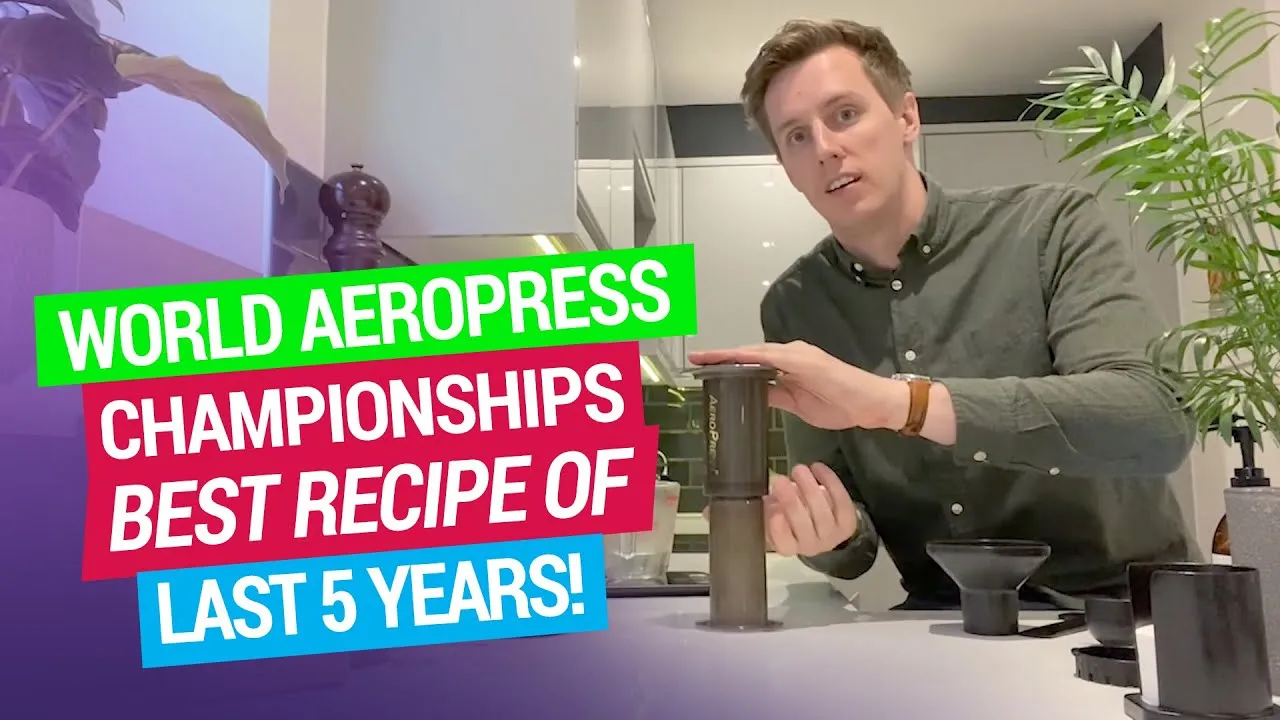
The World AeroPress Championship draws competitors from 60+ countries, all trying to make the best cup of coffee with a $35 brewer. After each year’s contest, winning recipes are published online. We brewed the 2015-2019 champions’ recipes back to back with the same beans and ranked them.
The Control: Standard AeroPress Method
First, we brewed using the manufacturer’s instructions: one scoop fine grounds, 80°C water, stir 10 seconds, press. Result: decent richness, smoky pepper, raisin, dark fruit. Solid but unremarkable. Every championship recipe below uses the inverted method — flipping the AeroPress upside down to create a sealed steeping chamber with full control over brew time.
For context on how the AeroPress stacks up against other methods, see our full AeroPress guide.
The Five Recipes, Ranked
#1: Wendelien Brouwer, 2019 (Netherlands) — Best Overall
| Parameter | Value |
|---|---|
| Coffee | 30g, coarse grind (7/10) |
| Water | 100g at 92°C |
| Method | Pour 10s, stir 20x in 10s, cap, push out air, flip at 0:40, press |
| Post-brew | Top up with 100g water, cool to 60°C by decanting |
Result: The clear winner. Dark fruit, black pepper, and smokiness all present but perfectly balanced — no bitterness, clean aftertaste, gorgeous roast profile. The coarse grind prevents over-extraction. The deliberate cooling to 60°C isn’t just about drinkability — flavor complexity increases as coffee cools below 70°C, and Brouwer’s decanting step controls that precisely.
#2: Filip Kucharczyk, 2016 (Poland) — Best Daily Driver
| Parameter | Value |
|---|---|
| Coffee | 35g, coarse grind |
| Water | 150g at 81°C |
| Method | Pour 15s, stir until 0:30, cap, wait until 1:00, flip, swirl, press |
| Post-brew | Add 100-120g water to taste |
Result: Mellow, approachable, and well-balanced. Not much bitterness, pleasant smoke and pepper, just enough fruit sweetness. This turned out to be almost identical to our own home method — and that’s a compliment. Low temperature + coarse grind + brief contact = consistent, forgiving, everyday excellent.
#3: Carolina Ibarra Garay, 2018 (USA) — Smooth but Subdued
| Parameter | Value |
|---|---|
| Coffee | 34.9g, fine grind (10/10) |
| Water | 400g at 85°C |
| Method | Pour 30s, stir with chopsticks 30s, cap, press 30s |
| Post-brew | Add 60g of 85°C water + 40g room-temp water |
Result: Very mellow and easy-drinking. The lower temperature and room-temp water addition make it instantly drinkable, but the rich dark fruit and smoky character from the 2019 entry were missing. A lot of steps for a subtle result.
#4: Paulina Miczka, 2017 (UK) — Over-Extracted
| Parameter | Value |
|---|---|
| Coffee | 35g, medium grind (8/10) |
| Water | 150g, temp unspecified |
| Method | Add water 15s, stir 15-35s, cap at 35s, flip at 1:05, press until 1:35 |
| Post-brew | Top with 160-200g hot water |
Result: Too bitter. The aggressive stirring and longer contact time pushed extraction past the sweet spot. Smoky character survived but the rich dark fruit was replaced by tartness. A reminder that more extraction isn’t always better.
#5: Lukas Zahradnicek, 2015 (Slovakia) — Nuclear Option
| Parameter | Value |
|---|---|
| Coffee | 20g, drip grind (7.3 on EK43) |
| Water | 230g at 79°C |
| Method | Add 60g water, “turbulent wiggle” 15s, bloom 13s, add remaining water 10s, gravity press 45s |
| Post-brew | None |
Result: Intensely potent. Bitter, smoky, aggressively peppery. The “turbulent wiggle” produced incredible aroma but the cup was overwhelming — like espresso without the body to support it. Fascinating technique, not a daily drinker.
What the Winners Teach Us
Looking across five years of recipes, several patterns emerge:
Coarser grinds win. The top two recipes both use coarse grinds. Finer grinds extract more (including more bitterness), which works in competition contexts with specific beans but is less forgiving at home. See our grind size guide for how to dial in grind for different results.
Lower temperatures are safer. Every recipe uses water well below boiling (79-92°C). The best results came from 81-92°C. Lower temperature = less extraction of bitter compounds = smoother cup. Our brew temperature guide explains the chemistry behind this in detail.
Bypass brewing works. Four of five recipes add water after pressing — brewing concentrated and diluting to taste. This gives you a stronger extraction (more flavor per gram of coffee) with the body and clarity of a longer brew. It’s the same principle behind espresso americanos.
Cooling matters. Brouwer’s deliberate cooling to 60°C wasn’t fussy — it was smart. Coffee flavor perception changes significantly as temperature drops. Many tasting notes only become apparent below 65°C.
Simplicity correlates with reliability. The 2016 recipe (our #2) is the simplest and the one we’d actually use daily. Championship recipes optimized for a single perfect cup in competition conditions aren’t always practical for everyday brewing.
Try Them Yourself
All winning recipes from 2008 to present are archived at the World AeroPress Championship website. Recent champions have added water chemistry specifications and exact grinder models to their recipes — the competition is getting more scientific every year.
Our recommendation: Start with the 2016 recipe (Kucharczyk) as your daily method. On weekends when you want to push for something special, try the 2019 recipe (Brouwer). Both are forgiving, repeatable, and produce excellent coffee with any decent AeroPress setup. A quality burr grinder will make a bigger difference than any recipe tweak — consistent grind size is the single biggest variable across all five recipes.
Frequently Asked Questions
- What is the inverted AeroPress method?
- The AeroPress is flipped upside down so the plunger seals the bottom, creating a closed steeping chamber. You add coffee and water, steep for a set time, then attach the filter cap, flip it onto your mug, and press. The advantage over the standard method is full control over steep time — in the normal orientation, coffee starts dripping through immediately, making timing inconsistent. Every WAC winner since 2015 has used the inverted method.
- Can I use World AeroPress Championship recipes with pre-ground coffee?
- You can, but results will differ. Championship recipes specify exact grind sizes calibrated for particular extraction profiles — pre-ground is typically a medium grind that won't match. The bigger issue is freshness: pre-ground coffee loses volatile aromatics within minutes of grinding. If pre-ground is all you have, the 2016 Kucharczyk recipe (coarse grind, low temperature, short steep) is the most forgiving choice since it's designed to under-extract slightly and avoid bitterness.
- How do I enter the World AeroPress Championship?
- Start at a local qualifying event. The WAC runs national competitions in 60+ countries — find yours at the World AeroPress Championship website. You bring your own beans and recipe; the organizers provide the AeroPress, grinder, and water. Judges score blind in knockout brackets. No professional barista experience is required — the competition is deliberately amateur-friendly, which is part of its appeal. Many national qualifiers have fewer than 20 competitors, so your odds of advancing are better than you'd think.
- Why does every AeroPress champion use paper filters instead of metal?
- Clarity. Championship judges evaluate coffee blind on flavor, not body or mouthfeel, and paper filters produce the cleanest, most transparent cup — letting delicate floral, fruit, and acid notes come through without oils or sediment muddying the picture. Metal filters add body and sweetness from oils, which is great for daily drinking but can mask the precise flavor details that win competitions. It's the same reason cupping (professional coffee evaluation) always uses paper-filtered or spoon-skimmed cups.
Some links above are affiliate links. If you purchase through them, we earn a small commission at no extra cost to you.