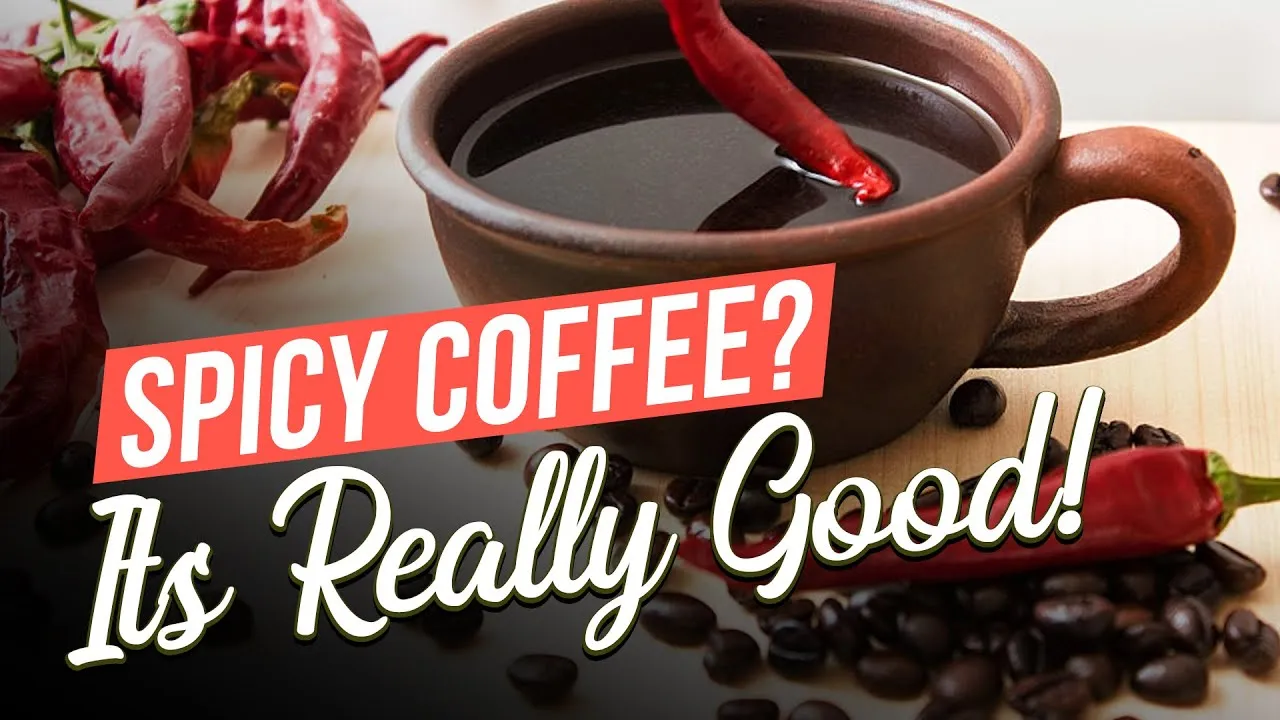
Some coffee traditions add spice. In parts of Ethiopia, Jeff Koehler writes, wild cardamom or a clove is sometimes pounded with the roasted beans, a curl of cinnamon bark near the Sudan border, or fresh wild ginger in Kafa; our Ethiopian coffee ceremony guide has more. In Mexico, café de olla is brewed with cinnamon and piloncillo. Not every coffee tradition uses spice, though: Türkiye’s registered description of Turkish coffee, and UNESCO’s description of it, name only coffee, water and sugar.
This page is about adding spice: how, how much, and four recipes. The amounts are our starting points, not anyone’s standard, so adjust them to taste.
Our March 2020 video is about a different kind of spicy coffee: coffees whose own flavor has spice notes, with no spice added. That’s covered near the end of this page.
Three ways to add spice
- In the grounds. Mix ground or crushed whole spice into the coffee before you add the water, and it brews with the coffee. Our recipe below does this in a French press, where the spice sits in the water for the whole steep.
- In the cup. Stir a pinch of ground spice into the finished coffee. It’s the quickest way to try a spice, but ground spice doesn’t dissolve, so some settles at the bottom of the cup.
- Simmered. Heat whole spices in the water, then add the coffee, as café de olla does. It takes longer and makes a sweet, spiced pot to share.
How much of each spice
Our starting amounts for a 12 oz mug’s worth of coffee:
| Spice | Start with | Best added |
|---|---|---|
| Cinnamon | ¼ tsp ground, or half a stick | In the grounds, or simmered |
| Cardamom | 1 green pod, crushed, or a pinch ground | In the grounds |
| Ginger | ⅛ tsp ground, or a thin slice of fresh | In the grounds or the cup |
| Nutmeg | A small pinch, freshly grated | In the cup or the milk |
| Clove | 1 whole clove, or a tiny pinch ground | In the grounds, or simmered |
| Star anise | 1 point broken from a pod | In the grounds, or simmered |
| Black pepper | A few grinds | In the grounds |
| Cayenne | A tiny pinch, about 1/16 tsp | In the cup |
Start at the low end, especially with clove, star anise and cayenne, and try one spice at a time before you combine them.
Keeping spices. USDA’s FoodKeeper gives ground spices 2 to 3 years in the pantry for best quality, and whole spices 3 to 4 years. Whole spices, ground or crushed as you need them, last longer.
Our spiced French press
Our own recipe, built on our Brew Guide’s French press for a 12 oz mug, which follows Jessica Easto’s eight-minute method:
- Coffee: 27.3 g, ground extra coarse.
- Spice: ¼ teaspoon ground cinnamon and 1 green cardamom pod, crushed.
- Water: 409 g at 205°F (96°C), a ratio of 1:15.
- Makes: about 12 US fl oz (355 ml), since the grounds hold back about 2 g of water per gram of coffee, the figure the Brew Guide uses.
- Time: about 10 minutes, 8 of them steeping.
- Warm the French press, then add the coffee, the cinnamon and the crushed cardamom pod, and stir them together.
- Start a timer and pour in all 409 g of water, wetting all the grounds.
- At 0:30, stir gently to sink the crust.
- Put the lid on with the plunger up and leave it until 8:00.
- Press gently and pour it all out straight away.
For more on the brewer itself, see our French press guide.
Café de olla
Café de olla is Mexico’s “pot coffee.” USDA’s Mexico City office describes it as roasted coffee prepared with cinnamon and sweetened, sold at breakfast time from street tricycles in Mexico City and other cities. El Universal, citing Claridades Agropecuarias, traces it to the Mexican Revolution, when, it says, the adelitas mixed coffee in water with spices to lift the fighters’ spirits.
This is El Universal’s recipe, in its own amounts:
- Water: 6 cups (about 1,420 ml, calculated).
- Piloncillo: one 200 g piece. Piloncillo is unrefined cane sugar; if you can’t find it, dark brown sugar is our stand-in.
- Cinnamon: 2 sticks.
- Cloves: 2.
- Ground coffee: 6 tablespoons.
- Put the water in a pot. El Universal recommends a clay pot (olla de barro), but a saucepan works.
- Add the piloncillo, cinnamon and cloves, and stir until the piloncillo dissolves.
- Boil it for 5 minutes.
- Add the coffee, turn the heat down and keep it hot, without boiling, for 5 minutes, stirring.
- Strain it, or let the grounds settle for a moment, and serve.
By weight, it’s a light coffee. Six tablespoons of ground coffee is about 42 g, at about 7 g per tablespoon (the figure in Nguyen Coffee Supply’s phin recipe), so the pot runs about 1:34 coffee to water by weight before any boils off (calculated). That’s far more water per gram of coffee than a 1:15 French press. For a stronger pot, add more coffee; for a less sweet one, use less piloncillo.
Our Mexican coffee guide covers the coffee itself and where it grows.
Cardamom coffee in a cezve
Turkish coffee’s registered method uses no spice, but cardamom is an easy addition. Follow our Turkish coffee guide for one small cup, 6 g of extra-fine coffee to 60 ml of cold water, and add 1 green cardamom pod, crushed, or a small pinch of ground cardamom with the coffee. Heat it slowly and take it off as the foam starts to form, before it boils. The cardamom is our variation, not part of the registered recipe.
Ginger and cayenne, stirred in
For one 8 oz cup of hot coffee, stir in ¼ teaspoon of ground ginger, a tiny pinch of cayenne (about 1/16 teaspoon), ½ teaspoon of honey and a splash of cream. Stir again before the last sip, since the ground spice settles. Cayenne brings heat, so add it a little at a time.
A spiced latte
Brew spiced coffee by any method above, or stir a pinch of cinnamon and cardamom into espresso, then add steamed milk and a little honey. Our milk steaming guide covers the milk. Our homemade coffee creamer has a spiced maple version too, and the same warm spices turn up in our gingerbread coffee and Christmas coffee recipes.
When coffee tastes spicy on its own
On a bag of unflavored coffee, spice notes aren’t added spice: they describe the coffee itself, and they’re what our video is about. World Coffee Research’s Sensory Lexicon, which WCR says is the basis for the revised Coffee Taster’s Flavor Wheel, groups them under spices:
- Brown spice: “the sweet, brown aromatic associated with spices such as cinnamon, clove, nutmeg, and allspice,” with cinnamon, clove, nutmeg and anise as attributes of their own.
- Pepper: the aromatic “characteristic of ground black pepper.”
- Pungent: “a sharp, physically penetrating sensation in the nasal cavity.”
A note like “cinnamon” on a bag describes what the roaster’s tasters found in that coffee, so treat it as what the coffee can taste like, not a promise. To learn to pick these notes out, smell the spice itself, then sip the coffee and breathe out through your nose.
Sources
- JayArr Coffee, “Spicy Coffee? It’s REALLY good!”, YouTube, March 31, 2020 (spice notes and the flavor wheel): youtube.com
- Jeff Koehler, Where the Wild Coffee Grows (Bloomsbury, 2017), ch. 6, “Gift for King and Country” (spices pounded with the beans in parts of Ethiopia)
- Türk Patent ve Marka Kurumu (TÜRKPATENT), traditional product name registration no. G8, Türk Kahvesi / Turkish Coffee, registered March 10, 2026 (preparation: water, coffee, then sugar to taste), in Turkish: registration (PDF)
- UNESCO Intangible Cultural Heritage, “Turkish coffee culture and tradition,” Representative List, inscribed 2013: ich.unesco.org
- El Universal, “Receta para preparar café de olla tradicional,” May 20, 2020, updated March 14, 2023 (the recipe, and the Revolution-era origin citing Claridades Agropecuarias): eluniversal.com.mx
- USDA Foreign Agricultural Service, Mexico: Coffee Annual, report MX2026-0026, May 13, 2026 (café de olla and how it’s sold): apps.fas.usda.gov
- Nguyen Coffee Supply, “Vietnamese Iced Coffee,” brew guide by Sahra Nguyen, November 14, 2018 (2 tablespoons = 14 g of coffee): nguyencoffeesupply.com
- Jessica Easto, Craft Coffee: A Manual (Agate Surrey, 2017), pp. 212–214, “The Eight-Minute French Press Method,” as scaled by our Brew Guide
- World Coffee Research, Sensory Lexicon, 2nd ed., version 2.0 (2017), “Spices,” pp. 40–41 (Brown Spice, p. 41): worldcoffeeresearch.org (PDF), and WCR’s Sensory Lexicon page (the lexicon as the basis for the revised flavor wheel), checked October 18, 2026: worldcoffeeresearch.org
- USDA Food Safety and Inspection Service, FoodKeeper data, version 128 (September 6, 2018), entries for “Spice/spices, ground” and “Spice/spices, whole,” retrieved October 18, 2026: fsis.usda.gov