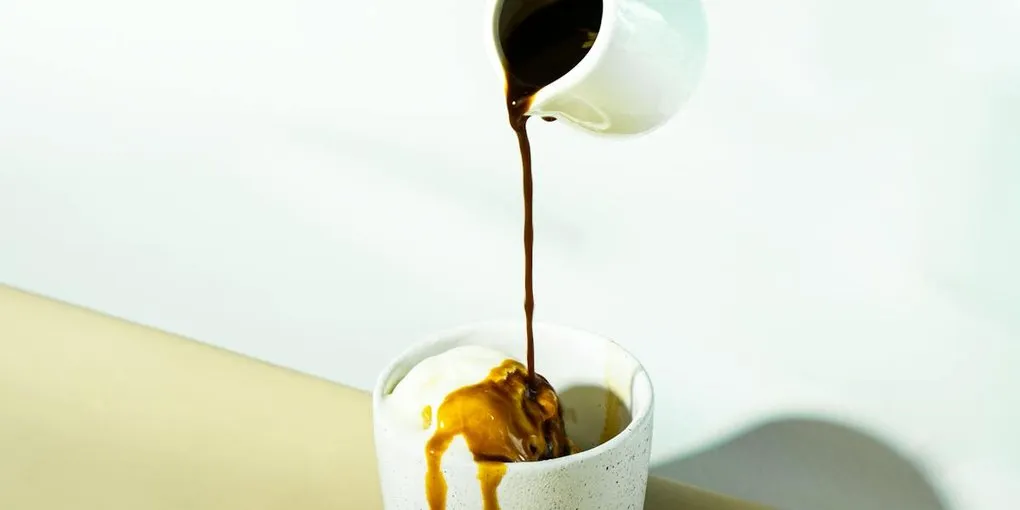
An affogato is two things, gelato and espresso, and the details change with the recipe: how much of each, whether there’s cream on top, and how hot the coffee is when it goes in. This page sets out two published recipes in their own numbers, where they differ, and what to use if you don’t have an espresso machine.
What the name means
Affogato is the past participle of the Italian verb affogare, to drown. The Treccani dictionary gives the dessert as one of its uses: gelato affogato, gelato served in a dessert cup and covered in liqueur, coffee or something else. The coffee version is affogato al caffè.
Where it began isn’t settled. De’Longhi, the Italian coffee-machine maker, writes that the affogato’s origins aren’t officially documented, and calls it an Italian creation, probably born in the bars and gelaterie of the 1950s and 1960s.
illy’s affogato, for one
illy, the Italian coffee company, publishes this recipe in Italian for one serving. It keeps the espresso and gelato in a fixed proportion: 20–25 ml of espresso for every 40 g of gelato.
- Espresso: one single shot, 20–25 ml (about ¾ fl oz).
- Gelato: 40 g, about one scoop.
- Fresh cream: as much as you like, whipped.
- Cocoa powder: a dusting. illy calls for low-fat cocoa.
- Makes: one small glass.
- Time: about 5 minutes, most of it whipping the cream.
- Pull a single shot of espresso, 20–25 ml, into an espresso cup.
- Put 40 g of gelato in a glass and pour the hot espresso over it.
- Whip the cream and spoon as much as you like on top.
- Dust with cocoa and serve straight away.
illy’s own warnings: don’t pour the espresso cold or lukewarm, because its heat is what melts the gelato a little and makes the hot-and-cold contrast; don’t wait before serving, or the gelato melts completely; and dust the cocoa on at the last moment, or it goes damp.
Two ingredients, or four. Leave out the cream and cocoa and you have the plain version in Treccani’s definition, which is the one America’s Test Kitchen makes below.
Scaling it. illy says to keep the proportion when you make more. A double shot from our Brew Guide is 36 g, a little less than two of illy’s shots, so in illy’s proportion it goes with about 60–70 g of gelato (calculated, counting a gram of espresso as about a milliliter).
America’s Test Kitchen’s affogato, for four
America’s Test Kitchen published its version on June 29, 2009. It uses ice cream and serves everything at the table:
- Vanilla ice cream: 1 pint, high-quality, about ½ cup for each person.
- Espresso: four 2-ounce servings, freshly brewed and still hot.
- Coffee liqueur, Armagnac or cognac: four 1-ounce servings, optional.
- Makes: 4 servings.
- Scoop the ice cream into individual bowls or parfait glasses, about ½ cup each.
- Bring them to the table with the espresso, and the liqueur if you’re using it, in small cups or shot glasses.
- Let each person pour the espresso, and the liqueur if they like, over the ice cream, and eat it straight away.
A 2-ounce serving of espresso is bigger than illy’s single shot, and bigger than our Brew Guide’s 36 g double.
Hot from the machine, or rested a minute?
The two Italian sources disagree here. illy says to serve the espresso at once, still hot, because the temperature contrast with the cold gelato is the point. De’Longhi says to let the coffee rest about a minute after brewing, so it’s hot but not boiling-hot, which it says keeps the contrast without melting the gelato at once. Try it both ways. Either way, once the espresso is on the gelato, serve it straight away; both recipes say so.
Gelato or ice cream
illy and De’Longhi use gelato, and America’s Test Kitchen uses ice cream. Either works. In the US, the label won’t tell you as much about gelato as it does about ice cream. Federal rules (21 CFR Part 135) set standards for ice cream and frozen custard, goat’s milk ice cream, mellorine, sherbet and water ices, but not for gelato. The ice-cream standard generally requires at least 10 percent milkfat and a weight of at least 4.5 pounds per gallon, with a milkfat exception for bulky flavor ingredients. Part 135 has no separate standard named gelato.
A gallon’s weight depends mostly on how much air is churned in, which ice cream makers call overrun. America’s Test Kitchen suggests a high-butterfat ice cream with low overrun, meaning less air, for a creamier affogato. USDA’s figures show how much a scoop can vary: half a cup of its regular vanilla ice cream weighs 66 g, and half a cup of its “rich” vanilla 107 g. Weighing the gelato, as illy does, gets around that: 40 g is about a third of a cup of the regular kind (calculated).
Flavors
De’Longhi starts with vanilla gelato and suggests fiordilatte or crema instead: neutral flavors, it says, that bring out the coffee without covering it. For a richer version it suggests hazelnut or chocolate, and its own recipe adds a few frozen berries to the glass.
With liqueur
Treccani’s definition already includes gelato drowned in liqueur. America’s Test Kitchen offers 1 ounce (about 30 ml) of coffee liqueur, Armagnac or cognac for each serving, poured over the ice cream with the espresso. It’s optional, and the affogato is just as much an affogato without it.
No espresso machine
- A moka pot. It makes a small, strong coffee to pour in place of the shot. It isn’t espresso, and James Hoffmann writes that it tends to make very strong, very bitter coffee; our moka pot guide has his method.
- Strong drip coffee. America’s Test Kitchen says a very strong cup of drip coffee made from good-quality dark-roast beans can stand in.
Other versions
- Cold brew. Our variation: pour cold brew concentrate over the gelato instead of espresso. It won’t melt the gelato the way hot espresso does, so it’s more like a float. Our cold brew concentrate guide has the method.
- Dairy-free. Use a plant-based frozen dessert in place of the gelato.
- Decaf. Decaf espresso works the same way. Decaf isn’t caffeine-free; our decaf guide explains how much is left.
Caffeine
If you serve an affogato after dinner, the caffeine counts. Our Caffeine Calculator puts a single shot of espresso, as in illy’s recipe, at 60–75 mg, and a double at 120–150 mg. Our caffeine guide has the figures for other drinks.
Sources
- illy, “Affogato al caffè: come prepararlo a casa con il caffè illy,” recipe page in Italian (ingredients for one serving, the 20–25 ml to 40 g proportion, method and common mistakes), checked October 18, 2026: illy.com
- America’s Test Kitchen, “Affogato,” published June 29, 2009 (serves 4; ice cream, espresso and optional liqueur amounts; serving at the table; the ice cream and drip-coffee notes), checked October 18, 2026: americastestkitchen.com
- De’Longhi Italia, “Affogato al caffè: la ricetta originale,” recipe page in Italian (origins, gelato flavors, resting the coffee about a minute), checked October 18, 2026: delonghi.com
- Istituto della Enciclopedia Italiana (Treccani), Vocabolario, “affogare” (the participle affogato, and gelato affogato), checked October 18, 2026: treccani.it
- Code of Federal Regulations, 21 CFR Part 135, “Frozen Desserts,” subpart B, and § 135.110(a)(2), “Ice cream and frozen custard,” eCFR, up to date as of October 15, 2026: ecfr.gov
- USDA FoodData Central, SR Legacy, “Ice creams, vanilla,” FDC ID 167575 (½ cup = 66 g), and “Ice creams, vanilla, rich,” FDC ID 167573 (½ cup = 107 g), checked October 18, 2026: fdc.nal.usda.gov
- James Hoffmann, The World Atlas of Coffee, revised edition (Mitchell Beazley, 2018), pp. 90–91, “Stove-Top Moka Pot”