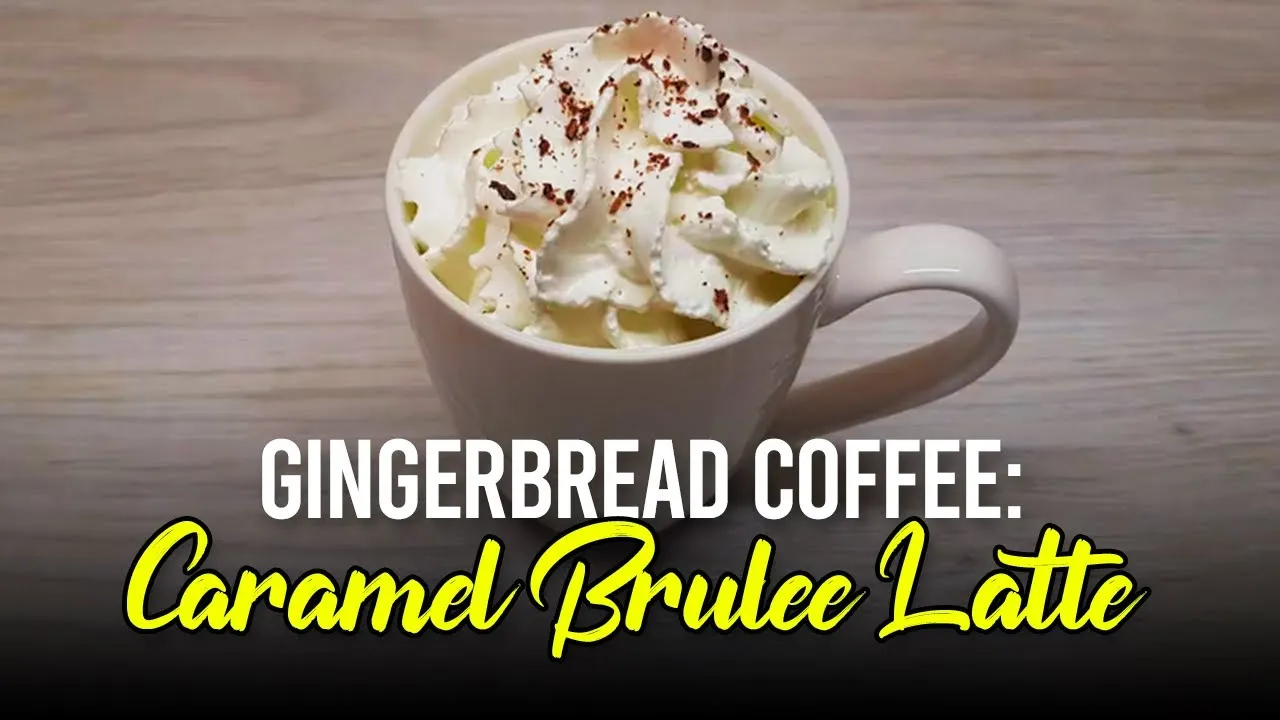
Gingerbread coffee is coffee sweetened and spiced like gingerbread: molasses and brown sugar, with ginger, cinnamon and clove. This page has two ways to make it. The first is the recipe in our video, a spice mix you stir into a mug of brewed coffee. The second is our own syrup, simmered and kept in a jar, for gingerbread lattes.
Our December 2019 video makes Allrecipes’ Gingerbread Coffee, a recipe submitted by Jennifer, who writes that a gingerbread latte at a local coffee shop inspired it. The amounts below are the ones on the video’s cards. The video has no narration, and it predates this revision, so the keeping and sweetness notes here come from the sources named on this page.
The spice-mix gingerbread coffee, from our video
For the spice mix (about 10 tablespoons by our estimate, enough for about 10 mugs):
- Molasses: ½ cup (about 170 g).
- Brown sugar: ¼ cup (about 55 g if packed).
- Baking soda: ½ teaspoon.
- Ground ginger: 1 teaspoon.
- Ground cinnamon: ¾ teaspoon.
For each mug:
- Hot brewed coffee: 1 cup (8 US fl oz, about 240 ml), poured in two parts.
- Spice mix: 1 tablespoon.
- Half-and-half: ¼ cup (2 fl oz, about 60 ml).
- To top: sweetened whipped cream and a light dusting of ground cloves.
- Makes: one mug of about 10½ US fl oz (310 ml) before the whipped cream, calculated from the volumes above.
- Time: about 20 minutes for the first mug, 10 of them chilling the mix.
Method:
- In a small bowl, stir together the molasses, brown sugar, baking soda, ginger and cinnamon until well blended.
- Cover the bowl and refrigerate it for at least 10 minutes.
- Pour ¼ cup of hot coffee into a mug and stir in 1 tablespoon of the spice mix until it dissolves.
- Add ¾ cup more hot coffee, then stir in ¼ cup of half-and-half.
- Top with whipped cream and a light dusting of ground cloves.
How it differs from Allrecipes’ card. Allrecipes writes the recipe for six mugs, with 6 cups of coffee and 1 cup of half-and-half stirred in “to taste,” and fills each cup “to within an inch of the top.” Our video measures it: 1 cup of coffee and ¼ cup of half-and-half per mug. Allrecipes also lists 1 teaspoon of ground cloves but uses them only as a light dusting on top, so most of that teaspoon is left over. Its recipe doesn’t say what the baking soda is for.
How sweet it is. Using USDA’s ingredient weights, the batch contains about 180 g of sugar in about 230 g of mixture. If it yields our estimated 10 tablespoons, that is about 18 g of sugar per tablespoon; the finished volume has not been measured. For a less sweet mug, use 2 teaspoons of the mix instead of a tablespoon. Using less brown sugar reduces the batch’s total sugar, as Allrecipes suggests; using less finished mix reduces the sugar added to each mug.
Keeping the mix. Allrecipes chills the mix covered and says it can be made ahead. USDA’s FoodKeeper has no entry for a homemade mix like this one (its molasses entry is for an opened commercial jar), so we don’t give it a shelf life. Keep it covered in the fridge, make small batches, and follow the FDA’s rule: “If you’re not sure or if the food looks questionable, throw it out.” Sweetened whipped cream keeps 1 day in the refrigerator, by FoodKeeper.
Allrecipes’ six mugs take 6 cups of brewed coffee. Our Brew Guide sizes that pot for a drip machine:
Our gingerbread syrup, for lattes
This syrup is our own recipe, not the one in the video. You make it ahead, keep it in a jar in the fridge, and stir it into espresso, brewed coffee or cold brew.
Ingredients:
- Water: 1 cup (about 237 g).
- Brown sugar: 1 cup, packed (about 220 g).
- Ground ginger: 1 tablespoon (about 5 g).
- Ground cinnamon: 1 tablespoon (about 8 g).
- Ground nutmeg: 1 teaspoon (about 2 g).
- Ground cloves: a pinch. Clove is strong, so go easy.
- Cinnamon stick: 1.
- Molasses: 1 to 2 tablespoons (20 to 40 g).
- Vanilla extract: ½ teaspoon.
Method:
- Put the water, brown sugar, ginger, cinnamon, nutmeg, cloves and cinnamon stick in a small saucepan.
- Bring it to a simmer, stirring until the sugar dissolves, and simmer for 10 to 15 minutes, until it thickens slightly.
- Take it off the heat and stir in the molasses and vanilla.
- Let it cool, take out the cinnamon stick, and pour the syrup into a clean jar.
Makes: it starts as about 500 g of ingredients, a little of which steams off, and makes roughly 1½ cups, about 24 tablespoons (our estimate; a longer simmer makes less). The ground spices settle, so shake or stir the jar before each use.
How sweet it is. The syrup holds about 230 to 245 g of sugar by USDA’s figures, roughly 10 g in each tablespoon (calculated from our 1½ cup estimate). A drink with 1 tablespoon has about 10 g from the syrup; with 2 tablespoons, about 20 g. Start with 1 and add more to taste.
Keeping it. As with the spice mix, FoodKeeper has no entry for a homemade syrup, so we don’t give it a shelf life. Keep it covered in the fridge, make small batches, and throw it out if you’re unsure, as the FDA advises.
Maple syrup can stand in for the molasses, but the syrup will then taste of maple more than gingerbread.
A gingerbread latte
- Espresso: 2 shots, a double, which our Brew Guide makes as 36 g in the cup from 18 g of coffee.
- Gingerbread syrup: 1 to 2 tablespoons.
- Milk: 6 fl oz (about 180 ml), steamed or heated and frothed.
- To top: a little foam and a dusting of cinnamon.
- Makes: about 8 US fl oz (235 ml) before the foam, calculated.
- Put the syrup in the bottom of a mug.
- Pull the 2 shots of espresso into the mug and stir.
- Steam the milk, or heat it in a saucepan and froth it.
- Pour the milk into the mug, spooning a little foam on top.
- Dust with cinnamon.
How hot? If you have a thermometer, Breville’s Bambino manual has milk ready at 140–149°F (60–65°C). James Hoffmann writes that milk begins to deteriorate in flavor and texture above 154°F (68°C), and that he finds milk heated to 140°F (60°C) better in sweetness and texture than very hot milk. Scott Rao’s café target is 150–160°F (66–71°C), and the top of that is past Hoffmann’s limit. Our milk steaming guide has the method with a steam wand. Without one, heat the milk in a saucepan and froth it in a French press, as our caramel brûlée latte does, or use a milk frother.
No espresso machine? A moka pot makes a small, strong coffee to use in place of the shots. It isn’t espresso, so the latte will taste a little different.
The quick version: spiced grounds
Our quickest version, with no syrup at all: mix the spices into ground coffee and brew it as usual.
For 1 pound (454 g) of ground coffee: 2 teaspoons of ground ginger, 2 teaspoons of ground cinnamon, 1 teaspoon of ground nutmeg and ¼ teaspoon of ground cloves. Stir it thoroughly, so the cloves don’t clump, and keep the coffee in an airtight container.
If you grind your beans fresh, mix the four spices in the same proportions in a small jar instead, and add a scant ¼ teaspoon of the blend to every 16 g of coffee, the Brew Guide’s dose for an 8 oz cup from a drip machine (calculated).
Honest assessment: Good, but noticeably less flavorful than the syrup method. Try this first since it requires nothing extra, then graduate to the syrup.
Adjusting the spice
- Too spicy: use less ginger and cloves.
- Not spicy enough: add more ginger first, then cinnamon.
- Cloves: they take over quickly, so add them in tiny amounts.
- Too sweet: use less of the mix or syrup, as above.
Iced, and other variations
- Iced: stir the syrup into cold brew concentrate and cold milk, then pour it over ice. Use the syrup rather than the spice mix, which the recipe dissolves in hot coffee. Our cold brew concentrate guide has the method.
- Gingerbread cookie rim: dip the rim of the mug in syrup, then in crushed gingerbread cookies, and top the drink with whipped cream.
- With a spirit: for coffee cocktails with published amounts, such as the IBA’s Irish coffee, see our coffee cocktails.
- More spices: our spicy coffee guide has starting amounts for eight spices, cayenne and black pepper among them.
- Spiced creamer: our homemade coffee creamer is another way to add flavor with the milk.
- More holiday drinks: our Christmas coffee recipes has the other five drinks from our holiday video.
Caffeine
The caffeine is all in the coffee. Our Caffeine Calculator puts an 8 oz cup of drip coffee, the coffee in one mug of the video’s recipe, at 105–195 mg, and the latte’s two shots of espresso at 120–150 mg.
Sources
- JayArr Coffee, “Gingerbread Coffee: A Christmas Miracle!”, YouTube, December 3, 2019 (the recipe on the video’s cards): youtube.com
- Allrecipes, “Gingerbread Coffee,” recipe 27027, submitted by Jennifer, updated August 6, 2026 (ingredients, directions, six servings, and the make-ahead and brown-sugar notes), checked October 18, 2026: allrecipes.com
- USDA FoodData Central, SR Legacy, checked October 18, 2026: “Molasses,” FDC ID 168820 (1 cup = 337 g; 74.7 g of total sugars per 100 g); “Sugars, brown,” FDC ID 168833 (1 cup packed = 220 g; 97.0 g per 100 g); “Spices, ginger, ground,” FDC ID 170926 (1 tbsp = 5.2 g, 1 tsp = 1.8 g); “Spices, cinnamon, ground,” FDC ID 171320 (1 tbsp = 7.8 g, 1 tsp = 2.6 g); “Spices, nutmeg, ground,” FDC ID 171326 (1 tsp = 2.2 g); “Leavening agents, baking soda,” FDC ID 175040 (½ tsp = 2.3 g): fdc.nal.usda.gov
- USDA Food Safety and Inspection Service, FoodKeeper data, version 128 (September 6, 2018), entries for “Molasses” and “Cream, whipped, sweetened,” retrieved October 18, 2026: fsis.usda.gov
- US Food and Drug Administration, “Are You Storing Food Safely?”, content current as of January 18, 2023: fda.gov
- Breville, the Bambino (BES450) Instruction Book, US edition, p. 13 (“Manual Milk Texturing”): breville.com (PDF)
- James Hoffmann, The World Atlas of Coffee, revised edition (Mitchell Beazley, 2018), p. 108, “Steaming Milk”
- Scott Rao, The Professional Barista’s Handbook (2008), p. 46, “Milk Steaming Goals”