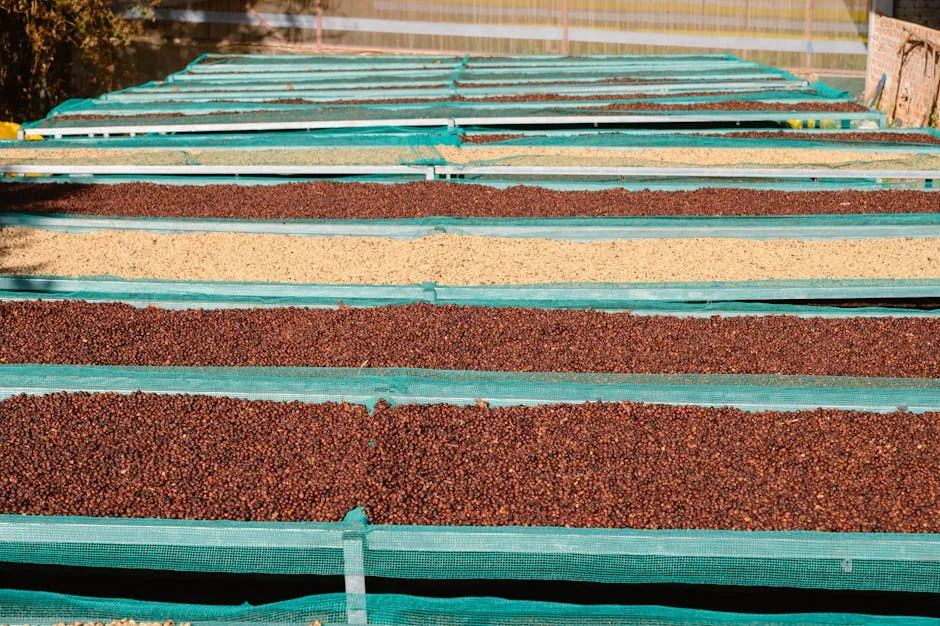
Myanmar might be the most surprising coffee origin you haven’t heard of. Tucked between China’s Yunnan, Thailand, Laos, and India, the country grows coffee at altitude on the Shan Plateau — a vast highland region that sits at 1,000—1,700 meters and produces cups with a flavor profile that doesn’t quite fit any existing category.
Where most specialty origins aim for bright acidity and fruit, Myanmar’s best coffees lean into something different: a savory, almost umami quality alongside caramel sweetness, dark chocolate, and a round, full body. It’s not what you expect from a Southeast Asian highland, and that unexpectedness is exactly what makes it interesting.
Myanmar’s specialty coffee sector barely existed before 2014. It’s young, small, fragile, and operating in a country facing enormous political and economic challenges. But the raw materials — altitude, terroir, willing farmers — are genuine, and the early results have been good enough to attract international attention.
A Very Brief Coffee History
Coffee was introduced to Myanmar during British colonial rule in the late 1800s, initially planted in Shan State and the Mandalay region. For most of the 20th century, it remained a subsistence crop — consumed locally, traded informally, and invisible to the global market. Myanmar’s decades of military rule and economic isolation kept the coffee sector frozen in a pre-commercial state.
The opening began in the early 2010s when Myanmar’s political situation briefly liberalized and international organizations gained access. What makes the story remarkable is what coffee replaced: in Shan State’s highlands, many farmers had previously grown opium poppy. UNODC, USAID (through Winrock International), and the Coffee Quality Institute supported a deliberate transition from poppy to coffee starting around 2014 — using specialty coffee as an economic alternative to opium production. The first specialty-grade export was just 36 metric tons in 2016. The Myanmar Coffee Association was formalized, and the country’s first specialty-grade exports followed.
Progress has been uneven. The 2021 military coup disrupted development programs and international relationships. Many NGO-funded projects paused or withdrew. But the farmers and cooperatives that had already built quality capacity continued producing, and Myanmar’s coffee has maintained a small but growing presence in specialty channels.
Growing Regions
Shan State (Southern)
Southern Shan State is Myanmar’s primary specialty coffee region. The Shan Plateau — a massive highland area stretching across eastern Myanmar — provides altitude (1,000—1,700 meters), volcanic soils, and a monsoon-influenced climate with distinct wet and dry seasons.
The main coffee-growing areas center around Ywangan Township — the specialty hub where 14,600 households across 90 of 125 villages grow coffee — along with Pindaya, Kalaw, and Yawnghwe, near the popular Inle Lake tourist region. Ywangan is where much of the development investment has concentrated, and where pioneers like Daw Su Su Aung (known as Myanmar’s “Coffee Lady”) founded the women-led Amayar cooperative. These towns sit at 1,200—1,500 meters, and the surrounding hillsides support hundreds of small coffee farms, many operated by Shan, Pa-O, and Danu ethnic communities.
The region’s infrastructure is basic. Roads are rough, processing facilities are few, and getting cherries to a wet mill quickly is a persistent challenge. But the terroir is genuine — cool nights, warm days, well-drained volcanic soil, and enough altitude to produce dense, flavorful beans.
Flavor profile: Savory/umami, dark chocolate, caramel, brown sugar, full body, moderate acidity, roasted nut.
Shan State (Northern)
Northern Shan State, around Hsipaw and Lashio, grows coffee at similar altitudes but with a slightly different character — cooler temperatures and higher rainfall produce a somewhat brighter, more citric profile. The region is less developed for specialty than the south, with fewer processing facilities and limited market access.
Flavor profile: Brighter acidity than southern Shan, citrus notes, chocolate, cleaner body.
Mandalay Region
The hills around Pyin Oo Lwin (Maymyo) at 1,000—1,200 meters produce small amounts of coffee with a milder, more straightforward profile. This area has historical significance (some of Myanmar’s oldest coffee plantings are here) but is not currently a major specialty producer.
Flavor profile: Mild, clean, nutty, low acidity.
Chin State
The remote western highlands of Chin State offer altitude (1,500+ meters) and untapped potential, but accessibility is extremely limited. A handful of development projects have begun working with Chin farmers, and early lots show promise. This is a frontier within a frontier.
Flavor profile: Limited data. Early reports suggest bright acidity, fruit, and good sweetness.
Varieties
Myanmar’s varietal landscape reflects its isolation and the influence of international development programs:
- S795: A Typica derivative (Kent x S288) developed in India. The most widely planted quality-focused variety in Myanmar. Produces clean, sweet cups with moderate complexity when grown at altitude.
- Catimor: Present, particularly in older plantings and lower-altitude areas. Cup quality is mediocre below 1,200 meters but acceptable at altitude.
- SL34: Introduced through development programs. Small plantings show promising fruit complexity.
- Bourbon and Typica: Very limited but present in some specialty-focused farms.
- Local varieties: Some indigenous or long-established varieties exist that haven’t been formally catalogued.
The varietal mix is still evolving. International partners have introduced better genetic material, but the transition from S795 and Catimor to higher-quality varieties takes years and involves financial risk that smallholder farmers can ill afford.
Processing
Processing is where Myanmar’s specialty sector has made the most visible progress:
Washed: The primary specialty method. Development programs invested heavily in wet mill infrastructure and farmer training on fermentation control, mucilage removal, and clean water use. Well-washed Myanmar lots are clean, sweet, and show the terroir clearly.
Natural: Growing in popularity as farmers gain confidence. Natural-processed Shan State coffee adds dried fruit, berry, and fermented sweetness to the base profile. The tropical climate makes controlled drying challenging, but raised beds and careful cherry selection have produced impressive results.
Honey: Emerging. Some cooperatives are experimenting with honey processing as a differentiation strategy, producing coffees with more body and fruit sweetness than washed lots.
Experimental: A few progressive producers have begun exploring anaerobic fermentation. Myanmar is early in this curve, but the global trend toward processing innovation is reaching even the newest origins.
The Savory-Umami Character
Myanmar’s most distinctive feature is a flavor note that’s unusual in specialty coffee: a savory, almost umami quality that surfaces in the best Southern Shan State lots. This isn’t a defect — it’s a genuine terroir expression that distinguishes Myanmar from its Southeast Asian neighbors (Thailand, Laos, Vietnam) and from the fruit-forward African origins that dominate specialty conversations.
The savory note typically presents alongside dark chocolate, caramel, and roasted nut, creating a cup that feels more substantial and dinner-table than the bright, tea-like coffees from Ethiopia or Malawi. Some tasters describe it as “brothy” or “meaty” in the most positive sense — the same quality that makes a well-reduced stock satisfying.
Whether this character comes from the terroir, the dominant varieties (S795, Catimor), the processing conditions, or some combination is not yet well understood. But it’s consistent enough across multiple farms and seasons to be considered a regional signature.
For drinkers accustomed to fruit-forward specialty coffee, Myanmar’s savory profile can be disorienting at first. But for those who find value in coffee that does something genuinely different — who crave complexity beyond the familiar citrus-berry-floral spectrum — it’s a revelation.
Challenges
Myanmar’s coffee sector faces significant obstacles:
- Political instability: The 2021 military coup disrupted international development programs, trade relationships, and the broader economy. Many specialty coffee projects have been paused or scaled back.
- Infrastructure: Roads, electricity, water, and processing facilities are all inadequate. Getting cherry from hillside farms to wet mills before quality degrades is a constant challenge.
- Scale: Total specialty-grade production is minuscule — perhaps 5,000—10,000 bags per year. This limits market visibility and buyer relationships.
- Market access: Myanmar lacks established green coffee export channels. Most specialty exports are facilitated by international NGOs or small trading companies.
- Farmer economics: Coffee competes with other crops for farmer attention. Without reliable premium prices for quality, the incentive to invest in specialty production is fragile.
These are not trivial problems, and they may not be solved quickly. Myanmar’s coffee future depends partly on the country’s political trajectory — a situation well beyond the coffee sector’s control.
Where to Buy Myanmar Coffee
Myanmar coffee appears in specialty channels primarily through:
- Atlas Coffee Club and similar subscription services that feature unusual origins
- Specialty roasters who specifically source from frontier origins (look for roasters highlighting “new origins” or “undiscovered” collections)
- Direct-trade importers who work with Myanmar cooperatives — companies like Expat Roasters, Gold Mountain Coffee Growers, and others who have built relationships in Shan State
When buying, look for:
- Shan State regional designation (ideally with township: Pindaya, Kalaw, Yawnghwe)
- Washed process for the cleanest expression of the terroir
- S795 or named variety — avoid generic “Myanmar” without details
- Roast date within 2—3 weeks
Search for Myanmar specialty coffee to find current offerings from roasters who source this emerging origin.
Brew Myanmar coffee with methods that preserve body — French press, AeroPress, or immersion-style pour-over. The savory, chocolate notes translate particularly well into espresso. Lighter roasts preserve more of the origin character; medium roasts bring out the chocolate and caramel.
Final Thoughts
Myanmar is specialty coffee’s newest frontier, and it’s genuinely worth exploring — not as a charity purchase but as a real quality proposition. The savory-umami character is unlike anything else in specialty. The terroir is real. The farmers are capable. And the early results, despite enormous structural challenges, have been good enough to earn respect from seasoned cuppers and specialty importers.
The country’s political situation adds a layer of complexity to every purchase. Buyers should seek out sourcing channels that demonstrably benefit farming communities rather than extractive intermediaries. The specialty coffee sector has the opportunity to support Myanmar’s agricultural economy at a critical moment — and get a genuinely interesting cup of coffee in return.
If you can find a fresh Shan State lot, try it. The coffee won’t taste like anything else on your shelf. That alone makes it worth the search.
Some links above are affiliate links. If you purchase through them, we earn a small commission at no extra cost to you.
Frequently Asked Questions
- What does Myanmar coffee taste like?
- Myanmar's specialty coffee has a distinctive savory, almost umami quality that sets it apart from other origins. Alongside this signature note, expect dark chocolate, caramel, brown sugar, roasted nut, and a full, substantial body with moderate acidity. It's more substantial and dinner-table than the bright, fruity coffees from East Africa -- and that difference is what makes it interesting.
- Where does coffee grow in Myanmar?
- Almost all of Myanmar's specialty coffee comes from the Shan Plateau in eastern Myanmar -- specifically the southern Shan State townships of Pindaya, Kalaw, and Yawnghwe, near Inle Lake. Farms sit at 1,000--1,700 meters on volcanic soils with monsoon-influenced seasons. Smaller amounts grow in northern Shan State, the Mandalay hills, and the remote Chin State highlands.
- Is Myanmar coffee ethically sourced?
- It depends on the supply chain. Myanmar's political situation (military coup in 2021) adds complexity to sourcing decisions. Look for coffee sourced through named cooperatives and importers who can document that payments reach farming communities directly. Organizations like Gold Mountain Coffee Growers and certain specialty importers have built transparent, community-benefiting supply chains. Avoid generic 'Myanmar' lots without provenance details.
- Why does Myanmar coffee have a savory/umami flavor?
- The savory quality in Southern Shan State coffee is a genuine terroir and varietal expression, not a defect. Whether it comes from the volcanic soils, the dominant S795 variety, the processing conditions, or some combination isn't fully understood yet. But it's consistent across multiple farms and seasons, making it a regional signature. It's comparable to the earthy quality in Sumatran coffee -- a positive expression of place.
- How should I brew Myanmar coffee?
- Methods that preserve body work best. French press and AeroPress showcase the chocolate, caramel, and savory notes beautifully. The full body also translates well into espresso. Pour-over works if you want to explore the acidity and origin character more. Medium roast is the sweet spot -- light enough to preserve the savory terroir signature, dark enough to develop the chocolate and caramel.