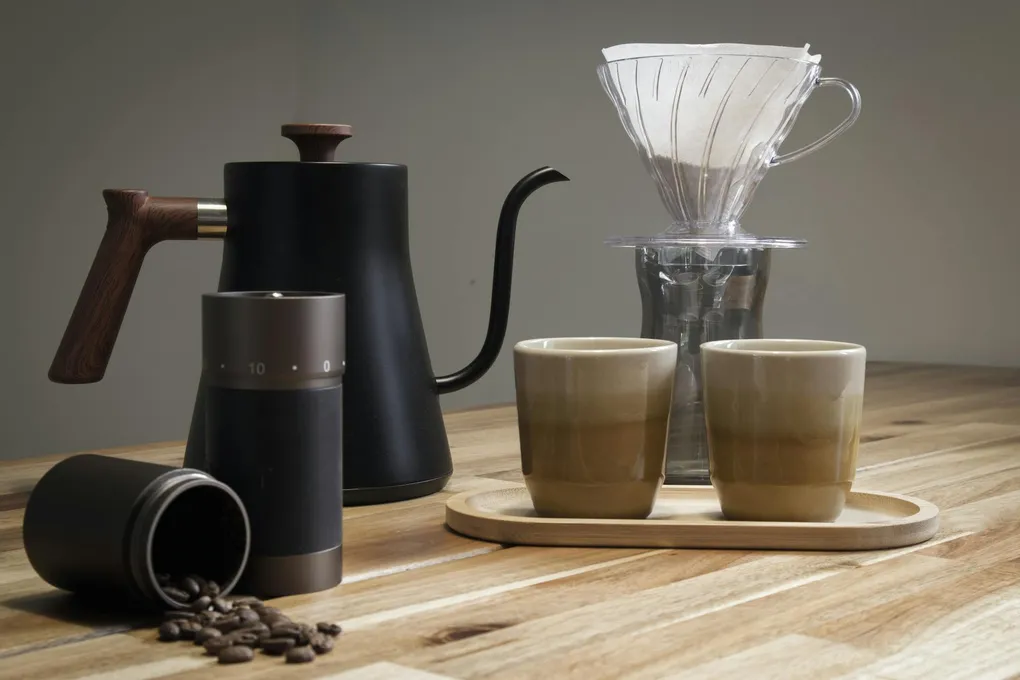
There’s a moment in every home brewer’s journey where the gear acquisition spiral begins. Maybe your pour over is inconsistent. Maybe you’re chasing a better espresso. Maybe you just watched a YouTube video where someone brewed with $3,000 of equipment and it looked incredible. So you start shopping — and this is where most people waste money.
The truth about coffee equipment is that it follows a strict hierarchy of impact. Some upgrades transform every single cup you make. Others change almost nothing. A $200 grinder paired with a $8 plastic V60 will produce dramatically better coffee than a $50 grinder with a $200 ceramic brewer. This isn’t opinion — it’s physics. The grinder determines particle size distribution, which determines extraction evenness, which determines whether your coffee tastes clean and sweet or muddled and harsh.
Here’s the hierarchy, ranked by how much each upgrade actually changes what’s in your cup.
1. Grinder — The Biggest Upgrade You Can Make
Impact: Transformative Cost: $40–600+
This is not debatable. The grinder is the single most important piece of coffee equipment you own. It matters more than the brewer, the kettle, the scale, and arguably more than the beans themselves (a good grinder makes mediocre beans taste decent; a bad grinder makes great beans taste bad).
Here’s why: coffee extraction depends on grind consistency. When all particles are roughly the same size, they extract at roughly the same rate — you get a clean, balanced cup. When particles vary wildly (dust mixed with boulders), the small particles overextract (bitter, ashy) while the large ones underextract (sour, grassy). You taste both simultaneously. That’s the “sour AND bitter” problem that confuses so many home brewers.
Blade grinders produce exactly this chaos — a random distribution of particle sizes with no repeatability. The leap from a blade grinder to even a cheap burr grinder is the single biggest quality jump in home coffee. Going from a cheap burr to a quality burr ($150–300) is the second biggest.
Jonathan Gagné’s particle distribution research confirms what every experienced brewer knows intuitively: grind uniformity has a larger effect on cup quality than any other variable except the coffee itself.
What to Buy
Budget ($40–80): Timemore C2/C3 hand grinder. The best value in coffee. 38mm conical burrs produce even grinds across the filter range. You have to crank by hand, which takes 30–60 seconds per cup.
Mid ($130–230): 1Zpresso JX-Pro ($130–160) for hand grinding — 48mm burrs, 12.5µm click adjustments, handles everything from pour over to espresso. For electric, Fellow Opus ($195–225) is half the noise of the Baratza Encore and truly all-purpose.
Premium ($300–650): Fellow Ode Gen 2 ($300–345) for filter only — 64mm flat burrs with outstanding consistency. Niche Zero ($580) for everything including espresso — 63mm conical, near-zero retention. Turin DF64 Gen 2 ($400–450) for espresso with upgrade potential — accepts aftermarket SSP burrs that push it to 80–90% of $1,500 grinder performance.
If you use the Fix My Coffee diagnostic and see “upgrade your grinder” in the recommendations, this is why. It’s the fix for sour-and-bitter, muddy, and inconsistent coffee. For more on how grind size affects your cup, see our micron chart.
2. Scale — The Cheapest Meaningful Upgrade
Impact: High (enables consistency) Cost: $15–40
You cannot reproduce a good cup of coffee without measuring. Ratios, the foundation of every recipe, require weights. “Two scoops” is meaningless — a tablespoon of light-roasted beans weighs differently than a tablespoon of dark-roasted grounds. The variance can be 30% or more between scoops.
A basic kitchen scale ($15) that reads to 1g works for filter methods. For espresso, you want 0.1g resolution ($25–40) because small dose changes produce big flavor shifts.
What a scale gives you: the ability to repeat your best cup. You brewed something perfect? Write down the dose and the water weight. Now you can make it again tomorrow. Without a scale, every brew is a guess.
Use our Brew Ratio Calculator to find the right dose — then weigh it.
What to Buy
$15–20: Any kitchen scale with 1g resolution and at least 2kg capacity. Doesn’t need to be a “coffee scale.” Just accurate and responsive.
$25–40: Timemore Black Mirror Basic+ or similar — 0.1g resolution, built-in timer, fits under most drippers. The timer is genuinely useful for tracking brew time without pulling out your phone.
3. Water — Free or Nearly Free
Impact: High (often underestimated) Cost: $0–30
Water is 98–99% of your finished cup by weight. If it tastes bad, your coffee tastes bad. If it has the wrong mineral content, it extracts wrong — too many minerals overextract (bitter, flat), too few underextract (sour, thin, hollow).
The ideal water for coffee has moderate mineral content. The SCA recommends 150 ppm TDS (acceptable range: 75–250 ppm), with the right balance of calcium, magnesium, and bicarbonate alkalinity. The SCA’s 2024 research found that alkalinity buffers 7.3x more strongly in pour over than espresso due to the different water-to-coffee ratios — so the same water can work perfectly for espresso and poorly for filter.
Magnesium preferentially extracts desirable flavor compounds (citric acid, malic acid, lactic acid), while calcium is less selective. This is why some mineral water recipes emphasize magnesium.
What to Do
Step 1 (free): Try bottled water. Crystal Geyser and Volvic are commonly recommended as good coffee water. If your coffee immediately tastes better, your tap water is the problem.
Step 2 ($5–15): Use a basic Brita or pitcher filter to remove chlorine and off-flavors. This fixes the most common tap water issue.
Step 3 ($15–30): Make DIY mineral water using concentrates (Third Wave Water, Lotus Water Drops, or homemade from Epsom salt + baking soda). Full instructions in our water recipes comparison.
4. Kettle — Essential for Pour Over, Optional Otherwise
Impact: Moderate to high (method-dependent) Cost: $30–100
If you brew pour over, a gooseneck kettle is essential — not optional. The thin spout gives you precise control over flow rate and pour placement, which directly controls extraction evenness. Pouring from a regular kettle onto a V60 is like painting with a garden hose.
If you brew French press, AeroPress, or use a drip machine, a gooseneck kettle adds nothing. You’re pouring water into a vessel and walking away. Any kettle works.
Temperature-controlled electric gooseneck kettles ($50–100) add another layer: you set the exact temperature and it holds it. This removes a variable. For light roasts (which need hotter water to extract properly) and espresso (where small temperature changes shift flavor significantly), it matters. For dark roasts and forgiving methods, it’s nice but not necessary.
What to Buy
Budget ($30–45): Any stovetop or electric gooseneck. The spout shape matters more than the brand.
Mid ($50–75): Fellow Stagg EKG — thin gooseneck, hydrophobic coating (cleaner pour), temperature hold. The most-recommended kettle in specialty coffee for a reason.
Skip if: You only brew French press, AeroPress, cold brew, or drip machine. Save the money for a better grinder.
5. Brewer — Last, and Least Important
Impact: Low (the vessel matters least) Cost: $8–40
This is the counterintuitive truth: the actual brewing device matters less than everything above it. A Hario V60 costs $8 for the plastic version. A French press costs $20. An AeroPress costs $35. These are simple vessels that hold coffee and water — the quality of the cup depends on what goes into them (evenly ground coffee, properly heated water, correct ratio), not the vessel itself.
The plastic V60 actually outperforms the ceramic version in one measurable way: plastic insulates better, maintaining higher and more stable slurry temperatures throughout the brew. Gagné confirmed this with thermal measurements.
Upgrading from a $20 French press to a $120 Espro press gives you a finer filter (less sediment) — that’s a real improvement. But it’s a marginal one compared to upgrading your grinder or fixing your water.
When to Invest in the Brewer
Espresso is the exception. Espresso machines need to hit 9 bar of stable pressure at a controlled temperature — this requires engineering. A $300 entry-level machine (Breville Bambino) works but has limitations: its ThermoJet thermoblock heating system heats water on demand rather than maintaining a reservoir, which actually gives it decent temperature stability for its price point — but you can’t steam and brew simultaneously. A $600–1,000 machine (Breville Barista Express, Gaggia Classic Pro) adds temperature stability and steaming power. Above $1,500, you’re paying for workflow speed, dual boilers, and pressure profiling — incremental improvements, not transformative ones.
The critical espresso insight: budget at least as much on the grinder as the machine. An $800 machine paired with a $100 grinder produces worse espresso than a $400 machine paired with a $400 grinder. Espresso is the most grind-sensitive method — 9 bar of pressure magnifies every inconsistency in particle size. This is the single most common mistake in home espresso setups.
For everything else, the brewer is the last thing to upgrade. Get the grinder, scale, water, and kettle right first.
When Upgrading Won’t Help
No equipment fixes these problems:
Stale beans. If your coffee was roasted more than a month ago, or ground more than 30 minutes ago, no grinder or kettle upgrade will make it taste fresh. Coffee peaks 7–21 days post-roast and degrades steadily after that — volatile aroma compounds gas off, oils oxidize, and the cup flattens out. Pre-ground coffee from the grocery shelf, which might be months post-roast, has already lost most of what makes specialty coffee worth buying. The fix is simple: buy smaller bags more often, and grind right before brewing.
Bad water. A Comandante grinder can’t compensate for heavily chlorinated, mineral-depleted, or sulfur-tasting tap water. Fix the water first — it’s cheaper than any equipment upgrade.
Wrong recipe. If you’re using 10g of coffee for 400ml of water, your coffee is weak because of math, not equipment. Use a scale and the Brew Ratio Calculator before spending money.
Not sure what’s actually wrong? The Fix My Coffee diagnostic walks you through symptoms to root causes — often the fix is free.
Common Upgrade Traps
Buying a $500 espresso machine before owning a $150 grinder. Espresso is the most grind-sensitive brewing method. A mediocre grinder produces inconsistent shots regardless of machine quality. Budget at least 50% of your espresso setup on the grinder.
Chasing diminishing returns. The jump from a $50 grinder to a $200 grinder is enormous. The jump from $200 to $600 is noticeable. The jump from $600 to $2,000 is measurable but subtle. Know where you are on the curve and spend accordingly.
Buying a temperature-controlled kettle for French press. Immersion methods are extremely forgiving of temperature. Water right off the boil works fine. Save the precision kettle for pour over.
Collecting brewers instead of mastering one. A V60, a Chemex, a Kalita, a Clever, and a siphon brewer all sitting on the counter doesn’t make better coffee than deeply learning a single one. Master the technique before diversifying the hardware.
The Upgrade Order
If you’re starting from scratch or rebuilding your setup, this is the order:
- Quality burr grinder ($130–300) — transforms every cup
- Kitchen scale ($15–25) — enables consistency
- Good water ($0–15) — removes the invisible variable
- Gooseneck kettle ($30–75, pour over only) — enables precision
- Better brewer (last) — the vessel is the least of your concerns
Total for a transformative filter coffee setup: $175–415. That’s less than many single gadgets that people buy first and wonder why their coffee didn’t improve.
Sources & Further Reading
- Gagné, J. The Physics of Filter Coffee — particle size distribution and extraction uniformity
- Hoffmann, J. How to Make the Best Coffee at Home — equipment hierarchy
- Hendon et al., Water for Coffee — mineral composition and extraction chemistry
Some links above are affiliate links. If you purchase through them, we earn a small commission at no extra cost to you.
Frequently Asked Questions
- Should I upgrade my grinder or my brewer first?
- Grinder, always. A $200 burr grinder with an $8 plastic V60 will dramatically outperform a $50 blade grinder with a $200 ceramic brewer. Grind consistency determines extraction evenness — it's the single biggest variable after the coffee itself. The brewer is just a vessel; the grinder is where flavor is made or lost.
- Is an expensive kettle worth it for pour over?
- A gooseneck kettle is essential for pour over — the thin spout gives you flow control that's impossible with a regular kettle. But you don't need the most expensive one. A $30 stovetop gooseneck works. Temperature-controlled electric models ($50–100) add convenience and precision, which matters more for light roasts. If you only brew French press or AeroPress, skip the gooseneck entirely.
- How much should I spend on a home espresso setup?
- The price-to-quality sweet spot is about $1,000–1,500 total — split roughly 50/50 between machine and grinder. Below that, you're making compromises that show in the cup. Above that, you're buying convenience and precision, not dramatically better espresso. The most common mistake: spending too much on the machine and too little on the grinder.
- Does water really make a noticeable difference?
- Yes — water is 98–99% of your finished cup. Try brewing one cup with your tap water and one with bottled spring water (Crystal Geyser or Volvic). If there's a noticeable difference, your tap water is holding your coffee back. Fixing it is cheap: a basic filter removes chlorine, and DIY mineral concentrates (Third Wave Water, Lotus Drops) cost $10–15 for dozens of brews.
- When does upgrading NOT help?
- When the problem is stale beans (roasted more than a month ago), bad water, or wrong recipe. No equipment purchase fixes those. If you're not sure what's actually wrong, use the Fix My Coffee diagnostic before spending money — the fix might be free.