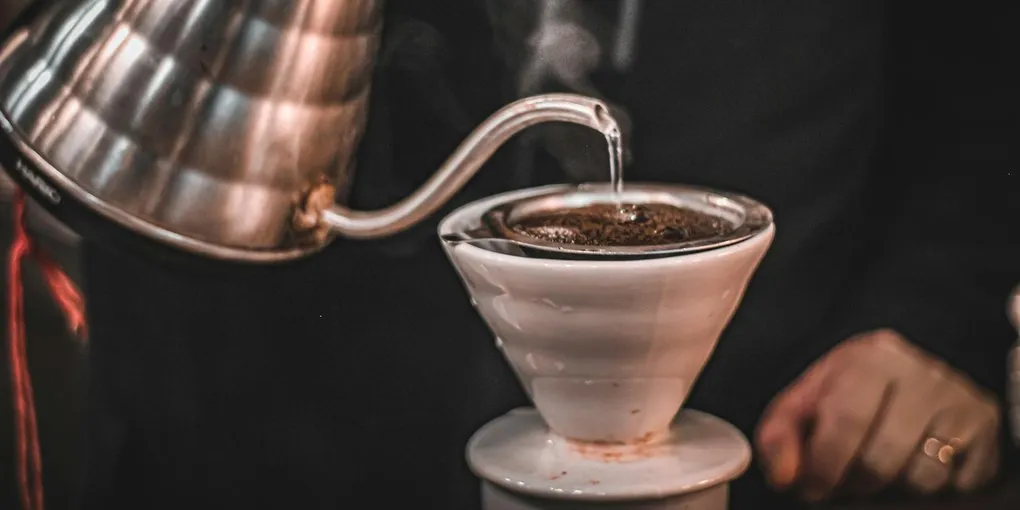
A gooseneck kettle is the third most important piece of coffee equipment you can own, after a burr grinder and a kitchen scale. That’s not marketing — it’s physics. The thin, curved spout produces a laminar (smooth) stream that saturates coffee grounds evenly, and a University of Pennsylvania study using high-speed imaging inside a pour-over cone showed exactly why this matters: laminar water jets trigger miniature avalanches of coffee particles on impact, creating an erosion-accretion-collapse cycle that drives strong, uniform extraction. Turbulent streams from standard kettles don’t produce the same effect.
The difference between a regular kettle and a gooseneck isn’t subtle. A standard kettle pours far too fast for controlled pour-over brewing. The best gooseneck kettles sustain flow rates as low as 1.5 grams per second, giving you precise control over how water contacts the coffee bed. That control determines whether your extraction is balanced or channeled, bright or muddy.
We researched and compared seven gooseneck kettles across every price point — from a $25 stovetop entry point to the premium electric model that Wirecutter, Tom’s Guide, and Serious Eats all ranked number one. Here’s what’s worth your money.
Why the Kettle Matters: The Science
Pour-over brewing is a percolation process governed by Darcy’s law — water flows through the coffee bed based on the bed’s permeability, the water column height, and the flow rate you introduce. When you pour too fast, water channels through paths of least resistance, over-extracting some grounds while leaving others barely touched. When you pour at a controlled, steady rate, the bed saturates evenly and extraction is uniform.
The UPenn research confirmed what baristas have known intuitively: a slow, laminar stream from a gooseneck doesn’t just “wet” the grounds — it digs into the coffee bed, triggering particle avalanches that expose fresh surfaces to water. Higher pour heights (while maintaining laminar flow) intensify this effect. And prolonging mixing time with slower pours leverages these avalanche dynamics for more thorough extraction.
There’s a temperature angle too. Jonathan Gagne’s measurements show that slurry temperature runs 5-15 degrees C lower than kettle temperature in most pour-over setups, depending on the dripper material. Plastic V60s with 99 degrees C water from the kettle can average as low as 84 degrees C in the slurry. That gap means temperature precision at the kettle directly affects what happens in the cup — and a kettle that can hold a target temperature during your 3-4 minute pour eliminates one variable from the equation.
Electric vs. Stovetop
This is the first decision you need to make, and the honest answer is simpler than most guides make it.
Electric kettles win on precision and convenience. Set a target temperature, press a button, and the kettle heats to that exact degree and holds it while you pour in stages. For daily pour-over brewing, this consistency is a meaningful advantage — you remove temperature as a variable entirely.
Stovetop kettles win on durability, price, and simplicity. No electronics means nothing to fail. A stainless steel stovetop gooseneck lasts decades. Pair one with a $10 instant-read thermometer and you get 90% of the electric experience at a fraction of the cost.
If you brew pour-over daily and want set-it-and-forget-it temperature control, go electric. If you’re starting out, travel, or prefer tools with no expiration date, start stovetop and upgrade later if you want to.
The 7 Best Gooseneck Kettles, Ranked
We’re going from least expensive to most expensive. Skip to your budget or read the full list.
1. BaristasBuddy Bohemian — About $25
Type: Stovetop (induction, electric, ceramic — not gas) Capacity: 1L
This is your entry point, and it’s a surprisingly good one. For the price of a bag of specialty coffee, you get a stainless steel gooseneck with genuinely impressive flow control. The wooden handle stays cool, the matte yellow finish looks great on a counter, and the triple-layered base works on induction and ceramic cooktops.
The catch: no built-in thermometer and no gas stove compatibility. You’ll need an instant-read thermometer to hit your target temperature.
If you want to try pour-over without committing to a $100+ kettle, this is the no-brainer starting point.
2. Hario V60 Buono — About $40
Type: Stovetop (all stove types including gas) Capacity: 1.0-1.2L
The industry standard. Walk into any specialty cafe doing pour-over and there’s a good chance you’ll see a Hario Buono behind the bar. The spout design has been refined over decades — James Hoffmann specifically praised it for producing a slow, controlled pour with a unique spout angle that most competitors can’t match.
It works on every stove type, including gas. There are no electronics to break. The ergonomics make long 3-4 minute pours comfortable. You’ll have this kettle for 15-20 years.
The trade-off is simplicity: no temperature display, no presets, no keep-warm. You boil, you check with a thermometer, you pour. For purists who want a lifetime tool, the Hario is our pick.
3. COSORI Electric Gooseneck — About $60
Type: Electric | Capacity: 0.8L | Power: 1200W
This is the kettle that shows up as “best value” in almost every roundup, and rightfully so. Five temperature presets (170 degrees F through full boil), a one-hour keep-warm function, and 100% stainless steel water contact — no plastic touching your water. It boils in under four minutes.
The controls can occasionally be unresponsive — a few owners report needing to unplug and replug once or twice a week. And the design is functional, not beautiful. But for the money, nothing in the electric category comes close. This is our best value pick.
4. Greater Goods Electric Gooseneck — About $60
Type: Electric | Capacity: 0.8L | Power: 1200W
Where the COSORI gives you presets, the Greater Goods gives you full degree-by-degree control from 104 to 212 degrees F. That’s a meaningful upgrade if you want to dial in exact brew temperatures for different coffees and roast levels.
The real standout is the counterbalanced handle — the weight shifts naturally as you tilt, reducing fatigue during long pours. A hydrodynamic vent in the spout prevents air bubbles from interrupting your stream. It’s a newer brand without the massive review history, but the engineering details are genuinely impressive for this price.
5. Bonavita 1L Digital Variable Temperature — About $90
Type: Electric | Capacity: 1.0L | Power: 1200W
Low Key Coffee Snobs called it “nearly the same brewing performance as the Fellow Stagg EKG at a noticeably lower cost.” That’s a big claim, and from what we’ve seen, it holds up.
One-degree precision, six presets, custom temperature memory, and notably fast heating — it reaches 205 degrees F faster than the Fellow. At a full liter, it holds more water than most electric goosenecks, which matters for Chemex brewing or making two cups.
The design is purely functional. Nobody’s putting this on Instagram. But if you care about what’s in the cup and not what’s on the counter, the Bonavita is the serious brewer’s value pick.
6. Fellow Stagg EKG — About $150
Type: Electric | Capacity: 0.9L | Power: 1200W
This is the one. Wirecutter’s number one pick. Tom’s Guide 4.5 out of 5. Serious Eats tested thirteen gooseneck kettles and put the Fellow on top. The review consensus is as close to unanimous as it gets.
The reason is the pour. In testing, the Fellow sustains a flow rate as low as 1.5 grams per second — no other consumer kettle matches that. A sixty-minute temperature hold keeps water at your target through the entire brew. The built-in brew stopwatch eliminates the need for a separate timer. And Jonathan Gagne specifically named the Fellow Stagg EKG as his choice, citing its thin gooseneck, hydrophobic coating, and long breakup length.
The honest trade-offs: it’s the slowest to reach temperature of the kettles we tested. The handle joint can get warm during extended use. And at 0.9 liters, it’s tight for Chemex brewing.
For precision, pour control, and aesthetics — this is our best overall pick.
7. Fellow Stagg EKG Pro — About $180
Type: Electric | Capacity: 0.9L | Power: 1200W
Everything the standard EKG does, plus five custom temperature presets and scheduling. The scheduling feature is genuinely clever — set it the night before and the kettle reaches your target temperature right when your alarm goes off.
The five presets are useful if you switch between brew methods: light roast at 208, medium at 200, green tea at 175. One button instead of dialing in each time.
But here’s the honest take: the standard EKG does 90% of what the Pro does for $30-60 less. Unless you genuinely brew multiple methods daily or love the scheduling feature, the base model is the smarter buy.
What Features Actually Matter
Not all gooseneck features affect brew quality equally. Here’s the ranking, based on the research and testing:
Spout design and flow rate control matter most. A narrow, curved gooseneck that can sustain 2-6 grams per second is the entire point. Without this, you’re just heating water in a pretty container.
Temperature control is second. Pour-over coffee extracts best at 195-205 degrees F (91-96 degrees C). Variable temperature lets you dial in for different roast levels and origins.
Temperature hold is third. You’re pouring in stages over 3-4 minutes. Without hold, water cools during the brew — and that 5-15 degree C gap between kettle and slurry temperature gets worse.
Capacity, ergonomics, and speed are quality-of-life features that matter for daily use but don’t directly change what’s in the cup.
Our Top Picks
Best overall: Fellow Stagg EKG. The pour control is genuinely unmatched, and every major review outlet agrees.
Best value: COSORI Electric Gooseneck. Temperature presets, keep-warm, and full stainless steel for about $60.
Best for purists: Hario V60 Buono. No electronics, no displays — just a beautifully designed spout that baristas have trusted for decades.
Pair any of these with a solid grind setup and the right coffee-to-water ratio, and you’ll notice the difference in your cup immediately. And if you’re curious how water chemistry plays into all of this, that’s the next variable worth exploring once your kettle game is dialed in.
Some links above are affiliate links. If you purchase through them, we earn a small commission at no extra cost to you.
Frequently Asked Questions
- Do I really need a gooseneck kettle for pour-over coffee?
- Yes -- and the science backs this up. A University of Pennsylvania study using high-speed imaging showed that laminar (smooth) water jets from gooseneck spouts trigger particle avalanches inside the coffee bed that drive uniform extraction. Standard kettles pour too fast for controlled pour-over. A gooseneck lets you pour at 2-6 g/s, which is the range needed for even saturation.
- What temperature should I set my gooseneck kettle to for pour-over?
- Start at 205 degrees F (96 degrees C) for medium roasts and adjust from there. Light roasts can handle 208-210 degrees F; darker roasts do better at 195-200 degrees F. Keep in mind that slurry temperature inside the dripper runs 5-15 degrees C lower than kettle temperature, so erring slightly hotter at the kettle is usually correct.
- Can I use a gooseneck kettle as my only kitchen kettle?
- You can, but electric gooseneck kettles are specialized tools -- they heat slower and hold less water (0.8-1.0L) than standard electric kettles (1.5-1.7L). For boiling water for pasta or filling a French press, a regular kettle is faster and more practical. Most pour-over enthusiasts keep both.
- Is the Fellow Stagg EKG worth the price over budget options?
- The Fellow's advantage is pour control -- it sustains flow rates as low as 1.5 g/s, which no other consumer kettle matches. If you brew pour-over daily and want the most precise stream possible, the Fellow justifies its premium. If you brew a few times a week, the COSORI at about $60 or a Bonavita at about $90 gets you excellent results for significantly less money.
- Should I buy stovetop or electric?
- Electric wins on daily convenience: set a temperature, press a button, and it holds the temp while you pour. Stovetop wins on durability and price -- a Hario Buono with a $10 thermometer lasts decades and gets you 90% of the electric experience. Start stovetop if you're new to pour-over; upgrade to electric if you find yourself brewing daily and wanting more precision.