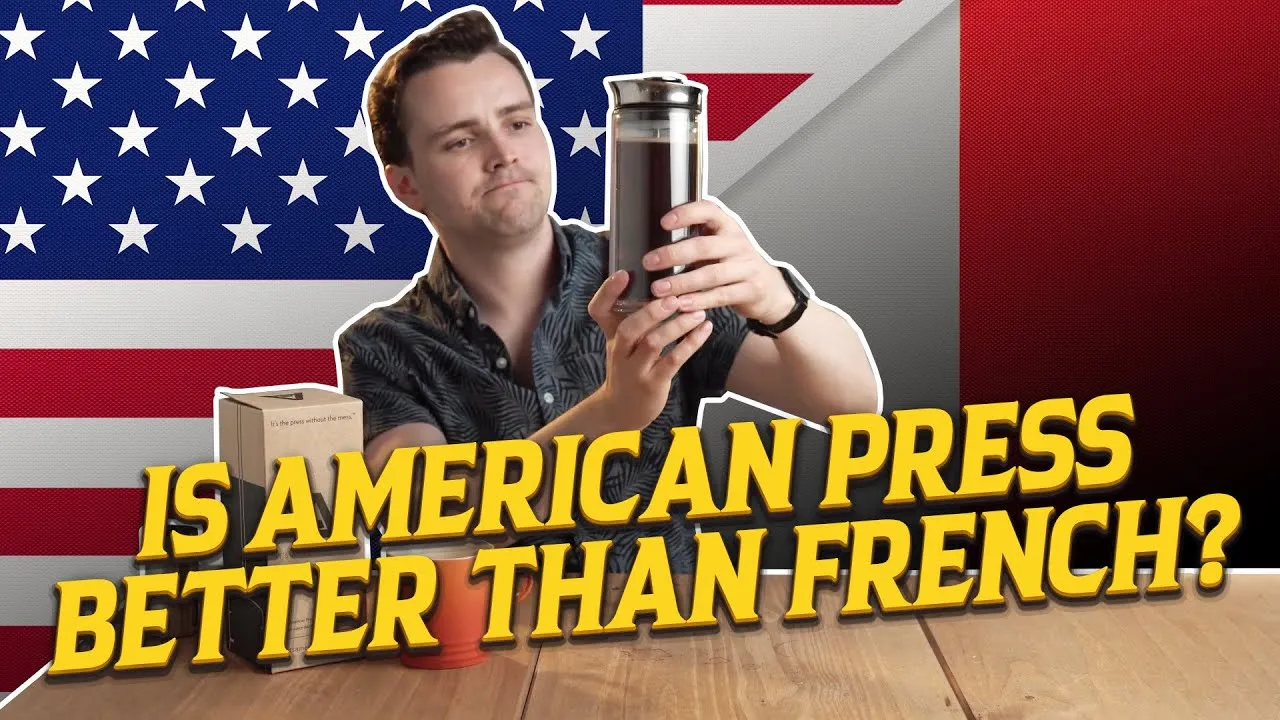
Nobody enjoys cleaning a French press. The American Press was invented by a college student who watched his peers leave dirty French presses sitting for days because the cleanup was too annoying. It won a Red Dot Design Award in 2018 and promises to fix immersion brewing’s biggest pain point. We tested it head-to-head against both the French press and the AeroPress.
How It Works
Three parts: a flask, a glass pod that holds grounds with a metal mesh filter, and a piston. Unlike a French press where grounds steep passively, the American Press uses “pressurized steeping” — you fill the pod, let it steep briefly, then press down, forcing water through the grounds. It’s a hybrid between immersion and percolation.
The key differentiator is 100-micron steel filtration — significantly finer than a French press mesh (typically 150-200 microns). Less sediment, cleaner cup. No paper filters or plastic pods. It brews up to 14 ounces in 2-3 minutes.
The construction is thoughtful: double-walled glass (safe to hold when hot), medical-grade silicone, polished stainless steel lid, and a designed steel pouring edge that genuinely doesn’t spill.
The Three-Way Taste Test
Same Costa Rican medium roast, same medium grind, same 93°C water, same ratios. Only the brewer changed.
French Press: Slightly woody overtone indicating mild over-extraction. Drinkable, pleasant in a casual way, but we knew these beans could do better. Noticeable sediment at the bottom.
AeroPress: Like a completely different coffee. Every flavor came through — fruity notes, subtle chocolate, complexity, clarity. If you’re purely chasing flavor, the AeroPress is hard to beat.
American Press: Better than expected. Surprising flavor complexity — not quite AeroPress level, but remarkably close and a clear step above the French press. Cleaner cup with less sediment, while still maintaining some of the body that immersion brewing delivers.
The Rankings
Flavor: AeroPress wins. The air pressure component gives it an extraction edge. But the American Press was surprisingly close — the 100-micron filtration produces cleaner coffee than a French press while retaining immersion-style body.
Cleanup: This is the American Press’s killer feature. Remove the pod, shake grounds into the trash, rinse. Done in under a minute. The AeroPress is also quick (pop cap, push puck, rinse), but slightly more involved. The French press is dead last — grounds stuck at the bottom, cleanup all over the sink, and we’re all guilty of leaving it dirty.
Portability: The American Press is shatterproof by design, contained, and lightweight. The AeroPress is similarly compact. French press glass carafes break.
Who Should Buy This
The best brewer is the one you’ll actually use. If you despise cleanup and your French press collects dust because of it, the American Press solves that problem elegantly. The pod pops out, grounds are gone, and there’s nothing to procrastinate about.
At $40-50, it sits between a French press ($20-30) and costs about the same as an AeroPress ($35-45). The coffee quality slots in exactly where you’d expect from the price: better than French press, slightly behind AeroPress.
Buy the American Press if: You want immersion-style coffee with the easiest cleanup of any brewer. You hate cleaning your French press. You want something portable and shatterproof.
Buy the AeroPress instead if: You want the absolute best flavor extraction from a manual brewer. You don’t mind slightly more cleanup effort.
Keep the French Press if: You brew large batches for multiple people (the American Press tops out at 14 ounces). There’s a reason French press remains one of the most popular brewing methods in the world — its full-immersion style produces a body and richness that filtered methods can’t quite replicate.
The American Press doesn’t try to be the best coffee brewer ever made. It tries to be a better, more practical version of immersion brewing — and it succeeds at that specific goal. If you want to get the most from whichever brewer you choose, pairing it with the right grind size and a quality burr grinder will matter more than the brewer itself.
Frequently Asked Questions
- Is the American Press easier to clean than a French press?
- Significantly. The American Press's pod system contains all the grounds in a removable basket — pop it out, knock the puck into the trash, rinse. A French press requires scraping wet grounds from the bottom of a glass carafe, which is messier and slower. Cleanup is the American Press's single biggest advantage.
- Does the American Press make better coffee than a French press?
- Different, not necessarily better. The American Press's 100-micron filter produces a cleaner, brighter cup with less sediment and fewer oils than a French press. If you like French press's heavy body and rich mouthfeel, you may find the American Press too clean. If French press sediment bothers you, the American Press solves that problem.
- Can I use the American Press for tea?
- Yes — the pod system works well with loose-leaf tea. Fill the basket with tea leaves instead of coffee, use appropriate water temperature for the tea type, and press. The fine mesh filter keeps leaves contained. It's actually one of the better dual-purpose brew devices.
- Is the American Press worth the higher price compared to a French press?
- If cleanup frustration is what keeps you from brewing daily, yes. A French press costs $20-40; the American Press costs $60-80. The premium buys you dramatically easier cleanup and a cleaner cup. If you're happy with French press cleanup and prefer the oilier cup it produces, save your money.
Some links above are affiliate links. If you purchase through them, we earn a small commission at no extra cost to you.