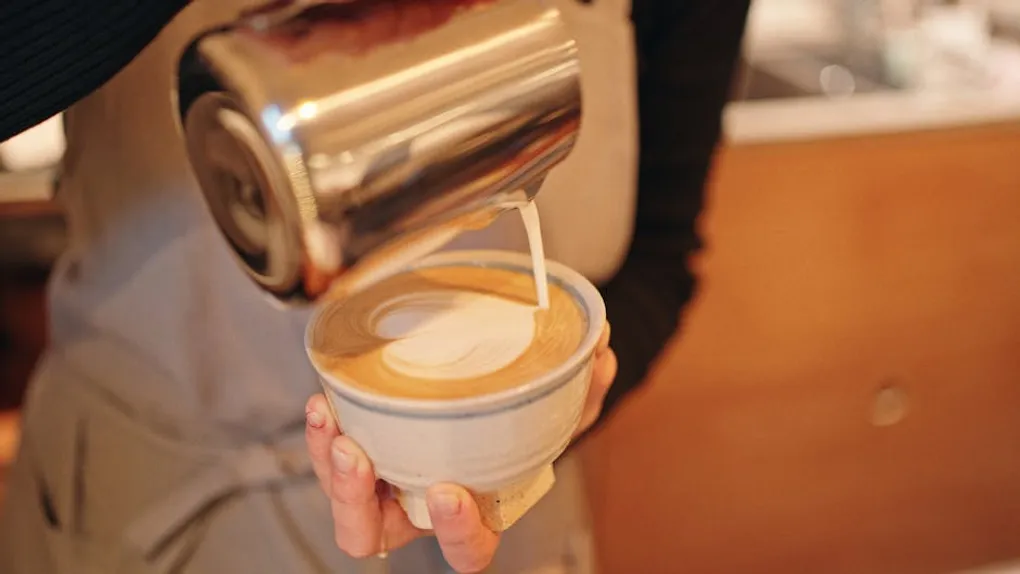
That six dollar latte you buy every morning. You know what’s in it — espresso, steamed milk, maybe a pump of vanilla. But do you know what you’re actually paying for?
The coffee beans in that cup — the ones a farmer grew, picked by hand, and shipped across an ocean — cost about ten cents. Ten cents out of six dollars. Less than two percent of the price. The other $5.90 goes somewhere, and where it goes tells you everything about the economics of the thing 400 million Americans drink every single day.
Here’s the full breakdown, from the farm to the cup to the cash register.
Prefer to watch? Here’s the full video version of this breakdown.
What’s Physically Inside a $6 Latte
A standard latte uses a double espresso shot — about 18 grams of ground coffee. At wholesale prices, that’s roughly $0.25 to $0.43 worth of roasted beans.
But those beans started as raw green coffee — the commodity that farmers actually grow and sell. At commodity prices, the green beans in your latte cost about $0.08 to $0.10. That’s the number in our title, and it checks out.
Then there’s everything else:
| Ingredient | Cost to the Shop |
|---|---|
| Green coffee beans (raw commodity) | $0.08 - $0.10 |
| Roasted beans (wholesale) | $0.25 - $0.43 |
| Whole milk (9 oz) | $0.21 - $0.36 |
| Paper cup | $0.10 - $0.15 |
| Lid | $0.05 - $0.08 |
| Sleeve | $0.05 - $0.07 |
| Vanilla syrup (1 pump) | $0.20 - $0.45 |
| Total raw materials | $0.89 - $1.42 |
Total raw materials for a flavored latte come to roughly $0.89 to $1.42 on a six dollar drink. That means about 15-24% of what you paid went to ingredients.
The other 76-85%? That’s where it gets interesting.
Where the Other $5 Actually Goes
Labor: The Biggest Cost
The biggest expense in any coffee shop isn’t ingredients. It’s people.
Labor takes 25-35% of a coffee shop’s revenue. The barista making your latte earns about $16 per hour on average. Run a seven-day operation with two staff per shift and you’re looking at $10,000 a month in wages alone — before benefits, payroll taxes, or shift coverage for sick days.
On a $6 latte, roughly $1.50 to $2.10 goes to labor costs.
Rent: The Second-Biggest Line Item
A sit-down cafe needs 1,500 to 2,000 square feet. In a decent urban location, that’s $2,000 to $8,000 a month. The industry rule of thumb: if rent exceeds 10% of revenue, you’re in trouble.
Equipment: The Upfront Hit
A commercial espresso machine runs $5,000 to $30,000. A quality commercial grinder adds $1,500 to $4,000. Total equipment to open a shop? $80,000 to $300,000. That cost gets amortized into every drink over years. If you’re curious about the home espresso equivalent, even consumer machines represent a significant investment — here’s our guide to the best espresso machines under $500 and under $200.
Credit Card Processing: The Hidden Drain
This one surprises people. The processing fee is about 2-3% per transaction, plus a fixed per-swipe charge of $0.05 to $0.10. On a $5 coffee, that per-swipe fee hits four times harder than on a $100 purchase. When your average ticket is five bucks, processing costs eat into margins fast.
Waste: The Invisible Cost
Cafes throw away 20-25% of their milk — overfilled pitchers, remakes, expired stock. That works out to roughly $1,500 a year in wasted milk alone.
The Full Operating Picture
| Cost Category | % of Revenue |
|---|---|
| Labor (wages, benefits, payroll taxes) | 25 - 35% |
| Rent and occupancy | 8 - 15% |
| Cost of goods (ingredients, cups, supplies) | 15 - 24% |
| Equipment amortization | 3 - 8% |
| Credit card processing | 2 - 4% |
| Utilities, insurance, marketing, waste | 5 - 10% |
| Total operating costs | 75 - 85% |
| Remaining for profit | 15 - 25% |
Add it all up — labor, rent, equipment, utilities, insurance, processing, marketing, waste — and total operating costs hit 75-85% of revenue. The owner keeps what’s left, and “what’s left” is often thinner than you’d expect.
The Supply Chain: Farm to Cup
The story of that ten-cent coffee bean is really a story about a very long supply chain with markups at every stage.
A coffee farmer — usually a smallholder with a few acres in Brazil, Colombia, Ethiopia, or Vietnam — sells raw green beans for about $1.00 to $1.50 per pound. After processing and export, those beans trade at the commodity price: roughly $1.60 to $2.80 per pound.
Then they cross an ocean. Shipping and import costs add another $1.00 to $1.50. A roaster buys those green beans for $3.00 to $5.00 per pound. Roasting adds $2.00 to $4.00 more — partly because you lose nearly 15% of the weight in the process. The beans literally shrink as moisture and CO2 escape. (If you want to understand what happens during roasting in more detail, we covered the chemistry of roast levels in depth.)
By the time a cafe buys roasted beans wholesale, they’re paying $8 to $12 per pound. The national restaurant average is about $10.92.
And when those beans get brewed and sold by the cup? One pound makes roughly 20-30 drinks. At $5-6 each, that pound generates $42 to $70 in revenue.
| Supply Chain Stage | Price per Pound |
|---|---|
| Farmer sells green beans | $1.00 - $1.50 |
| Commodity/export price | $1.60 - $2.80 |
| After shipping and import | $3.00 - $5.00 |
| After roasting | $8.00 - $12.00 |
| Revenue when brewed and sold | $42 - $70 |
| Total markup: farm to cup | 30x - 70x |
The total markup from the farm gate to your hand? Thirty to seventy times. That’s not a typo.
The Farmer’s Share
Here’s the part that’s hard to hear.
The World Economic Forum estimates that the farmer who grew the beans in your latte earns about $0.03 to $0.04 per cup. That’s roughly 1% of what you paid.
5.5 million of the world’s 12.5 million smallholder coffee farmers live below the international poverty line of $3.20 a day. Many experience three to eight months of food scarcity every year. They grow one of the world’s most popular beverages and can’t reliably feed their families.
Fair Trade and Direct Trade programs help some farmers earn 20-50% more per pound. But most of the world’s coffee still moves through commodity markets where the farmer’s share is a tiny fraction of the retail price.
And even when prices spike — like they did in 2024 and 2025 during the global coffee crisis — many farmers don’t actually earn more. The droughts that drove prices up also destroyed their crops. Higher price per bag times fewer bags often equals the same income. Or less.
The Oat Milk Question
This might be the most revealing detail in coffee shop economics.
Dairy whole milk costs the shop about $0.02 per ounce. Oat milk costs about $0.06 per ounce. So switching your latte to oat milk costs the shop roughly $0.36 extra.
What do they charge you? $0.50 to $1.50. For $0.36 of additional cost.
That upcharge has been one of the highest-margin moves in the history of coffee shops — an 8x to 25x markup on the actual cost difference.
To be fair, some of that premium covers higher spoilage rates and the complexity of stocking multiple milk options. But the math is the math.
The tide is turning, though. Starbucks dropped their plant milk upcharge in November 2024, and over 325 chains have followed. But your neighborhood indie shop might still charge that extra dollar — and for a business running on 13% margins, it’s hard to blame them.
Drip vs. Latte: What Shops Really Want You to Order
If you’re a coffee shop owner, what do you actually want people to order?
| Drip Coffee | Latte | |
|---|---|---|
| Retail price | $2.50 - $3.50 | $5.00 - $6.00 |
| Cost to make | $0.25 - $0.50 | $1.00 - $1.40 |
| Gross margin | 80 - 90% | 70 - 85% |
| Absolute profit per drink | About $2.50 | About $3.50 - $4.50 |
A drip coffee has the highest margin percentage on the menu — 80-90%. But a latte generates $3.50 to $4.50 in absolute profit versus about $2.50 for drip. You’d need almost two drip sales to match one latte.
When you’re paying $16 per hour for labor and $8,000 a month for rent, you need every customer spending as much as possible. Margin percentage matters. But absolute dollars per transaction matter more.
That’s why the menu boards feature the lattes. That’s why seasonal specials are always espresso-based. The drip coffee is more profitable per unit of ingredient. But the latte is more profitable per customer.
(And if you’re a drip coffee person curious about espresso drinks, here’s our guide to what a cortado actually is and the difference between ristretto and lungo shots.)
How Coffee Compares to Other Beverage Markups
Before you get too worked up about coffee markups, here’s some context from across the food service industry:
| Beverage | Typical Markup |
|---|---|
| Fountain soda | 1,100%+ |
| Iced tea | 1,000 - 2,000% |
| Cocktails | 400 - 500% |
| Latte | 500 - 700% |
| Draft beer | 200 - 300% |
| Wine by the glass | About 200% |
That $2 Coke at a restaurant costs about $0.05 to $0.12 to produce — cup, syrup, carbonated water. That’s it. Iced tea is even more extreme.
Your latte’s 500-700% markup puts it right in the middle of the pack. And wine by the glass has one of the lowest markups on a typical menu — about 200%. Why? Because customers can look up the retail price on the bottle. The transparency keeps markups honest.
The entire food service industry runs on high markups and thin margins. Coffee isn’t the exception. It’s the norm.
The Business Reality: Why Most Coffee Shops Fail
Those thin margins bring us to an uncomfortable truth.
50-75% of independent coffee shops close within five years. The average profit margin for the ones that survive? 13.8%. On a $6 latte, that’s about $0.83. On a six-figure investment.
Startup costs run $100,000 to $300,000 for a sit-down location. You need to clear roughly $30,000 to $35,000 a month in revenue just to break even. And most new shops don’t hit that number for the first year or two.
The shops that make it tend to share a few things:
- The owner works in the shop. Not managing from a distance — actually pulling shots and running the register.
- The format is compact and efficient. Less square footage means less rent, fewer staff, and faster service.
- Upselling is consistent. Every extra shot, every syrup, every pastry add-on improves the ticket average.
- There’s a loyal base of regulars. Not foot traffic, not tourists. Regulars who come five days a week.
Drive-throughs are quietly becoming the smarter bet. Same margins, smaller footprint, faster turnover, less labor. A drive-through kiosk can generate $1,300 per square foot per year. A sit-down cafe? $300 to $800.
The romantic vision of the cozy neighborhood coffee shop is an expensive one to maintain.
The Third Place Is Disappearing
In the early 1990s, Howard Schultz built Starbucks around an idea from sociologist Ray Oldenburg. Home is your first place. Work is your second. And a community gathering spot — the cafe, the pub, the barbershop — is your third place.
Schultz designed Starbucks to be that third place. Dim lighting. Plush armchairs. Earth tones. Rounded tables that encouraged lingering. The product wasn’t really the coffee. It was the permission to sit and stay.
And you paid for it. Not consciously, maybe. But the price of a Starbucks latte always included a little bit of rent — your share of the cost of occupying that comfortable seat.
Here’s the twist. Starting around 2022, Starbucks began dismantling the third place. Armchairs replaced with hard chairs and metal stools. Mobile ordering took priority. Drive-throughs now dominate sales.
The experience that justified the premium is largely gone. But a grande latte hit $5.65 in New York by 2025. You’re still paying third-place prices for what’s increasingly a grab-and-go operation.
The Latte Factor: $6/Day = $270,000 in 30 Years?
There’s a famous personal finance concept called the Latte Factor, popularized by author David Bach.
The math is simple:
- $6 per day on coffee
- $2,190 per year
- Invested at 8% return for 30 years
- Final value: approximately $270,000
It’s a real number. And for some people, awareness of daily spending habits genuinely matters.
But the counterargument is strong. The Latte Factor implies that small luxuries are the main obstacle to wealth. In reality, structural costs — housing, healthcare, student loans — take 40-60% of most people’s income. Cutting out lattes doesn’t fix that math.
What Your $6 Latte Actually Pays For
The real value of understanding your latte’s economics isn’t about whether to buy it or not. It’s about knowing what you’re paying for:
- $0.08-0.10 — Green coffee beans (the commodity)
- $0.25-0.43 — Roasted beans at wholesale
- $0.36-0.54 — Milk, cup, lid, sleeve
- $0.20-0.45 — Flavoring (vanilla syrup)
- $1.50-2.10 — Labor (the barista and everyone behind them)
- $0.48-0.90 — Rent (your share of the lease)
- $0.10-0.18 — Credit card processing
- $0.30-0.50 — Equipment, utilities, insurance, marketing, waste
- About $0.83 — Profit (if the owner is lucky, at a 13.8% margin)
And somewhere at the very beginning of that chain, $0.03 to $0.04 went to the farmer who grew the beans.
It’s not simple. It’s not a scam. And the person who deserves more from your six dollars is probably the one who grew the beans.
If you want to understand why coffee prices have been surging and what’s driving the economics at a global scale, we covered the full story in our piece on the coffee crisis. And for getting the most out of every bean at home, our coffee-to-water ratio guide is the place to start.
Some links on this site are affiliate links. If you purchase through them, we earn a small commission at no extra cost to you.
Frequently Asked Questions
- How much does a latte actually cost a coffee shop to make?
- A flavored latte costs a coffee shop about $0.89 to $1.42 in raw materials — beans, milk, cup, lid, sleeve, and syrup. But when you add labor (25-35% of revenue), rent, equipment amortization, credit card processing, utilities, and waste, total costs hit 75-85% of the retail price. On a $6 latte, the shop keeps about $0.83 in profit at the industry-average 13.8% margin.
- Why is the markup on lattes so high?
- A latte's 500-700% markup sounds extreme, but it's actually in the middle of the pack for food service. Fountain soda marks up at 1,100%, iced tea at 1,000-2,000%. The high markup exists because the cost of serving the drink — labor, rent, equipment — far exceeds the cost of the ingredients. Coffee shops spend 75-85% of revenue on operating costs, leaving slim profit margins even with the markup.
- How much does the coffee farmer earn from my latte?
- About $0.03 to $0.04 per cup — roughly 1% of the retail price. The World Economic Forum estimates that 5.5 million of the world's 12.5 million smallholder coffee farmers live below the international poverty line of $3.20 a day. Fair Trade and Direct Trade programs help some farmers earn 20-50% more per pound, but most coffee still moves through commodity markets where the farmer's share is minimal.
- Is the oat milk upcharge justified?
- Oat milk costs a coffee shop about $0.36 more per latte than dairy — $0.06 per ounce versus $0.02 for whole milk. But many shops charge $0.50 to $1.50 for the switch, an 8-25x markup on the actual cost difference. Some of that covers higher spoilage and stocking complexity, but it remains one of the highest-margin moves in coffee shop history. Starbucks dropped the surcharge in November 2024, and over 325 chains have followed.
- Why do so many coffee shops fail?
- 50-75% of independent coffee shops close within five years. The combination of high startup costs ($100,000-$300,000), thin margins (average 13.8% for survivors), and the need to clear $30,000-35,000 per month in revenue just to break even makes the business extremely difficult. The shops that survive typically have an owner who works on-site, a compact format, consistent upselling, and a loyal base of regulars rather than foot traffic.
- Is it cheaper to make lattes at home?
- Significantly. A home latte costs roughly $0.50-1.50 per cup depending on your beans and milk — compared to $5-7 at a shop. The upfront investment in an espresso machine ($200-500 for a capable home setup) pays for itself within a few months of daily use. You lose the convenience and the experience, but the per-cup economics are roughly 4-10x cheaper.