If you order a “macchiato” at a third-wave specialty café and at a Starbucks two blocks away, you will get two completely different drinks. One arrives in a 2.5-ounce demitasse, mostly espresso, with a polite spoonful of foam. The other arrives in a 16-ounce cup, mostly milk, sweetened with vanilla syrup and laced with caramel sauce. Both are called “macchiato.” Only one matches the original Italian definition.
This is not a story about who is wrong. Millions of Americans love Caramel Macchiatos, and that drink is its own genuinely good beverage. But the name carries a specific Italian meaning — macchiato literally means “stained” — and understanding that meaning makes you a better orderer and a better home barista. Here is what each drink actually is, where the confusion came from, and how to get exactly what you want at any counter.
Macchiato Means “Stained” in Italian
The word macchiato is the past participle of the Italian verb macchiare, which means “to stain” or “to mark.” The full traditional name is caffè macchiato — literally, “stained coffee” or “spotted coffee.” The “stain” is the small dollop of milk foam that marks an otherwise pure shot of espresso. Italians coined the term so baristas could distinguish a plain espresso (caffè) from one served with that small splash of milk on top — a way of asking for “espresso, but a little softer.”
That linguistic detail matters because it tells you what proportion to expect. A stain is small. A stain does not cover the surface. A stain is something you notice on top of something else. A traditional macchiato is espresso with a stain of milk — not espresso swimming in milk.
A Caffè Macchiato Is Espresso with a Dollop of Foam
The classic Italian caffè macchiato is a 1- to 2-ounce shot of espresso topped with about ½ to 1 ounce of milk foam — total volume around 2 to 3 ounces, served in a demitasse cup. The drink is roughly 80% espresso, 20% foam by volume, which means the espresso flavor is the dominant taste and the milk simply rounds off the sharpest edges. There is no steamed milk in a traditional caffè macchiato — only the foam from properly aerated milk.
The recipe at most Italian bars looks like this: pull a single (or sometimes double) shot of espresso into a small cup, steam a small pitcher of milk to develop a layer of foam, and spoon — or briefly pour — about a tablespoon of that foam onto the espresso surface. That is the entire drink. No syrup. No drizzle. No second pour. It is finished in about three sips.
The Italian version exists because espresso culture in Italy is built around small, intentional drinks consumed quickly at the bar. A caffè macchiato is what you order when a straight espresso feels a little too sharp at 9 a.m. and a cappuccino would be too much milk for after 11 a.m. (Italians have strong opinions about cappuccino timing, but that is a different article — see our bone dry cappuccino guide for that rabbit hole.)
A Latte Macchiato Is the Inverse Drink
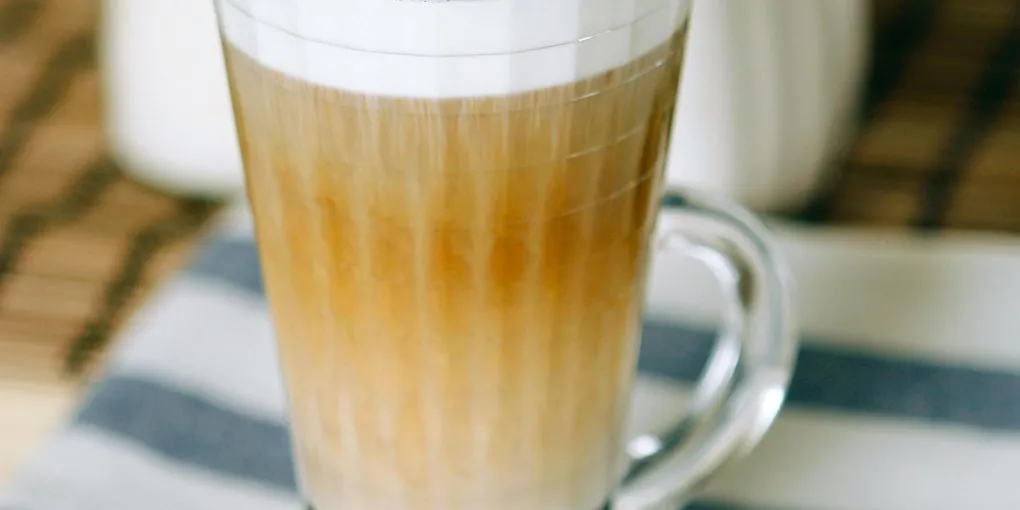
A latte macchiato is the milk that gets stained, not the espresso. The recipe inverts every element of the caffè macchiato. You start with a tall, clear glass filled with warm steamed milk and a layer of foam on top. Then you pour an espresso shot through the foam. The espresso “stains” the milk in a visible dark stripe down the middle of the glass before settling into a layered drink — espresso at the bottom, milk in the middle, foam on top.
The latte macchiato is roughly 6 to 8 ounces total, dominantly milk, with the espresso accounting for maybe 15 to 20 percent of the volume. Flavor-wise it sits between a latte and a cappuccino — milk-forward, gently coffee-flavored, sweeter than a caffè macchiato because the steamed milk’s denatured lactose contributes more perceived sweetness. It is the drink Italians traditionally served to children who wanted to feel grown up at the breakfast table: lots of warm milk with just enough coffee flavor to count.
Two drinks. Same name. Espresso-dominant or milk-dominant depending on which you order. Italian baristas distinguish them every day without confusion. American menus rarely list both, which is part of why the term has drifted.
The Starbucks Caramel Macchiato Is Its Own Drink
Starbucks introduced the Caramel Macchiato in fall 1996, created by Starbucks employee Hannah Su as part of the company’s 25th-anniversary menu. It was originally meant to be a limited seasonal item; customer demand made it permanent within months. The recipe bears almost no resemblance to either Italian original. A standard 16-ounce Caramel Macchiato contains: vanilla syrup at the bottom of the cup, steamed 2% milk poured over the syrup, two espresso shots poured on top of the milk (this is the “macchiato” — the espresso “stains” the milk surface), and a crosshatch of caramel sauce drizzled on top. Total volume around 16 ounces. Total sugar roughly 33 grams in a grande, mostly from the vanilla syrup and caramel.
Functionally, this is a sweetened vanilla latte with caramel drizzle. The “macchiato” component — espresso poured on top of milk rather than under it — is the only structural element borrowed from the Italian latte macchiato. Everything else (the vanilla, the caramel, the size, the sugar) is a Starbucks creation.
To be clear: there is nothing wrong with the drink. It is well-engineered for its purpose. The vanilla and caramel cover the bitterness of mass-roasted espresso, the milk volume makes it sippable for 30 minutes, and it works as a daily indulgence. The Caramel Macchiato has been one of Starbucks’ top-selling drinks for nearly three decades, and a lot of people genuinely love it — they are not wrong to.
What Starbucks did was take the technical detail that distinguishes a latte macchiato (espresso poured on top) and use it as the basis for a flavored milk drink that is, in proportion and taste, much closer to an American flavored latte than to anything served in Rome. The drink is named aspirationally — borrowing Italian vocabulary — rather than literally. That is fine. It is just useful to know, especially if you walk into a specialty café expecting Starbucks proportions and get a 2-ounce shot of espresso with a spoonful of foam instead.
How to Make a Traditional Macchiato at Home
Making a caffè macchiato at home requires an espresso machine capable of producing real pressure-extracted espresso (around 9 bar at the group head) and a steam wand or milk frother. The recipe is short.
Caffè macchiato — the espresso-forward version:
- Pull a 1- to 2-ounce shot of espresso into a 3-ounce demitasse cup. Use 18 grams of finely ground coffee for a double, dialed in to extract in 25–30 seconds. The espresso is the entire drink — quality matters more than in a latte where milk hides flaws. (Our how to dial in espresso guide covers the basics.)
- Steam 2 to 3 ounces of whole milk in a small pitcher. Aerate enough to build a meaningful foam layer on top — this is closer to cappuccino texture than latte microfoam. Stop steaming around 140°F (60°C) so the milk stays sweet. Above 154°F (68°C), milk proteins denature, the milk develops a “cooked” taste, and perceived sweetness drops.
- Spoon — or carefully pour — about a tablespoon (½ to 1 oz) of foam onto the espresso. You want a visible white “stain” centered on the crema, not a full milk pour. The espresso should still dominate the cup.
- Drink within 60 seconds. Like all small espresso drinks, the texture degrades quickly once foam separates from liquid.
Latte macchiato — the milk-forward version:
- Steam 6 ounces of whole milk in a tall pitcher. Aerate until you have a clear foam cap (about 1 inch) over warm liquid milk. Pour into a tall, clear glass.
- Let the milk settle for 30 seconds so foam and liquid layer cleanly.
- Pull a 1-ounce single shot of espresso. Pour it slowly through the foam into the milk below. You will see a dark espresso stripe stain through the white milk before settling.
- Serve unstirred. The visual layering is part of the drink.
The home tools you need are the same as for any espresso drink: a pressure-bar espresso machine, a decent grinder, and a steam wand. A French press cannot produce real espresso pressure, so you cannot make a true macchiato without a real machine — though you can approximate the flavor profile with a stovetop Moka pot and warm frothed milk on top.
How to Order a Macchiato Without Ending Up with the Wrong Drink
The order you place depends entirely on which counter you are standing at.
At a specialty / third-wave café: Just say “macchiato.” You will get the traditional caffè macchiato — espresso with a small dollop of foam, around 2 to 3 ounces. If you want to be precise, “traditional macchiato” or “Italian macchiato” makes it unambiguous. If you actually want the Starbucks-style drink, do not order a macchiato — order a “vanilla latte with caramel drizzle” and they will make exactly that. Specialty baristas appreciate the precision; you will get a better drink.
At Starbucks: “Caramel Macchiato” gets you the vanilla-syrup-and-caramel version. If you want the traditional Italian version at Starbucks, order an “espresso macchiato” — Starbucks does have it on the menu and it is essentially what Italians serve, though with Starbucks’s darker espresso. It costs roughly half the price of a Caramel Macchiato and is a third the size.
At a generic chain café (Dunkin’, Tim Hortons, Peet’s, etc.): This is the danger zone. “Macchiato” at these shops can mean either drink depending on the chain and the barista. Best practice: ask “Is your macchiato the small Italian one or the latte version?” The barista will tell you, and you will get what you want.
If you are still working out the broader landscape of espresso drinks, our coffee shop ordering guide walks through the full menu — macchiato, cortado, cappuccino, flat white, and latte — with the milk ratios that distinguish them. The macchiato sits at the espresso-heavy end of that spectrum; the latte sits at the milk-heavy end.
The Macchiato Has a Specific Place in the Espresso Spectrum
The caffè macchiato is the smallest milk drink on the menu — closer to a straight espresso than to a cappuccino. The latte macchiato is closer to a cappuccino. The Caramel Macchiato is closer to a sweetened latte. All three sit in different places on the same spectrum, even though they share a name.
| Drink | Espresso : Milk | Total Size | Milk Texture |
|---|---|---|---|
| Espresso (solo/doppio) | 1:0 | 1–2 oz | None |
| Caffè Macchiato | 1:0.3 | 2–3 oz | Small foam dollop |
| Cortado | 1:1 | ~4 oz | Steamed, no foam |
| Flat White | 1:2 | 5–6 oz | Microfoam |
| Cappuccino | 1:2 | 5–6 oz | Thick foam layer |
| Latte | 1:3–4 | 8–12 oz | Steamed, thin foam |
| Latte Macchiato | 1:5 | 6–8 oz | Layered foam + milk |
| Caramel Macchiato (Starbucks) | 1:7+ | 12–16 oz | Steamed milk + syrups |
The traditional caffè macchiato makes sense in a specific situation: you want espresso, but you want it slightly softer. A straight shot is too sharp; a cortado is too milky; a cappuccino is too foamy. The macchiato hits a precise gap — espresso with the edges rounded, finished in three sips. It is also the drink that most clearly reveals espresso quality. The foam softens the shot but does not mask it — which is exactly the opposite of the Caramel Macchiato, where vanilla syrup and caramel are designed to cover any espresso flaws. If the shop you are in roasts beautifully, the caffè macchiato is the order that lets you taste their work without committing to a full demitasse of straight espresso. The Starbucks version will still be there next time you want sugar and milk volume. They are different tools for different moments.
Frequently Asked Questions
- How much caffeine is in a traditional macchiato vs. a Starbucks Caramel Macchiato?
- A traditional caffè macchiato made with a single shot has about 63 mg of caffeine; with a double shot it doubles to roughly 126 mg. A grande (16 oz) Starbucks Caramel Macchiato also contains 2 espresso shots, so it lands around 150 mg of caffeine — comparable to the double-shot Italian version, despite being five times the volume and adding 33 grams of sugar.
- Is a macchiato stronger than a latte?
- By concentration, yes — a caffè macchiato is dramatically stronger because the espresso is barely diluted with milk. A 2.5-oz macchiato is roughly 80% espresso by volume, while a 12-oz latte is roughly 75% milk. By total caffeine, a double-shot latte and a double-shot macchiato are equivalent — but per sip, the macchiato hits much harder.
- What is an espresso macchiato vs. a latte macchiato at Starbucks?
- The 'Espresso Macchiato' on the Starbucks menu is the closest thing they offer to the traditional Italian caffè macchiato — espresso topped with a dollop of milk foam, around 3 oz. The 'Latte Macchiato' is a separate Starbucks creation: steamed milk with espresso shots poured on top, served in a 12 to 16-oz cup, no caramel. Neither is the same as a Caramel Macchiato, which contains vanilla syrup and caramel drizzle.
- Can you make a macchiato with a Moka pot or AeroPress?
- You can approximate one. A Moka pot produces a strong, espresso-style coffee at roughly 1.5 bar of pressure — not real 9-bar espresso, but close enough in concentration to work as the base. Pull a 1.5-oz Moka pot shot into a small cup, top with a tablespoon of frothed milk foam (a French press plunger or handheld frother works), and serve. The result is recognizably a macchiato in proportion, though it will lack the crema of true espresso.
- Why does my macchiato taste bitter?
- Three likely causes. First, the espresso is over-extracted — too fine a grind, too long a shot time, or water too hot. Second, the foam was steamed past 154°F, denaturing milk proteins and developing a 'cooked' flavor that reads as harsh against the espresso. Third, you are tasting bitter crema sitting on the surface — Hoffmann recommends skimming crema off Americanos for this reason; the same applies if your macchiato has an overly thick, dark crema cap. A traditional macchiato should taste sharp and clean, not harsh.