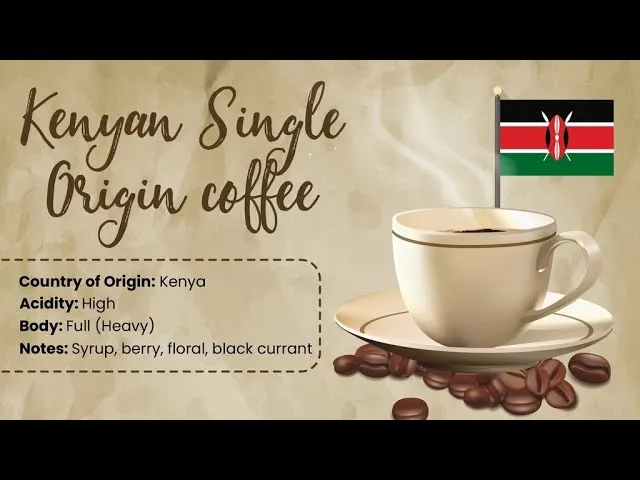
Kenya produces roughly 783,000 bags of coffee per year — not massive by global standards — but its beans consistently rank among the most sought-after in specialty coffee. The reputation is well earned. Kenyan coffee delivers a combination of brightness, complexity, and intensity that very few origins can match. If Ethiopia is the origin story, Kenya is the masterclass.
The Flavor Profile
Kenyan coffee is full-bodied, pleasantly acidic, and richly flavored with distinct floral notes and a range from sweet acidity to berry-toned finishes. You might experience blackcurrant and grapefruit in the first sip, then pick up tomato leaf and jasmine as the cup cools. The flavors are layered and evolve with temperature — more so than almost any other origin.
What makes Kenyan acidity distinctive is its chemical character. Much of it comes from phosphoric acid — the same acid that gives cola its sparkle. Where citric acid (common in Central American coffees) tastes sharp and lemony, and malic acid (common in Costa Rican coffees) tastes round like apple, phosphoric acid tastes sweeter and more sparkling. It’s why Kenyan brightness feels alive and effervescent rather than sour.
A 2023 study published in Food Chemistry Advances (Birke Rune et al.) found that only citric and phosphoric acid are present in coffee above their detection thresholds. Kenya’s phosphoric acid concentration is what sets it apart from virtually every other origin. If you want to train yourself to recognize it, taste a sip of Coca-Cola (which contains phosphoric acid) alongside a sip of lemon water (citric acid). That sparkling-versus-sharp distinction is exactly what you’re tasting in Kenyan coffee versus a washed Guatemalan.
This is opinionated coffee. It’s not mellow or subtle — it has real presence. People either love Kenyan coffee or need to find something else. It’s quite different from Ethiopian coffee, which tends toward delicate florals, or Indonesian coffee, which goes heavy and earthy.
The Varieties: SL-28 and SL-34
Two varieties dominate Kenyan production, and both are considered among the finest in the world.
SL-28 — A Bourbon-related selection developed at Kenya’s Scott Agricultural Laboratories in the 1930s. The World Coffee Research Varieties Catalog rates its cup quality as “Exceptional” — the highest rating possible, shared only with Geisha. SL-28 produces the most distinctive, complex Kenyan flavor profiles: blackcurrant, citrus, intense sweetness. It thrives at the highest altitudes but is demanding to grow — susceptible to coffee leaf rust and lower-yielding than modern alternatives.
The Bourbon lineage that produced SL-28 traces an extraordinary path: Ethiopia to Yemen to Réunion Island (the French tried three times: 1708, 1715, 1718) to Zanzibar via Spiritan missionaries (1859) to Bagamoyo, Tanzania (1862) to Kikuyu, Kenya to Bura, Kenya (1893). The Scott Labs then selected from this stock in the 1930s, identifying SL-28 as genetically outstanding. That selection is now among the most celebrated coffee varieties on earth.
SL-34 — A Typica-related Scott Labs selection. Very good cup quality, slightly more productive than SL-28. More cocoa, berry, and floral notes, with equally complex potential. Somewhat more disease-tolerant, which is increasingly important as coffee leaf rust and coffee berry borer push into highland areas across Kenya and Latin America.
Together, SL-28 and SL-34 are responsible for the flavor profile the world associates with “Kenyan coffee.” No other country grows these varieties at the same scale and altitude, which is why you can’t replicate Kenyan flavor simply by transplanting seeds elsewhere. The terroir matters, but the varieties matter more.
Batian — Kenya’s answer to the rust crisis. A modern variety with complex parentage (including SL-28, SL-34, Rume Sudan, N39, K7, SL4, and Timor Hybrid genetics) bred specifically for high rust resistance while maintaining very good cup quality. WCR rates it “Very Good” with very large beans and production starting in year two. It won’t match a top SL-28 lot for sheer intensity, but it’s a serious variety — not a compromise.
Ruiru 11 — An F1 hybrid composite. Very high yield, compact dwarf plant, rust-resistant, and must be seed-propagated from controlled crosses. Historically criticized for simpler cup quality, but improving with better farming practices. Rated “Good” by WCR.
The future of Kenyan coffee depends on how well the industry balances these new varieties against the old. Losing SL-28 to rust would be a catastrophic loss for global coffee diversity — and with up to 50% of suitable coffee-growing land potentially lost by 2050 due to climate change, that threat is real. Kenya’s top five producing areas now experience 57 additional days per year above 30°C compared to historical averages — temperatures that stress Arabica plants.
The Growing Regions
The Mount Kenya corridor — Nyeri, Kirinyaga, and surrounding areas — is where the most exciting Kenyan coffee comes from. The combination of altitude (routinely above 1,600 meters), volcanic soil, and equatorial sunlight creates ideal conditions for dense, flavor-packed beans.
The Grading System
Kenya takes quality control seriously. The Coffee Board of Kenya grades beans after harvest by size, shape, color, and density:
Kenya AA — Largest beans (screen size 18-19), fewest defects. The premium designation. This is what you want when spending good money on Kenyan coffee.
Kenya AB — A blend of A (screen size 17-18) and B grades. Ranges in quality but many AB lots are excellent and significantly less expensive than AA.
Kenya Peaberry (PB) — Naturally smaller, rounder beans from cherries that produced only one seed instead of the usual two. Sometimes more concentrated flavor. (You can read more about peaberry beans in our Tanzania Peaberry review.)
Kenya C, TT, T — Lower grades. Smaller beans, more defects. Generally not specialty quality.
Important clarification: AA means the biggest beans, not necessarily the best flavor. Some AB lots outperform AA lots at cupping. But the grading system does ensure that what you buy has been professionally evaluated and sorted — more infrastructure than most origins offer.
Double Wash Processing
Most Kenyan coffee goes through washed processing with a distinctive twist: double fermentation. After harvest, beans ferment in water for 24-72 hours, then are washed, fermented again for 24-48 hours, washed again, and dried. This extended, labor-intensive process creates the bright, clean, complex flavor notes that define Kenyan coffees.
The double wash produces higher clarity than single-wash methods. You taste the bean and its terroir with minimal interference from residual fruit sugars — which is exactly why Kenyan coffees can showcase those layered, evolving flavor notes that keep changing as the cup cools.
The Auction System
Kenya has maintained a weekly coffee auction since the 1950s, where lots are competitively bid on by international buyers every Tuesday in Nairobi. This system creates transparency around pricing and quality. Only top-quality coffees make it to auction, and buyers know exactly what they’re getting — grade, lot, farm or cooperative, processing method.
The auction system is also why Kenyan coffee costs more. Competitive bidding drives prices up for the best lots — good for farmers, expensive for consumers. But it keeps quality incentives aligned: grow better coffee, earn more at auction. It’s a major reason Kenya’s reputation remains sterling even as production volumes stay relatively modest.
How to Brew Kenyan Coffee
Pour-over (V60, Chemex, Kalita Wave): Best method. Slower, controlled extraction highlights the nuanced flavors and signature acidity. Medium-fine grind, 200°F. A flat-bottom dripper like the Kalita Wave will emphasize sweetness — research shows flat-bottom drippers produce more uniform extraction than conical ones, resulting in sweeter brews.
French press: Works but the oils and sediment will mute some brightness. Coarser grind, 4 minutes max. You trade acidity clarity for body.
Espresso: Can pull a stunning shot, but dial in carefully. The brightness can become sharp if underextracted — aim for 27-30 second pulls. Medium-roasted Kenyan espresso with steamed milk is spectacular.
Roast level: Light to medium. Darker roasts bury the phosphoric acid brightness and berry complexity that justify Kenyan coffee’s premium price. As coffee researcher George Howell puts it: “Dark roast covers things like a heavy sauce.” With Kenya, you want the meat, not the sauce.
Let the cup cool. Kenyan coffees are some of the most temperature-dynamic in the world — the best flavors often emerge below 140°F. That blackcurrant note that makes people obsess over SL-28? It often doesn’t fully appear until the cup has been sitting for five minutes. Pour, take a sip, then give it time.
Buying and Storing Tips
Look for specific farm or cooperative names, not just “Kenyan coffee.” A Nyeri SL-28 AA is a different experience than a generic Kenya AA blend. The more information on the bag, the more the roaster cares about traceability.
If you’re comparing African origins, Rwandan coffee offers a gentler entry point — similar altitude and care, but less intense acidity. And for the full Africa comparison, see our Kenyan coffee flavor notes guide for specific roaster recommendations.
Freshness matters: Peak flavor is 7-21 days post-roast, with a 3-4 day rest after roasting (CO2 levels are too high before that). Don’t refrigerate — coffee absorbs odors and moisture condenses.
Freezing works. If you find an exceptional lot, buy extra, seal it airtight in portion-sized bags, and freeze. Scott Rao found that a 6-year-old frozen Kenya AA was “really good” — oxidation drops roughly fifteen-fold when beans are properly frozen. Grind while still frozen if you can; cold beans fracture more uniformly, producing more even extraction.
Looking for specific bags to try? Our Kenyan coffee reviews break down the best options by roaster.
Kenyan coffee isn’t cheap, and it isn’t trying to be. It’s one of the world’s great origins — complex, intense, and unlike anything else you’ll taste. Start with a washed SL-28 from Nyeri, brewed as a pour-over at medium roast. If that doesn’t convert you, this origin might not be for you. But if it does — and for most people, it does — you’ll understand why Kenya commands the prices it does.
Some links above are affiliate links. If you purchase through them, we earn a small commission at no extra cost to you.
Frequently Asked Questions
- Why does Kenyan coffee taste so different from other African coffees?
- Two reasons: unique varieties and unique processing. SL-28 and SL-34 (developed at Scott Labs in the 1930s) produce flavor profiles found nowhere else — intense blackcurrant, sparkling phosphoric acidity, and layered complexity. Kenya's double-wash fermentation (24-72 hours, then a second 24-48 hour soak and rewash) creates exceptional clarity. No other origin combines these specific varieties with this processing intensity.
- Is Kenya AB coffee worth buying instead of Kenya AA?
- Often yes. AA is a size grade (largest beans), not a quality grade. Some AB lots outperform AA lots at cupping, and AB typically costs significantly less. The correlation between bean size and cup quality is real but imperfect. Look for additional details — region, variety, processing — rather than relying on the grade alone. A Nyeri AB with specific sourcing information can be a better buy than a generic Kenya AA.
- How should I store Kenyan coffee?
- Peak flavor is 7-21 days post-roast with a 3-4 day rest after roasting for CO2 to off-gas. Store airtight, cool, and dark. Never refrigerate — coffee absorbs odors and moisture condenses on the beans. If you find an exceptional lot, freeze portions in airtight bags immediately. Properly frozen beans can stay excellent for months — one test found a 6-year-old frozen Kenya AA was still really good. Grind from frozen for the most uniform particle distribution.
- What does phosphoric acid taste like in coffee?
- Sparkling, almost sweet, effervescent — the same acid that gives Coca-Cola its characteristic brightness. It's distinctly different from the sharp citric acid in Central American coffees or the round malic acid in Costa Rican coffees. Phosphoric acid is why Kenyan coffee feels alive and vibrant rather than sour. Try tasting a sip of cola alongside a sip of lemon water to train your palate on the difference.