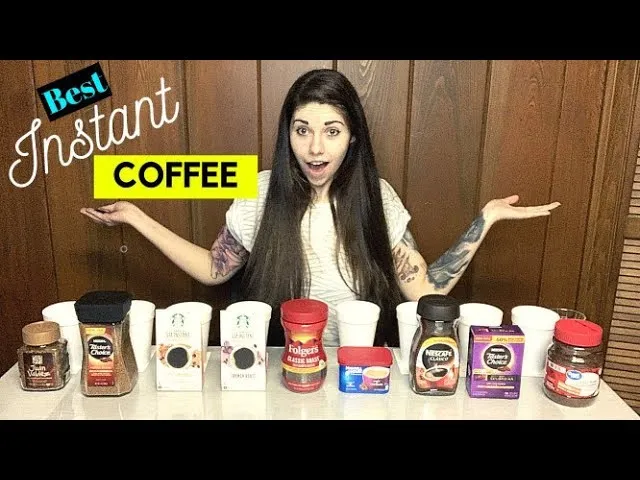
In June 2020 we went to Walmart, bought every instant coffee it had, nine in all, and scored each one out of 10, tasted black apart from one sweetened mix. Before tasting, we lined them up in the order we expected to like them, going on brand and packaging alone: the fancier-looking jars and the two Starbucks boxes near the top, Walmart’s store brand near the bottom. We were clearly wrong.
A correction. An earlier version of this page had Folgers Classic Roast winning at 7 out of 10 and Maxwell House at 6. The cups in the video show both at 5, and none of the nine above 6. It also called the tasting blind, though we lined the jars up by brand first, and gave Great Value’s jar the wrong name. The scores below are the numbers written on the cups, and the tasting notes are from the video.
Our 2020 scores
| Coffee | Score | What we noted |
|---|---|---|
| Great Value Classic Roast instant (medium) | 6 | The surprise: smooth, good flavor, not watery; a little lighter than a medium |
| Juan Valdez instant | 6 | A good flavor and smell, and not bitter |
| Folgers Classic Roast instant (medium) | 5 | Rich yet smooth, no lingering aftertaste; tasted like a true medium |
| Taster’s Choice House Blend (light medium) | 5 | Stronger and heavier than its label suggested, with a slightly bitter aftertaste |
| Maxwell House International Café Français | 5 | A sweetened mix, so not a fair comparison: light, not too sweet, a little watery |
| Taster’s Choice Colombian (medium) | 4 | Good smell and a rich flavor, but darker than its label, with a lingering bitterness |
| Starbucks VIA Instant Colombia (medium) | 3 | Bold, bitter and strong, with an almost artificial aftertaste |
| Starbucks VIA Instant French Roast (dark) | 2 | Smooth but bitter, with a lingering, slightly acidic aftertaste |
| Nescafé Clásico (dark) | 2 | Really strong and a little acidic; we didn’t finish the cup |
Two 6s, three 5s, and nothing higher. Keep in mind these are instant coffees, and we didn’t expect them to taste as good as brewed coffee. There were some drinkable ones here, though: they weren’t terrible, but none made it over a 6.
The coffees, one by one
The two 6s
Great Value Classic Roast. We expected Walmart’s store brand to be one of the worst, and it was one of the better coffees here: a really good flavor, not watery and very smooth. It tasted a little lighter than the medium on the label, which we happened to like.
Juan Valdez. We’d lined it up near the top because it looked fancy and was one of the higher-priced jars, and it lived up to that: a good flavor, a good smell, and not bitter. It was the first one we tried, and we’d drink it.
The three 5s
Folgers Classic Roast. We put it in the middle of our guesses, and it was better than we expected, with no lingering aftertaste and a rich flavor that was still smooth. It’s labeled a medium roast and actually tasted like one, unlike some of the others. We’d finish this cup.
Taster’s Choice House Blend. Labeled light medium, but it had a very strong, heavy taste and a slightly bitter aftertaste. Not the greatest we tried, but we’d drink it.
Maxwell House International Café Français. We picked it up as an instant coffee before noticing it already contains creamer and sugar, so it isn’t a like-for-like comparison. Made up as the package directs, it tasted light, with a very good flavor, not too sweet, but almost a little watery; next time we’d use a little more mix or less water. If you like milk and sugar, you may enjoy this one.
The rest
Taster’s Choice Colombian. A really good smell, and a little stronger, almost dark, when you first sip it, with a lingering bitterness. It has a rich flavor and was definitely drinkable, but darker than its medium label.
Starbucks VIA Instant Colombia. Bold, bitter and pretty strong, with a strange aftertaste almost like artificial flavoring. We weren’t fans.
Starbucks VIA Instant French Roast. A nice flavor at first, smooth yet bitter, then a lingering aftertaste that was a little acidic. We didn’t care for it at all.
Nescafé Clásico. Definitely dark and really, really strong. It smells nice, but it’s a little acidic with an aftertaste. If you like your coffee very strong you might like it, but we didn’t finish the cup.
What each jar lists now
Checked on each maker’s website on October 18, 2026. Recipes and names change, so a jar on the shelf today may not be what we tasted in 2020.
| Coffee | Still sold? | What the maker lists |
|---|---|---|
| Great Value Classic Roast | Yes, at Walmart | Ingredients: coffee. One slightly rounded teaspoon per 6 fl oz cup |
| Juan Valdez Classic | Yes | Freeze-dried Colombian arabica. One level teaspoon (about 1.8 g) to 4 oz of 190°F water |
| Folgers Classic Roast | Yes | A medium roast; the page lists no ingredients or caffeine |
| Taster’s Choice House Blend | Yes | Ingredients: instant coffee, from arabica and robusta, “brewed and then flash frozen.” One teaspoon per 6 oz |
| Maxwell House Café Français | Not on Kraft Heinz’s US product list; grocers still sell it | Grocers’ listings put non-dairy creamer and sugar ahead of the instant coffee |
| Taster’s Choice Colombian | Not in Nescafé’s current US range | — |
| Starbucks Instant Colombia | Yes, now sold as Starbucks Instant | 100% arabica coffee |
| Starbucks Instant French Roast | Yes, now sold as Starbucks Instant | 100% arabica coffee |
| Nescafé Clásico Dark Roast | Yes | 100% pure coffee, from arabica and robusta. One teaspoon per 6 oz |
We can’t read the exact version on our Juan Valdez jar in the video; the Classic is its standard jar.
How much caffeine is in a cup?
None of these makers’ pages lists caffeine. As a general figure, USDA’s FoodData Central gives 26 mg of caffeine per 100 g of regular instant coffee made with water, which comes to about 47 mg in USDA’s 6 fl oz serving (calculated). Your cup depends on how much powder you use: the makers above suggest anything from a teaspoon per 6 oz to a teaspoon per 4 oz, so check your own jar. Our caffeine guide has the FDA’s and EFSA’s guidance on daily amounts.
How instant coffee is made
Instant coffee is brewed coffee with the water taken out. A 2024 review of coffee manufacturing in Food Engineering Reviews describes the steps: the roasted, ground coffee is extracted with hot water or steam, the extract is concentrated, and then it’s dried one of two ways.
- Spray-drying, the most common method, atomizes the concentrate into a chamber of hot air, typically about 250°C (480°F) going in, where the droplets dry into a fine powder. The fine powder is often agglomerated into larger granules so it dissolves more easily.
- Freeze-drying freezes the extract solid, then removes the ice under vacuum by sublimation, turning it straight to vapor. It costs more to run, because of the freezing and the vacuum.
The review’s authors write that the main disadvantage of spray-drying is believed to be a loss of aroma and flavor, and that studies have found freeze-drying preserves coffee’s sensory qualities better. Freeze-dried instant is decades old: Mark Pendergrast’s history of coffee dates the first, General Foods’ Maxim, to 1964, with Nestlé’s Taster’s Choice following. The historian Jonathan Morris describes freeze-drying replacing the original spray-dried method in Nestlé’s Gold Blend, launched in the late 1960s and sold in the US as Taster’s Choice.
Our scores didn’t line up neatly with the method, though. Juan Valdez, which calls its Classic freeze-dried, tied for first with the Great Value jar, whose listing doesn’t say how it’s made. Nescafé describes Taster’s Choice House Blend as “brewed and then flash frozen”, and its two Taster’s Choice jars scored 5 and 4.
Making a better cup of instant
Follow the jar first: the amounts above vary from maker to maker. Juan Valdez gives a water temperature, 190°F (88°C); Nescafé and Great Value just say hot water.
If you’d like to brew at home without much gear, our guides to the French press and the AeroPress walk through each.
Which to buy now
By our 2020 scores, among the jars still sold:
- The two 6s: Great Value Classic Roast (Walmart’s own brand, from Walmart) and Juan Valdez Classic (Amazon search).
- The 5s: Folgers Classic Roast (Amazon search), Taster’s Choice House Blend (Amazon search) and, if you take milk and sugar, Maxwell House Café Français (Amazon search).
- The rest: Starbucks Instant Colombia (Amazon search) (3), and Starbucks Instant French Roast (Amazon search) and Nescafé Clásico (Amazon search) (2 each).
Some links above are affiliate links. If you buy through them, we earn a small commission at no extra cost to you.
For Starbucks’ coffee beyond its instant line, see our Peet’s vs Starbucks comparison.
Sources
- JayArr Coffee, “We Bought EVERY Instant Coffee at the Supermarket!” (video, June 2020): the scores, read from the numbers written on each cup (shown together at 9:10), and the tasting notes from the narration: youtube.com
- Walmart, “Great Value, Classic Medium Roast Instant Coffee, 8 oz” listing (ingredients, preparation), checked October 18, 2026: walmart.com
- Juan Valdez, “Classic Instant Coffee 3.5oz” product page (freeze-dried, origin, preparation), checked October 18, 2026: juanvaldezcafestore.com
- Folgers, “Classic Roast Instant Coffee” product page, checked October 18, 2026: folgerscoffee.com
- Nescafé US, “House Blend Instant Coffee” (Taster’s Choice) and “Dark Roast Instant Coffee” (Clásico) product pages, and the Taster’s Choice and single-serve ranges, checked October 18, 2026: nescafe.com
- Kraft Heinz, Maxwell House US product list, checked October 18, 2026: kraftheinz.com; Food Lion, “Maxwell House International Cafe Francais Beverage Mix” listing (ingredients): foodlion.com
- Starbucks Coffee at Home, “Colombia” and “French Roast” Starbucks Instant product pages (ingredients), checked October 18, 2026: athome.starbucks.com
- US Department of Agriculture, FoodData Central, SR Legacy 14215, “Beverages, coffee, instant, regular, prepared with water” (caffeine per 100 g; 6 fl oz serving of 179 g): fdc.nal.usda.gov
- Saleh Al-Ghamdi, Bandar Alfaifi, Wael Elamin and Mustapha Abdul Lateef, “Advancements in Coffee Manufacturing: From Dehydration Techniques to Quality Control,” Food Engineering Reviews (2024), sections “Process of Instant Coffee,” “Spray Drying Method,” “Freeze Drying Method” and “Agglomeration Method”: doi.org/10.1007/s12393-024-09383-5
- Mark Pendergrast, Uncommon Grounds: The History of Coffee and How It Transformed Our World, rev. ed. (Basic Books, 2019), ch. 14, “Robusta Triumphant” (Maxim, 1964), p. 257, and ch. 15, “A Scattered Band of Fanatics” (Maxim and Taster’s Choice), p. 285 (ebook pagination)
- Jonathan Morris with Robert W. Thurston, “Coffee, a Condensed History,” ch. 41 in Robert W. Thurston, Jonathan Morris and Shawn Steiman, eds., Coffee: A Comprehensive Guide to the Bean, the Beverage, and the Industry (Rowman & Littlefield, 2013): Nescafé, and freeze-drying in Gold Blend and Taster’s Choice