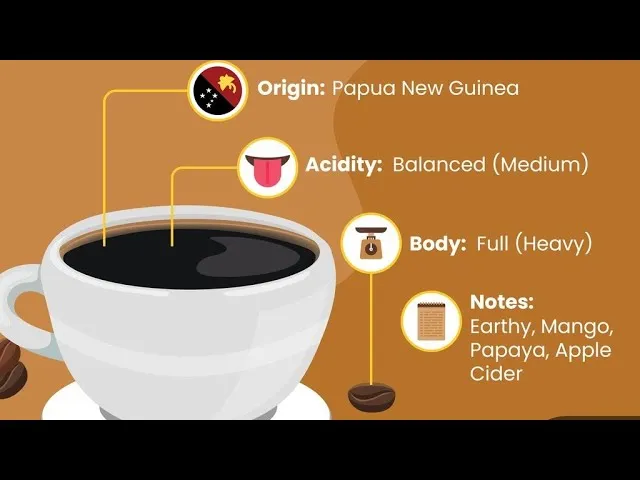
Papua New Guinea is one of the most overlooked origins in specialty coffee. When people think single-origin, they picture Ethiopia, Colombia, or Kenya — but PNG has been quietly producing world-class beans for decades. The reason it flies under the radar has more to do with marketing and distribution than quality. Once you taste a well-roasted PNG coffee, you understand why the few roasters who source it get excited.
What PNG Coffee Tastes Like
Papua New Guinean coffee combines sweet tangs with low-tone fruity richness in a distinctive, immediately recognizable profile:
- Tropical fruit — mango and papaya are the signature notes, clean and refined rather than jammy
- Heavy body — full, substantial mouthfeel that gives the cup real weight
- Earthy undertone — grounds the sweeter notes, adds depth
- Medium acidity — pleasantly bright without being sharp
- Chocolate and nut — warm, grounding sweetness that develops as the cup cools
- Clean, bright finish — a crisp aftertaste that lingers
The fruit notes are the standout. Unlike some natural-processed coffees where fruit can feel fermenty or overripe, PNG’s fruit character is clean and refined. There’s a genuine interplay between the tropical sweetness, earthy depth, and crisp finish that keeps you interested through the entire cup.
PNG coffees also tend to be oilier than other origins, which contributes to their excellent body and mouthfeel. That heavy body places PNG closer to Indonesian coffees like Sumatra and Java in texture, while the clean brightness is more reminiscent of East African origins. It’s a rare combination — few origins deliver both heavy body and clean acidity in the same cup.
Where PNG Sits in the Coffee World
| Origin | Body | Acidity | Signature Notes |
|---|---|---|---|
| PNG | Heavy | Medium | Tropical fruit, earth, chocolate |
| Kenya | Full | High (phosphoric) | Blackcurrant, grapefruit, berry |
| Colombia | Medium | Low-moderate (citric) | Caramel, chocolate, citrus |
| Sumatra | Very heavy | Very low | Earth, herbal, tobacco |
| Ethiopia | Light-medium | High (citric) | Floral, bergamot, berry |
PNG occupies a genuinely unique position — the body of an Indonesian origin with the brightness of an African one. If you like Sumatran coffee’s heft but want more flavor clarity, or you like Kenyan complexity but want more body, PNG is your answer.
The Blue Mountain Connection
Here’s what makes PNG genetically interesting: much of its Arabica is descended from Jamaican Blue Mountain stock — itself a Typica selection. Typica is the original coffee variety, with gentle malic acidity, clean sweetness, and the highest cup quality potential of any lineage.
The Jamaican Blue Mountain comparison is practical, not just historical. PNG delivers a similar quality profile — balanced, sweet, full-bodied — at a fraction of Blue Mountain’s notoriously inflated price. You’re getting Typica quality without the Jamaican brand premium. If someone recommends Blue Mountain but you can’t justify the cost, try PNG Highlands first.
Where It’s Grown
The main growing regions are the Eastern Highlands and Western Highlands, centered around Mount Hagen. Coffee grows at 1,400 to 2,200 meters in volcanic soil with tropical warmth and humidity — ideal conditions for slow bean development and complex flavor.
Named estates to look for:
- Sigri — One of PNG’s most recognized. Consistently produces balanced, complex cups with vivid tropical fruit and chocolate.
- Korgua — High-altitude estate with excellent acidity and clean finish.
- Kimel — Another Highlands producer with a growing reputation.
The challenge for PNG has always been infrastructure, not bean quality. Remote highlands, limited roads, and fragmented smallholder production make consistent sourcing harder than in countries with established export systems.
How It’s Grown and Processed
Most PNG coffee comes from smallholder farmers using traditional methods. Coffee grows under native tree canopy as part of diverse agricultural practices — shade-grown and effectively organic without the certification cost.
Processing is predominantly washed, which produces the clean, bright cups PNG is known for. The washing removes fruit before drying, letting you taste the Typica genetics and volcanic terroir distinctly. Some producers are experimenting with natural processing — drying the whole cherry — which amplifies the already-pronounced tropical fruit into something even bolder. Natural PNG coffees are still uncommon but spectacular when well-executed.
Quality variance is higher in PNG than in most origins because of the distributed smallholder structure. This is why buying from specialty roasters who’ve vetted their PNG sources matters more here than with a standardized origin like Costa Rica.
How to Brew PNG Coffee
Because of PNG’s oily character and full body, brew methods that preserve those oils produce the best results:
French press — the best method for PNG. Immersion brewing extracts those oils fully, giving you the complete body and mouthfeel. The metal filter lets everything through — exactly what you want with an oily, full-bodied origin. Medium-coarse grind, 4 minutes.
Metal filter pour-over or drip: Gold-tone or steel mesh filters preserve the oils that paper would absorb. A flat-bottom dripper (Kalita Wave) with a metal filter is ideal — research shows flat-bottom drippers produce more uniform extraction that emphasizes sweetness.
Paper filter pour-over: Works — you’ll get a cleaner, brighter cup with more emphasis on the fruit notes, but you’ll lose some of the body that makes PNG special.
AeroPress: A solid middle ground. The short steep time and gentle pressure extract good body while giving you control over oil content via your filter choice (paper for cleaner, metal for fuller).
Espresso: Medium-roast PNG pulls a sweet, full shot. The heavy body translates well to concentrated brewing, and the tropical fruit provides interesting complexity.
Roast level: Medium is the sweet spot. Enough development to bring out the chocolate and earth notes while preserving the tropical fruit. Go too light and you may miss the body; go too dark and you’ll bury the fruit that makes PNG distinctive.
Buying Tips
Look for “Highlands” on the bag — Eastern or Western Highlands is where the best PNG coffee comes from. Named estates (Sigri, Korgua) are reliable quality markers.
PNG Highlands Coffee on Amazon — search for estate names when possible.
Value proposition: PNG sits in a sweet spot price-wise. Less expensive than Kenya or Ethiopian competition lots, more interesting than comparably-priced Central American coffee. One of the best quality-to-price ratios in single-origin coffee.
Let the cup cool. PNG’s complexity develops with temperature. The tropical fruit notes — mango, papaya — often don’t fully appear until the cup drops below 140°F. Take a sip hot, then revisit five minutes later. The evolution is part of what makes PNG worth the search.
It’s worth tasting PNG alongside other body-forward origins — see how it compares to Indonesian coffee or the roasty depth of Indian Monsoon Malabar. PNG’s agricultural distinctiveness isn’t limited to coffee — the island also produces cacao with a unique smoke character that’s unlike any other origin in the chocolate world.
Some links above are affiliate links. If you purchase through them, we earn a small commission at no extra cost to you.
Frequently Asked Questions
- Is Papua New Guinea coffee similar to Jamaican Blue Mountain?
- Yes — genetically. Much of PNG's Arabica descends from Jamaican Blue Mountain stock (itself a Typica selection). The cup profiles are similar: balanced, sweet, full-bodied with clean sweetness and gentle acidity. The practical difference is price — PNG delivers comparable Typica quality at a fraction of Blue Mountain's premium. If someone recommends Blue Mountain but the price is hard to justify, PNG Highlands is the informed alternative.
- Why is PNG coffee hard to find?
- Infrastructure, not quality. Coffee grows in remote highlands with limited roads. Production comes from fragmented smallholder farms rather than large organized estates. Distribution channels are less developed than in countries like Colombia or Kenya. Specialty roasters who stock PNG have invested real effort in sourcing — which is actually a quality signal. Check roasters in the Pacific Northwest and Australia, who tend to carry PNG more regularly due to geographic proximity.
- What does PNG coffee taste like compared to Sumatran?
- Both are heavy-bodied with earthy undertones, but PNG is cleaner and brighter. Sumatran coffee gets its characteristic earthy/herbal/tobacco flavor from the giling basah wet-hulling process — PNG uses standard washed processing, which produces more clarity and lets tropical fruit notes (mango, papaya) shine through. If you like Sumatran heft but want more flavor transparency, PNG is the answer.
- What's the best way to brew PNG coffee?
- French press. PNG's oily character and full body are best showcased by immersion brewing with a metal filter, which lets all the oils through. Medium-coarse grind, 4 minutes. If you prefer a cleaner cup, a metal-filter pour-over preserves the oils while adding some clarity. Paper filters work but strip out the body and oils that make PNG special.