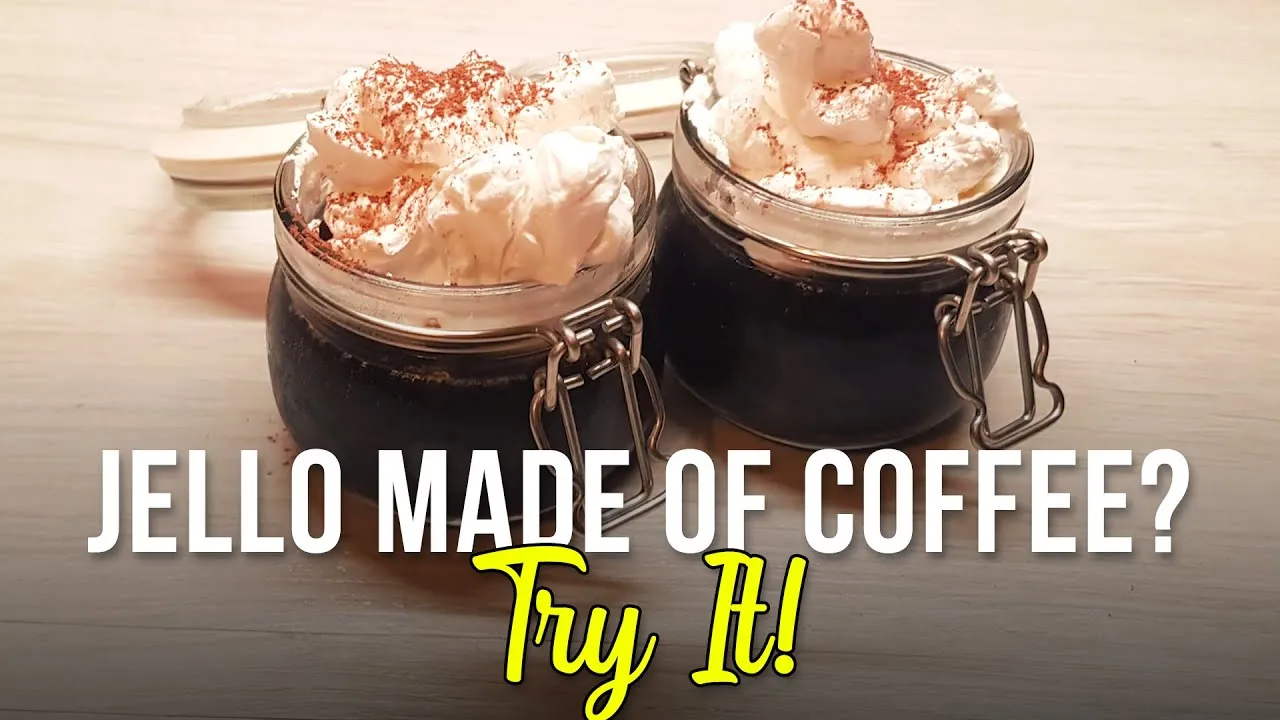
Coffee jelly is older than it looks. Atlas Obscura’s Anne Ewbank traces American recipes back to an 1836 issue of the Lady’s Book, and Fannie Farmer’s Boston Cooking-School Cook Book gives one, served with sugar and cream. It is best known today as a Japanese café dessert. Ewbank reports one theory that a Japanese journalist published a recipe in 1914 after studying home economics in the United States, and writes that it became popular in Japan in the 1960s, after the Mikado coffee shop chain began serving it. “Jello” comes from Jell-O, a brand of flavored gelatin; this recipe uses plain, unflavored gelatin.
Our coffee jelly
For 4 servings:
- Gelatin: 1 envelope (¼ oz, 7 g) of unflavored gelatin, such as Knox Original Unflavored Gelatine (Amazon search). Knox Canada’s guide says one 7 g envelope gels 500 ml of liquid; our recipe uses two US cups, about 475 ml. Knox also says that a recipe asking for a tablespoon of gelatin needs one envelope.
- Cold water: ¼ cup (60 ml), to soften the gelatin.
- Coffee: 1¾ cups (415 ml), hot and freshly brewed, a little stronger than usual (see below).
- Sugar: 3 tablespoons (about 38 g, calculated from USDA’s 4.2 g per teaspoon), or to taste.
- Salt (a pinch) and vanilla extract (½ teaspoon), both optional.
- To serve: cream, whipped cream or sweetened condensed milk.
- Makes: about 2 cups (475 ml) of jelly, calculated from the liquids above.
- Time: about 10 minutes, plus chilling.
Method:
- Sprinkle the gelatin over the cold water in a heatproof bowl and let it stand for about 1 minute.
- Stir the sugar and the salt into the hot coffee until they dissolve.
- Pour the hot coffee over the softened gelatin and stir for at least 2 minutes, until no granules are left.
- Stir in the vanilla, if you’re using it, and let the mixture cool to room temperature.
- Pour it into a shallow dish or four small cups, cover and refrigerate until firm.
- Cut it into cubes, or serve it in the cups, with cream, whipped cream or sweetened condensed milk.
The steps follow Knox’s own method. Softening the gelatin in cold water first keeps it from clumping, and you can tell it has dissolved when there are no granules left; rub a little against the side of the bowl and it should feel smooth. Don’t boil the mixture, which Knox says can destroy the gelatin’s gelling ability. Knox’s guide puts setting at 1 to 6 hours in the fridge, depending on the amount of gelatin and the set you want; overnight is easiest. Too much gelatin makes the jelly rubbery, so for a softer set use more coffee. Atlas Obscura’s recipe, for example, sets 2½ cups of liquid with one envelope and serves it from ramekins.
Knox also says to let the mixture cool to room temperature before it goes in the fridge. Don’t leave it out much longer than that: USDA’s food safety service says cooked food should go in the refrigerator within 2 hours, or within 1 hour above 90°F (32°C).
Brewing the coffee
The ¼ cup of water for the gelatin is an eighth of the jelly, so it waters the coffee down a little. Our fix is to brew at the Brew Guide’s stronger drip setting, 1:15.5 instead of its usual 1:17: that’s about a tenth more coffee for the same water, which roughly makes up for it (calculated). Use a coffee you’d enjoy black. Nothing in the recipe hides its flavor except the sugar and the cream you add.
Gelatin or agar?
Gelatin is animal-derived, so it is not vegan or vegetarian. Knox Canada’s FAQ identifies its gelatin as pork-derived; check the specific product if its animal source matters to you. For a vegan coffee jelly, use agar, which is made from seaweed.
Cape Crystal Brands, which sells Cape Crystal agar agar powder (Amazon search), gives 1 teaspoon (about 2 g) of agar powder per cup of liquid for a firm dessert jelly. For this recipe, that’s 2 teaspoons (about 4 g) of agar for 2 cups (475 ml) of coffee, with no separate water. Agar works differently from gelatin:
- Boil it. Cape Crystal says to whisk the agar into the liquid and boil it for 60 seconds to dissolve it fully. Stir the sugar in too.
- It sets without the fridge. By Cape Crystal’s account it gels between 35 and 40°C (95 and 104°F), so it starts to set as it cools.
- It’s firmer. Gelatin melts at about body temperature, which gives it its melt-in-the-mouth texture; agar gives a firmer gel. Cape Crystal’s table goes down to ¼ teaspoon per cup for a soft, panna cotta–like set.
- Acidic additions may change the result. Cape Crystal recommends about 20% more agar below pH 4. Rao and Fuller’s tested coffees were above that threshold, at pH 4.85–5.13; that study did not test this jelly recipe.
How to serve it
- With cream: Farmer’s recipe serves it with sugar and cream, and Atlas Obscura’s with whipped cream or sweetened condensed milk.
- In a glass: spoon the cubes into iced coffee or milk, as the second recipe in our video does.
- In the fridge: keep it covered. USDA’s general guidance for cooked leftovers is 3 to 4 days in the refrigerator. We haven’t found a more specific figure for coffee jelly, so use that.
The two recipes in our video
Our May 2020 video makes two variations, neither of them the plain recipe above. The amounts are the ones on its screen, and it predates this revision.
- Spiked Coffee Jelly: 2½ teaspoons of unflavored gelatin softened in ¼ cup of coffee liqueur for 5 minutes, a pinch of salt and ½ cup of granulated sugar, then 1½ cups of espresso stirred in. It’s poured into small jars, refrigerated until firm, and topped with whipped cream and cocoa powder. By Knox’s tablespoon-per-envelope rule, that’s about the same gelatin to liquid as our recipe (calculated). It contains alcohol.
- Frozen Coffee Jelly: gelatin bloomed in 3 tablespoons of cool water for 2 minutes and stirred into 2 cups of hot brewed coffee with 2 tablespoons of sugar and 1 tablespoon of vanilla extract, then set in a cube mold. The cubes go into a glass with whipped cream (¾ cup of heavy cream whipped with 1 teaspoon each of vanilla and sugar) and a mix of 1½ cups of cooled coffee and ¼ cup of chocolate syrup. The video doesn’t show how much gelatin goes in; Knox’s one envelope for 2 cups is close to that much liquid.
How much caffeine?
Each of the four servings holds about 104 ml (3½ fl oz) of coffee: the 415 ml in the recipe, divided by four (calculated). That’s a little under half an 8 fl oz cup.
For more coffee desserts and drinks, try the coffee and cola ice cream float, the caramel brûlée latte or spicy coffee with cinnamon, cardamom and café de olla.
Sources
- JayArr Coffee, “Jello made of Coffee? TRY IT!”, YouTube, May 10, 2020 (the two recipes and the amounts shown on screen): youtube.com
- Winland Foods (E.D. Smith Knox, Canada), “Knox Gelatine Products” (each 7 g envelope gels 2 cups, 500 ml; one packet for each tablespoon a recipe calls for), “About Knox” (blooming in ¼ cup of cold liquid for about 1 minute; don’t boil; setting in 1 to 6 hours) and “Frequently Asked Questions” (stir at least 2 minutes; too much gelatin turns rubbery; cool to room temperature before refrigerating; pork source), checked October 18, 2026: knoxgelatine.com. Its FAQ notes that Knox sold in the US is made by Kraft Heinz.
- Kraft Heinz, “Finger Gelatin” recipe (JELL-O flavor gelatin, and Knox Unflavored Gelatine in envelopes of ¼ oz each), checked October 18, 2026: kraftheinz.com
- Cape Crystal Brands, “How Do I Substitute Agar Powder for Gelatin?”, last reviewed June 18, 2025 (agar as “a seaweed polysaccharide,” gelatin as an animal collagen that melts at body temperature, ratios by texture, the 60-second boil, gelling at 35–40°C, the pH note), checked October 18, 2026: capecrystalbrands.com
- Niny Z. Rao and Megan Fuller, “Acidity and Antioxidant Activity of Cold Brew Coffee,” Scientific Reports 8 (2018): 16030, abstract (pH of the hot and cold brews): doi.org/10.1038/s41598-018-34392-w
- USDA FoodData Central, “Sugars, granulated,” FDC ID 169655, SR Legacy (1 tsp = 4.2 g), checked October 18, 2026: fdc.nal.usda.gov
- Anne Ewbank, “Make a Historic Boston Dessert That Became a Japanese Favorite,” Atlas Obscura, April 28, 2021 (the 1836 Lady’s Book recipe, the 1914 theory, Mikado and the 1960s, and a recipe with 2½ cups of liquid to one envelope): atlasobscura.com
- Fannie Merritt Farmer, The Boston Cooking-School Cook Book, revised edition (Little, Brown, 1910), “Coffee Jelly,” made like her Lemon Jelly and served with sugar and cream; Project Gutenberg eBook #65061: gutenberg.org
- USDA Food Safety and Inspection Service, “Leftovers and Food Safety,” last updated July 31, 2020 (refrigerate within 2 hours, or 1 hour above 90°F; 3 to 4 days in the refrigerator), checked October 18, 2026: fsis.usda.gov
Some links above are affiliate links. If you purchase through them, we earn a small commission at no extra cost to you.