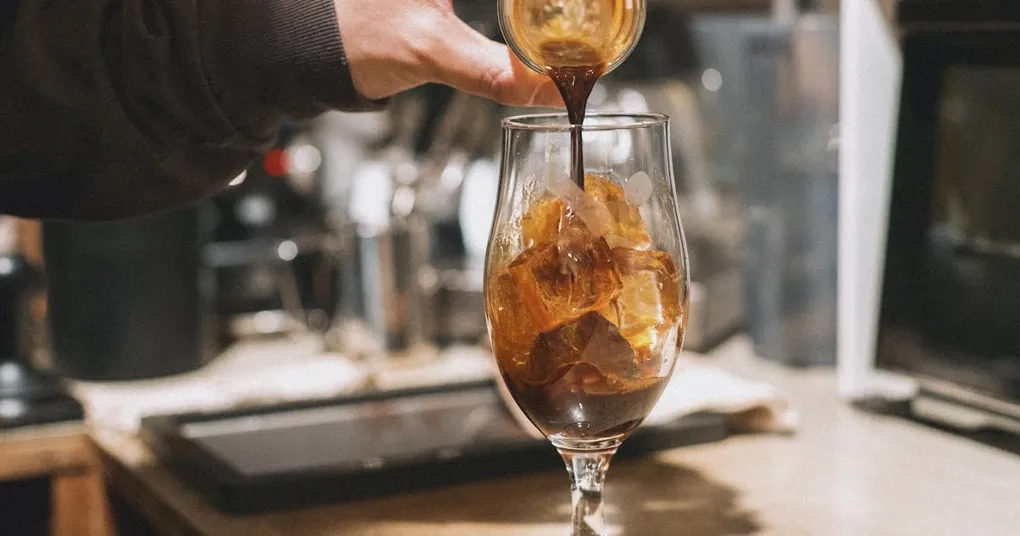
The conventional wisdom on iced coffee is wrong in one important direction. Most people believe cold brew is “less acidic” than hot coffee. It’s true — but not for the reason usually given. And understanding why produces a completely different picture of when to use cold brew, when to use flash brew (Japanese iced coffee), and what you’re actually trading between them.
Two Methods, Two Chemistries
Japanese iced coffee (flash brew) is exactly what it sounds like: you brew hot coffee directly over ice. The ice is weighed and counted as part of the total water volume, so when hot coffee meets the ice, it chills instantly. You end up with full-temperature extraction followed by immediate cold temperature — all the volatile aromatics and organic acids that hot water extracts are captured in the cup before they can dissipate.
Cold brew never touches hot water. Ground coffee steeps in room temperature or cold water for hours. Cold water extracts differently than hot water — not just slower, but selectively differently. Some compounds extract readily at any temperature. Others require heat to solubilize. The resulting beverage is chemically distinct from hot-brewed coffee, not merely the same coffee at lower temperature.
This is the core difference. Flash brew is hot-brewed coffee that happens to be served cold. Cold brew is a fundamentally different beverage.
The Acidity Paradox
Here’s where the conventional wisdom goes sideways.
Cold brew is widely described as “less acidic” than hot coffee. True. But the common assumption — that lower acid means lower pH — is incorrect.
Research by Rao and Fuller (2018) measured both cold brew and hot brew and found nearly identical pH levels: approximately 4.85–5.13 for both methods. The pH range overlaps almost entirely. Cold brew is not meaningfully less acidic by pH.
What it does have is significantly lower titratable acidity — a measure of total dissolved acid content, not hydrogen ion concentration. Titratable acidity is 28–50% lower in cold brew than in hot brew at equivalent concentrations. These are different measurements of different things.
The distinction matters because titratable acidity is what produces the physical sensation of acidity in your mouth — the brightness, the tartness, the sensation that makes a wine or coffee feel lively. pH tells you how corrosive a liquid is. Titratable acidity tells you how much acid is present to interact with your taste receptors.
Cold brew’s “smoothness” and “low acidity” comes from lower total dissolved acid content, not from lower pH. The two measures just aren’t the same thing, and most popular coverage conflates them.
Why cold brew has less titratable acidity:
- Less quinic acid. Quinic acid forms from the hydrolysis of chlorogenic acids (CGAs) — but that hydrolysis is temperature-dependent. Hot water catalyzes it; cold water largely doesn’t. Cold brew contains significantly less quinic acid as a result.
- Fewer melanoidins. Melanoidins are large, complex browning compounds produced during roasting. They’re poorly soluble in cold water, so they extract minimally in cold brew. In hot coffee, they’re a significant component that contributes both bitterness and perceived acidity.
- Fewer volatile compounds overall. GC-MS analysis shows cold brew contains 36 identified volatile aroma compounds. Of those, 25 were higher in concentration in hot brew. Heat drives volatile extraction; cold water captures far fewer.
Cold Brew Extraction Kinetics: When to Stop
Cold brew extraction doesn’t proceed uniformly from start to finish. Research on extraction kinetics shows distinct phases:
0–3 hours: Rapid surface extraction. The most soluble compounds — primarily sugars and some organic acids — dissolve quickly from the surface of each particle. This is the fast phase.
3–7 hours: Slower diffusion. Extraction continues as water diffuses into the interior of particles and soluble compounds diffuse outward. Rate slows significantly.
~6–7 hours: Caffeine and chlorogenic acid equilibrium. These compounds reach approximate equilibrium between coffee and water — steeping beyond this point produces diminishing returns for caffeine and CGA extraction.
The practical implication: steeping cold brew beyond 7 hours is not adding meaningfully to the chemical complexity of the brew. It is, however, adding time for less desirable compounds to continue extracting.
Cordoba et al. (2019) tested this directly. They compared cold brew brewed for 14 hours against cold brew brewed for 22 hours and had trained evaluators score both. The 14-hour brew scored higher than the 22-hour brew for sweetness, fruity/floral character, and creamy body. The 22-hour brew scored higher for bitterness. Steeping longer didn’t make the coffee better — it made it more bitter and less fruity.
This runs directly counter to the common home brewer assumption that “longer is more flavorful.” More time extracts more bitter compounds. 14 hours — not 24, not overnight-plus — is closer to the optimum.
Grind Size, Time, and Concentration: The Variables
Cold brew has three dimensions to dial: grind size, steep time, and ratio (coffee to water).
Grind size × time relationship:
| Grind Size | Particle Range | Optimal Steep Time |
|---|---|---|
| Coarse (most forgiving) | 1,000–1,400μm | 12–18 hours |
| Medium | 600–1,000μm | 8–12 hours |
| Medium-fine | 400–600μm | 6–8 hours |
Coarser grinds extract more slowly and give you the widest timing window — harder to over-extract accidentally. Medium and medium-fine grinds extract faster and taste brighter and more complex, but the timing window narrows considerably. Medium-fine cold brew that steeps 18 hours will taste like it was left out too long.
Concentration ratios:
- Concentrate (for dilution): 1:4 to 1:8 coffee to water by weight. A 1:4 concentrate diluted 1:1 with water produces a 1:8 ready-to-drink ratio — similar strength to strong hot coffee.
- Ready-to-drink (RTD): 1:12 to 1:15 coffee to water by weight. This is roughly the pour-over brewing ratio range, so you’re comparing similar strength levels.
Making concentrate is efficient for batch production — you brew less volume and dilute at serving time, which extends refrigerator storage and allows flexibility for different serving styles (straight, over ice, with milk, with sparkling water).
Shelf life (Lopane, 2024): Refrigerated cold brew concentrate is safe to drink for up to 42 days. Flavor quality degrades more quickly than safety — most people notice deterioration starting around 4–6 weeks. Diluted ready-to-drink cold brew should be consumed within 2–3 days — once diluted, microbial activity can proceed faster and flavor degrades quickly.
Flash Brew: The Method for Light Roast Single Origins
Flash brew’s chemistry makes it the correct method for showcasing light-roast single origins. Hot extraction preserves the full acid and aromatic profile — the citric acidity of a washed Ethiopian, the malic brightness of a Kenyan, the delicate floral notes that cold water never extracts — while the instant chilling locks those volatiles in before they dissipate.
The result: iced coffee that tastes like a great hot coffee served cold. The flavors are bright, complex, and distinct. This is why specialty cafés that serve single-origin light roasts almost universally use flash brew rather than cold brew for their iced coffee.
Cold brew, by contrast, is better suited to medium and dark roasts. The suppressed acidity and lower volatile content of cold brew translates well into chocolate, caramel, and nutty profiles — dark roast flavors that benefit from the smoothing that cold extraction provides. A light-roast single origin brewed cold often tastes muted and flat because cold water simply can’t extract what makes that coffee interesting.
Immersion vs Kyoto Drip: The Cold Brew Spectrum
Within cold brew, the method itself changes the cup. Two primary approaches:
Immersion cold brew is the standard home method: ground coffee steeped in cold water in a jar, bottle, or dedicated brewer. Full water contact throughout the steep. Produces a full-bodied, chocolatey, heavy cup. Most of the cold brew you’ve bought in a can or bottle is immersion cold brew.
Kyoto tower (Dutch cold drip) is completely different in mechanism. Cold water drips through a coffee bed one drop at a time — literally drop by drop over 3–8 hours, controlled by a valve at the top of a tall glass tower. The extremely slow percolation creates a fundamentally different extraction profile: floral, fruity, bright, and clean. A well-made Kyoto drip cold coffee has more in common with flash brew than with immersion cold brew, despite using cold water throughout.
The contrast between immersion cold brew and Kyoto drip is striking enough that side-by-side tasting of the same coffee through both methods is one of the most educational experiments in home coffee brewing.
Caffeine: The Counterintuitive Numbers
Cold brew’s reputation as a concentrated, high-caffeine beverage is accurate — but the mechanism is counterintuitive.
A standard ready-to-drink (RTD) cold brew in a 16-oz serving contains approximately 200–280mg of caffeine. Compare that to an equivalent 16oz of hot-brewed pour over coffee at around 200–250mg. The numbers are similar for RTD. But most commercial cold brew is sold as or derived from concentrate — and a 16oz serving of concentrate (undiluted or lightly diluted) can contain significantly more.
How? Cold water extracts caffeine efficiently despite extracting many other compounds less efficiently. Caffeine reaches near-equilibrium in cold water within 6–7 hours, and the high coffee-to-water ratios used for cold brew concentrate pack more caffeine per volume than a standard pour over ratio. Per fluid ounce, cold brew concentrate has dramatically more caffeine than hot coffee — it’s just typically consumed diluted.
The practical note: if you’re drinking cold brew RTD from a can or bottle, pay attention to serving size. Many commercial RTD cold brews are sold in 8oz or 11oz bottles with 200+ mg caffeine — not 16oz, as assumed above. The per-can caffeine can be higher than you expect. See our full caffeine guide for more on caffeine by brew method.
Flash Brew Protocol
Flash brew requires adjusting your recipe to account for the ice volume:
Standard approach:
- Decide your final beverage weight (e.g., 300g)
- Split: 60% hot water (180g), 40% ice (120g)
- Dose: same as your standard pour over ratio applied to total water (e.g., 1:15 = 20g coffee for 300g total water)
- Grind: slightly finer than usual pour over — compensating for lower extraction from the reduced hot-water volume
- Brew: normal pour-over technique, directly over pre-weighed ice in your server
- Temperature: use 205°F / 96°C water — slightly hotter than usual, again compensating for lower volume
The ratio split is flexible. 60/40 hot/ice is a common starting point. More ice produces a lighter, more diluted cup; less ice produces a stronger but slightly warmer serving temperature. If your flash brew tastes sour or thin, grind finer or increase the hot-water proportion. If it tastes bitter or harsh, grind coarser or increase the ice proportion.
Which Method for Which Coffee
Use flash brew for:
- Light-roast single origins from Ethiopia, Kenya, Colombia, Panama
- Coffees you love hot and want to experience cold without changing the flavor profile
- Any situation where you want to taste the origin character clearly in an iced format
- Coffees with distinctive floral or fruity aromatics that cold water would suppress
Use cold brew (immersion) for:
- Medium and dark roasts
- Coffees destined for milk-based iced drinks (lattes, RTD drinks)
- Batch production — cold brew concentrate scales better than flash brew
- Coffees where you want to reduce perceived acidity and increase body and chocolatey character
Use Kyoto drip for:
- Light to medium roasts where you want cold-brew smoothness without cold-brew heaviness
- Slow-sip appreciation — the visual experience of a Kyoto tower is part of the appeal
- The most technically refined cold coffee experience you can produce at home
Cold Brew at Home: The Simplest Approach
The simplest home cold brew setup: a 32oz mason jar, a kitchen scale, and a fine-mesh strainer or a Hario V60 with paper filter for straining.
Basic recipe: 100g medium-coarse ground coffee, 750g cold filtered water. Steep 12–14 hours in the refrigerator. Strain through paper filter (removes sediment and fines that cloud the cup). Dilute 1:1 to 1:2 with water or milk when serving.
The paper-filter straining step is worth doing — cold brew strained through metal mesh contains more suspended particles that cloud and slightly bitter the cup. Paper-filter cold brew is cleaner and stays cleaner during storage.
For a dedicated cold brew brewer, the Hario Mizudashi cold brew pitcher is the most recommended entry-level option. It has a built-in mesh strainer and a convenient serving spout, and costs around $25–35. Serious cold brew enthusiasts may want a dedicated Toddy cold brew system, which uses paper filters and produces an exceptionally clean concentrate.
Water quality matters for cold brew as much as for hot. Cold extraction amplifies mineral character that heat-based methods partially mask — soft water produces flat cold brew, excessively hard water produces harsh cold brew. The coffee water recipe guide covers water mineral targets for cold brew specifically.
The Bottom Line
Flash brew and cold brew are not interchangeable techniques for the same goal. They produce chemically different beverages suited to different coffees and different use cases.
Flash brew: hot extraction preserves the full acid and aromatic profile. Use it for light roast single origins where you want to taste the coffee clearly. It’s faster (5 minutes), more technique-sensitive, and best made to order.
Cold brew: cold extraction produces lower titratable acidity (28–50% less), fewer volatiles, and a smooth, chocolate-nutty profile. The lower acidity is real — it’s just not from lower pH, as commonly claimed. Optimal steep time is around 14 hours, not 24. Concentrate keeps safely for 42 days refrigerated.
The “less acidic” claim for cold brew is real but misunderstood. The pH data shows hot and cold brew are nearly identical. What cold brew has is less total dissolved acid, which means less of the sensory experience of acidity. For dark roast lovers and people with acid sensitivity, that’s a genuine advantage. For light roast enthusiasts who want to taste what makes a coffee interesting, flash brew preserves what cold brew suppresses.
Frequently Asked Questions
- Is cold brew actually less acidic than hot coffee?
- Partially true — but not for the reason usually stated. Cold brew has nearly identical pH to hot coffee (4.85–5.13 for both, per Rao & Fuller 2018). What cold brew has is 28–50% lower titratable acidity — a measure of total dissolved acid content, not hydrogen ion concentration. Titratable acidity is what produces the sensory experience of acidity in your mouth. Cold brew is smoother and less tangy because it contains less total acid, not because it's less corrosive. The popular claim that cold brew is 'less acidic' conflates two different measurements.
- How long should cold brew steep?
- 14 hours, not 24. Cordoba et al. (2019) found that 14-hour cold brew scored higher than 22-hour cold brew for sweetness, fruity/floral character, and creamy body. The 22-hour brew scored higher for bitterness. Caffeine and chlorogenic acids reach near-equilibrium in cold water around 6–7 hours — steeping beyond that adds bitter compounds without adding the aromatic complexity many home brewers assume they're gaining. For coarse-ground cold brew, 12–18 hours is the practical sweet spot.
- What is Japanese iced coffee (flash brew)?
- Flash brew — also called Japanese iced coffee — is pour-over brewed directly over ice. The ice is weighed and counted as part of the total water, so when hot coffee hits the ice, it chills instantly. This method preserves the full acid and aromatic profile of hot coffee while delivering it cold. Flash brew retains 25+ volatile compounds that cold brew suppresses, makes bright citrus and floral notes more perceptible, and takes 5 minutes instead of 12–18 hours. It's the correct method for light-roast single origins served cold.
- Does cold brew have more caffeine than regular coffee?
- Per fluid ounce of concentrate, yes — significantly more. Per 16oz ready-to-drink serving, approximately the same: 200–280mg for cold brew RTD versus 200–250mg for hot pour over. Cold water extracts caffeine efficiently despite extracting many other compounds less well. The high coffee-to-water ratio in cold brew concentrate means a lot of caffeine per volume, but when diluted to drinking strength, the caffeine levels converge with hot coffee. Many commercial RTD cold brews are sold in smaller-than-expected volumes — check the serving size.
- How long does cold brew last in the fridge?
- Refrigerated concentrate is safe for up to 42 days per Lopane (2024). Flavor quality degrades before safety becomes a concern — most people notice deterioration at 4–6 weeks. Diluted ready-to-drink cold brew should be consumed within 2–3 days; once diluted, microbial activity proceeds faster and flavor degrades quickly. Keep concentrate separate from water until serving to maximize shelf life.
- Is cold brew or flash brew better for light roast coffee?
- Flash brew, decisively. Light roasts are characterized by the floral and fruit aromatics, bright organic acids, and delicate complexity that come from origin and processing rather than roasting. Cold water extracts these compounds significantly less well than hot water — GC-MS analysis shows 25 of 36 volatile aroma compounds are higher in concentration in hot brew. Flash brew captures the full light-roast flavor profile and serves it cold. Cold brew suppresses exactly what makes light roasts interesting. For medium and dark roasts, cold brew's profile (smooth, chocolatey, low-acid, heavy body) is a better match.
Some links above are affiliate links. If you purchase through them, we earn a small commission at no extra cost to you.