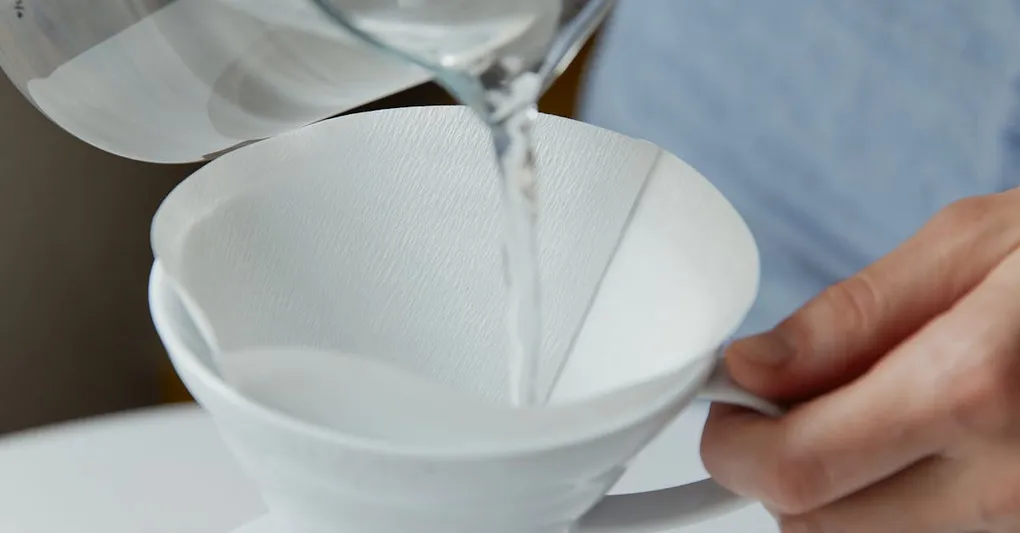
The most common question about pour over drippers isn’t which brand to buy — it’s what the shape actually does. Does a flat-bottom dripper like the Kalita Wave make fundamentally different coffee than a cone like the V60? Yes. Is one better? It depends on what you mean by “better.”
Coffee scientist Jonathan Gagne’s research into pour over fluid dynamics — which models coffee beds as porous media and applies real fluid mechanics to brewing — gives us a clear framework for understanding these differences. The findings are counterintuitive in places. Flat-bottom drippers consistently produce sweeter, higher-extraction brews than conical ones, despite being considered “beginner” equipment. And the material your dripper is made of affects your coffee more than most people realize.
Here’s what the physics actually says.
The Core Difference: How Water Moves Through Each Shape
The fundamental difference between conical and flat-bottom drippers is what happens between the coffee bed and the filter.
In a cone dripper, the filter meets the walls of the dripper at an angle. As water moves through the coffee bed and toward the filter, some of it runs between the filter and the wall of the dripper without passing through any coffee at all. This is bypass — water that goes from kettle to cup without meaningful extraction. The flavor contribution of bypass water is essentially zero: it’s just dilution.
Gagne’s research shows that bypass follows a cubic relationship with water column height in cone drippers. Below about 6cm of water depth in the cone, bypass is relatively limited. Above that level, bypass accelerates dramatically — the relationship is not linear. This is why pour-over technique for the V60 emphasizes pouring in small, frequent additions: keeping the water column below the height where bypass becomes significant. It also explains why larger doses in a V60 (which create a taller bed) require more careful technique than smaller doses.
In a flat-bottom dripper like the Kalita Wave, the geometry is different. The flat coffee bed rests on a flat filter above three small holes. Water percolates downward through the entire bed before exiting — there’s no path for water to run between filter and wall. This means every drop of water that enters the dripper must pass through the coffee bed. Extraction is structurally more uniform, and there’s far less bypass.
This geometric advantage explains Gagne’s key finding: flat-bottom drippers produce sweeter, higher-extraction brews. The “higher extraction” part is mechanical — more water contact with more coffee for longer. The “sweeter” part follows directly: sweeter compounds dissolve in the middle of the extraction sequence, and a dripper that extracts more evenly pulls more of those compounds into the cup.
Cone Drippers: The V60
The Hario V60 is the dominant cone dripper in specialty coffee — used in cafes, competitions, and home setups worldwide. The 60-degree cone angle creates a single spiral rib pattern along the interior that helps the filter stay away from the wall and maintain airflow. Single bottom drain hole. Available in plastic, ceramic, glass, metal, and copper.
Flow rate: Fastest of the three main types. The single drain hole and steep cone angle means water moves through quickly. A well-ground dose on a V60 should complete in roughly 2:30-3:30 for a standard single cup (15-20g coffee).
Bypass: Present and technique-dependent. Gagne’s cubic relationship means a high-water-column pour will send significantly more bypass through than a low, controlled pour. This is both the V60’s limitation and its appeal: skilled technique can minimize bypass; inconsistent technique amplifies it.
Cup profile: Fruit-forward, bright, and detailed. The relative speed of flow and paper filtration produces a clean, clear cup that shows origin character well. Light roast Ethiopian or Kenyan coffees are particularly suited to the V60’s ability to resolve distinct, bright acidity.
Technique dependency: High. Your pour rate, pour pattern, bloom quality, and water distribution all produce noticeable differences in the cup. This is why the V60 is beloved by enthusiasts and intimidating to beginners. The ultimate pour-over guide covers V60 technique in full.
Material matters more than you think. Gagne’s thermal property ranking produces a counterintuitive result: plastic V60s provide the best insulation during brewing. Why? Plastic conducts heat poorly, so the dripper doesn’t absorb much heat from the water passing through it. Ceramic conducts more heat — it warms up as brewing progresses, but also absorbs heat from the initial pours, cooling the brew water. Glass performs worst for thermal stability. The Fellow Stagg XF and similar vacuum-insulated metal drippers also perform well. If you brew light roasts at temperatures near 205 degrees and care about temperature consistency throughout the brew, a plastic dripper isn’t a downgrade from ceramic — it’s actually better on this dimension.
Grind reference (Easto): Medium, like sea salt. Baratza Virtuoso range 12-20.
Flat-Bottom Drippers: The Kalita Wave
The Kalita Wave uses a flat, circular coffee bed with three small holes at the bottom. The wavy filter keeps the paper off the flat bottom of the dripper, maintaining consistent airflow and preventing suction that could stall the brew. Available in glass, stainless steel, and ceramic.
Flow rate: Slower and more controlled than a V60. The three small holes create more resistance than the V60’s single open drain. This extends contact time slightly and reduces technique sensitivity — the dripper is more self-regulating.
Bypass: Minimal. The flat geometry means water must pass through the coffee bed to exit. This is the Kalita’s structural advantage.
Cup profile: Balanced and sweet. The even extraction produces a cup with good body, clear sweetness, and balanced acidity — not as fruit-forward or detailed as the V60, but more consistently pleasant and forgiving of variation in technique or coffee quality. If you want a dripper that produces excellent coffee reliably, this is it.
Technique dependency: Low to moderate. The flat bed and self-regulating flow make the Kalita significantly more forgiving than the V60. You still benefit from a good bloom and deliberate pouring, but small errors don’t derail the cup the way they can on a V60. This makes the Kalita the better recommendation for brewers who want great results without treating every brew as a technical exercise.
Forgiveness for origin variability: Because bypass is minimal and extraction is structurally even, the Kalita also performs more consistently across different coffees — lighter roasts, darker roasts, different origins. A V60 requires grind adjustments for different coffees to compensate for changing flow rates; the Kalita is more tolerant.
Grind reference (Easto): Medium, same range as V60. The flat bed and controlled holes do the work; grind targeting is the same.
Hybrid Case: The Chemex
The Chemex occupies a distinct position — it’s technically a cone (similar 60-degree angle) but uses a dramatically different filter. The Chemex filter is 20-30% thicker than standard V60 or Kalita Wave filters. That extra thickness changes the entire character of the brew.
Filter science: Paper filter pore size typically runs 10-30 micrometers (Gagne). Wet paper filters don’t just block particle sizes — they act as depth filters, trapping compounds both by size and by adsorption as liquid passes through the filter matrix. The Chemex’s thicker filter adsorbs significantly more of the coffee’s oils and fine particles than either a V60 or Kalita Wave paper. The result is the cleanest, most tea-like cup of any pour over dripper.
Cup profile: Clean, bright, crisp. What the Chemex trades for that clarity is body and mouthfeel — the heavy filter strips away most of what would contribute to a rich texture. This makes Chemex ideal for delicate, high-acidity light roasts where maximum clarity is the goal, and less suited for coffees where body is a feature.
Flow rate: Slow. The thick paper creates high resistance. Chemex brews require a slightly coarser grind than V60 to compensate, or brew times stretch past 5 minutes.
Bypass: Similar to V60 in terms of cone geometry. But because the filter itself is the dominant variable, bypass is somewhat offset by the filter’s slower flow and greater surface area.
Aesthetic note: The Chemex is genuinely beautiful — the hourglass shape and glass construction are industrial design classics. For coffee lovers who entertain or care about the visual presentation of brewing, this is a real consideration. But it’s fragile and requires more care than a plastic V60 or steel Kalita.
How Grind Size Interacts with Dripper Shape
One underappreciated detail from Gagne’s research: flow rate through a pour over dripper is not primarily controlled by the average particle size of your grind. It’s controlled by the D10 — the 10th percentile particle size, meaning the finest 10% of your ground coffee.
The fine particles pack densest and create the greatest resistance to water flow. Increase your grind setting and you shift the whole distribution coarser, but the D10 shifts too — and that’s what actually opens or closes the flow. This matters for dripper selection because it explains why cone and flat-bottom drippers have somewhat different grind sensitivity. In a cone dripper, fines can migrate toward the single drain hole and pack, slowing flow dramatically. In a flat-bottom dripper, fines distribute across the flat bed, creating more even resistance that doesn’t suddenly stall.
Practically: if your V60 is stalling (brew time over 4:30), try grinding slightly coarser before changing anything else. If your Kalita is running fast (brew time under 2:00), try grinding finer. The flat-bottom is more self-correcting, but not immune to grind-quality effects.
The grind size guide covers the full grind-method matrix if you’re dialing in a new dripper. For the science behind particle distribution and how your grinder’s burr geometry shapes what ends up in your cup, that deep dive is worth the read.
Which One to Buy
Buy a V60 if: You want maximum control and flavor expression, you’re willing to invest in technique, you primarily brew light roast single origins, and you enjoy the pour over ritual as a deliberate practice. The plastic V60-02 (about $9) is a genuine recommendation at any skill level — thermal stability advantage included.
Buy a Kalita Wave if: You want consistently excellent coffee with lower technique burden, you brew different coffees regularly (it tolerates more variability), you share brewing duties with someone who finds the V60 fussy, or you value the structural insurance of a flat-bottom design. It’s the dripper Gagne’s research most clearly validates as producing sweeter, more extraction-even results.
Buy a Chemex if: Maximum cup clarity is your priority, you frequently brew for multiple people (the Chemex carafe holds 6-10 cups), you care about presentation, and you understand you’re trading body for cleanness. A 6-cup or 8-cup Chemex is also an excellent option for entertaining or office brewing — the carafe keeps coffee warmer longer than a single-serve dripper.
Own all three if: You’re serious about the full range of what pour over can do. Each shape has a genuine flavor niche, and running the same coffee through all three in the same session is one of the most educational things you can do for your coffee understanding. Our best pour over coffee makers guide covers the full market if you’re comparing options.
The Equipment Ecosystem
The dripper is only one variable. A good grinder matters more than any dripper choice — grind uniformity determines extraction evenness more than dripper geometry. A gooseneck kettle matters for flow control, especially on a V60. A scale makes every dripper more consistent.
If you’re building a pour over setup from scratch, the investment priority: grinder first, then scale, then kettle, then dripper. A Kalita Wave used with a mediocre grinder will produce worse coffee than a plastic V60 with an excellent one. The dripper shape is the finishing variable, not the dominant one.
For a deeper comparison of immersion versus percolation brewing, see pour over vs French press — it covers the extraction physics behind both categories.
Frequently Asked Questions
- Does dripper shape actually affect coffee taste?
- Yes, measurably. The key difference is bypass — water that flows between the filter and dripper wall without passing through the coffee bed. Cone drippers (V60) have significant bypass that follows a cubic relationship with water column height, diluting the brew and reducing effective extraction of sweet mid-range compounds. Flat-bottom drippers (Kalita Wave) require all water to pass through the coffee bed, producing structurally more even extraction. Jonathan Gagne's research shows flat-bottom drippers consistently produce sweeter, higher-extraction brews than conical ones.
- Is the Kalita Wave better than the V60?
- Better at producing consistent, sweet, even-extraction results with less technique dependency — yes. Better at expressing detailed origin character in a fruit-forward, bright cup — the V60 has an edge there. Neither is objectively superior; they have different flavor profiles and technique curves. Gagne's research validates the Kalita's structural advantage (minimal bypass, even extraction), while the V60 remains the choice of many specialty professionals for competition and evaluation work precisely because its technique sensitivity gives skilled brewers maximum control.
- Why does the Chemex filter make such a difference?
- Chemex filters are 20-30% thicker than standard pour over papers. The thick paper doesn't just block particles by size — it acts as a depth filter, adsorbing oils and fine particles as liquid passes through the filter matrix. This strips far more of the coffee's oils and fines than a standard V60 or Kalita Wave paper, producing the cleanest, most tea-like cup of any pour over dripper. The tradeoff is body: the filter removes what would contribute to mouthfeel richness.
- Does dripper material — ceramic vs plastic vs glass — matter?
- More than most people expect, specifically for thermal stability. Gagne's modeling shows plastic V60s provide the best insulation during brewing — plastic conducts heat poorly, so the dripper absorbs little heat from the brew water and temperature stays consistent. Ceramic conducts more heat, absorbing from early pours and warming through the brew. Glass performs worst. For light roasts brewed at 200-205 degrees where temperature consistency matters, a plastic V60 is not a budget compromise — it's the thermally optimal choice.
- What controls flow rate in a pour over dripper?
- Primarily the finest 10% of your grind distribution (the D10), not the average particle size. The finest particles pack densest and create the greatest resistance to water flow. This is why coarsening your grind opens flow rate — you're shifting the D10 coarser and reducing the dense packing that slows water. Cone drippers are more sensitive to fine particle migration toward the drain hole; flat-bottom drippers distribute resistance more evenly across the bed, making them more forgiving of grind variability.
- What's the best pour over dripper for beginners?
- The Kalita Wave, for three reasons: minimal bypass means consistent results regardless of how high you pour, the flat coffee bed distributes flow evenly without requiring precise pour technique, and the self-regulating three-hole design compensates for more variation in grind size and water distribution. The V60 is excellent but rewards precision — small technique errors produce noticeable flavor swings. Start with the Kalita, then add a V60 once you want to explore technique-driven control.
- Do I need to use the matching brand's filters for each dripper?
- For the Kalita Wave, yes — the wavy filter is structurally important. A flat filter in a Kalita will collapse and restrict flow. For the V60, other brands' cone filters work, but pore size can vary. For the Chemex, you must use Chemex-branded or specifically Chemex-compatible filters — the filter thickness and shape are what produce the Chemex's distinctive cup character. Using a thinner filter defeats the purpose of the Chemex design.
Some links above are affiliate links. We may earn a small commission if you purchase through them, at no extra cost to you. We only recommend equipment we’d use ourselves.