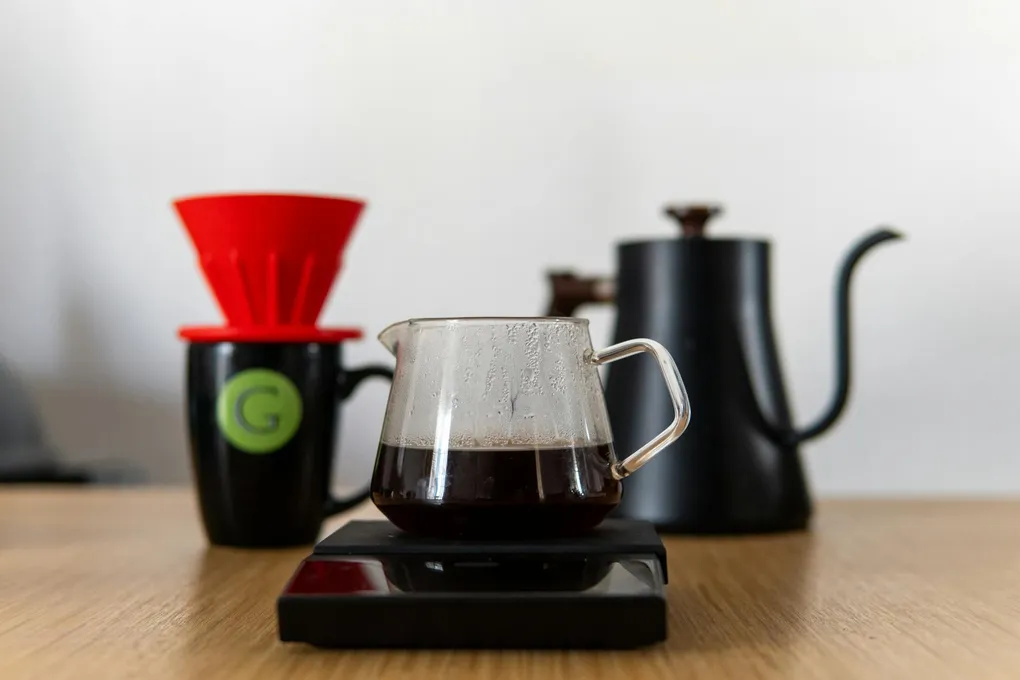
If you change one thing about how you make coffee, make it this: weigh your coffee and water. Every time. The ratio between the two — how many grams of coffee per gram of water — is the single most controllable variable in brewing, and it’s the one most people get wrong because they’re eyeballing it with tablespoons.
A “scoop” of coffee means nothing. A scoop of light-roasted whole beans weighs differently than a scoop of dark-roasted ground coffee. Bean density, grind size, and roast level all change how much coffee fits in that spoon. Two people using “two scoops” can be off from each other by 30% or more. That’s the difference between a thin, watery cup and something too strong to finish.
Ratios fix this. A ratio of 1:16 means 1 gram of coffee for every 16 grams of water. It doesn’t matter what size your mug is, what coffee you’re using, or what continent you’re on. 1:16 is 1:16. A $15 kitchen scale and this one concept will improve your coffee more than any gadget purchase.
What the Ratio Actually Controls
Here’s the part most guides skip: ratio controls strength, not extraction. These are different things, and confusing them is where most troubleshooting goes sideways.
Strength is how much dissolved coffee is in your cup — measured as Total Dissolved Solids (TDS), expressed as a percentage. A pour over at 1.3% TDS tastes “normal.” At 0.9% it tastes watery. At 1.6% it’s very intense. The SCA’s recommended range for filter coffee is 1.15–1.45% TDS.
Extraction is how much of the coffee’s available solubles you dissolved — measured as Extraction Yield (EY). Target: 18–22%. This is controlled by grind size, water temperature, and brew time — not ratio.
Why does this matter? Because you can have a perfectly extracted cup that tastes weak (right EY, wrong ratio — not enough coffee), and you can have a strong cup that tastes sour (right ratio, wrong EY — ground too coarse). Ratio and extraction are independent dials. Changing one doesn’t automatically fix the other.
If your coffee tastes weak but balanced (no sourness, no bitterness, just… thin), the fix is almost always more coffee or less water. That’s a ratio problem. If your coffee tastes sour or bitter regardless of strength, that’s an extraction problem — change your grind size or time, not your ratio.
For a deeper dive into how these interact, see our guide to coffee strength vs. extraction.
Ratios by Brewing Method
Every method has a different optimal ratio because each method produces a different style of coffee. Espresso is concentrated by design. Pour over is meant to be drunk at full volume. Cold brew is brewed as a concentrate and diluted. The ratio reflects these intentions.
Filter Methods (Pour Over, Drip, Clever Dripper)
Default ratio: 1:16 Range: 1:15 – 1:17
This is the SCA’s recommended zone. At 1:16, a single cup (250ml of water) needs about 15.6g of coffee. Round to 16g.
| Method | Default | Range | Notes |
|---|---|---|---|
| Hario V60 | 1:16 | 1:15–1:17 | Finer grind compensates for fast flow |
| Chemex | 1:16 | 1:15–1:17 | Thick filter absorbs oils; slightly more coffee compensates |
| Kalita Wave | 1:16 | 1:15–1:16 | Flat bottom = more even extraction, less need to push ratio |
| Clever Dripper | 1:16 | 1:15–1:16 | Immersion + percolation hybrid; very forgiving |
| Drip machine | 1:16 | 1:15–1:17 | SCA standard: 55g per liter |
All of these methods land in the same general range because they’re all producing full-strength, ready-to-drink filter coffee.
French Press
Default ratio: 1:16 Range: 1:15 – 1:17
Same range as filter, but the metal mesh filter passes oils that paper traps. This makes French press taste fuller at the same ratio. Hoffmann’s widely-used French press recipe calls for 75g per liter (1:13.3) — a notably stronger ratio than filter methods, reflecting his preference for a more full-bodied immersion brew. Start at 1:16 and adjust downward if you want something richer — French press is very forgiving of ratio tweaks because immersion brewing naturally resists overextraction.
AeroPress
Default ratio: 1:16 (American-style) or 1:6 (concentrate) Range: 1:6 – 1:16
The AeroPress has the widest ratio range of any method because it can brew in two completely different styles. At 1:16, you’re making a standard-strength cup. At 1:6 to 1:11, you’re brewing a concentrate that gets diluted with hot water — closer to an Americano. Competition recipes often use extreme concentrations (1:6 or lower) diluted to taste.
Espresso
Default ratio: 1:2 Range: 1:1.5 – 1:2.5
Espresso ratios work differently. An 18g dose of coffee produces 36g of liquid (a 1:2 ratio). This is called a “normale” shot — Rao’s preferred normale range is 1.5–2.0x dose weight (1:1.5 to 1:2), with longer ratios up to 1:2.5 for lighter roasts. A ratio of 1:1 to 1:1.5 is a ristretto (shorter, more concentrated — Rao defines it as 60–140% of dose weight). A 1:2.5 or 1:3 is a lungo (longer, lighter). Small changes in espresso ratios produce dramatic flavor shifts.
Moka Pot
Default ratio: ~1:7 to 1:10 Range: 1:7 – 1:10
Moka pot ratios are less adjustable because the pot’s design constrains both the coffee dose (fill the basket) and the water amount (fill to the safety valve). You’re mostly locked in. If the result is too strong, dilute after brewing rather than trying to under-fill the basket.
Cold Brew (Concentrate)
Default ratio: 1:7 Range: 1:5 – 1:8
Cold brew is brewed as a concentrate and diluted before drinking. At 1:7 (e.g., 100g coffee to 700g water), the concentrate is roughly 2x strength — dilute 1:1 with water or milk. The final drinking strength should approximate 1:15 to 1:18 after dilution.
Turkish Coffee
Default ratio: ~1:10 Range: 1:9 – 1:12
The strongest non-espresso method. The ultra-fine grind and unfiltered service create an extremely full-bodied, concentrated cup. Adjusting ratio here is less common — traditional recipes are fairly fixed. See our Turkish coffee guide for the full technique.
Roast Level Changes Everything (at the Same Ratio)
A detail that catches people off guard: the same 1:16 ratio produces a noticeably different cup depending on roast level. Dark roasts are less dense than light roasts — the beans expand more during roasting and lose 16–18% of their weight. This means 16g of dark-roasted coffee takes up more volume than 16g of light-roasted coffee.
More importantly, dark roasts are more porous and extract faster initially — but they actually contain fewer total available solubles. Gagné’s research shows that darker roasts have lower extraction yield potential than light roasts at the same ratio. The faster initial extraction can make a dark roast taste stronger at short brew times, which is why a 1:16 cup of dark roast often seems more intense than a 1:16 cup of light roast — even though the weight is identical. This is also why some people feel like they need “more coffee” when they switch to a light roast.
The practical takeaway: if you switch roast levels and the cup tastes off, adjust the ratio slightly before changing anything else. Going from dark to light? Try 1:15 instead of 1:16. Light to dark? Try 1:17. This accounts for the solubility difference without overcomplicating your recipe.
Pre-Ground vs. Whole Bean: A Ratio Wrinkle
Pre-ground coffee loses volatile compounds (and mass) to staling faster than whole beans. Over days and weeks, off-gassing CO2 carries aroma compounds with it. The coffee gets lighter — literally. A 16g dose of freshly ground beans contains more extractable material than a 16g dose of three-week-old pre-ground.
This doesn’t mean you need to recalculate ratios for pre-ground. But it does explain why the same ratio that produces a great cup with freshly ground beans can taste slightly thin with pre-ground. If you’re using pre-ground and the cup is consistently weak, adding an extra gram or two of coffee is a reasonable adjustment.
The better fix, of course, is grinding fresh — but that’s an equipment discussion, not a ratio one. (See our equipment upgrade roadmap for where a grinder fits in the priority list.)
Quick Reference: How Much Coffee Per Cup
Use our Brew Ratio Calculator for precise amounts, or reference this table for standard filter methods:
How to Adjust by Taste
Start at the method’s default ratio and brew once. Then taste and adjust:
Too weak / watery (but not sour)? Increase coffee dose. Go from 1:16 to 1:15, or even 1:14. You’re solving a strength problem — the extraction is probably fine.
Too strong / intense? Decrease coffee dose. Go from 1:16 to 1:17 or 1:18. Or simply add hot water after brewing (this is literally what an Americano is).
Sour? This usually isn’t a ratio problem — it’s under-extraction. Grind finer, use hotter water, or brew longer. Increasing the dose might mask the sourness with more body, but the root cause is grind/time/temperature.
Bitter? Again, usually extraction, not ratio. Grind coarser, use slightly cooler water, or shorten the brew. But if the coffee is both bitter AND very strong, try increasing water (1:17 or 1:18) as a quick fix.
The golden rule: change one variable at a time. If you adjust ratio and grind simultaneously, you won’t know which change helped. If you’re not sure what’s wrong, try our Fix My Coffee diagnostic — it walks through the most common issues.
Common Mistakes
Using tablespoons instead of grams. A level tablespoon of coffee weighs anywhere from 5g to 8g depending on the bean, roast, and grind. Two tablespoons could be 10g or 16g. That’s a 60% variance. Buy a scale.
Not accounting for water retention. Coffee grounds absorb about 2x their weight in water. If you use 30g of coffee, roughly 60ml of water stays trapped in the spent grounds and never makes it to your cup. Your 500ml of water produces about 440ml of brewed coffee. This is normal — don’t add extra water to compensate, or you’ll dilute the cup.
Measuring water by the mug. Your “cup” is not the same as your friend’s “cup.” A small mug is 200ml. A large mug is 400ml. A coffee maker “cup” is 150ml. These are wildly different amounts of water, and “two scoops per cup” produces wildly different results in each one.
Changing ratio to fix extraction problems. If your coffee is sour, adding more coffee won’t fix the sourness — it’ll give you stronger sour coffee. The fix for sourness is grind finer. The fix for bitterness is grind coarser. Ratio adjusts strength; grind/time/temp adjusts extraction.
The SCA Standard (and When to Ignore It)
The Specialty Coffee Association recommends 55 grams of coffee per liter of water — a 1:18.2 ratio — as the standard for batch brewing. This is slightly weaker than the 1:16 default used by most third-wave coffee guides. Why the difference?
The SCA standard was developed for commercial batch brewers making coffee that needs to hold up in an airpot for 30–60 minutes. A slightly lighter brew degrades more gracefully over time than a stronger one. For immediate consumption — pour over made at the counter, French press served right away — most people prefer the 1:15 to 1:16 range.
If you’re following a recipe from a roaster’s bag or a competition brewer, use their ratio. If you’re starting from nothing, start at 1:16 and adjust. The SCA standard is a reference point, not a law.
The Tool
Our Brew Ratio Calculator does the math for you — pick a method, enter your desired volume, and it gives you the exact coffee dose. It covers every method listed here and lets you dial ratios up or down by taste preference.
Sources & Further Reading
- SCA Brewing Best Practices / Brewing Control Chart
- Gagné, J. The Physics of Filter Coffee — extraction yield and TDS framework
- Hoffmann, J. How to Make the Best Coffee at Home — practical ratio guidance
- Rao, S. Everything but Espresso — ratio vs. extraction independence
Frequently Asked Questions
- What is the best coffee-to-water ratio?
- For most filter methods (pour over, drip, French press), start at 1:16 — one gram of coffee for every sixteen grams of water. This is the SCA's recommended middle ground. From there, adjust to taste: 1:15 for a stronger cup, 1:17 for a lighter one. Espresso uses 1:1.5 to 1:2.5, cold brew concentrate uses 1:5 to 1:8, and AeroPress can range from 1:6 (concentrate) to 1:16 (standard).
- How many grams of coffee do I need per cup?
- For a standard 250ml cup at a 1:16 ratio, you need about 15.6g of coffee — round to 16g. For a 350ml mug, about 22g. For a full liter (4 cups), about 63g. Use our Brew Ratio Calculator for exact amounts by method and volume.
- Why should I weigh coffee instead of using scoops?
- A tablespoon of coffee can weigh anywhere from 5g to 8g depending on bean size, roast level, and grind size. That's a 60% variance — the difference between a watery cup and an overpowering one. A $15 kitchen scale eliminates this guesswork and makes every brew repeatable.
- Does changing the ratio fix sour or bitter coffee?
- Usually not. Sourness is typically under-extraction (grind finer, brew longer, use hotter water), and bitterness is typically over-extraction (grind coarser, brew shorter, use cooler water). Ratio primarily affects strength/concentration, not extraction. If your coffee is weak but balanced, then yes — use more coffee. But if it's sour or bitter, the fix is grind, time, or temperature.
- How much water do grounds absorb?
- Coffee grounds retain about 2x their weight in water. If you use 30g of coffee, roughly 60ml of water stays trapped in the spent grounds and never makes it to your cup. So 500ml of water produces about 440ml of brewed coffee. This is normal — don't add extra water to compensate.