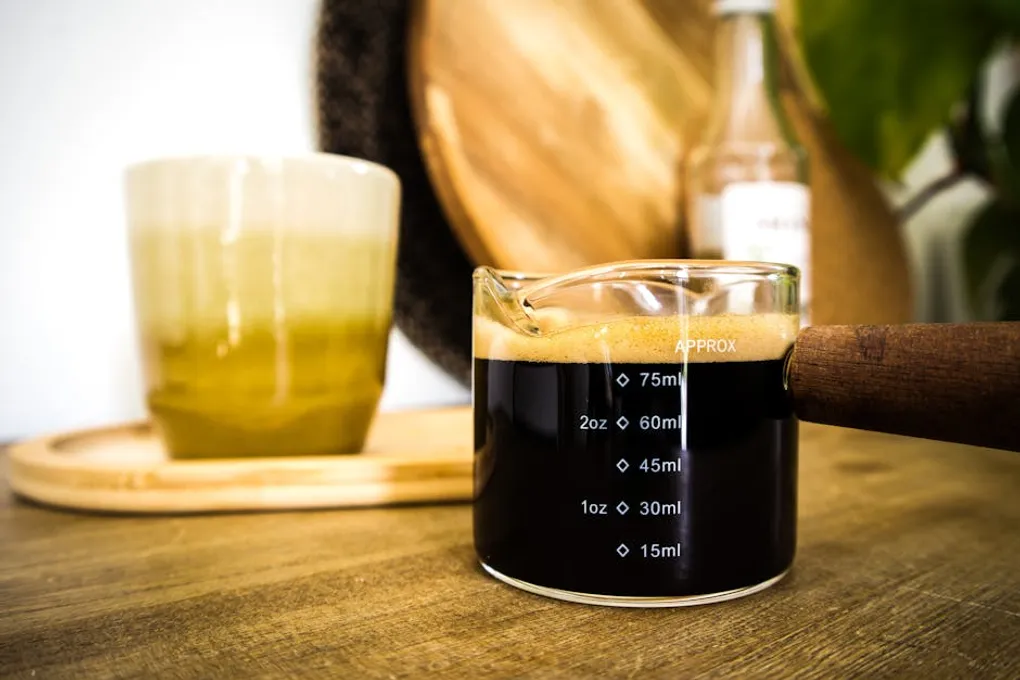
Every time you brew coffee, you’re running a selective extraction. Hot water contacts ground coffee and dissolves some of the soluble material inside. Not all of it — not even close. Roasted coffee is roughly 28-30% soluble by weight. The remaining 70% is insoluble cellulose that stays behind in the grounds no matter what you do.
The question is: how much of that soluble 28-30% did you actually dissolve? That number — expressed as a percentage — is your extraction yield. And it determines, more than almost any other variable, whether your coffee tastes good.
What Extraction Yield Is (And Why It Matters)
Extraction yield (EY) is the percentage of your coffee dose that ended up dissolved in the water. The Specialty Coffee Association sets the “ideal” range at 18-22%. Below 18%, you haven’t dissolved enough of the good stuff. Above 22%, you’ve pulled out too much of the bad stuff.
That said, coffee scientist Jonathan Gagne argues these boundaries are somewhat arbitrary. Optimal extraction depends on the specific coffee, the roast level, and your grinder. A high-quality grinder producing uniform particles can push past 22% and still taste clean. A cheap grinder with lots of fines and boulders might taste muddled at 20%. The numbers are useful as a starting point, not gospel.
The Math: How to Calculate Extraction Yield
The formula is straightforward:
EY% = (Brewed Coffee Weight x TDS%) / Coffee Dose
TDS stands for Total Dissolved Solids — the percentage of your brewed coffee that is dissolved coffee material rather than water. You measure it with a refractometer (more on that later).
Here’s a real example. Say you brew a pour-over with:
- 18g of coffee (your dose)
- 300g of brewed coffee in the cup
- 1.35% TDS (measured with a refractometer)
Plug it in: EY = (300 x 0.0135) / 18 = 22.5%
That’s right at the top of the SCA range. If that cup tastes clean and sweet, you’re golden. If it’s slightly bitter or astringent, you’ve crept a touch too far — and now you know exactly where you stand.
Without a refractometer, you can’t calculate a precise number. But you can still understand what’s happening and taste your way to the right zone.
The Order of Extraction: Why Sour Comes Before Bitter
This is the single most important concept for understanding extraction. Compounds don’t dissolve randomly — they extract in a predictable sequence based on molecular size and solubility:
1. Fruity acids come first. These are the smallest, most soluble molecules. They dissolve almost immediately — bright, fruity, floral aromatics. On their own, they taste sharp and sour.
2. Maillard compounds come next. As extraction continues, you start pulling nutty, caramel, malty, and smoky flavors. These are the products of the Maillard reaction during roasting — the same chemistry that makes toast and seared meat taste good.
3. Browning sugars follow. This is where perceived sweetness lives. Chocolate, vanilla, honey, toffee. Less-caramelized sugars dissolve first, then the deeper caramel compounds. This is the sweet spot — literally.
4. Dry distillates come last. The slowest to extract, the least desirable. Tobacco, carbon, ash, bitterness. Even in small amounts, dry distillates can mask the flavors extracted before them. Too many of them, and the cup turns hollow, harsh, and astringent.
This sequence is why under-extraction tastes sour and over-extraction tastes bitter. Stop too early, and you’ve only dissolved the acids. Go too far, and you’ve pulled out the dry distillates that overwhelm everything else.
What Under-Extraction Tastes Like
If your coffee is under-extracted (roughly below 18% EY), you’ll taste:
- Sour — sharp, biting acidity without the sweetness to balance it
- Salty — a minerally, almost savory edge
- Thin — watery body, lacking depth
- Grassy or vegetal — raw, undeveloped flavor
- Missing sweetness — the sugars never dissolved
The key tell: sourness without sweetness. A well-extracted coffee can be bright and acidic, but it has sweetness underneath. Under-extracted coffee is just sour.
What Over-Extraction Tastes Like
If your coffee is over-extracted (roughly above 22% EY), you’ll taste:
- Bitter — a persistent, unpleasant bitterness beyond normal coffee bittering
- Astringent — drying, almost tannic, like over-steeped tea
- Hollow — the middle flavors get masked by the harsh dry distillates
- Dry — a sandpapery mouthfeel
- Harsh finish — lingers unpleasantly
The key tell: a drying sensation and bitterness that sticks around long after you swallow. It’s unmistakable once you know what you’re looking for.
Strength vs. Yield: The Critical Distinction
This is where most people get confused. Strength and extraction yield are not the same thing. They measure different things. They can move independently. Getting this distinction straight will change how you think about coffee.
Strength = TDS% — how concentrated your brewed coffee is. How much dissolved material is in the cup. A good filter coffee lands around 1.15-1.45% TDS. Espresso is dramatically higher: 8-13% TDS.
Yield = EY% — how much material you removed from the grounds. How thoroughly you extracted the coffee. The SCA targets 18-22%.
Here’s the critical insight, articulated clearly by Jessica Easto: you can have strong, under-extracted coffee AND weak, over-extracted coffee. These seem contradictory, but they’re not.
Strong, under-extracted coffee: use a high dose of coffee with very little water and a short brew time. The cup is concentrated (high TDS) but you only dissolved the acids (low EY). Result: intense sourness.
Weak, over-extracted coffee: use a small amount of coffee with way too much water. The cup is dilute (low TDS) but you extracted everything possible from those grounds (high EY). Result: thin, bitter, hollow. This is diner coffee — running a gallon of water through a small basket of grounds that’s been sitting on the burner.
Understanding this distinction matters for diagnosis. If your coffee is bitter, the answer isn’t necessarily “use less coffee.” If it’s sour, the answer isn’t necessarily “use more.” You need to figure out whether the problem is strength or yield, and adjust accordingly.
How they interact with brewing variables:
- Higher water temperature increases both strength and yield simultaneously
- More water (higher ratio) decreases strength but increases yield
- Finer grind increases both — more surface area means faster, more complete extraction
- Longer brew time increases yield; its effect on strength depends on the method
Getting the right grind size is the most direct lever on extraction yield. And water temperature shapes how aggressively all four stages of extraction proceed.
The SCA Brewing Control Chart
The Brewing Control Chart — originally developed by MIT chemist E.E. Lockhart in the 1950s — plots TDS (strength) on the Y axis and EY (yield) on the X axis. The “ideal” zone sits in the center: 18-22% EY, 1.15-1.45% TDS.
In 2023, Guinard’s research at UC Davis updated the chart based on modern consumer preference testing. Rather than identifying a single new “Gold Cup” zone, the study found two distinct consumer preference clusters — one that preferred lower TDS with moderate extraction, and another that preferred higher extraction yields. This suggests there may not be a single ideal zone that fits all consumers, challenging the one-size-fits-all nature of the original chart. Two other notable findings: the acceptable extraction window is wider than the original chart suggests, and TDS has a bigger effect on consumer preference than extraction yield alone. People are more sensitive to how strong their coffee is than to subtle differences in extraction completeness.
That makes intuitive sense. Most casual coffee drinkers who say they like “strong coffee” or “weak coffee” are talking about TDS, whether they know it or not. Extraction yield determines flavor balance, but strength determines the perceived intensity of the experience.
Evenness of Extraction: The Hidden Variable
Gagne’s most important insight has nothing to do with hitting a target number. It’s about uniformity.
If some coffee particles in your brew bed are over-extracted while others are under-extracted, the cup will taste both sour AND bitter simultaneously — even if the average extraction yield falls right in the “ideal” range. You’ve mixed together sour under-extracted liquid and bitter over-extracted liquid. The math averages out. The taste does not.
A brew at 20% EY with uneven extraction can taste worse than one at 19% with even extraction.
This is why grind uniformity matters so much. A grinder that produces lots of fine dust (“fines”) alongside large chunks (“boulders”) guarantees uneven extraction: the fines over-extract while the boulders under-extract, regardless of your recipe. It’s also why technique matters — uneven water distribution in a pour-over creates channels where some grounds get over-extracted and others barely get touched.
The practical takeaway: obsessing over a number is less useful than investing in a good grinder and consistent technique. Both contribute more to a balanced cup than any refractometer reading.
Refractometers: Should You Buy One?
A refractometer measures TDS by shining light through a thin film of your brewed coffee and calculating the concentration of dissolved solids based on how much the light refracts. Combined with your dose and beverage weight, you can calculate EY precisely.
The main options for home use:
- VST CoffeeTool (about $300 and up) — the industry standard. Used in competitions and by professional Q-graders. Highly accurate. Requires a companion app.
- Atago PAL-COFFEE (about $350) — another professional-grade option. Digital, standalone, no app required. Different models for filter vs. espresso.
- DiFluid R2 Extract (about $100) — the budget option that changed the game. Reasonably accurate for home use and dramatically cheaper than the alternatives. This is the device that democratized coffee refractometry.
How to use one: Brew your coffee. Take a small sample (a teaspoon or two). Let it cool to room temperature — temperature affects the reading. Place a few drops on the lens. Read the TDS%. Plug it into the formula with your dose and beverage weight. Done.
Is it worth it? Honest take: probably not for most people. Unless you’re obsessively optimizing recipes, competing, or trying to build a rigorous understanding of cause and effect when dialing in, you don’t need one. Most people can taste the difference between 17% and 22% extraction without a number attached to it. The sour-to-bitter spectrum is your built-in refractometer.
Where a refractometer does help: when you change one variable and want to know exactly what happened. Did switching from a 15:1 to a 16:1 ratio change your extraction? By how much? A refractometer gives you a data point instead of a guess. For people who enjoy that kind of systematic approach, the DiFluid R2 Extract at about $100 is a reasonable investment. For everyone else, taste is enough.
Practical Adjustments Without a Refractometer
This is the section that actually matters for most people. You don’t need to calculate extraction yield to fix your coffee. You need to taste it, identify the problem, and adjust in the right direction.
If your coffee tastes too sour (under-extracted):
- Grind finer — increases surface area, accelerates extraction
- Increase water temperature — hotter water extracts more efficiently
- Increase brew time — give the water more contact time with the grounds
- Increase agitation — stir more, pour more aggressively, create more turbulence
These all push extraction yield higher, pulling more of the sugars and Maillard compounds that balance the initial acids.
If your coffee tastes too bitter (over-extracted):
- Grind coarser — reduces surface area, slows extraction
- Decrease water temperature — cooler water extracts less aggressively
- Decrease brew time — cut the extraction short before dry distillates dominate
- Decrease agitation — pour gently, don’t stir, minimize turbulence
These all pull extraction yield lower, stopping before you dissolve the harsh compounds at the end of the sequence.
If your coffee tastes too weak (low strength):
- Increase dose — more coffee per unit of water
- Grind finer — extracts more from the same dose
If your coffee tastes too strong (high strength):
- Decrease dose — less coffee per unit of water
- Increase water volume — dilutes the brew
Notice the pattern: sour/bitter is an extraction yield problem. Weak/strong is a strength (TDS) problem. They require different fixes. If your coffee is sour AND weak, you need to increase both extraction and strength — grinding finer handles both. If it’s bitter AND strong, grind coarser and use less coffee. If it’s sour AND strong, you have concentrated under-extraction — increase your water volume and brew time. If it’s bitter AND weak, you have dilute over-extraction (the diner coffee problem) — use more coffee, less water, and a coarser grind.
For method-specific context on how extraction plays out in practice, see the ultimate pour-over guide and the AeroPress guide.
The Bottom Line
Extraction yield is the lens through which everything about coffee brewing makes sense. The order of extraction explains why sour comes before bitter. The strength-yield distinction explains why “strong” and “good” aren’t the same thing. The concept of extraction evenness explains why a $200 grinder matters more than a $100 refractometer.
You don’t need to measure your extraction yield to make great coffee. But understanding what it is — and how every variable you control pushes it higher or lower — turns coffee brewing from guesswork into a system. Taste the cup. Identify sour or bitter. Adjust in the right direction. Repeat.
That’s extraction yield in practice. No refractometer required.
Frequently Asked Questions
- What is a good coffee extraction yield?
- The SCA standard is 18-22%, though UC Davis research (Guinard, 2023) found the acceptable window is wider than that. Notably, the study identified two distinct consumer preference clusters rather than one universal zone, suggesting different people genuinely prefer different extraction profiles. The 'right' number depends on your coffee, roast level, and grinder quality. A uniform grinder can produce excellent cups above 22%, while a grinder with lots of fines and boulders can taste muddled at 20%. Use the range as a starting point, not a hard rule.
- What is the difference between coffee strength and extraction yield?
- Strength (TDS%) measures how concentrated your brewed coffee is — how much dissolved coffee material is in the cup. Extraction yield (EY%) measures how much material you removed from the grounds. They move independently. You can have strong, under-extracted coffee (concentrated but sour, from a high dose with short brew time) and weak, over-extracted coffee (dilute but bitter — this is diner coffee made by running too much water through too little grounds).
- Why does my coffee taste sour and bitter at the same time?
- This usually signals uneven extraction, not a single extraction problem. If your grinder produces a wide range of particle sizes, the small particles (fines) over-extract while the large particles (boulders) under-extract. You end up with sour acids from the boulders and bitter dry distillates from the fines in the same cup. The fix is better grind uniformity — a higher-quality grinder — rather than adjusting brew time or temperature.
- Do I need a refractometer to make better coffee?
- No. Most people can taste the difference between under-extracted (sour, thin, lacking sweetness) and over-extracted (bitter, astringent, harsh) coffee without measuring it. A refractometer is useful if you want precise data when dialing in recipes or isolating the effect of a single variable change. The DiFluid R2 Extract at around $100 is the most accessible option. But for everyday brewing, taste the cup, identify sour or bitter, and adjust grind size, temperature, or brew time accordingly.
- What is the SCA Brewing Control Chart?
- A chart originally developed by MIT chemist E.E. Lockhart in the 1950s that maps coffee strength (TDS%) on the Y axis against extraction yield (EY%) on the X axis. The 'ideal' zone traditionally sat at 18-22% EY and 1.15-1.45% TDS for filter coffee. Guinard's 2023 UC Davis study challenged the single-zone model, finding two distinct consumer preference clusters rather than one universal ideal. The study also found that TDS has a bigger effect on consumer preference than extraction yield alone, and that the acceptable extraction window is wider than the original chart suggests.
Some links above are affiliate links. If you purchase through them, we earn a small commission at no extra cost to you.