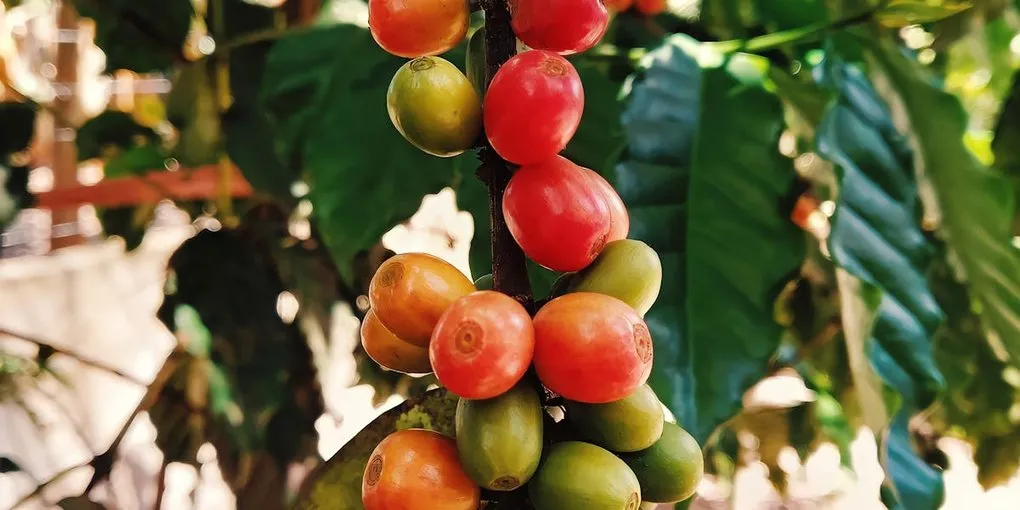
A coffee bean is not a bean at all. It is the seed of a fruit — a cherry that grows on trees in the tropical belt between the Tropics of Cancer and Capricorn. The “bean” you grind every morning is nested inside multiple protective layers, each with a specific biological function and a direct impact on how your coffee tastes.
Understanding the anatomy of a coffee cherry explains things that otherwise seem mysterious: why processing methods produce such different flavor profiles, why some coffees taste fruity while others taste clean, why natural process coffees develop that wild sweetness, and why cascara tea tastes nothing like coffee despite coming from the same plant. Each layer between the outer skin and the seed contributes to or protects the flavor compounds that end up in your cup.
The Outer Skin (Exocarp)
The outermost layer of the coffee cherry is the exocarp, a thin, tough skin that protects everything inside from insects, UV radiation, and physical damage. It is smooth and waxy when the fruit is immature, starting green and gradually changing color as the cherry ripens.
Ripe cherry color depends on variety. Most Arabica varieties turn deep red at maturity, which is why you hear the phrase “red cherry picking” associated with quality harvesting. Some varieties ripen to yellow (Yellow Bourbon, Yellow Catuai) or even orange. The color change signals that sugars in the fruit have reached peak concentration and the seed inside has fully developed.
The skin contains modest amounts of caffeine — a natural insecticide the plant produces to deter herbivory. It also contains chlorogenic acids and anthocyanins (the same pigments found in blueberries and red grapes). When dried after processing, this skin becomes cascara, increasingly valued as a byproduct rather than waste. Cascara contains roughly 25 milligrams of caffeine per cup, compared to 80-100 milligrams in a cup of coffee, because caffeine concentrates in the seed, not the fruit.
The EU approved cascara as a novel food in 2022, though it has been consumed for centuries in producing countries — “qishr” in Yemen and “hashara” in Ethiopia are traditional cherry-skin beverages that predate the roasted-seed coffee we drink today.
The Pulp and Mucilage (Mesocarp)
Immediately beneath the skin lies the pulp, a thin layer of soft, sweet fruit flesh. In most coffee species this layer is relatively thin compared to other stone fruits like peaches or plums. The pulp blends into a thicker inner layer called the mucilage — a sticky, sugar-rich gel that clings tenaciously to the parchment layer beneath it.
The mucilage is where the most consequential flavor development happens during processing. This layer is packed with simple sugars (glucose, fructose, sucrose), organic acids, and pectin. Its sugar concentration is high enough that a refractometer reading of ripe mucilage typically shows 15-22 Brix. For comparison, grape juice destined for winemaking averages 20-26 Brix.
What happens to the mucilage during processing fundamentally shapes the coffee’s flavor:
- Washed process: The mucilage is removed through fermentation in water tanks (12-72 hours) followed by washing. The result is a clean, bright cup where terroir and varietal character dominate. Stripping away the fruit lets you taste the seed’s intrinsic qualities.
- Natural (dry) process: The entire cherry dries intact on patios or raised beds. The mucilage sugars ferment and concentrate around the seed for weeks, infusing it with fruity, wine-like, sometimes wild flavors. Natural process coffees from Ethiopia can taste like blueberry jam or tropical fruit precisely because those mucilage sugars spent extended time in contact with the bean.
- Honey process: The skin is removed but some or all of the mucilage is left on during drying. The amount of mucilage retained creates a spectrum: white honey (least mucilage, closest to washed), yellow honey, red honey, and black honey (most mucilage, closest to natural). Costa Rica pioneered this approach, and the technique provides a graduated control dial between clean and fruity.
The mucilage also plays a central role in newer experimental processing. In anaerobic fermentation, cherries are sealed in oxygen-free tanks where controlled microbial activity transforms mucilage sugars into volatile esters and organic acids that produce intensely fruity, confectionery profiles. Co-fermentation techniques add external fruit pulp (passion fruit, pineapple, mango) alongside coffee mucilage, giving microbes additional sugars to metabolize.
The Parchment Layer (Endocarp)
Beneath the mucilage sits the parchment, a rigid, papery hull that encases the seed like a protective shell. Botanically this is the endocarp — the same structural layer that forms the hard pit in a peach or the shell of a walnut, though in coffee it is much thinner.
The parchment serves as the seed’s primary physical barrier. It is tough enough to protect the bean during drying and storage, and it plays a crucial role in moisture regulation. Coffee in its parchment state (“pergamino” in Spanish-speaking countries) can be stored for months with relatively stable moisture content, which is why many producing countries export coffee in parchment rather than hulled. The parchment acts as a natural equilibrium buffer, slowing moisture exchange with the ambient environment.
During wet processing, parchment is what you see after the mucilage is washed away — clean, pale yellow husks that rattle when dry. In Indonesia’s unique Giling Basah (wet-hulled) process, the parchment is mechanically removed while the bean is still at 30-35% moisture content rather than the standard 10-12%. This aggressive early removal exposes the bean to faster, less controlled drying, producing the earthy, heavy-bodied, low-acidity profile characteristic of Sumatran and Sulawesi coffees. The parchment removal timing is what creates that flavor — the same beans processed with standard parchment drying would taste completely different.
The Silver Skin (Spermoderm)
Inside the parchment, directly against the bean surface, lies the silver skin — a thin, papery membrane also called the spermoderm or chaff. It is the innermost protective layer, analogous to the thin skin on a peanut.
During roasting, the silver skin detaches from the bean and flakes off as chaff. If you have ever roasted coffee at home or watched a commercial roaster operate, the chaff collecting in the exhaust is silver skin separating under heat. Not all of it comes off. Residual silver skin in the center crease of the bean can remain attached even after roasting.
The silver skin has minimal direct flavor impact on the brewed cup, but it plays an indirect role in roast quality. Excessive silver skin retention (sometimes visible as lighter patches on roasted beans) can indicate uneven heat penetration during roasting. Some roasters consider heavy chaff production as an indicator of the bean’s density and moisture content — higher-altitude, denser beans tend to retain silver skin more stubbornly.
In terms of the cherry’s lifecycle, the silver skin formed during seed development as the integument (seed coat). By the time the cherry is picked, it has become thin and dry. It is biologically complete and serves no further function for the plant, which is why it detaches so readily under the thermal stress of roasting.
The Seed (The “Bean”)
The seed itself — what the world calls a coffee “bean” — is the endosperm of the coffee cherry. Most cherries contain two seeds lying flat against each other with their flat sides facing inward. Occasionally a cherry produces only one seed, which develops into a round shape called a peaberry (about 5-10% of a harvest). Tanzanian peaberry lots are specifically sought after by some roasters who believe the rounder shape produces more even roasting.
The green coffee seed is roughly 28-30% soluble by weight. The rest is insoluble cellulose that forms the rigid cell structure. Within those cells are the precursor compounds that roasting will transform into flavor:
- Sucrose (6-9% in Arabica, 3-7% in Robusta): Nearly 100% consumed during roasting through caramelization and Maillard reactions. All perceived “sweetness” in medium-roast coffee is aroma-mediated after the sugar is gone.
- Chlorogenic acids (CGAs): The most abundant polyphenols, contributing 15-325 milligrams per cup. They degrade during roasting into CGA lactones (primary bitterness source at 60-70% of total perceived bitterness) and eventually phenylindanes in dark roasts.
- Amino acids: Undergo Strecker degradation during roasting to produce specific aldehydes — valine becomes malty notes, leucine becomes dark chocolate, phenylalanine becomes honey and floral character.
- Lipids (15-17% in Arabica): Include cafestol and kahweol, the diterpene compounds that paper filters trap and that can raise LDL cholesterol in unfiltered brewing methods.
- Caffeine (1.2-1.5% in Arabica, 2.2-2.7% in Robusta): A natural insecticide the plant produces. Robusta’s higher caffeine content is one reason it is more pest-resistant but also more bitter.
The seed’s cell structure matters for brewing. Higher-altitude coffees develop denser cells with more concentrated compounds, which is why altitude correlates with quality. Jonathan Gagne’s research shows that approximately 25.6% of variation in extraction yield can be explained by elevation. Ethiopian and Kenyan coffees consistently extract more than Central American coffees, partly because the denser bean structure holds more solubles per unit weight.
How Anatomy Connects to Your Cup
Every layer of the coffee cherry influences the final cup, either through its presence during processing or through its removal.
What the fruit layers contribute: Sweetness, fruitiness, body, and fermentation complexity. The more mucilage contact during processing, the more the fruit’s sugar profile infuses the seed. This is a dial, not a switch — from the zero-contact clarity of a fully washed coffee to the full-fruit intensity of a natural.
What the parchment controls: Drying rate, moisture stability, and protection during storage and transport. The timing and method of parchment removal (standard dry milling versus wet hulling) creates dramatically different flavor profiles from identical seeds.
What the seed contains: The 900 to 1,000 flavor-producing molecules and 800+ volatile aromatics that roasting transforms and extraction dissolves. Everything in your cup was either already in the seed as a precursor compound or was introduced by how the fruit layers were handled during processing.
When you read a bag label that says “washed” versus “natural” versus “honey,” you are reading a description of which layers were removed and when. When you taste blueberry in a natural Ethiopian or clean citrus in a washed Kenyan, you are experiencing the consequence of those anatomical decisions. The coffee cherry is a small fruit with a lot of engineering inside it — each layer exists for a reason, and each one shapes what ends up in your cup.
Frequently Asked Questions
- Can you eat a coffee cherry?
- Yes. The fruit is edible and has been consumed in coffee-producing countries for centuries. The pulp is sweet and mildly tannic, somewhat like a cross between a cranberry and a watermelon rind. In Yemen the dried skins are brewed as 'qishr' and in Ethiopia as 'hashara.' The dried skin and pulp are also sold as cascara, which the EU approved as a novel food in 2022. Cascara contains roughly 25 milligrams of caffeine per cup (compared to 80-100 milligrams in coffee) and is remarkably high in polyphenols. It tastes like dried dates and raisins with floral honey notes — nothing like roasted coffee, because the fruit is never roasted.
- Why do most coffee cherries have two beans?
- The coffee cherry is a drupe (stone fruit), and like other drupes, its ovary typically contains two ovules. Each ovule develops into one seed, and the two seeds grow facing each other with their flat sides pressed together, which gives coffee beans their characteristic flat-faced shape. In about 5-10% of cherries, only one ovule gets fertilized or one seed fails to develop, and the remaining seed grows into a round shape called a peaberry.
- What makes natural-process coffee taste fruity?
- The fruitiness comes directly from the mucilage layer — the sugar-rich gel between the skin and the parchment. In natural (dry) processing, the entire cherry dries intact, so the mucilage sugars (15-22 Brix, comparable to wine grapes) ferment around the seed for weeks during drying. Microbes convert those sugars into volatile esters, organic acids, and alcohols that infuse into the porous bean.
- What is cascara, and why is it becoming popular?
- Cascara is the dried skin and pulp of the coffee cherry, traditionally discarded as waste after the beans are extracted. Coffee processing generates approximately 20 million tons of waste annually, and cascara turns a disposal problem into a revenue stream. It is brewed like tea and has a naturally sweet dried-date character with floral notes. Low caffeine content (about a quarter of a cup of coffee) makes it accessible to people who want the flavor without the stimulant intensity.
- Does the parchment layer affect coffee flavor?
- Not directly in the cup, but its handling during processing has a massive indirect effect. In standard processing, the parchment stays on the bean during drying and is removed by dry milling only after the bean reaches 10-12% moisture content. In Indonesia's Giling Basah (wet-hulled) process, parchment is mechanically stripped while the bean is still at 30-35% moisture, producing the earthy, heavy, low-acidity profile characteristic of Sumatran coffee.